
Wood vs Stone in Valheim: What Your Walls Are Actually Made Of
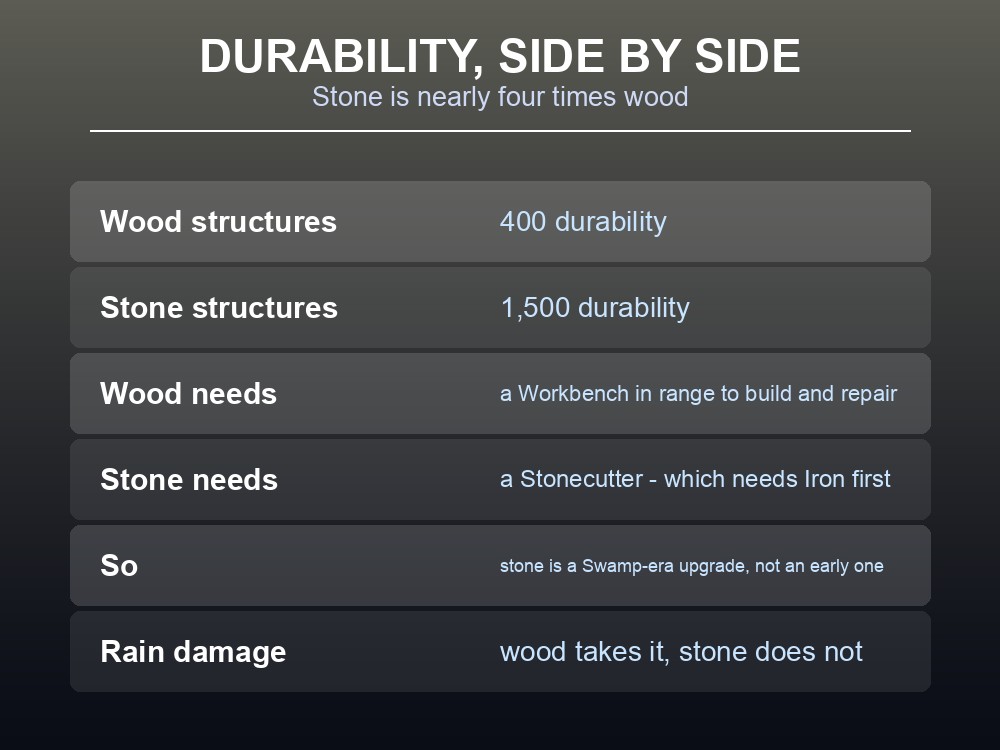
Wood structures have 400 durability. Stone has 1,500. That is nearly four times as much, and it comes with immunity to rain damage, resistance to fire and frost, and immunity to poison and spirit — against a single vulnerability. Knowing what that vulnerability is matters, because it is the difference between a base that survives a raid and one that does not. This covers both tiers, what stone costs per piece, and the support rule that decides what you can actually build with it.
On sourcing. Iron Gate do not publish system documentation. The figures below come from the community wikis and can change with any patch.
Durability, Side by Side
| Wood | Stone | |
|---|---|---|
| Durability | 400 | 1,500 |
| Requires | A Workbench in range | A Stonecutter |
| Which requires | Nothing — it is the first station | Iron, from the Swamp |
| Rain damage | Yes | None |
Read the third row. The Stonecutter needs Iron, and iron needs the Swamp Key from The Elder — so stone building is a Swamp-era upgrade, not something available to a new player. Everything you build before then is wood, and wood decays in the rain.
That rain clause is why early bases fall apart on their own. Wood needs a Workbench in range not merely to build but to repair, and without one nearby your walls quietly degrade whether or not anything attacks them.
Stone's Resistance Profile
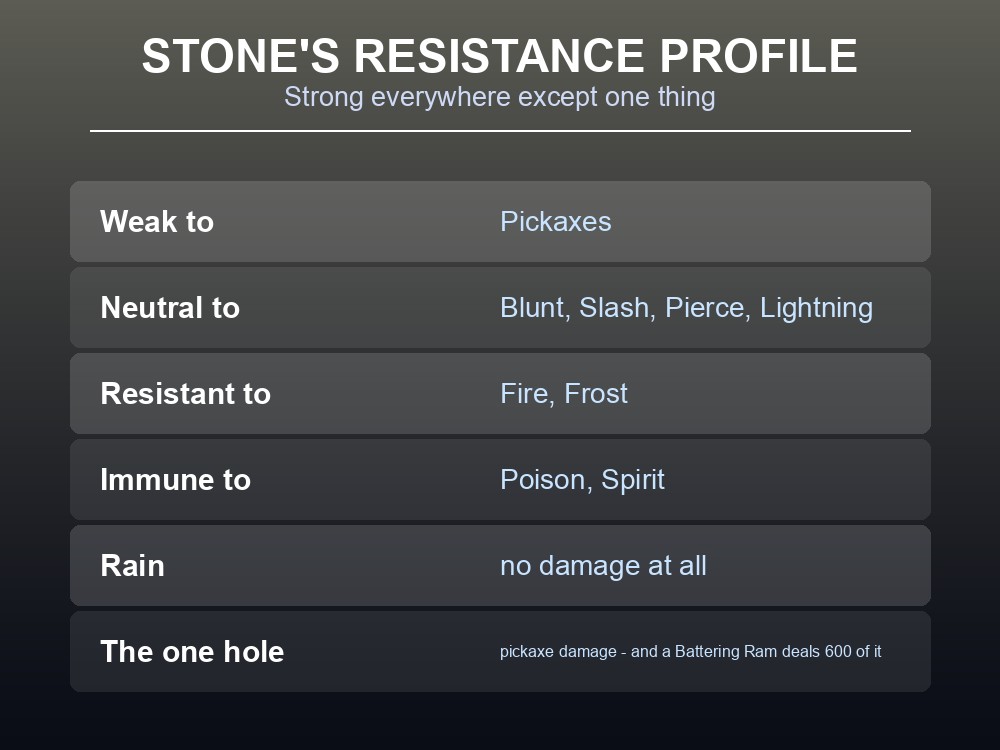
| Damage type | Effect on stone |
|---|---|
| Pickaxe | Weak — this is the hole |
| Blunt, Slash, Pierce, Lightning | Neutral |
| Fire, Frost | Resistant |
| Poison, Spirit | Immune |
| Rain | No damage |
Stone has exactly one vulnerability, and it is pickaxes.
That sounds academic until you look at what deals pickaxe damage. The Battering Ram deals 600 pickaxe damage per punch, automatically, every 20 seconds. A stone wall at 1,500 durability lasts roughly three punches — about a minute.
So stone is excellent against everything the world throws at it — fire, frost, poison, weather, ordinary attacks — and specifically poor against the one tool designed to break rock. That is a coherent design rather than an oversight, but it is worth knowing before you assume stone equals safe.
The fire and frost resistance is the practically valuable half, since fire spreads between wooden structures and is a genuine threat in the Ashlands.
What Stone Actually Costs
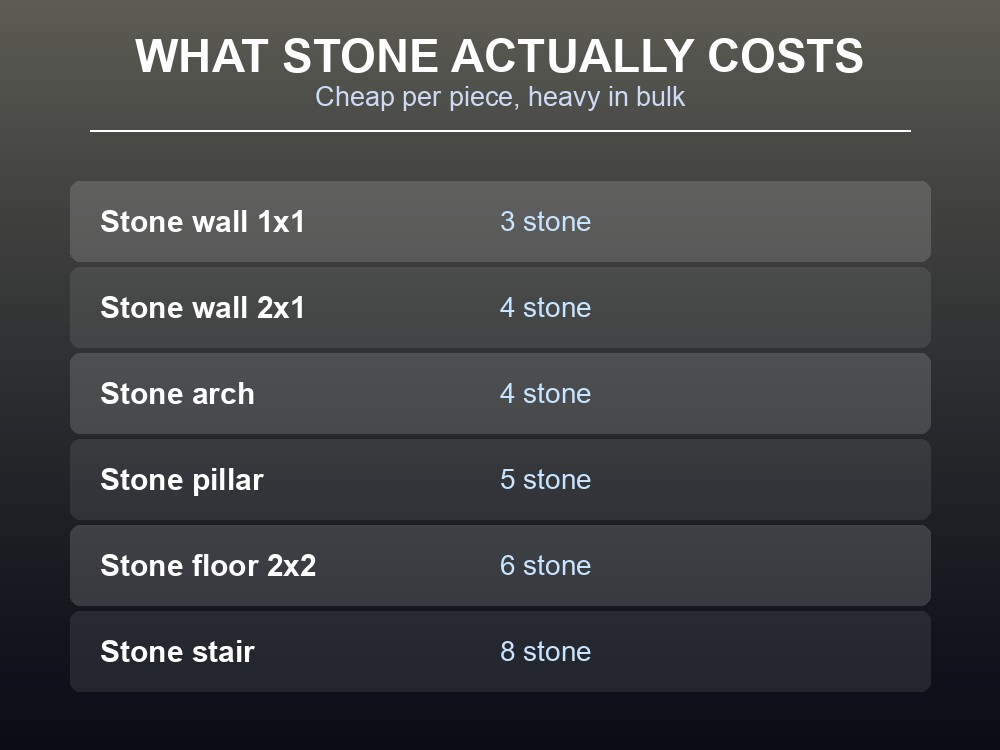
| Piece | Stone |
|---|---|
| Stone wall 1×1 | 3 |
| Stone wall 2×1 | 4 |
| Stone arch | 4 |
| Stone pillar | 5 |
| Stone wall 4×2 | 6 |
| Stone floor 2×2 | 6 |
| Stone stair | 8 |
Note the efficiency at scale. A 4×2 wall costs 6 stone while a 1×1 costs 3 — so the large panel covers eight times the area for twice the material. Building in large pieces where the design allows is roughly a four-fold saving.
Stone itself is not scarce — it comes from the ground everywhere and from every rock you break — but it is heavy, and a stone base is measured in hundreds of units. This is where Megingjord's +150 carry weight or Moder's +300 pays for itself.
The Support Rule
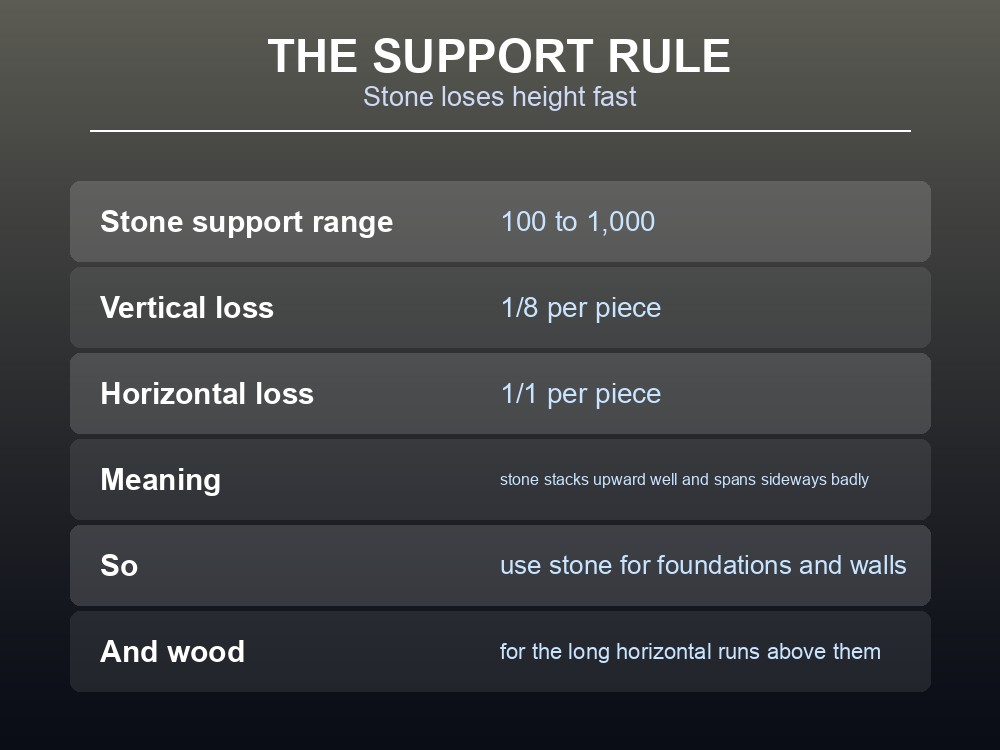
| Property | Value |
|---|---|
| Support range | 100 – 1,000 |
| Vertical loss | 1/8 per piece |
| Horizontal loss | 1/1 per piece |
Those two loss figures are the whole of stone building design.
Vertically, stone is superb — losing only an eighth of its support per piece means a stone column climbs a long way before it turns red. Horizontally it is terrible — losing the full amount per piece means a stone beam cannot span any real distance unsupported.
So the rule that follows is simple: stone goes up, wood goes across.
Build your foundations, walls and pillars in stone, where the vertical strength does the work and the 1,500 durability protects you. Then run the long horizontal spans in wood, which is what wood's support profile is good at — and which is why almost every well-built Valheim hall is a stone base with a wooden roof.
This also explains a common failure. A player upgrades an entire build to stone, extends a stone floor outward, and watches it collapse — because horizontal stone loses support eight times faster than vertical stone does. The material did not fail; the direction did.
For the full mechanic, see why your build collapsed.
How to Choose Materials
- Build in wood until you have Iron — the Stonecutter needs it, so stone is a Swamp-era upgrade.
- Keep a Workbench in range of wooden structures, or they decay in the rain.
- Use stone for foundations, walls and pillars, where vertical support is strong.
- Use wood for long horizontal spans — stone loses support 8× faster sideways.
- Prefer large panels: a 4×2 wall is 6 stone against a 1×1's 3.
- Do not assume stone is raid-proof. It is weak to pickaxes, and a Battering Ram deals 600.
Practical tips
- Wood 400 durability, stone 1,500 — and wood takes rain damage while stone does not.
- The Stonecutter needs Iron, so stone follows The Elder, not Eikthyr.
- Stone's only weakness is pickaxes — resistant to fire and frost, immune to poison and spirit.
- Vertical loss 1/8, horizontal loss 1/1. Stone up, wood across.
- A 4×2 wall costs 6 stone; a 1×1 costs 3. Build big where you can.
- A Battering Ram's 600 pickaxe damage goes through a stone wall in about three punches.
Running your own Valheim server
A stone base is hours of hauling, and it only pays off if it is still standing when everyone next logs in — raids fire on a timer and wooden structures decay in the rain whether or not anyone is present. A gamever Valheim server keeps the world live for up to 10 players, so repairs and upgrades can be shared across a group rather than falling to whoever hosts. One-click backups protect a build measured in hundreds of stone.
Conclusion
Valheim gives you two building tiers, and the numbers are decisive: wood at 400 durability, which takes rain damage and needs a Workbench in range to repair, against stone at 1,500 durability with no rain damage at all — but requiring a Stonecutter, and therefore Iron, which makes it a Swamp-era upgrade rather than an early one. Stone is resistant to fire and frost, immune to poison and spirit, and neutral to every ordinary attack — with one weakness: pickaxes, which is exactly what a Battering Ram's 600 damage per punch delivers. Costs run 3 stone for a 1×1 wall up to 8 for a stair, with large panels roughly four times more efficient. And the rule that shapes every stone build: vertical support loses 1/8 per piece while horizontal loses 1/1 — so stone goes up and wood goes across.
Want a base that survives between sessions? Rent a Valheim server at gamever.io — instant setup, one-click backups and updates, and 24/7 uptime. Start with a free trial and use promo code WELCOME.