
Why Your Valheim Build Collapsed: Stability, Support and the Numbers Behind It
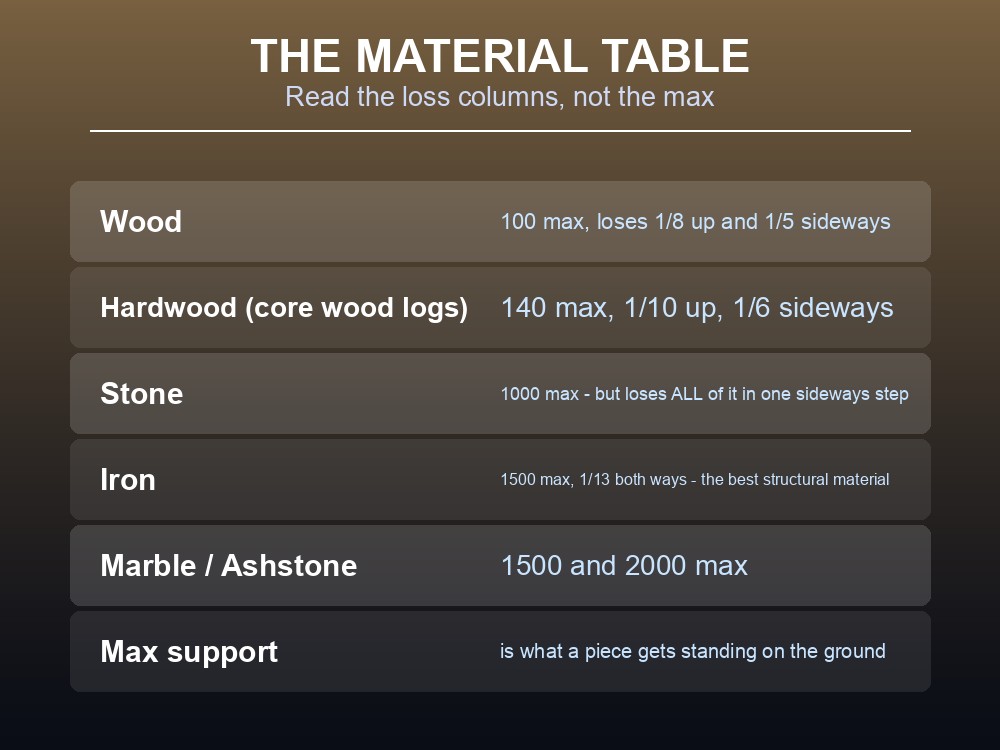
Valheim does not simulate real structural loads — it propagates a number called support outward from the ground, losing a fraction of it at every piece. Wood starts at 100 support and loses 1/8 going up and 1/5 going sideways; stone starts at 1000 and loses nothing horizontally at all. Once a piece drops to its material's minimum, it breaks. Understanding those two numbers is the difference between a hall that stands and a pile of logs.
On sourcing. Iron Gate do not publish these values. The figures below come from the community Valheim wiki, and can change with any patch.
The Material Table
| Material | Used by | Max support | Min support | Vertical loss | Horizontal loss |
|---|---|---|---|---|---|
| Wood | Wood, Thatch, Shingle, Darkwood, Ashwood | 100 | 10 | 1/8 | 1/5 |
| Hardwood | Log (core wood) | 140 | 10 | 1/10 | 1/6 |
| Stone | Stone | 1000 | 100 | 1/8 | 1/1 |
| Iron | Wood iron, Cage, Dvergr metal, Flametal | 1500 | 20 | 1/13 | 1/13 |
| Marble | Black marble | 1500 | 100 | 1/8 | 1/2 |
| Ashstone | Grausten | 2000 | 100 | 1/10 | 1/3 |
Read the loss columns, not the max column. Max support is what a piece gets standing directly on the ground — or on natural rock or a tree. What decides how far you can build is how quickly support drains as it travels.
Stone's horizontal loss of 1/1 is the outlier and it is brutal: a stone piece loses all of its support in one sideways step. Stone builds upward beautifully and sideways barely at all — which is why stone arches and cantilevers fail where wooden ones survive.
Iron is the structural material. 1/13 in both directions is the lowest loss in the game, and it is the same up and sideways — so iron beams carry further than anything else, in any direction.
Hardwood beats wood on both counts — 140 max against 100, and 1/10 vertical against 1/8. If a wooden build is sagging, core wood logs are a direct upgrade without changing style.
How Support Travels
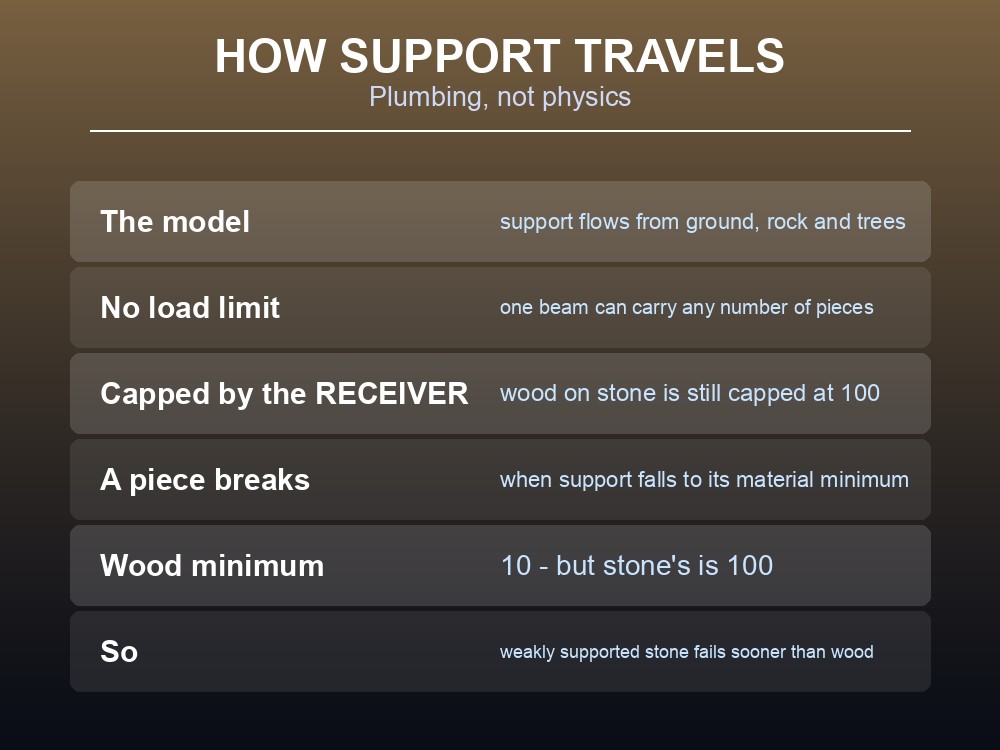
The wiki's own analogy is the most useful mental model: support "does not work like it does with real materials and resembles more how pressure propagates in a plumbing system. Or a magic force coming from ground and trees and flowing through the building pieces."
Two consequences follow, and both are counter-intuitive:
There is no load limit. "There is no limit on how many other pieces a single beam could support." A single beam can hold an entire wing. Real-world instincts about overloading do not apply.
Support is capped by the receiving material, not the giving one. A wooden piece placed on well-supported stone is capped at wood's 100, not stone's 1000. Mixing materials does not inherit the stronger one's ceiling — which is why a wooden extension off a stone tower still sags after a few metres.
A piece breaks when its support falls to or below its material's minimum. For wood that is 10; for stone and marble it is 100. Note the implication: stone has a high floor as well as a high ceiling, so a stone piece that is only weakly supported fails sooner than a wooden one in the same position.
And ground contact is the reset. Anything touching terrain, rock or a tree gets full max support. The cheapest fix for a sagging structure is almost always another vertical run down to the ground, not a thicker beam.
Practical Building Rules
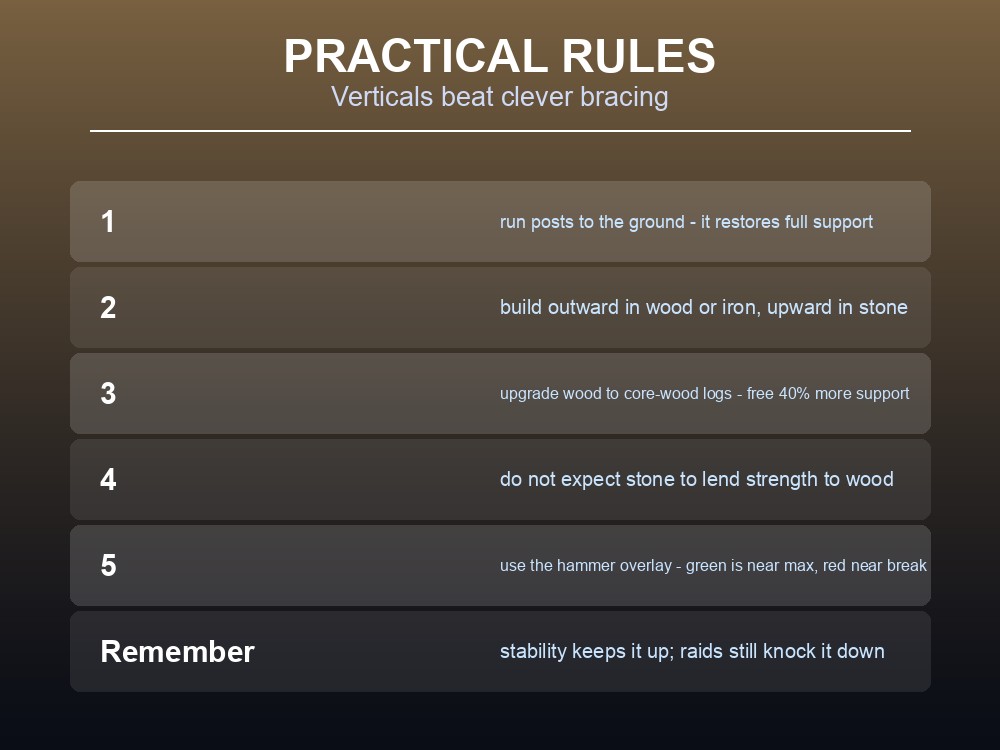
Five rules that follow directly from the numbers:
- Run posts to the ground wherever you can. Ground contact restores support to maximum; nothing else does.
- Build outward in wood or iron, upward in stone. Stone loses everything sideways; iron loses least in both directions.
- Upgrade wood to core-wood logs for +40% max support and lower vertical loss, at no change in appearance.
- Do not expect stone to lend its strength to wood. The receiving material's cap applies.
- Watch the colour overlay. The hammer's support view is the same number this article is about — green is near max, red is near the break point.
On a shared server, stability failures are a group problem. One player extending a hall sideways in stone can drop pieces that other people's rooms were resting on — support flows through the whole connected structure, not per-player.
And remember what damages structures, because a stable build can still fall: Ashlands cinder rain damages structures and sets them on fire, and raids target base pieces directly. Stability keeps a building up; it does not keep it intact.
Dynamic Stability
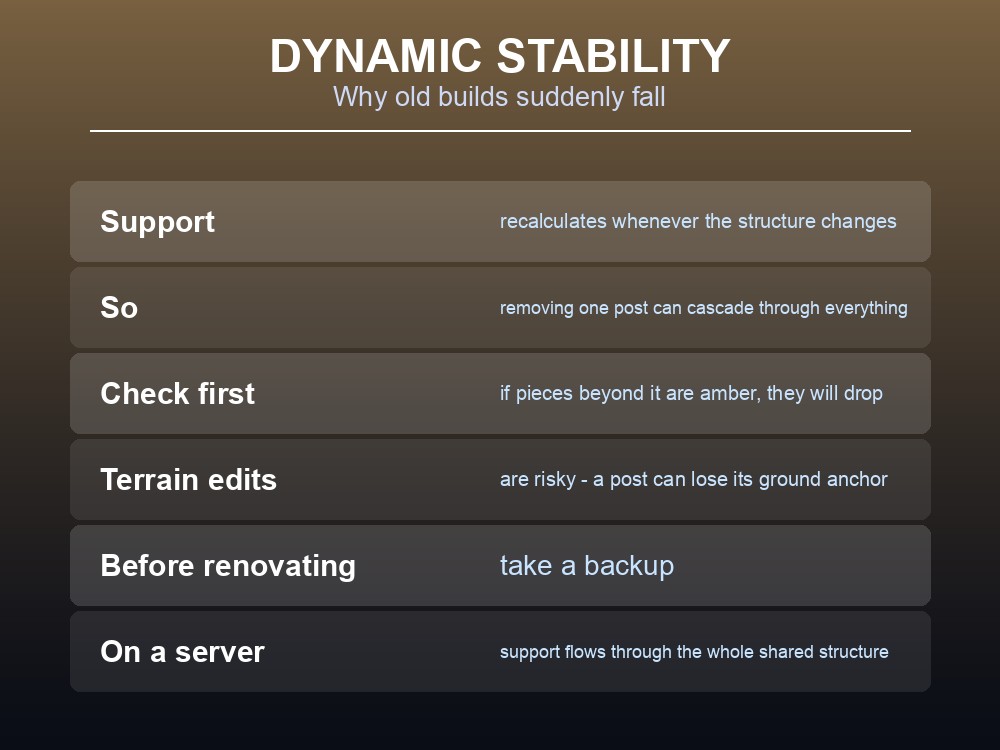
Support is recalculated when the structure changes, which is why a build can stand for days and then collapse the moment you remove what looked like a decorative post.
The cascade is the danger. When a piece breaks, everything that was drawing support through it recalculates — and if that pushes them below their minimum, they break too. A single mis-timed hammer swing at a load-bearing post can take a wing down.
Before demolishing anything in an old build, check whether support flows through it. The hammer's overlay will show you: if pieces beyond it are already amber, removing it will finish them.
This is also why terrain edits are risky near structures. Raising or levelling ground with a hoe changes what counts as ground contact — and a post that was resting on terrain can lose its anchor.
A practical habit for a server: before a big renovation, take a backup. Structural cascades are not reversible in game, and a rollback is the only way to recover a hall someone accidentally dropped.
Practical tips
- Wood: 100 max, loses 1/8 up and 1/5 sideways. Stone: 1000 max, but loses everything in one sideways step.
- Iron is the best structural material — 1/13 loss in both directions.
- Core-wood logs beat plain wood: 140 max support and 1/10 vertical loss.
- Ground, rock and tree contact restores full support. Verticals beat bracing.
- A wooden piece on stone is capped at wood's 100 — materials do not inherit strength.
- Stone's minimum is 100, so weakly-supported stone fails sooner than wood would.
- There is no load limit — one beam can carry any number of pieces.
- Removing a post recalculates everything downstream. Back up before renovating.
Running your own Valheim server
A large build is the work of many sessions and often several people, and support flows through the whole connected structure regardless of who placed what — so a rollback point matters more here than almost anywhere else. A gamever Valheim server takes one-click backups, keeps the world online around the clock for up to 10 players, and updates automatically so client and server versions never drift apart.
Conclusion
Valheim's stability system propagates a value called support outward from ground contact, losing a fraction at every connection, and breaks any piece that falls to its material's minimum. Wood starts at 100 and loses 1/8 vertically and 1/5 horizontally; hardwood logs improve both to 140 and 1/10; stone reaches 1000 but loses everything in a single sideways step; iron is the best structural material at 1/13 in both directions; and Grausten tops the table at 2000. The rules that follow are simple: ground contact restores full support, so verticals beat clever bracing; a piece is capped by its own material, so wood on stone stays wood; and there is no load limit, so one beam can hold a wing. The danger is dynamic: support recalculates whenever the structure changes, and removing a single load-bearing post can cascade through everything drawing support through it.
Want a rollback point before the big renovation? Rent a Valheim server at gamever.io — instant setup, one-click backups and updates, and 24/7 uptime. Start with a free trial and use promo code WELCOME.