
Every Party Buff Pal in Palworld (& the +15~30% Nobody Runs)
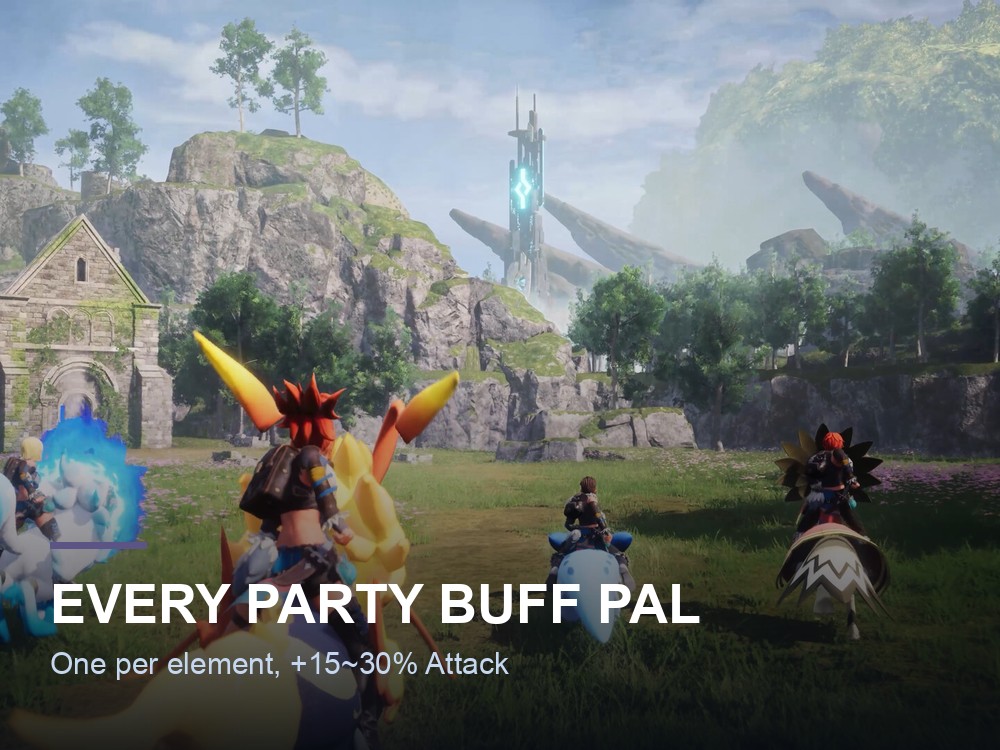
Eleven Pals give every Pal of a matching element +15~30% Attack just for sitting in your party — and almost all of them are first-hour catches. Cremis, Sparkit, Kelpsea, Bristla and Hoocrates are the Pals most players release before they leave the starting zone. That is the whole reason this system is invisible: the buff is real, it is free, and it comes attached to creatures nobody thinks twice about.
Every Party Buff Pal
| Element | Pal(s) |
|---|---|
| Neutral | Cremis, Ribbuny |
| Dark | Hoocrates, Demon Eye |
| Electric | Sparkit |
| Water | Kelpsea |
| Fire | Kelpsea Ignis |
| Grass | Bristla |
| Ice | Foxcicle |
| Ground | Dumud |
| Dragon | Quivern |
Every one gives the same figure: +15~30% Attack to Pals of that element.
Note that Neutral and Dark each have two options — Cremis or Ribbuny for Neutral, Hoocrates or Demon Eye for Dark — so there is no scarcity problem. And Ribbuny does double duty, since its partner skill also grants +1 Handiwork to every Base Pal.
How It Works
| Rule | Detail |
|---|---|
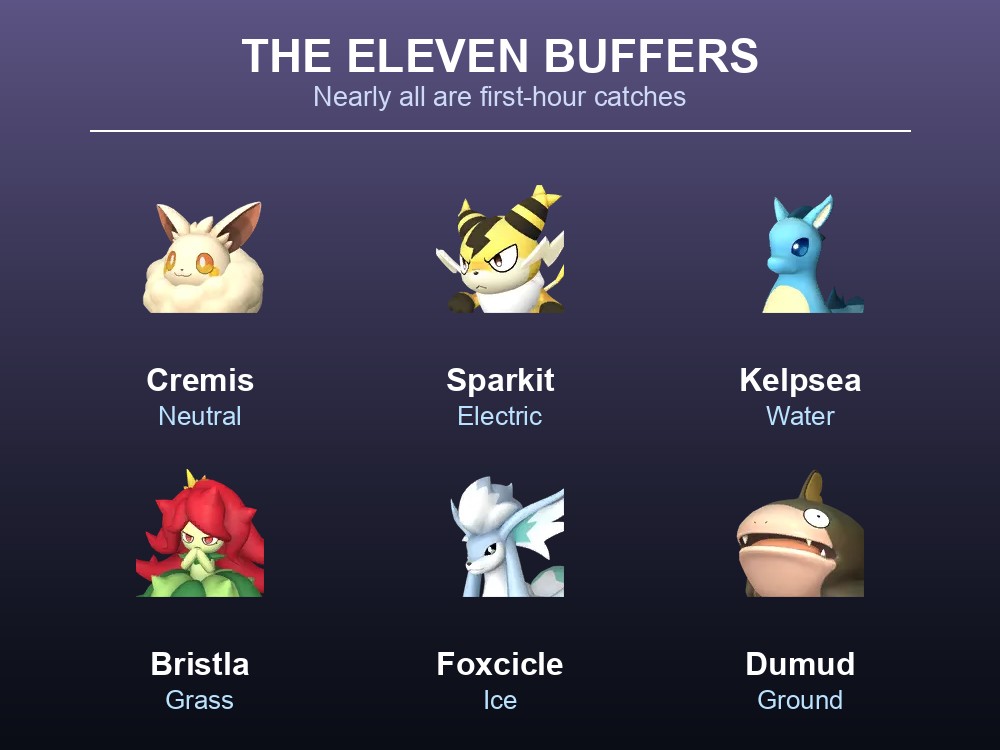
| Effect | +15~30% Attack to Pals of that element |
| Condition | The buffer only has to be in your party |
| Does it fight? | No — it does not need to be active or deployed |
| Stacking | No. Two Neutral buffers give one bonus |
| Applies to | Your Pals — not your own weapon damage |
That fourth row is the one that decides your loadout. Since buffs do not stack, there is no point carrying two of the same element — and since you have five party slots, you can run at most a handful of different elemental buffs at once.
And the fifth row is the limit worth understanding. A party buff raises your Pal's attack, not yours. If you fight primarily with a firearm, this system does very little for you; if you fight through your Pals, it is one of the cheapest damage increases available.
Compare it against the alternative use of that slot. One party slot spent on a buffer means one fewer attacker — so the buff is worth it when your remaining Pals share an element, and worth nothing when your party is a mixed bag. Building around one element is what makes party buffs pay.
Nearly All of Them Are Starter Pals
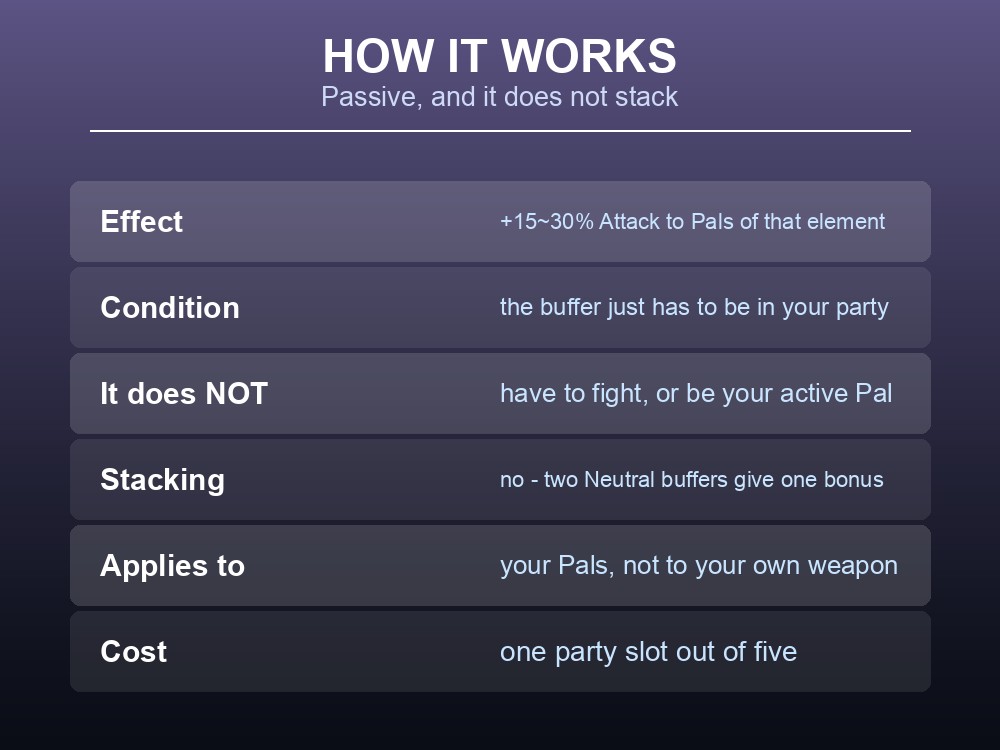
Look at the acquisition cost of that list. Cremis, Sparkit, Kelpsea, Bristla, Hoocrates and Ribbuny are all early, common catches — several of them from the first hour. Foxcicle and Dumud are mid-game and still easy. Only Quivern is a genuine catch.
That is the whole reason this system goes unused. A mechanic attached to Pals you meet before you understand the game is a mechanic you have already dismissed. By the time attack percentages matter to you, Cremis is a memory.
The practical move is to go back for one. A Kelpsea takes minutes to find and gives every Water Pal in your party +15~30% Attack for the rest of the game. That is a better return than most of what you will do in the same ten minutes at Level 50.
And they cost nothing to keep. These are low-rarity Pals with small food intake — parking one in a party slot is not a resource decision, only a slot decision.
Carry Weight Is the Other One
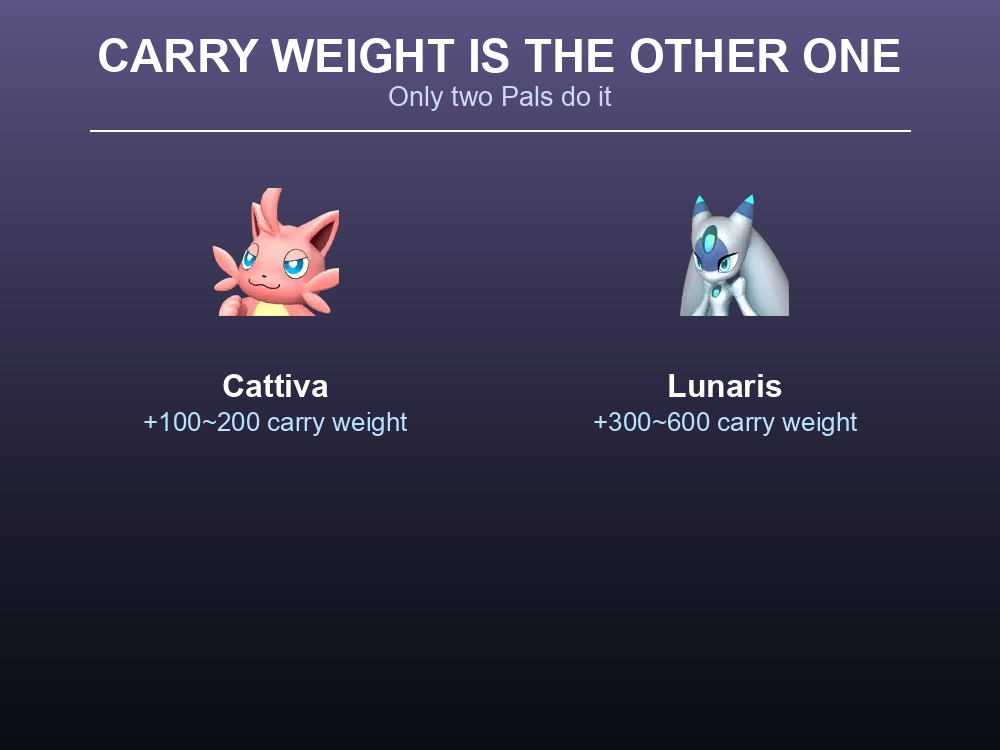
Exactly two Pals in Palworld raise your carrying capacity:
| Pal | Carry weight |
|---|---|
| Cattiva | +100~200 |
| Lunaris | +300~600 |
Put those numbers against the alternative. A Weight status point gives +50, and the standard advice is to pour your first twenty points into Weight to reach 600 – 800 capacity.
Lunaris at its maximum is worth twelve status points in a single party slot. Cattiva at its maximum is worth four — and Cattiva is a starting-zone Pal, available in your first hour, which makes it one of the strongest early-game picks in the game and one nobody takes.
Why it matters beyond convenience: you cannot dodge while overencumbered. Carry weight is a combat stat in Palworld, not just an inventory one — so a Pal that adds 600 capacity is removing a failure mode, not merely saving trips.
How to Use Party Buffs
- Decide your party's element first. A buff only pays if your other Pals share the type.
- Take one buffer, never two of the same element — they do not stack.
- Go back for a Kelpsea, Cremis or Sparkit. They cost minutes and last the whole game.
- Remember it buffs Pals, not your weapon. Gun-focused players get less from this.
- Carry Cattiva early and Lunaris later for weight — +200 and +600 respectively.
- Prefer Ribbuny for the Neutral slot, since it also gives +1 Handiwork at base.
Practical tips
- Eleven Pals, one per element, all giving +15~30% Attack. They do not stack.
- The buffer only needs to be in the party — it never has to fight.
- It buffs your Pals, not your own weapon damage.
- Most of them are first-hour catches — which is exactly why the system is ignored.
- Cattiva gives +100~200 carry weight and is available in the starting zone.
- Lunaris at +300~600 is worth twelve Weight status points in one slot.
Running your own Palworld 1.0 server
Party composition is something a group tunes together — one player carrying the element buff while the others bring the damage. On a dedicated Palworld 1.0 server the world stays live around the clock so everyone can catch the buffer they need without waiting on a host, and your base keeps producing while the party is out. Full crossplay lets the whole group contribute, and one-click backups protect a roster you have tuned slot by slot.
Conclusion
Palworld has eleven party buff Pals, one or two per element, each granting +15~30% Attack to Pals of that element while simply sitting in your party — Cremis and Ribbuny for Neutral, Hoocrates and Demon Eye for Dark, Sparkit, Kelpsea, Kelpsea Ignis, Bristla, Foxcicle, Dumud and Quivern for the rest. The buffs do not stack, they apply to your Pals rather than your own weapon, and the buffer never has to fight. The reason nobody uses them is that almost every one is a first-hour catch you released long before attack percentages mattered. Separately, exactly two Pals raise carry weight — Cattiva at +100~200 and Lunaris at +300~600 — and since a Weight status point gives just +50, a maxed Lunaris is worth twelve status points in one slot. Given that you cannot dodge while overencumbered, that is a combat upgrade rather than a convenience.
Want the world live while your group tunes its party? Rent a Palworld server at gamever.io — instant setup, one-click backups and updates, full crossplay and 24/7 uptime. Start with a free trial and use promo code WELCOME.