
Every Fire Source in Valheim: Four of Them, and They Are Not Equal

Every fire in Valheim does the same five things: removes Cold, adds the Fire effect, rapidly removes Wet, reduces Freezing to Cold, and produces smoke. What separates a Campfire from a Hearth is not what it does but how much punishment it takes and how much comfort it gives — and the gap is larger than the recipe suggests.
On sourcing. Iron Gate do not publish system documentation. The figures below come from the community wikis and can change with any patch.
What Every Fire Does
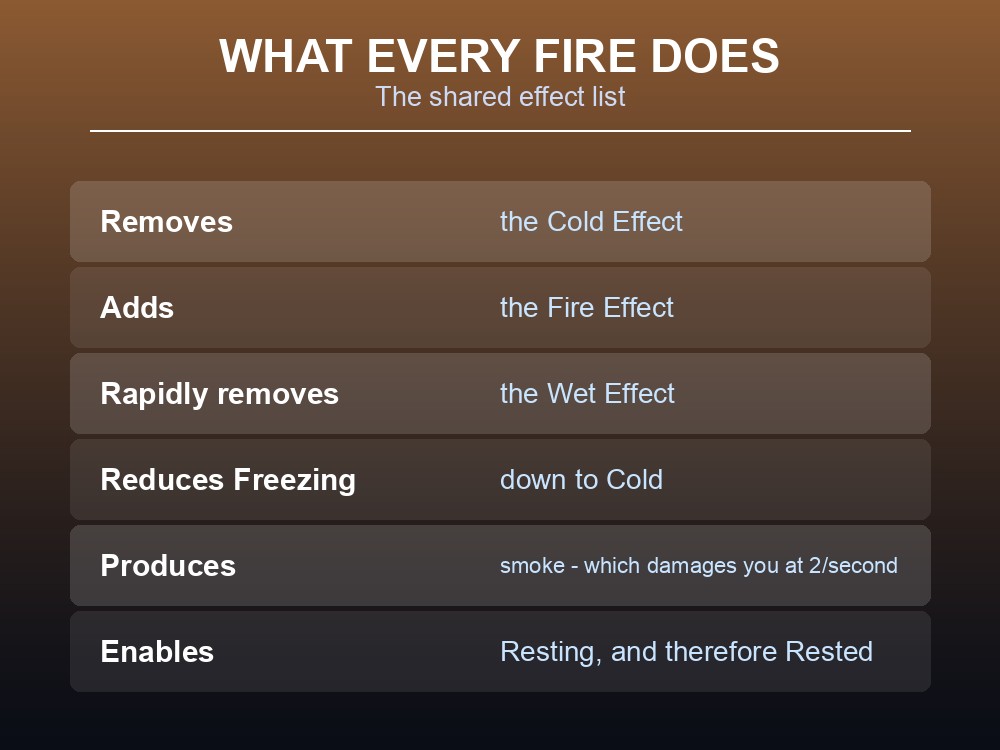
| Effect | Detail |
|---|---|
| Removes the Cold Effect | The night penalty — −50% health regeneration |
| Adds the Fire Effect | Which enables Resting |
| Rapidly removes the Wet Effect | The Fire effect expires Wet 10× faster |
| Reduces Freezing to Cold | Mountain survival, without frost resistance |
| Produces smoke | Which deals 2 damage per second if it pools |
The Wet interaction is the underrated one. As covered in our status effects guide, the Fire effect makes the Wet timer expire ten times faster — so a fire is not just warmth, it is a towel. Coming in from a storm, standing by a fire for a few seconds removes a −25% health regeneration penalty you would otherwise carry for minutes.
Reducing Freezing to Cold is a survival mechanic, not a comfort one. Freezing is −100% health regeneration and 1 damage per second; Cold is −50% and no damage. A fire in the Mountain is the difference between dying slowly and not.
And every fire enables Resting, which leads to Rested after twenty seconds — the strongest buff in the game at +50% health, +100% stamina, +50% XP and +100% Eitr regeneration.
The smoke is the cost. Every fire produces it, and Smoked deals 2 damage per second with no audio cue. Our smoke guide covers venting properly; the short version is that a roof needs a hole above every fire.
Campfire Against Hearth
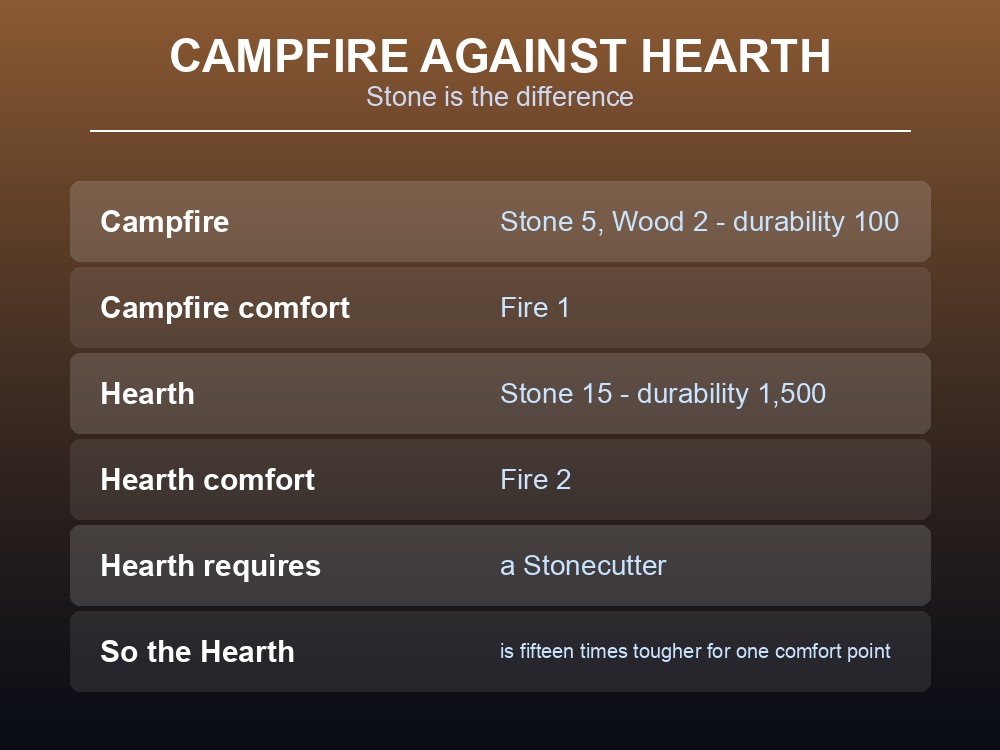
| Campfire | Hearth | |
|---|---|---|
| Recipe | Stone ×5, Wood ×2 | Stone ×15 |
| Durability | 100 | 1,500 |
| Comfort | Fire 1 | Fire 2 |
| Size | ~2×2 | 4×3 |
| Station needed | — | Stonecutter |
Fifteen times the durability for one extra comfort point is the trade, and stated that way it sounds poor. It is not, because durability here means survivability in a raid — a Campfire at 100 durability is destroyed by things that do not scratch a Hearth.
The comfort point is worth having too. As our comfort guide covers, only the highest item in each category counts, and Fire is a category — so a Hearth's Fire 2 replaces a Campfire's Fire 1 rather than adding to it. You cannot get to comfort 17 with a Campfire.
The Hearth's 4×3 footprint is the planning constraint. It is a large object, and a hall designed around a Campfire will not fit one later. Decide early, because retrofitting a Hearth means rebuilding the room.
And the Hearth needs a Stonecutter, which needs Iron — so it is a Swamp-era upgrade, not a starting one.
Which to Build Where
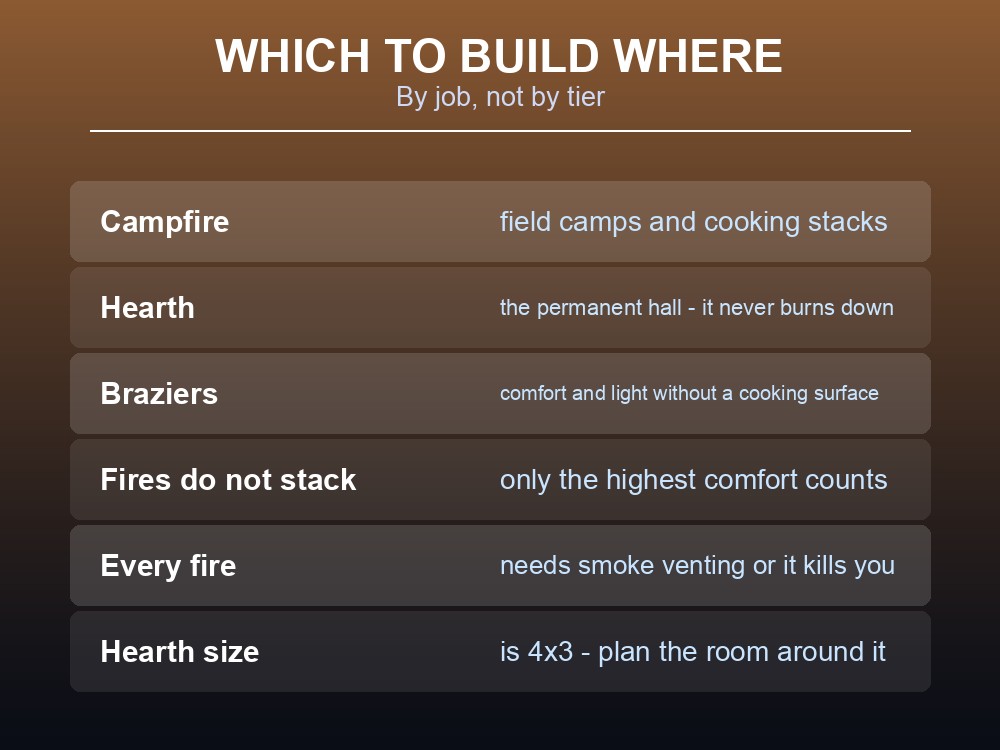
Campfire: field camps and cooking stacks. At Stone ×5 and Wood ×2 it is disposable, which is exactly what you want at a temporary outpost or a mining camp. It is also the fire most players stack cooking stations over — seven, or ten if placed halfway inside.
Hearth: the permanent hall. 1,500 durability means it survives raids, Comfort 2 means it contributes to the cap, and its size means it anchors the room. Build the hall around the Hearth, not the other way round.
Braziers: light and comfort without a cooking surface. The Hanging brazier and Standing brazier both count as Fire for comfort and both remove Cold — and the hanging one can support cooking stations, which the standing one cannot. Use them where you want warmth and light but no smoke column in the middle of a room.
Fires do not stack with each other. Two Campfires in one room is one Campfire's worth of comfort. Build one good fire, not three cheap ones.
And vent every one of them. Ten cooking stations over one fire is a lot of smoke, and the damage arrives without a sound cue. A hole in the roof directly above the fire is not optional.
Practical tips
- Every fire removes Cold, adds Fire, clears Wet 10× faster and reduces Freezing to Cold.
- Every fire produces smoke — 2 damage per second if it pools.
- Campfire: Stone ×5, Wood ×2, durability 100, Comfort Fire 1.
- Hearth: Stone ×15, durability 1,500, Comfort Fire 2 — needs a Stonecutter.
- Fires do not stack — only the highest comfort counts.
- The Hearth's 4×3 footprint means designing the room around it from the start.
- Braziers give light and comfort without a cooking surface; the hanging one supports stations.
- Twenty seconds by any fire gives you Rested.
Running your own Valheim server
A Hearth-anchored hall is the room a group returns to between expeditions — and it only works if it is standing when they get back. A gamever Valheim server keeps it persistent for up to 10 players, with one-click backups so a raid that reaches the door never costs the hall.
Conclusion
Valheim's fire sources all do the same five things — remove Cold, add the Fire effect, clear Wet ten times faster, reduce Freezing to Cold, and produce smoke that deals 2 damage per second. What separates them is durability and comfort. A Campfire costs Stone ×5 and Wood ×2 for 100 durability and Comfort Fire 1; a Hearth costs Stone ×15 for 1,500 durability and Comfort Fire 2 — fifteen times the toughness for one comfort point, which is worth it because that durability is raid survival and that point is the difference between reaching the comfort cap and not. The Hearth needs a Stonecutter and occupies 4×3, so plan the hall around it early rather than retrofitting. Braziers cover light and comfort without a cooking surface. And since fires do not stack, build one good fire rather than three cheap ones — then cut a hole in the roof above it.
Want a hall that is still standing? Rent a Valheim server at gamever.io — instant setup, up to 10 players, one-click backups and updates, and 24/7 uptime. Start with a free trial and use promo code WELCOME.