
Smoke in Valheim: Why Your Smelter Stopped and How to Vent a Base
A Valheim smelter that has stopped is almost never out of fuel — it is out of air. Every smoke-producing structure shuts down if it cannot produce smoke for four seconds, and smoke needs about a metre of clearance to move. That is the whole mechanic, and it explains the two most common base failures: production halting in a sealed workshop, and the Smoked effect quietly killing someone asleep upstairs.
On sourcing. Iron Gate do not publish this. The details below come from the community Valheim wiki, and can change with any patch.
What Makes Smoke
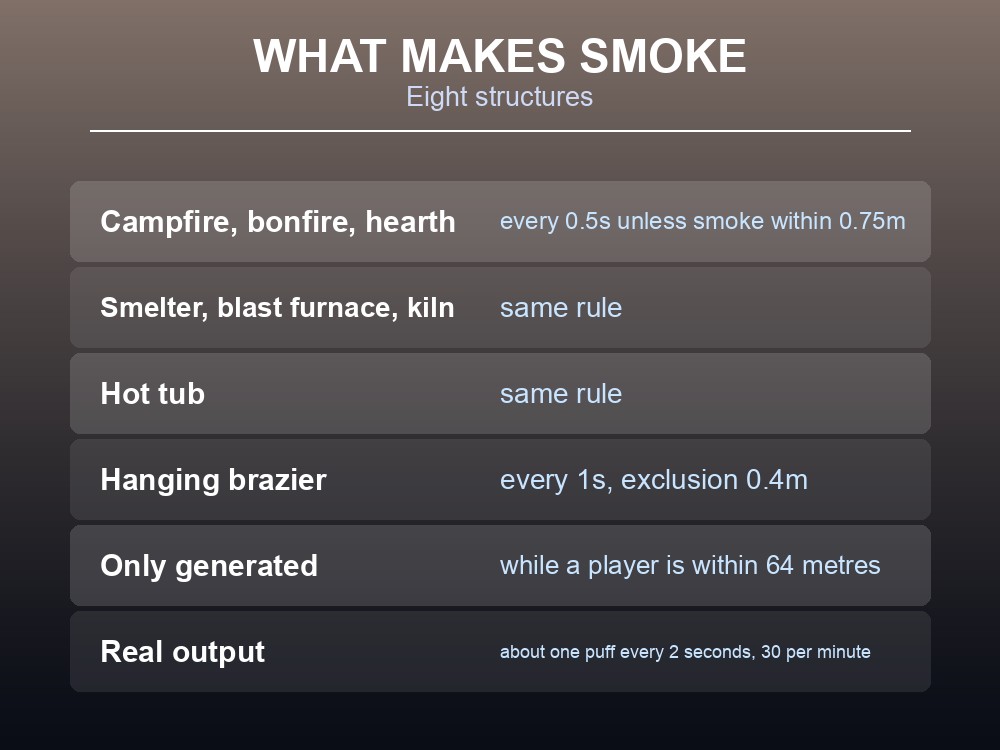
Eight structures produce it, and only while a player is within 64 metres:
| Structure | Rate |
|---|---|
| Campfire | Every 0.5 s, unless smoke within 0.75 m |
| Bonfire | Every 0.5 s, same rule |
| Hearth | Every 0.5 s, same rule |
| Smelter | Every 0.5 s, same rule |
| Blast furnace | Every 0.5 s, same rule |
| Charcoal kiln | Every 0.5 s, same rule |
| Hot tub | Every 0.5 s, same rule |
| Hanging brazier | Every 1 s, unless smoke within 0.4 m |
The "unless smoke within 0.75 m" clause is the throttle. A structure will not add a new puff while one is still sitting on top of it — so realistic output is about one instance every 2 seconds, roughly 30 per minute.
And the rule that shuts things down: "Structures stop working if they aren't able to produce smoke for 4 seconds."
So a stalled smelter is a ventilation report. If smoke cannot clear the 0.75-metre exclusion zone fast enough, new smoke cannot spawn, and after four seconds the structure stops.
Note the 64-metre condition too. Smoke is only generated while a player is within 64 metres — which is also why a workshop behaves differently when you walk away and come back.
How Smoke Moves
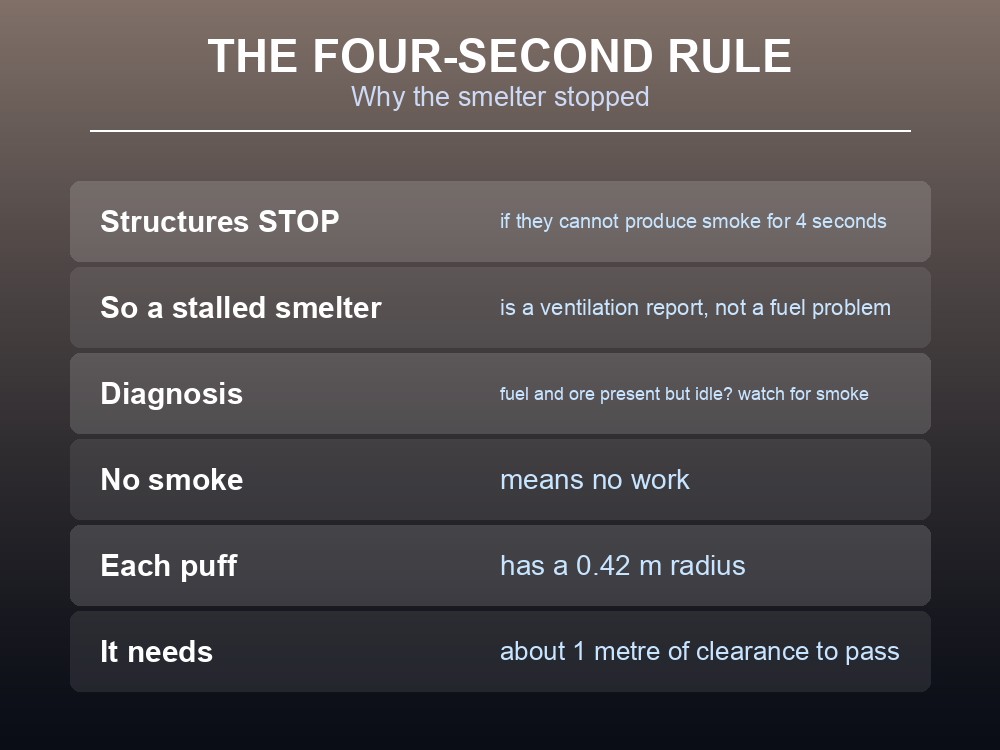
Each smoke instance has a radius of 0.42 metres, which means it "requires about 1 meter space to get through."
That number is the design constraint for every chimney you will ever build. A gap narrower than a metre does not vent — it collects.
Smoke rises at 0.75 m/s and drifts, and it is slow enough that a tall enclosed space simply fills from the top down.
The wiki flags a technique worth stealing: "Beams can be used to block smoke movement while still leaving gaps to interact with the structures." Beams are thin enough to interact through but solid enough to redirect smoke — so you can shape where it goes rather than only whether it escapes.
And players caught in it take damage. "Players inside the smoke get Smoked effect which deals damage over time." In a badly vented workshop that is a slow, confusing death — particularly for anyone standing still at a bench.
Venting Without Losing Cover
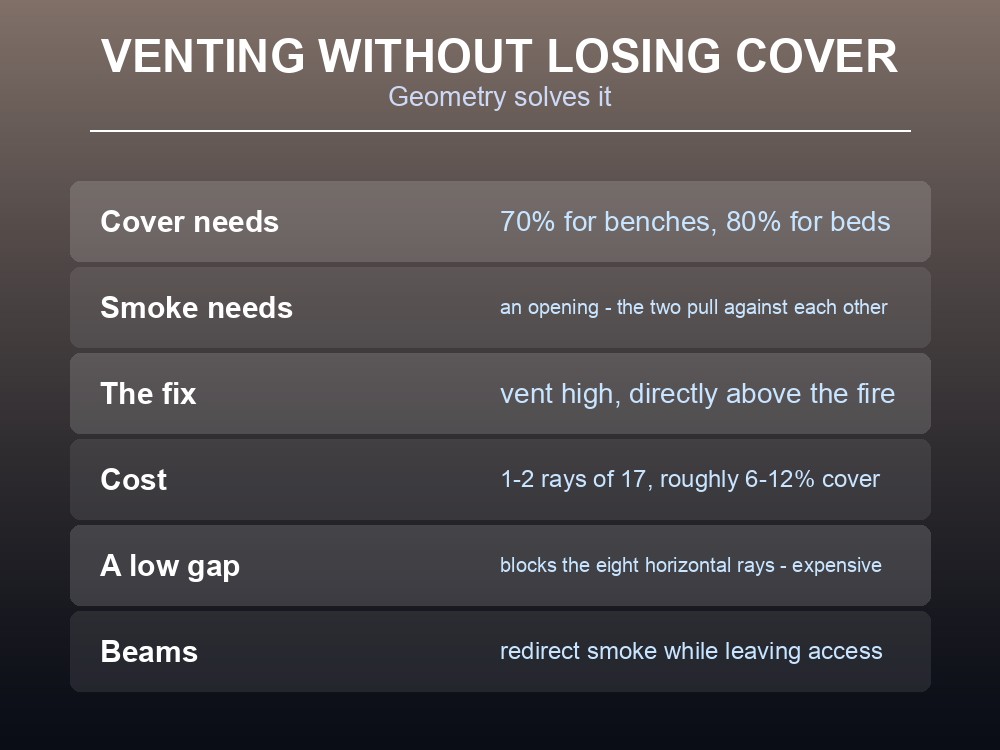
This is the real design problem, because two systems pull in opposite directions.
Cover wants the room sealed: 70% for crafting stations, 80% for a bed. Smoke wants an opening.
The resolution comes from how cover is measured. Valheim casts 17 rays — one straight up, eight horizontal, eight at 45 degrees. A vent placed high and directly above the fire intersects only the vertical ray and perhaps one or two upper diagonals. You lose one or two rays out of seventeen — roughly 6–12% of cover — and gain full ventilation.
A gap low in a wall is the expensive choice, because it sits in the path of the eight horizontal rays, which are the ones large rooms already struggle to block.
Practical arrangements that work:
- One missing roof tile directly over the fire, with at least a metre of clear space beneath it.
- A raised lantern-style roof section — walls that stop short of the peak.
- Beams above the fire to steer smoke towards the vent rather than across the room.
- Keep the ceiling above the fire clear of floors — a mezzanine directly over a hearth is a smoke trap.
Designing a Workshop
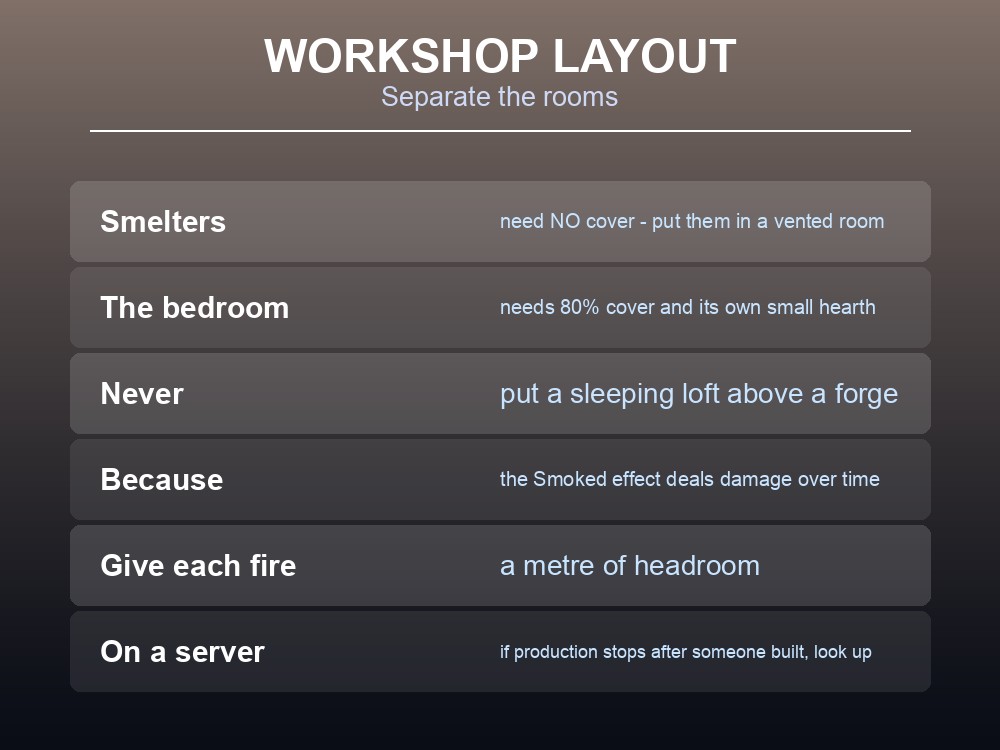
The layout that avoids every failure mode at once:
- Put the smelters, kiln and blast furnace in their own room with a generous roof vent, or outdoors under a roof with open sides. They need no cover at all to function — cover is a requirement for workbenches and beds, not for smelters.
- Keep the bed room separate and sealed. It needs 80% cover, a roof, and a fire nearby — so give it a small hearth with its own dedicated vent rather than sharing the smelting hall's air.
- Do not stack a sleeping loft over the forge. Smoke rises; the Smoked effect does not care that you are asleep.
- Give each fire a metre of headroom. The exclusion radius is 0.75 m and the puff is 0.42 m across.
On a shared server this is worth agreeing once, because smoke problems are usually caused by someone else's helpful addition — a new floor above the hearth, a wall closed off to keep raiders out, a second smelter squeezed into a corner. If production stops after someone has been building, look up.
And the diagnosis is quick: if a structure has fuel and ore but is idle, stand back and watch for smoke. No smoke means no work.
Practical tips
- A structure stops after 4 seconds without venting. A stalled smelter is a ventilation problem.
- Smoke needs about 1 metre of clearance; each puff is 0.42 m across.
- New smoke will not spawn within 0.75 m of existing smoke — that is the throttle.
- Real output is about one puff every 2 seconds, ~30 per minute.
- Smoke only generates with a player within 64 metres.
- Vent high, directly above the fire — it costs 1–2 of the 17 cover rays.
- Smelters do not need cover. Only workbenches (70%) and beds (80%) do.
- Never put a sleeping loft above a forge — the Smoked effect deals damage over time.
Running your own Valheim server
Ventilation problems are almost always introduced by someone else's building session, and the fastest fix for a workshop that stopped working overnight is a rollback rather than an investigation. A gamever Valheim server takes one-click backups, keeps the base online around the clock for up to 10 players, and updates automatically so client and server versions never drift apart.
Conclusion
Valheim's smoke system is short and unforgiving: eight structures produce smoke, only while a player is within 64 metres, at roughly one instance every 2 seconds — and any of them stops working after 4 seconds without being able to vent. Each puff has a 0.42-metre radius and needs about a metre of clearance, and a new one will not appear within 0.75 metres of an existing one, which is the throttle that stalls sealed rooms. Players standing in it take the Smoked damage-over-time effect. The design tension is with cover — crafting stations need 70%, beds need 80% — and the resolution is geometric: because cover is measured with 17 rays, only one of which points straight up, a vent placed high and directly above the fire costs one or two rays while solving ventilation completely. Keep smelters in their own vented room, keep the bedroom sealed with a small dedicated hearth, and never build a sleeping loft over a forge.
Want to roll back the building session that broke your workshop? Rent a Valheim server at gamever.io — instant setup, one-click backups and updates, and 24/7 uptime. Start with a free trial and use promo code WELCOME.