
Wild Egg Spawns in Palworld: 754 Draw Points on a Three-Hour Clock
Wild eggs are the cheapest way to add Pals to your roster — no spheres, no capture power, no fight. What almost nobody knows is the shape of the system underneath: 754 draw points across the world map, each on a 180-minute cooldown. Three real hours. That single number turns egg hunting from a wander into a route.
The Two Numbers
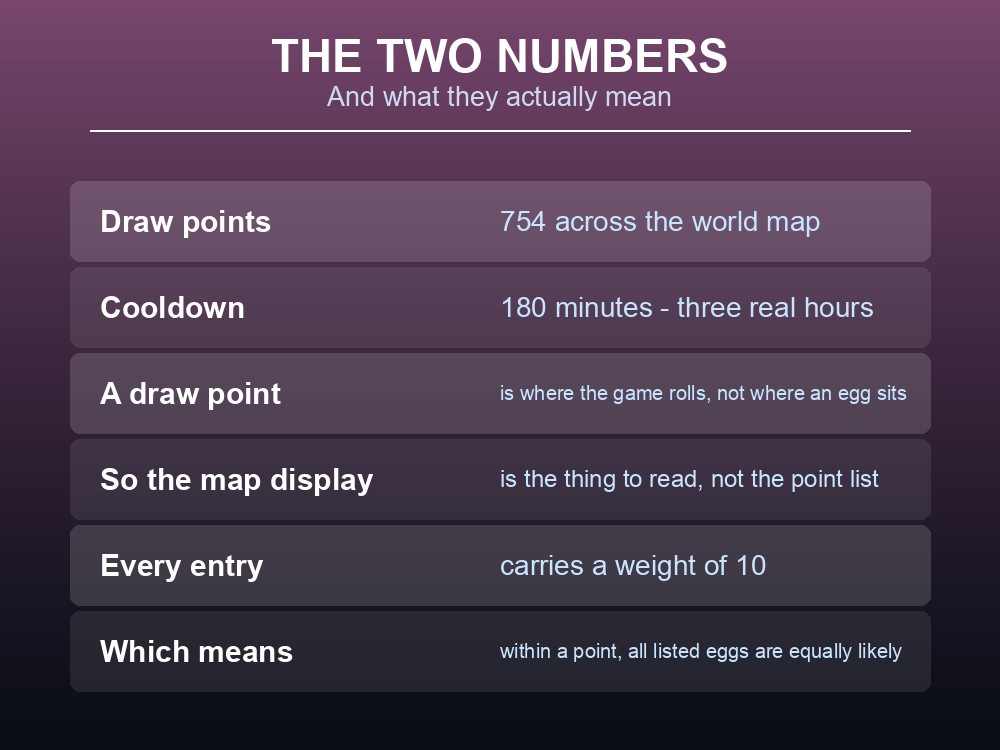
| Draw points | 754 across the world map |
| Cooldown | 180 minutes — three real hours |
| Weight per entry | 10, uniformly |
A "draw point" is not an egg. It is a location where the game rolls for one — which is why the raw point list is not the thing to navigate by. The egg display on the in-game map is what you actually read, and the point list only tells you where the game is capable of placing one.
The uniform weight of 10 matters more than it looks. Every egg listed at a given point carries the same weight, which means within a point, all its listed eggs are equally likely. There is no rare-egg roll hidden inside a point — the rarity lives in which points exist where, not in the odds at any one of them.
Three hours is a long cooldown by Palworld standards. For comparison, base production runs continuously and dungeon resets are far shorter. An egg point you cleared at lunchtime is not back until mid-afternoon.
Why the Route Matters
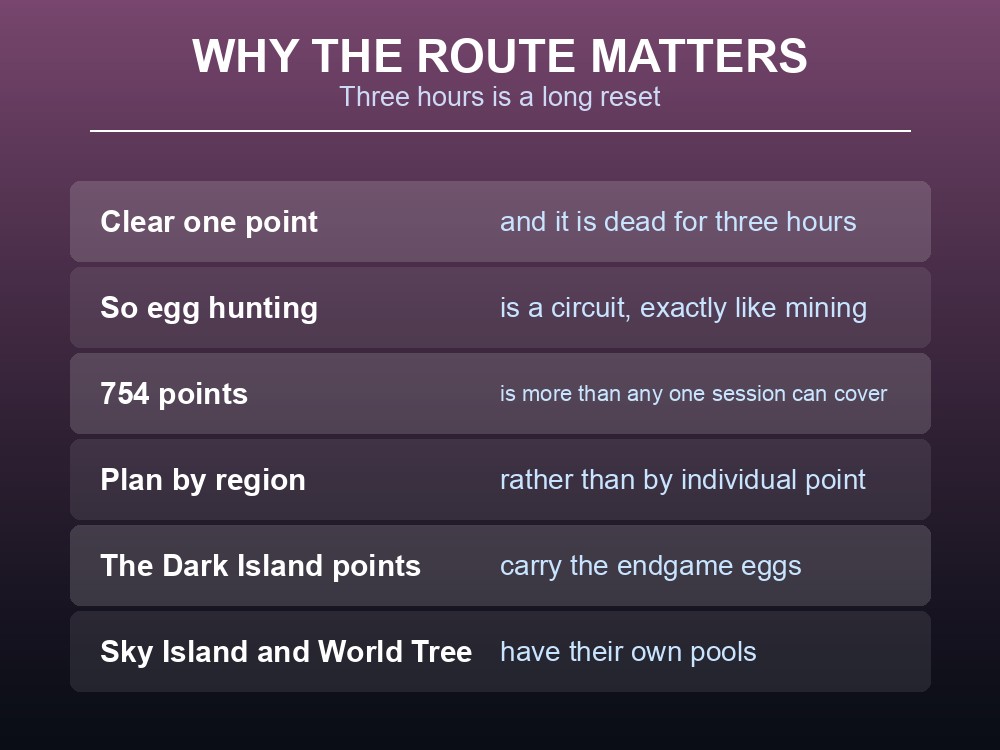
Egg hunting is a circuit, exactly like mining. Clear a cluster, move to the next region, and by the time you loop back the first has reset. Standing at one point waiting is the single worst way to farm eggs.
754 points is more than any one session covers, so the practical unit is the region rather than the individual point. Plan a loop that touches several regions and you will never wait on a cooldown.
The regional pools are genuinely different. The Dark Island points carry the endgame eggs — Nitemary, Omascul, Lyleen Noct and the rest of the high-level Dark roster. Sky Island and the World Tree have their own pools again. As with skill fruit orchards, where you farm decides what you can get, not how likely you are to get it.
Match the region to what you need. If you are hunting a Huge Dark Egg, the Dark Island points are the place — going anywhere else is not slower, it is impossible.
And note that the cooldown is per point, not global. Clearing one point does not lock its neighbours, which is why a dense cluster is worth far more than a scattered pair.
What You Are Actually Farming
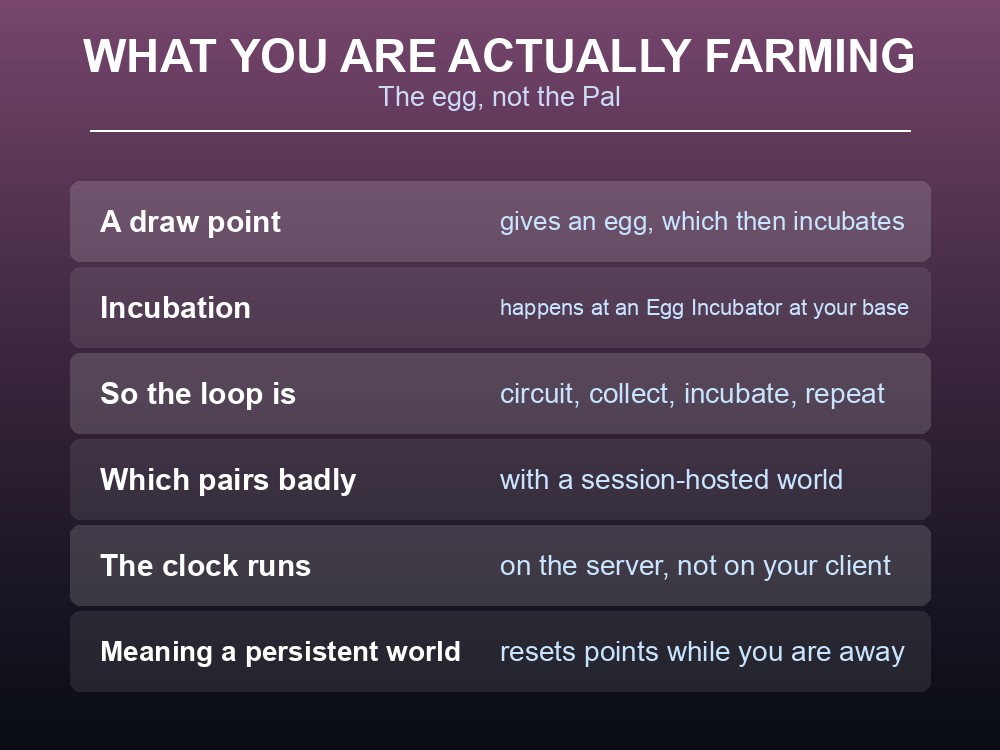
A draw point gives you an egg, not a Pal. The egg then has to go into an Egg Incubator at your base and finish its timer before you see anything — so the full loop is circuit → collect → incubate → repeat, with two clocks running at once.
Those two clocks are why this system rewards a persistent world. The 180-minute point cooldown and the incubation timer both run on the server's clock, not your client's. On a world that only exists while somebody is hosting it, both stop the moment the last player logs out. On a world that runs continuously, you come back to reset points and finished eggs at the same time.
Which makes egg farming an unusually good use of a shared world. One player runs the circuit, everybody's incubators fill, and the points reset for the group rather than per person.
Build more incubators than you think you need. The bottleneck in this loop is almost never the eggs — it is having somewhere to put them when you get back with eight.
And do not sell eggs. They are the only no-combat source of high-tier Pals in the game, and a Huge egg that hatches badly is still a Pal you did not have to fight for.
Practical tips
- 754 draw points, each on a 180-minute (three-hour) cooldown.
- A draw point is where the game rolls, not where an egg sits — read the map display.
- Every egg at a point has weight 10 — equal odds within that point.
- Egg hunting is a circuit, not a camp. Loop regions, never wait.
- Regional pools differ — Dark Island carries the endgame eggs.
- The cooldown is per point, so dense clusters are worth far more.
- Both clocks run on the server, so a persistent world resets while you are away.
- Build more incubators than you think you need.
Running your own Palworld 1.0 server
A three-hour cooldown and an incubation timer are both server-side clocks — they only advance on a world that keeps running. A gamever Palworld server does exactly that, with full crossplay, automatic updates and one-click backups, so a circuit cleared this morning is ready again this afternoon whether or not anyone was online.
Conclusion
Palworld's wild egg system runs on 754 draw points with a 180-minute cooldown each. A draw point is where the game rolls for an egg, not where one sits — the in-game map display is what you navigate by — and every egg listed at a point carries the same weight of 10, so there is no hidden rarity roll within a point. The rarity lives in geography: Dark Island points hold the endgame eggs, and Sky Island and the World Tree have pools of their own. Three hours is long enough that egg hunting is a circuit rather than a camp, and because the cooldown is per point, dense clusters are worth far more than scattered ones. Both the point cooldown and the incubation timer run on the server's clock, which makes this one of the systems that rewards a continuously running world most directly.
Want a circuit that resets while you sleep? Rent a Palworld server at gamever.io — instant setup, one-click backups and updates, full crossplay and 24/7 uptime. Start with a free trial and use promo code WELCOME.