
The Hoe in Valheim: Five Wood, Two Stone, and It Reshapes the World
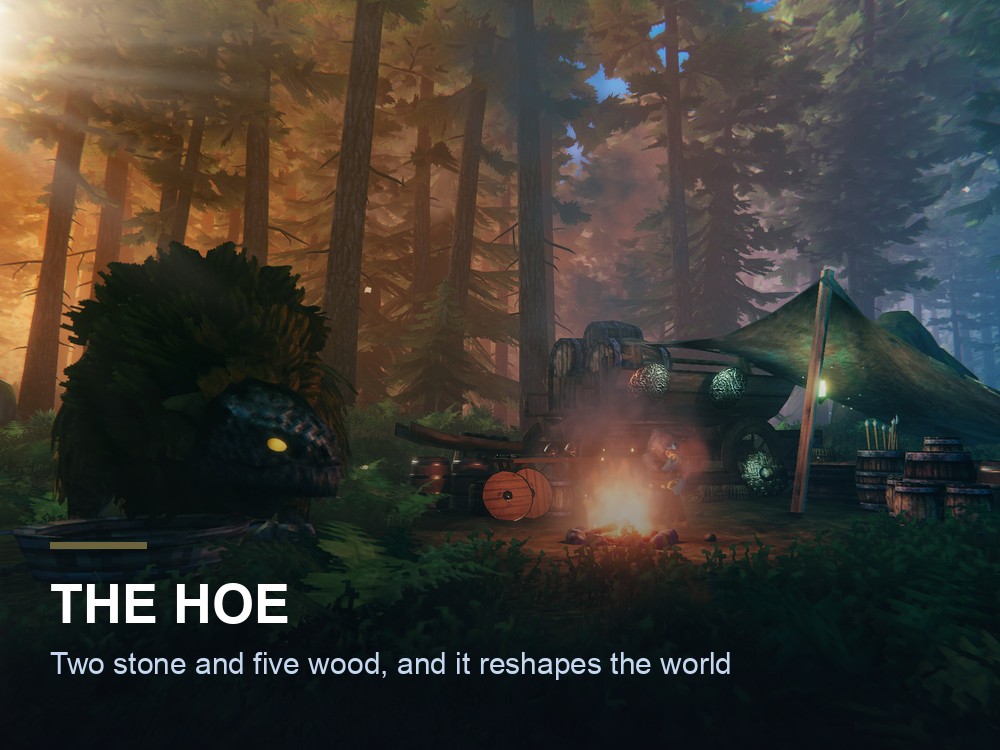
The Hoe costs five wood and two stone. It is available from your first Workbench, it is the least glamorous item in Valheim, and it does more to determine whether your base works than any weapon you will ever build. Levelling ground is what stone construction requires, raising ground is the cheapest wall in the game, and neither of those is what most players use it for.
On sourcing. Iron Gate do not publish system documentation. The figures below come from the community wikis and can change with any patch.
The Cheapest Tool in the Game
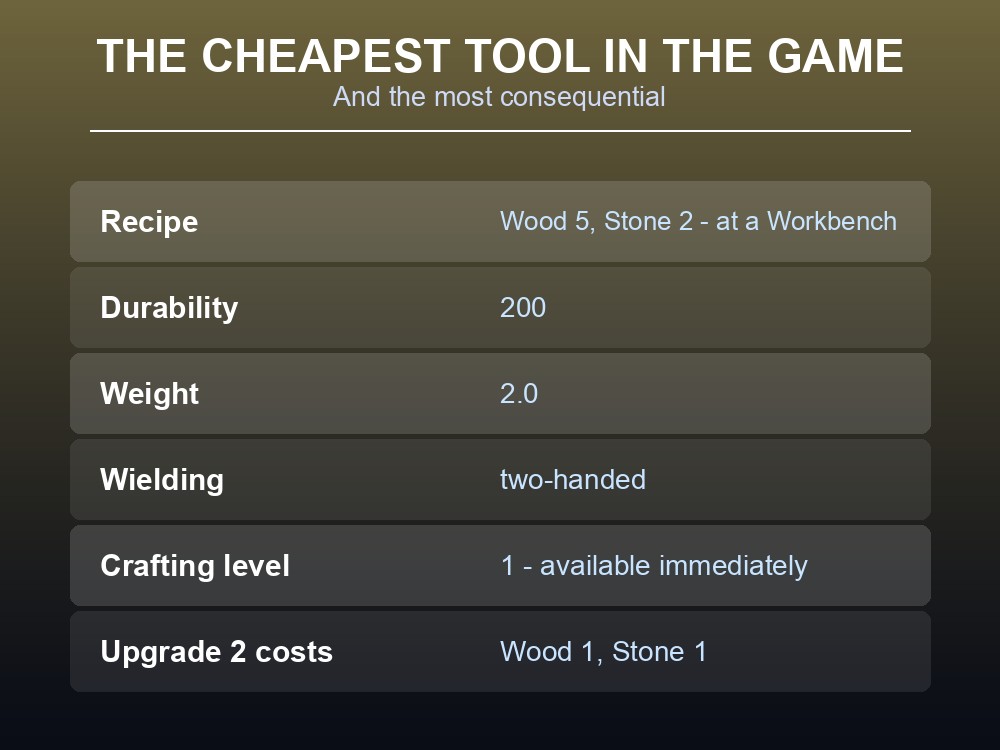
| Recipe | Wood ×5, Stone ×2 |
| Station | Workbench |
| Crafting level | 1 — available immediately |
| Durability | 200 |
| Weight | 2.0 |
| Wielding | Two-handed |
Crafting level 1 means there is no reason not to have one. The Hoe is available the moment your first Workbench is placed, and its recipe is cheaper than a single arrow stack.
The upgrade path is almost free too. Level 2 costs Wood ×1 and Stone ×1; level 3 costs Wood ×2 and Stone ×2. Each level adds 200 durability, which is the only thing upgrading changes.
Two-handed is the practical note. You cannot hold a shield while terraforming, which sounds obvious until you are raising a wall with a raid inbound. Terraform in peace, not under pressure.
What It Actually Does
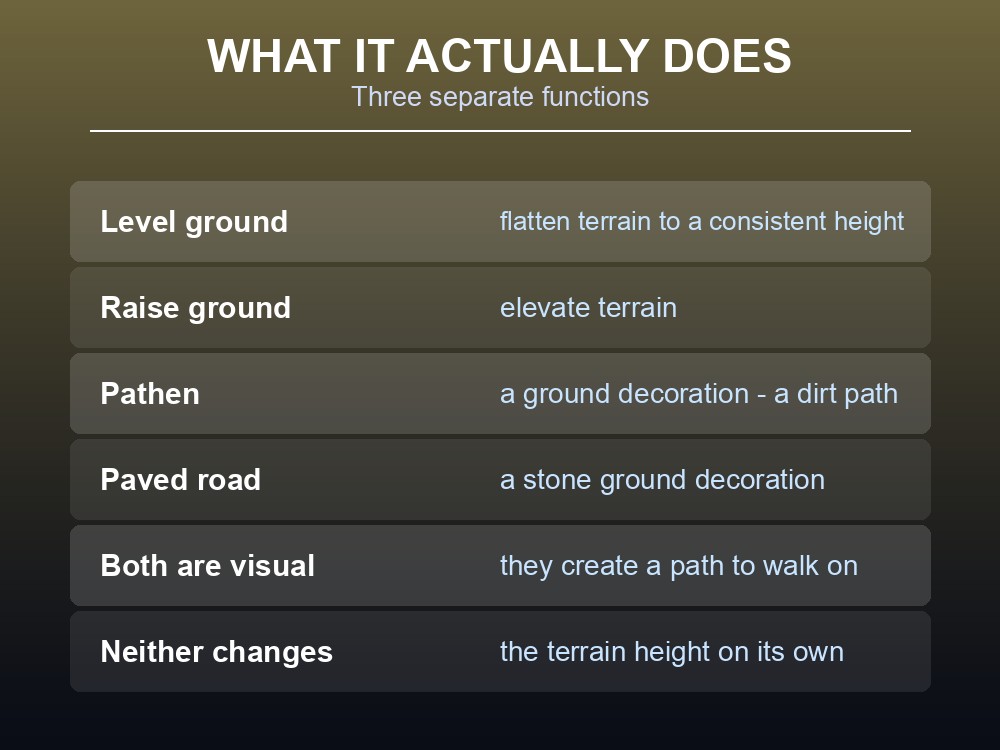
The Hoe has four modes, and they do genuinely different things:
| Mode | Effect |
|---|---|
| Level ground | Flattens terrain to the height you are standing at |
| Raise ground | Elevates terrain |
| Pathen | A dirt ground decoration |
| Paved road | A stone ground decoration |
"Level ground" levels to your feet, not to the average. That is the detail that turns a frustrating half-hour into a two-minute job: stand where you want the floor to be, then level outward. Standing in the hole and levelling produces a hole.
Pathen and Paved Road are purely visual. The wiki is explicit that they "visually create a path for players to walk on" — they do not change terrain height and they are not a speed bonus. If you were laying paved road expecting faster travel, it does not do that.
Raising ground is the function nobody uses enough. It costs stone rather than building materials, it is not destroyed by raids the way a wooden wall is, and it does not need structural support because it is terrain rather than a structure.
Why Terraforming Matters
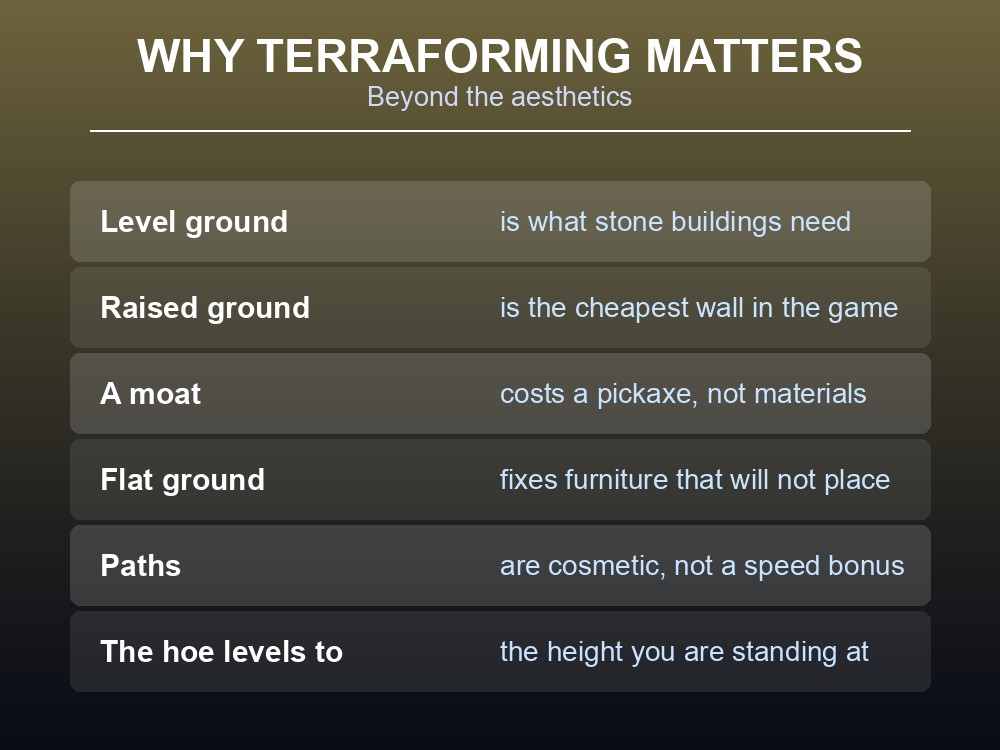
Flat ground is a requirement, not a preference. Stone floors need something level to sit on, and a great many "this piece will not place" problems are terrain problems rather than snapping problems. Before you fight the build menu, level the ground.
A raised earth wall is the cheapest fortification in Valheim. It costs a Hoe's durability and stone rather than wood, it cannot be smashed by most attackers the way a palisade can, and combined with a pickaxe-dug moat it produces a base perimeter that costs almost nothing. Most enemies cannot climb a sufficiently steep raise.
And the moat is a pickaxe job, not a Hoe job. The two tools work as a pair — dig down with the pickaxe, raise up with the Hoe — and the resulting ditch-and-bank is the standard Valheim defence for good reason.
Terraforming also fixes furniture. Comfort items, crafting stations and beds all want a flat surface; a floor that looks flat but is not will refuse placements without explaining why.
One caution: terrain modification has a performance cost. As covered in our world-loading guide, every change is stored in the world file. A base built on heavily reshaped ground is heavier to load than one built on ground as found — worth knowing before you flatten an entire meadow.
Practical tips
- Wood ×5, Stone ×2 at a Workbench, available at crafting level 1.
- Upgrades cost almost nothing and only add durability (200 per level).
- "Level ground" levels to the height you are standing at — stand on the target floor.
- Pathen and Paved Road are purely cosmetic — no speed bonus, no height change.
- Raised earth is the cheapest wall in the game and needs no structural support.
- Pair the Hoe with a pickaxe — dig a moat, raise a bank.
- Level ground before fighting the build menu — most placement failures are terrain.
- Heavy terraforming increases world-file size and load cost.
Running your own Valheim server
Terraforming is permanent world data, which means it only pays off on a world that persists — and it is exactly the kind of slow, collaborative work a group does across many sessions. A gamever Valheim server keeps that world running for up to 10 players, with one-click backups so an afternoon of levelling is never lost.
Conclusion
The Valheim Hoe costs Wood ×5 and Stone ×2 at a Workbench, is available at crafting level 1, and carries 200 durability with upgrades that add only more of the same. Its four modes do genuinely different jobs: Level ground flattens terrain to the height you are standing at — stand on the target floor, not in the hole — Raise ground elevates it, and Pathen and Paved Road are purely cosmetic decorations with no speed bonus and no effect on height. The two functions that matter most are the ones players use least: flat ground is a hard requirement for stone construction and most furniture placement, and raised earth is the cheapest and most durable wall in the game, needing no structural support because it is terrain rather than a structure. Pair it with a pickaxe for the classic ditch-and-bank, and remember that heavy terraforming is stored in the world file and costs load performance.
Want a world worth reshaping? Rent a Valheim server at gamever.io — instant setup, up to 10 players, one-click backups and updates, and 24/7 uptime. Start with a free trial and use promo code WELCOME.