
How Valheim Loads the World: Zones, ZDOs and Why Big Bases Cost Performance
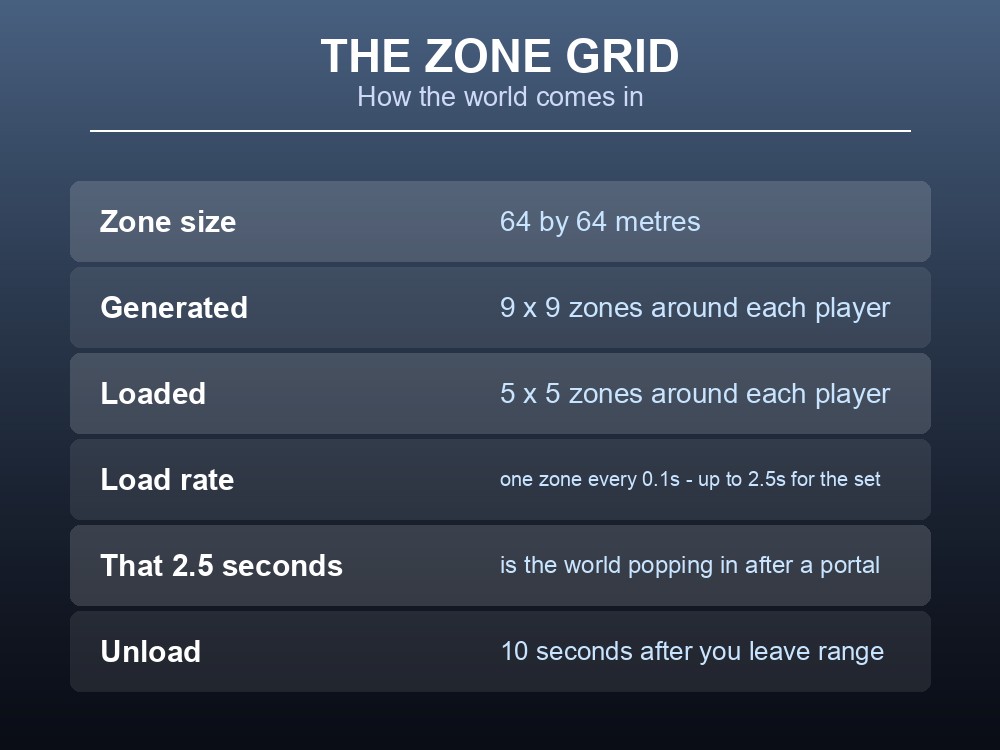
Valheim's world is a grid of 64-metre squares, and each player pulls a bubble of them into memory as they move. The game generates 9 × 9 zones around you and keeps 5 × 5 loaded, adding them one every tenth of a second — which is why arriving somewhere new takes a couple of seconds to populate. For a server owner this is the whole performance story: cost scales with how many separate places people stand, not with how big your map is.
On sourcing. Iron Gate do not publish this. The details below come from the community Valheim wiki, and can change with any patch.
The Zone Grid
| Property | Value |
|---|---|
| Zone size | 64 m × 64 m |
| Grid origin | 0,0 at the centre of the first zone |
| Generated around each player | 9 × 9 zones |
| Loaded around each player | 5 × 5 zones |
| Load interval | one zone every 0.1 s — up to 2.5 s for all nearby zones |
| Unload delay | 10 seconds after leaving the 5 × 5 range |
That 2.5-second figure is the "world popping in" you notice after a portal. It is not lag; it is the load queue working through 25 zones at ten per second.
Generation and loading are different things. Generation places pregenerated locations — abandoned houses, dungeon entrances — and vegetation, then "most objects are unloaded from the game world" again. Loading initialises creatures and structures for play.
Biome is stored at zone corners, and a location's biome is decided by which corner biome dominates:
| Corner arrangement | Dominant biome share |
|---|---|
| 1 biome | 100% |
| 2 biomes, 2 corners each | 50% each |
| 1 biome on 3 corners | ~80% |
| 4 different biomes | 25% each |
This is why biome edges feel arbitrary — and there is a trick in it: "Biomes can be used to detect the middle of a zone by checking when the current biome changes."
ZDOs: What the Server Actually Stores
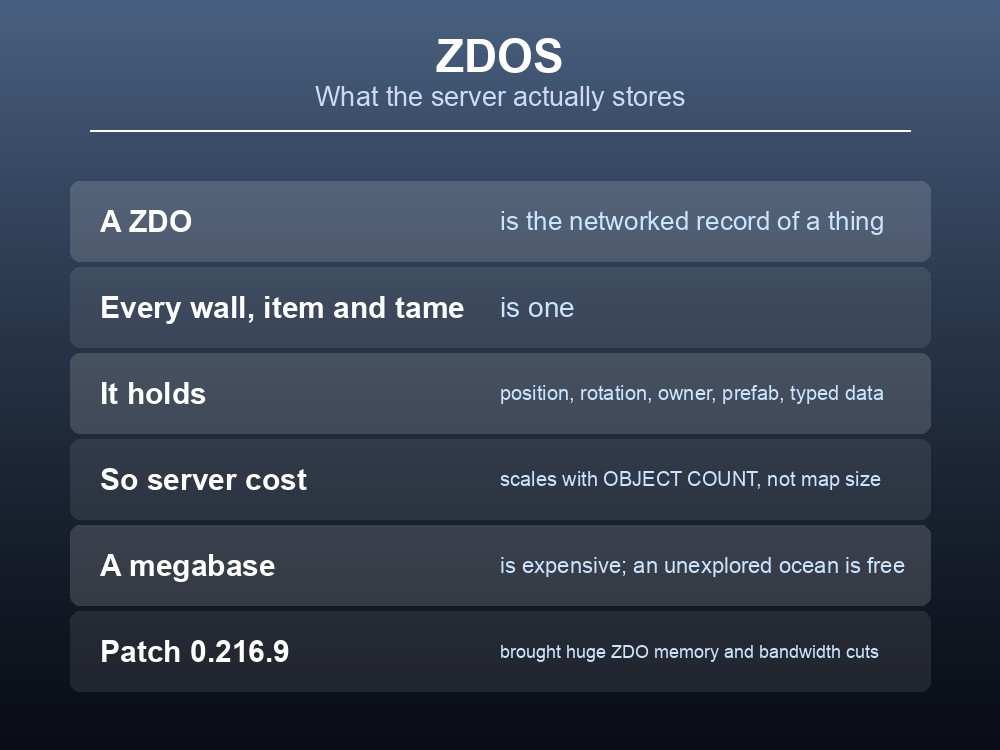
A ZDO — Zone Data Object — is the networked record of a thing. It is "the only mechanism capable of direct object ↔ object communication between client ↔ server ↔ client", and it is what persists in your world file.
Each one carries position, rotation, sector, prefab hash, owner, revisions, plus typed key-value data — float, Vector3, Quaternion, int, long, string and byte arrays — and connection data for things like portal pairing and spawner-to-spawned links.
This is the honest answer to "why does my server slow down". Every wall, every item on the floor, every tamed boar is a ZDO that must be stored, serialised and kept in sync. A megabase is not expensive because it is large in metres; it is expensive because it is thousands of individually networked objects.
Iron Gate have optimised this directly: patch 0.216.9 brought "huge ZDO optimizations taking into account data design to drastically reduce memory usage and network bandwidth."
Locations behave specially on servers. "Locations are fully spawned on servers then subsequently destroyed (ghost mode). The only remaining part is the ZDO." The server keeps a lightweight proxy; the client renders the real thing.
What This Means for a Server
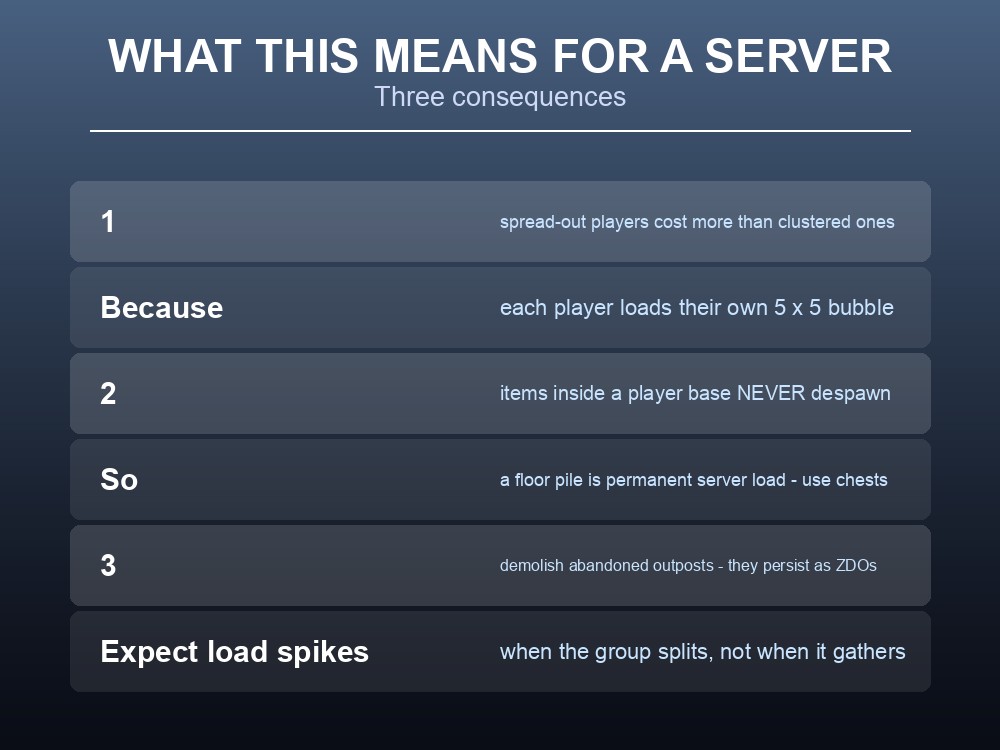
The load model is per-player, and that has three practical consequences.
1. Spread-out players cost more than clustered ones. Each player loads 5 × 5 zones. Ten players in one base share largely the same bubble; ten players in ten corners of the map load close to ten separate sets of zones, creatures and ZDOs.
2. Dropped items are permanent server load. Inside a player base radius, items never despawn — which is convenient and also means a floor covered in surplus ore is a permanent set of ZDOs the server carries forever.
3. Zones unload 10 seconds after you leave. Brief back-and-forth across a boundary keeps zones resident; a genuine departure frees them.
The practical guidance for a busy server:
- Clear item piles off the floor. Chests store many items as fewer objects; a floor pile is one ZDO each.
- Demolish abandoned outposts rather than leaving them. Structures persist as ZDOs whether or not anyone visits.
- Expect load spikes when the group splits, not when it gathers.
And note what the earlier performance work targeted: Iron Gate specifically called out "massively reduced CPU usage of armour stands" and improvements "in areas with many instances" — both symptoms of exactly this problem.
Zones and Everything Else
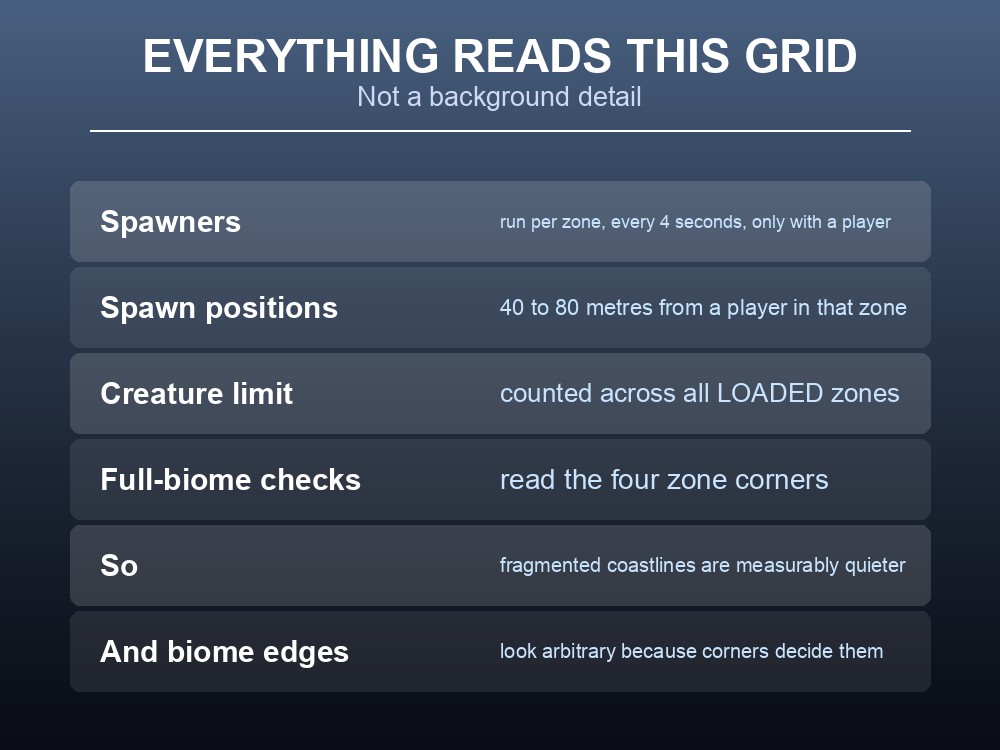
The zone grid is not a background detail — several systems are built directly on it.
Spawning runs per zone. "Every 4 seconds, zones with a player process their spawners", and spawn positions are chosen 40–80 metres from a player in that zone. No player in a zone means no spawning at all.
The creature limit is counted across loaded zones, not per zone — so what your group is fighting in one place genuinely suppresses spawns in another nearby.
Full-biome checks read zone corners. A spawner that requires a full biome will fail in any zone whose corners disagree — which is why fragmented coastlines are quieter than solid inland biomes.
Put together, the zone system explains a set of otherwise unrelated observations: why the world takes two seconds to appear after a portal, why a split group meets more enemies in total, why a fragmented map feels emptier, and why the server slows down as a base grows rather than as the map is explored.
Practical tips
- Zones are 64 × 64 m. 9 × 9 are generated around each player, 5 × 5 loaded.
- Loading runs at one zone per 0.1 s — up to 2.5 s for the full set.
- Zones unload 10 seconds after you leave range.
- Every object is a ZDO — walls, floor items, tames. Base size drives server cost, not map size.
- Items inside a player base never despawn. Floor piles are permanent load.
- A split group loads more zones than a gathered one.
- No player in a zone means no spawning in it.
- Biome is decided by zone corners, which is why edges look arbitrary.
Running your own Valheim server
Zone loading and ZDO count are exactly the costs that a dedicated machine absorbs better than someone's gaming PC hosting in the background — and they grow with every base your group builds. A gamever Valheim server runs the world on hardware meant for it, around the clock for up to 10 players, with one-click backups and automatic updates so client and server versions never drift apart.
Conclusion
Valheim divides the world into 64 × 64 metre zones, generates 9 × 9 around each player and keeps 5 × 5 loaded, adding one every 0.1 seconds — so a full local set takes up to 2.5 seconds — and unloading them 10 seconds after you leave. Everything placed in the world is a ZDO, a networked record holding position, ownership and typed data, and it is ZDO count rather than map size that drives server cost — which is why a megabase or a floor covered in dropped items is expensive while an unexplored ocean is free. Items inside a player base never despawn, making floor piles permanent load. The same grid underpins the rest of the game: spawners only run in zones containing a player, spawn positions are chosen 40–80 metres away, the creature limit is shared across loaded zones, and biome is decided by zone corners — which is why biome edges look arbitrary and fragmented coastlines feel emptier.
Want the world running on hardware built for it? Rent a Valheim server at gamever.io — instant setup, one-click backups and updates, and 24/7 uptime. Start with a free trial and use promo code WELCOME.