
The Gods of Ashenfall: Who's Who in Dragonwilds, and What Each One Gives You
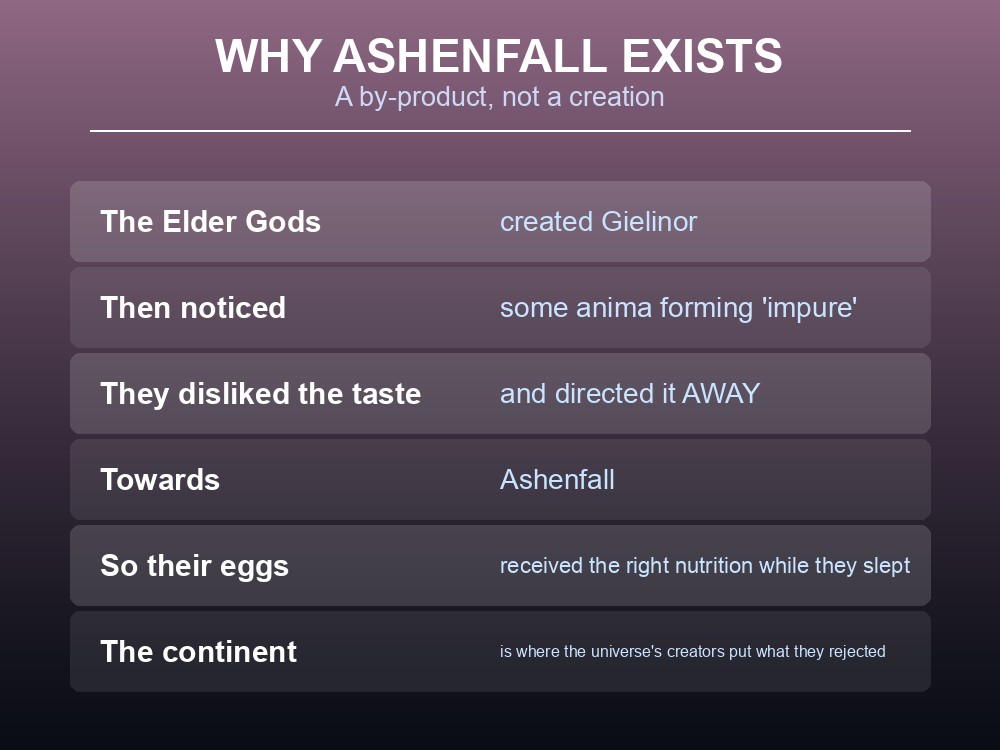
Ashenfall exists because the Elder Gods did not like the taste of a particular kind of anima, and pushed it here to keep it away from their eggs. That is the founding fact of Dragonwilds' setting, and almost everything else follows from it — the Withering, the Amalgamated, the dragonkin, and a continent that four separate pantheons have all tried to claim. Better still for a player: every god on the list has gear, a quest or a region attached. Here is the map.
On sourcing. The lore below comes from the community RuneScape: Dragonwilds wiki, and can change with any patch.
How Godhood Works Here
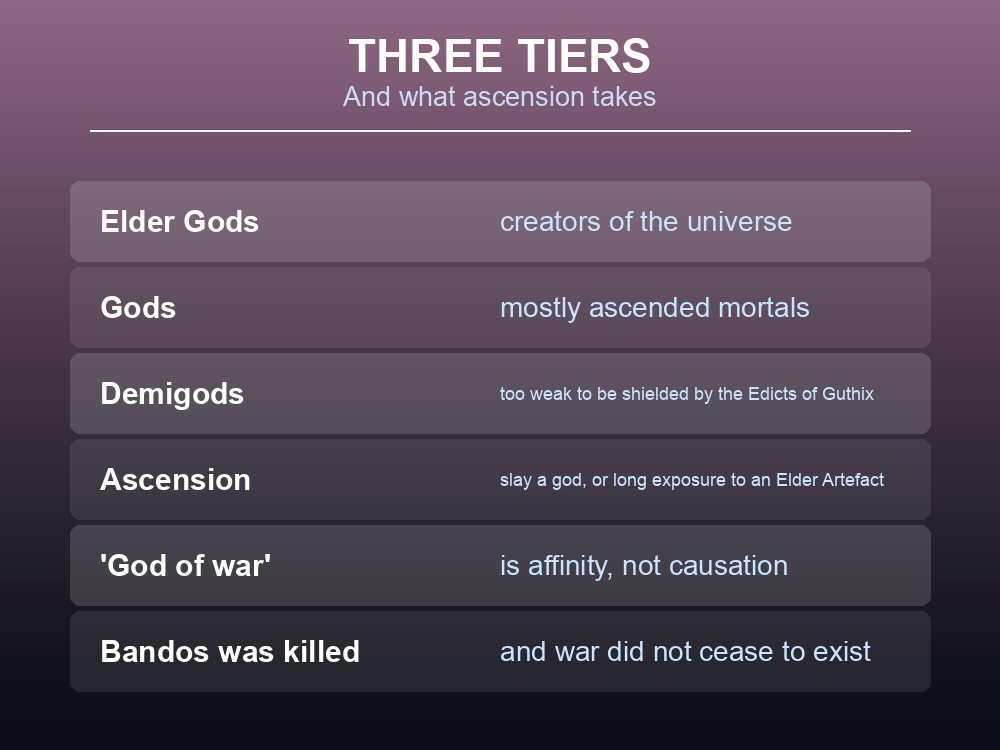
The wiki is precise about a distinction most fantasy settings blur. Being called "the god of war" is a relationship of affinity, not causation — "when Bandos was killed, war did not cease to exist."
There are three tiers:
| Tier | What they are |
|---|---|
| Elder Gods | The creators of the universe, fundamentally distinct from the rest |
| Gods | Beings of divine energy whose power stems from connections to the Elder Gods. Most were once mortal and ascended |
| Demigods | The same, but lacking the power to be shielded from Gielinor by the Edicts of Guthix — lesser deities |
Ascension happens two ways: by slaying another god, or by prolonged exposure to an Elder Artefact.
And that is why Ashenfall is where it is. After creating Gielinor, the Elder Gods noticed "impure" anima forming, disliked the taste, and directed the unwanted anima towards Ashenfall so their eggs would receive the right nutrition while they slept. The continent is, in its origin, a place the universe's creators used as a bin.
The Gods You Meet Through Gear
| God | Where they show up in play |
|---|---|
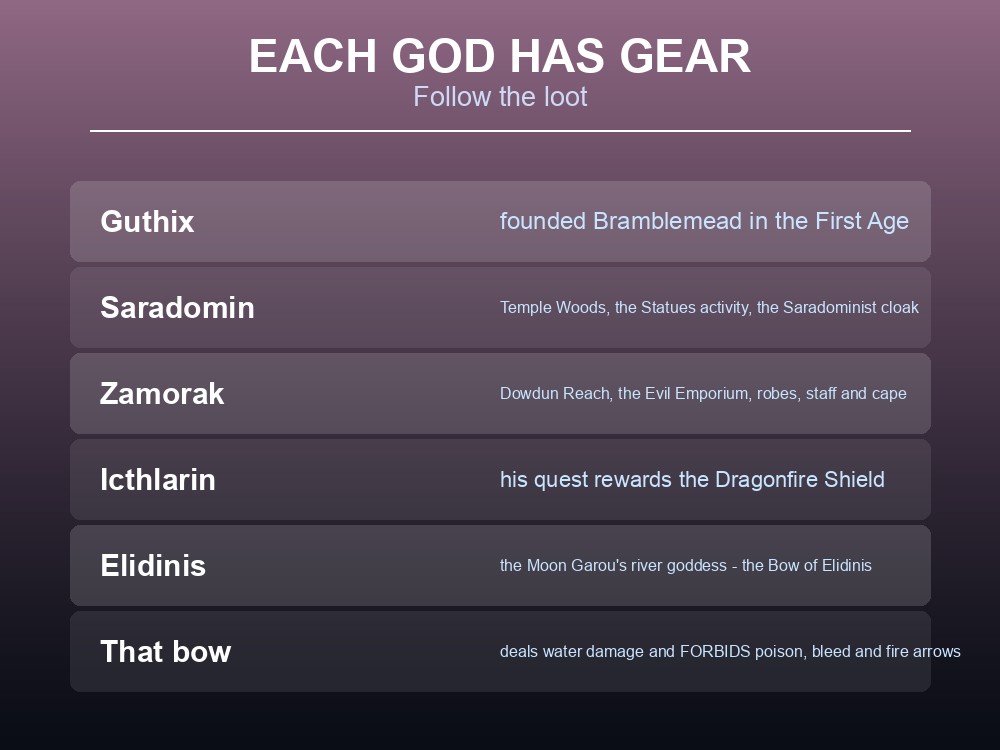
| Guthix | Brought the first settlers to Brynmoor and founded Bramblemead in the First Age |
| Saradomin | Temple Woods and the Temple of Saradomin; the Statues of Saradomin activity; the Saradominist cloak |
| Zamorak | Dowdun Reach, the Black Knights, the Evil Emporium; Zamorak robes, the Zamorak Staff and the Zamorak cape |
| Icthlarin | Icthlarin's Little Helper, which rewards the Dragonfire Shield and unlocks the magic carpet |
| Elidinis | Umbral Sands; the Bow of Elidinis |
| Lougrim | The garou, and the silver dire wolf legend |
Guthix is the reason there is anything human here at all. He brought his followers — mostly human — to the continent, founded Bramblemead in the First Age, and later banished the gods deemed too powerful or dangerous. He was killed by Sliske at the end of the Fifth Age, appointing the World Guardian as his final guardian.
Saradomin arrived third-hand. Saradominist settlers reached Ashenfall during the Third Age, built a camp on the clifftop above Bramblemead Valley, and the villagers — feeling abandoned by their own god — converted. Loyalty to the priesthood then determined noble rank in the region. The Statues of Saradomin activity, which needs no prerequisite at all and can be started in your first hour, is the surviving in-game trace.
Zamorak is Dowdun Reach's whole identity. Banished with the rest, he returned after Guthix's death, tried to rule Gielinor, was defeated by the World Guardian, and is still looking for a way back. His gear — the robes, the staff and the cape — comes from Postie Pete at the Evil Emporium, and the Zamorak Staff trades increased burning damage from fire spells for reduced air, water and earth damage.
Elidinis is the Moon Garou's god. The Menaphite goddess of fertility and growth, known as the goddess of the river to the Menaphites and the River Goddess to the Moon Garou, she visited Umbral Sands during the Third Age and the garou there came to worship her. Her weapon, the Bow of Elidinis, makes arrows deal water damage and gives kills a chance to drop Water Orbs that restore health and hydration — and, fittingly for a goddess of purity, it forbids poison, bleed and fire arrows entirely.
The Ones Who Are Not Gods
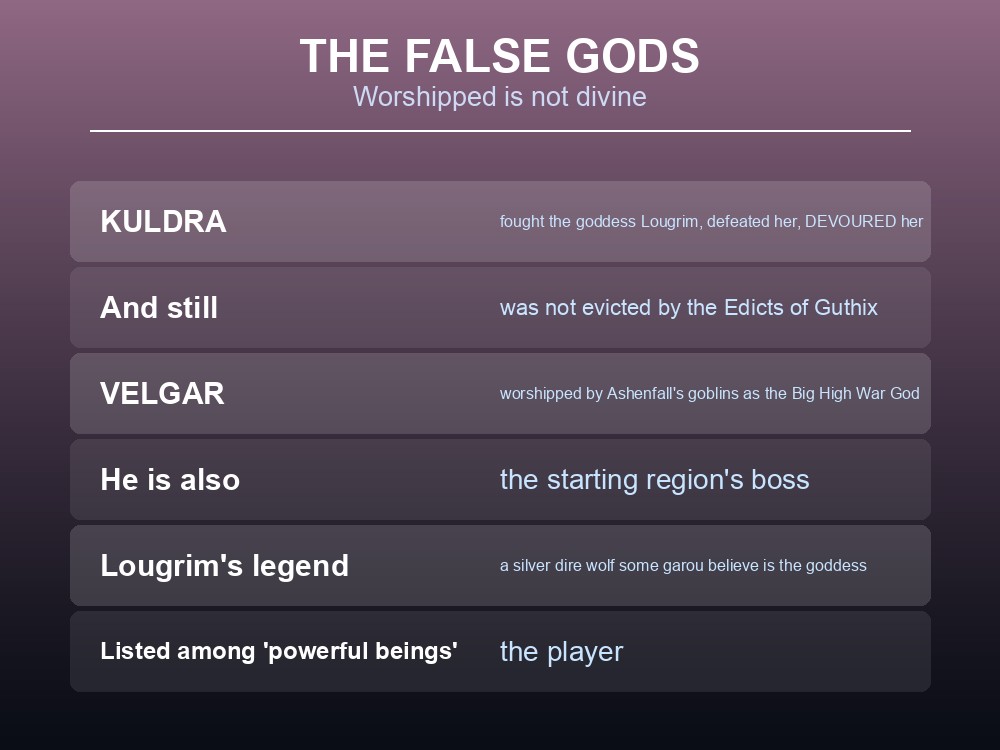
Three figures central to Dragonwilds are worshipped as gods without being gods, and the distinction has mechanical consequences.
Kuldra — the dragon queen — fought the goddess Lougrim, defeated her, devoured her, and claimed the title of High Queen. But she was not evicted by the Edicts of Guthix, because she was never classified as being as powerful as a god. Killing and eating a goddess did not make her one.
Velgar — the green dragon who ruins Brynmoor, and the target of Dragon Slayer — was worshipped by Ashenfall's goblins as the new Big High War God after his victory. He is the boss of the starting region, and a false deity to an entire faction.
Brakka rounds out the list of claimed godhood.
Lougrim's fate is the one to know, because it explains the garou. Although dead and devoured, a legend persists of a silver dire wolf, which some garou believe to be the goddess — which is why a race you mostly meet as Berserkers, Druids and Hunters has a religious dimension at all.
And note who the wiki lists under "powerful beings" alongside the World Guardian: the player. The player characters are described as "considerably powerful human adventurer(s) who had gone toe to toe with Velgar, Imaru, and Fuzan and won." In a setting this careful about who counts as divine, that is a deliberate placement.
Reading the Lore Without Reading a Wiki
Dragonwilds delivers almost all of this through item descriptions and lore scraps rather than cutscenes, which is why so many players finish the campaign without encountering it.
Three places it lives:
- The Journal — opened with J — records every lore scrap you find alongside enemies, resources and recipes. Most players never open it.
- Item descriptions. The history of Brynmoor's schism between "pure" humans and the Amalgamated is told through the flavour text on Hard Leather Body, Reinforced Legs, Studded Leather Chaps and Dark Mage Robes — armour pieces, not documents.
- In-text characters. Around thirty named residents of Brynmoor appear only in journals and never as NPCs.
On a shared server that creates a small coordination problem worth naming. Journal contents are per-character, like map pins and vault discovery — so one player reading every lore scrap does not unlock them for anyone else. If the setting matters to your group, everyone has to pick up their own scraps.
The practical suggestion: treat the Journal as the group's shared reference for weaknesses and resistances — which is its most useful function anyway — and let the lore accumulate as a side effect. The person who reads the Journal is also the person who knows what beats the thing you are fighting.
Practical tips
- Ashenfall exists because the Elder Gods pushed "impure" anima here, away from their eggs.
- "God of X" is affinity, not causation — killing Bandos did not end war.
- Ascension comes from slaying a god or long exposure to an Elder Artefact.
- Guthix founded Bramblemead; Saradomin's followers arrived in the Third Age and built Temple Woods.
- Zamorak is Dowdun Reach — his gear comes from the Evil Emporium.
- Elidinis is the Moon Garou's goddess; the Bow of Elidinis deals water damage and blocks poison, bleed and fire arrows.
- Kuldra devoured the goddess Lougrim and still was not counted as a god.
- Velgar is a false god to Ashenfall's goblins — and the starting region's boss.
- Lore lives in item descriptions and the Journal (J), and the Journal is per-character.
Running your own RuneScape: Dragonwilds server
Lore scraps accumulate slowly across dozens of sessions and belong to the character who found them — which only builds into something on a world that stays put. A gamever Dragonwilds server keeps Ashenfall available around the clock for up to six players, updates automatically so client and server versions never drift, and takes one-click backups before disruptive changes.
Conclusion
Ashenfall's premise is that the Elder Gods directed the anima they found "impure" towards this continent to keep it away from their sleeping eggs — which makes the setting a by-product rather than a creation. On top of that sit three tiers of divinity — Elder Gods, gods and demigods, the last defined by lacking the power to be shielded by the Edicts of Guthix — and a cast that maps cleanly onto content: Guthix founded Bramblemead, Saradomin's Third Age settlers built Temple Woods and left the Statues of Saradomin activity, Zamorak owns Dowdun Reach and the Evil Emporium's gear, Icthlarin's quest rewards the Dragonfire Shield and the magic carpet, and Elidinis is the Moon Garou's river goddess behind the Bow of Elidinis. Three central figures are worshipped without being divine — Kuldra, who devoured the goddess Lougrim and still was not counted a god, Velgar, whom Ashenfall's goblins made their Big High War God, and Brakka. It is all delivered through item descriptions and lore scraps rather than cutscenes, recorded in a per-character Journal — which is also, conveniently, where every enemy's weaknesses are written down.
Want a world where the story has time to accumulate? Rent a Dragonwilds server at gamever.io — instant setup, one-click backups and updates, and 24/7 uptime. Start with a free trial and use promo code WELCOME.