
Every Plantation in Palworld 1.0: Costs, Work Amounts & Growth Times
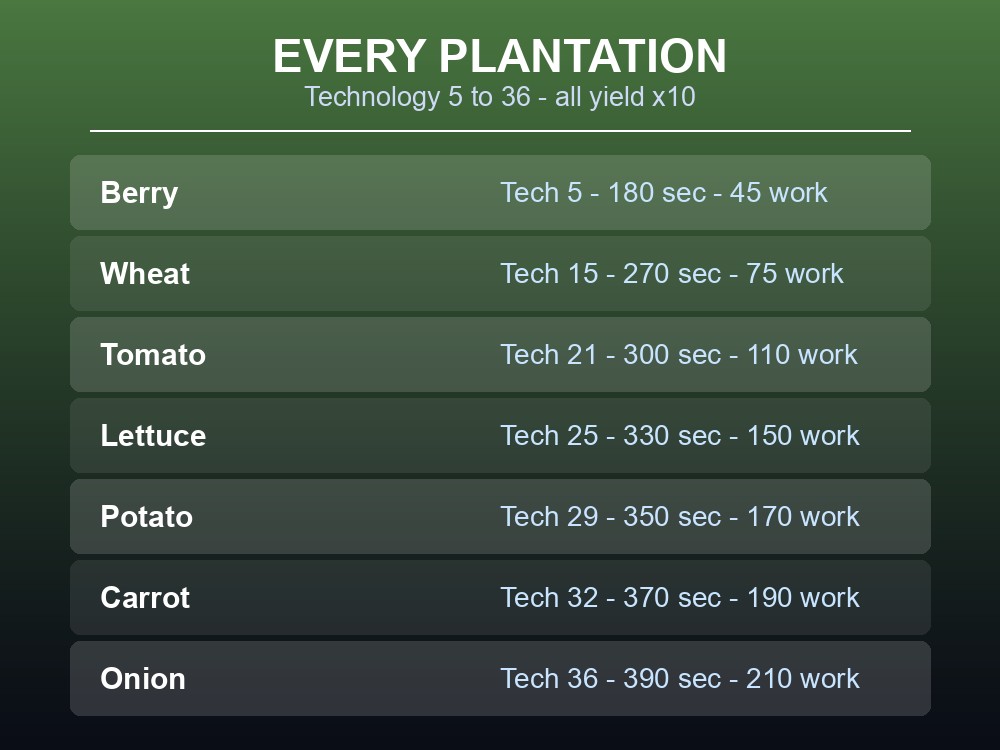
Plantations are how a Palworld base feeds itself. Every cooked dish in the game traces back to one — Cake needs Flour, Flour needs Wheat, Wheat needs a Wheat Plantation — and a base without crops means hand-gathering berries forever. There are seven plantations, unlocking from Technology 5 to Technology 36, and the thing most players get wrong is not the build cost. It is that each one needs three different work suitabilities to function at all.
The Seven Plantations
| Plantation | Tech | Build cost | Work each phase | Growth |
|---|---|---|---|---|
| Berry | 5 | 3 Berry Seeds, 10 Wood, 10 Stone | 45 | 180 sec |
| Wheat | 15 | 3 Wheat Seeds, 15 Wood, 15 Stone | 75 | 270 sec |
| Tomato | 21 | 3 Tomato Seeds, 70 Wood, 50 Stone, 5 Aquatic Pal Fluids | 110 | 300 sec |
| Lettuce | 25 | 3 Lettuce Seeds, 100 Wood, 70 Stone, 10 Aquatic Pal Fluids | 150 | 330 sec |
| Potato | 29 | 3 Potato Seeds, 30 Wood, 20 Stone, 3 Aquatic Pal Fluids | 170 | 350 sec |
| Carrot | 32 | 3 Carrot Seeds, 30 Wood, 20 Stone, 1 Aquatic Pal Fluids | 190 | 370 sec |
| Onion | 36 | 3 Onion Seeds, 30 Wood, 20 Stone, 2 Aquatic Pal Fluids | 210 | 390 sec |
Every plantation yields x10 of its crop per harvest. That number never changes — not at Technology 5 and not at Technology 36.
Two things follow from that, and both are worth planning around.
The Three-Suitability Rule
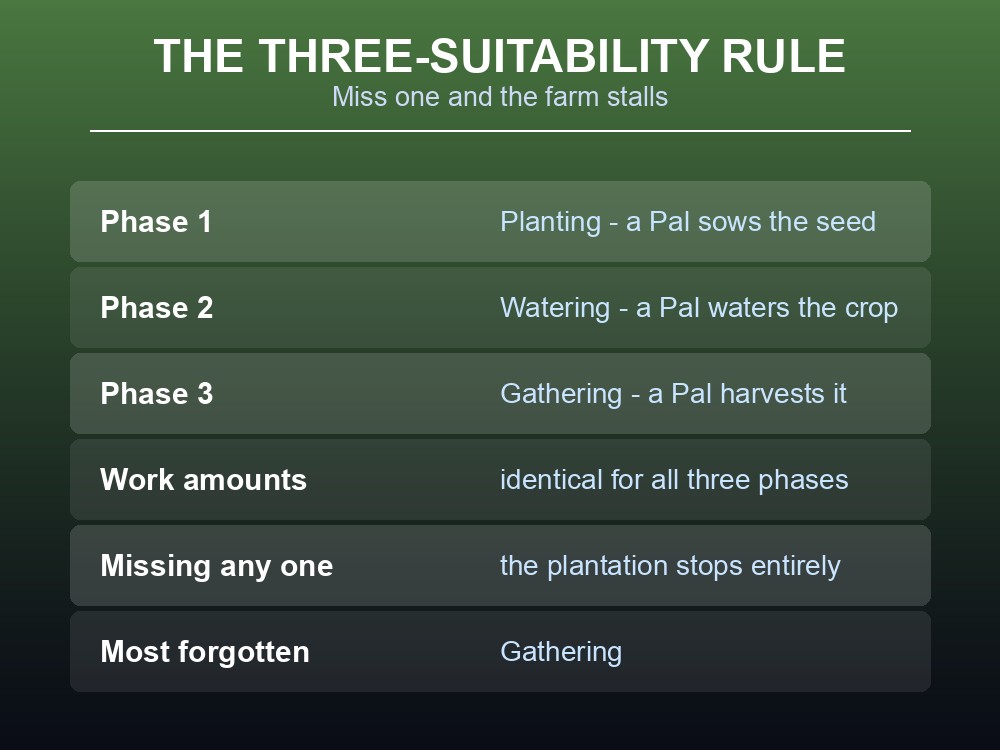
This is the mechanic that breaks new bases. A plantation runs a three-phase cycle, and each phase needs a different work suitability:
- Planting — a Pal sows the seed.
- Watering — a Pal waters the crop.
- Gathering — a Pal harvests it.
The work amounts are identical for all three phases. A Berry Plantation needs 45 Planting, 45 Watering and 45 Gathering; an Onion Plantation needs 210 of each.
If any one of the three is missing, the plantation stops. A base with Planting and Gathering Pals but no Watering Pal will sow crops, leave them unwatered, and never harvest anything. This is the single most common reason a farm appears to be "broken" — nothing is broken, one third of the cycle has nobody to run it.
So before you build the first plantation, make sure your base covers all three:
- Planting — Pals with the Planting suitability.
- Watering — this is also what the Crusher and Mill require, so a Watering Pal earns its slot several times over.
- Gathering — often the one people forget.
A Pal covering two or three of these at once is worth far more than its raw level suggests. Mossanda carries Planting Lv3 alongside Lumbering, Transporting and Handiwork, which is why it shows up on base rosters despite unremarkable stats.
Work Cost Rises Faster Than Yield
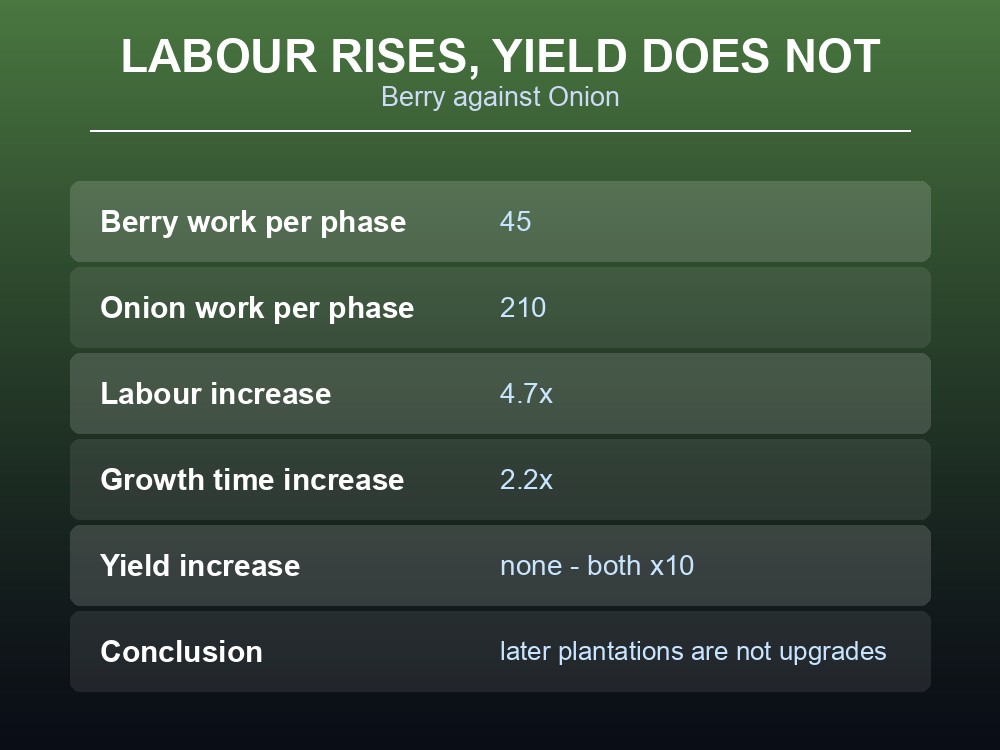
Compare the two ends of the table:
| Berry (Tech 5) | Onion (Tech 36) | |
|---|---|---|
| Work per phase | 45 | 210 |
| Total work per cycle | 135 | 630 |
| Growth time | 180 sec | 390 sec |
| Output | x10 | x10 |
The labour cost rises 4.7×. The growth time only rises 2.2×. The yield does not rise at all.
That is a genuine efficiency cliff, and it has a practical consequence: late-game plantations are not upgrades to early ones. A Berry Plantation is not made obsolete by an Onion Plantation — it remains the cheapest crop per unit of Pal labour in the game, by a wide margin.
Build the later plantations because you need those specific crops for recipes, not because you expect them to out-produce berries. If your Pals are spending their day on Onion Plantations, your base throughput is lower than it looks.
Build cost is not monotonic either. Note that Lettuce (Tech 25) costs 100 Wood, 70 Stone and 10 Aquatic Pal Fluids — while Potato (Tech 29), Carrot (Tech 32) and Onion (Tech 36), all unlocked later, cost only 30 Wood and 20 Stone each. Tomato and Lettuce are the two expensive builds; everything after them is cheap. If you are short on Aquatic Pal Fluids, build Carrot (1 fluid) before Lettuce (10).
What Each Crop Is Actually For
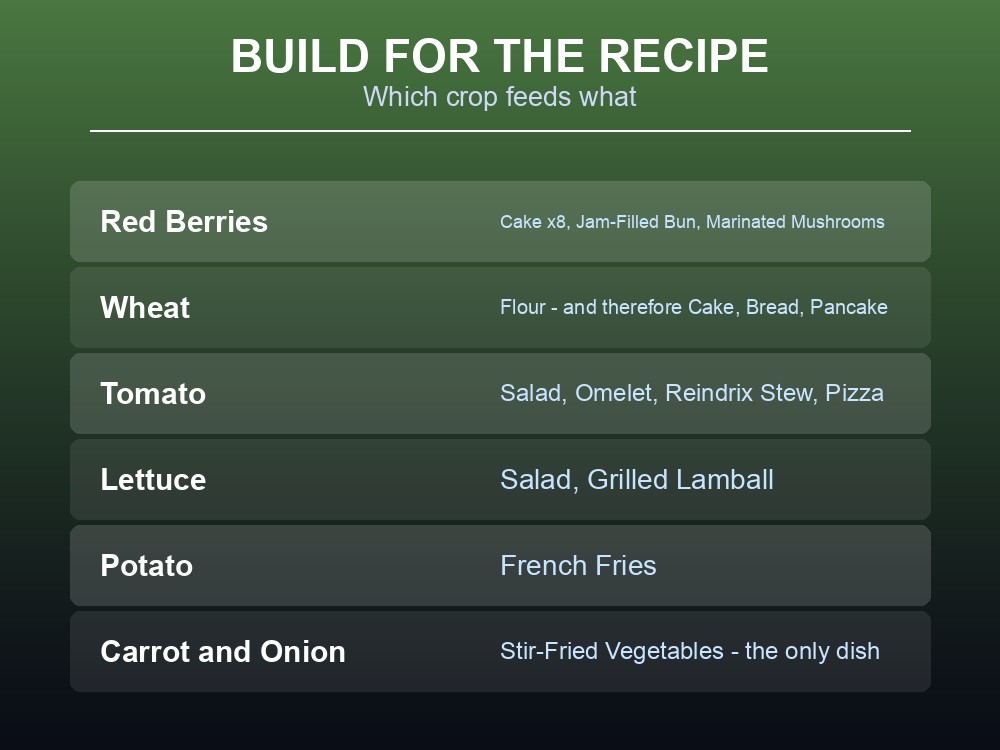
Do not build all seven. Build the ones your recipes consume:
| Crop | What needs it |
|---|---|
| Red Berries | Cake (x8), Jam-Filled Bun, Marinated Mushrooms, Herb Roasted Lamball, Chikipi Sauté, Stewed Galeclaw |
| Wheat | Flour — and therefore Cake, Bread, Pancake, Rushoar Gyoza, Fried Gloopie Balls |
| Tomato | Salad, Omelet, Reindrix Stew, Pizza |
| Lettuce | Salad, Grilled Lamball |
| Potato | French Fries |
| Carrot | Stir-Fried Vegetables |
| Onion | Stir-Fried Vegetables |
Berry and Wheat are the two you cannot skip. Both feed Cake, which is the gate on the Breeding Farm — one Cake costs 5 Flour, 8 Red Berries, 7 Milk, 8 Egg and 2 Honey. Since Flour comes from Wheat at the Mill, a breeding operation is really a Wheat Plantation, a Berry Plantation, a Mill and a Ranch working together.
Onion and Carrot share a single recipe between them. Stir-Fried Vegetables is the only dish that uses either, which makes them the two most skippable plantations in the game unless you specifically want that dish.
Practical tips
- Every plantation needs Planting, Watering and Gathering. Missing one stops the whole cycle — this is why farms "break."
- All seven yield x10 per harvest, from Technology 5 to Technology 36.
- Berry is the most labour-efficient crop in the game — 45 work per phase against Onion's 210, for the same output.
- Build for recipes, not for tier. Later plantations are not upgrades.
- Berry + Wheat are mandatory if you intend to breed — both feed Cake.
- Carrot needs 1 Aquatic Pal Fluid; Lettuce needs 10. Build accordingly when fluids are scarce.
Running your own Palworld 1.0 server
Plantations are the clearest case for a persistent world: crops grow on a timer, and a Berry Plantation cycling every 180 seconds produces nothing at all while your game is closed. A dedicated Palworld 1.0 server keeps your Pals planting, watering and harvesting around the clock, so a farm you set up on Friday has produced all weekend. Full crossplay lets a group split base duties across platforms, and one-click backups and automatic updates protect a base you have invested weeks in.
Conclusion
Palworld has seven plantations, from Berry at Technology 5 to Onion at Technology 36, and all seven produce exactly x10 per harvest. The rule that matters most is structural rather than numerical: each one runs Planting → Watering → Gathering, each phase needs a different work suitability, and missing any one of the three stops the farm entirely. Beyond that, note that work cost rises 4.7× across the range while yield stays flat, which makes Berry Plantations the most labour-efficient crop in the game and makes later plantations a matter of which recipes you need rather than progression. Berry and Wheat are the two you cannot skip, because both feed Cake and Cake gates breeding.
Want your crops growing while you are offline? Rent a Palworld server at gamever.io — instant setup, one-click backups and updates, full crossplay and 24/7 uptime. Start with a free trial and use promo code WELCOME.