
The Breeding Farm in Palworld 1.0: Setup, Cake & Egg Output
Every genuinely strong Pal in Palworld comes out of a Breeding Farm, not a sphere. Catching gives you a random roll on passives and stats; breeding lets you stack four good passives and land at the top of a species' stat range. The building itself is cheap and early — Technology Level 19 — but it is gated by something most players do not expect: Cake, and therefore your Ranch. Here is the whole setup.
Building It
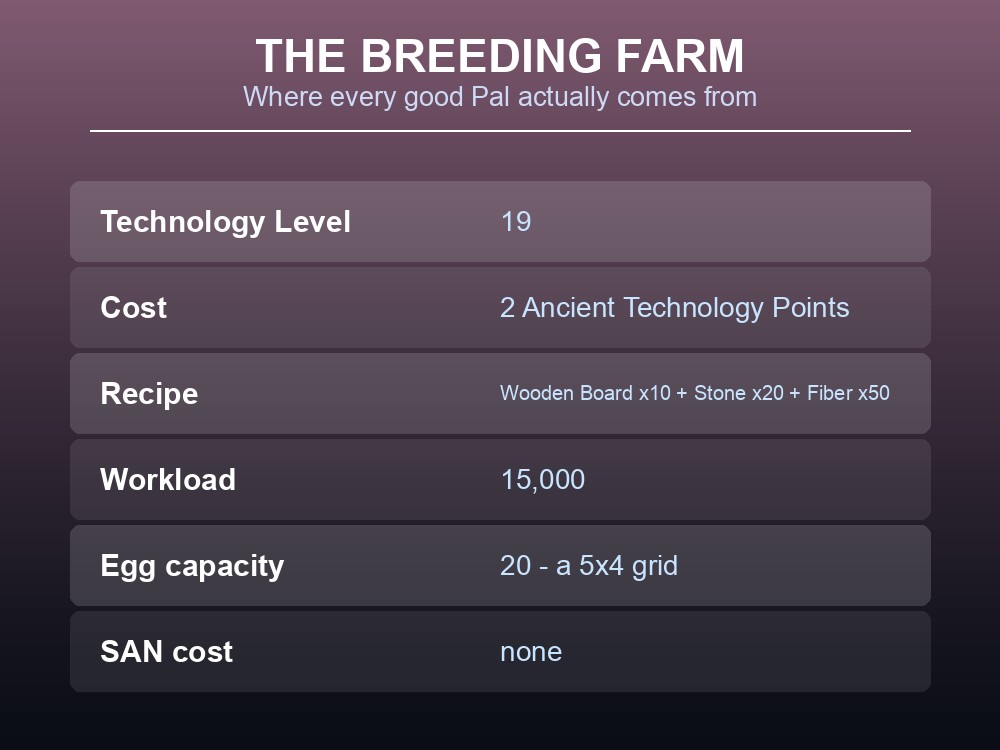
| Field | Detail |
|---|---|
| Technology Level | 19 |
| Cost | 2 Ancient Technology Points |
| Recipe | Wooden Board x10, Stone x20, Fiber x50 |
| Workload | 15,000 |
| Egg capacity | 20, in a 5×4 grid |
| SAN cost | None |
That last line matters more than it looks. Breeding does not consume SAN, so the two Pals in the farm are not slowly going miserable the way workers at a production station do. You can leave a pair in there indefinitely.
The 15,000 workload is substantial for Technology Level 19, so assign several Handiwork Pals to the build rather than watching one grind it out.
How Breeding Works
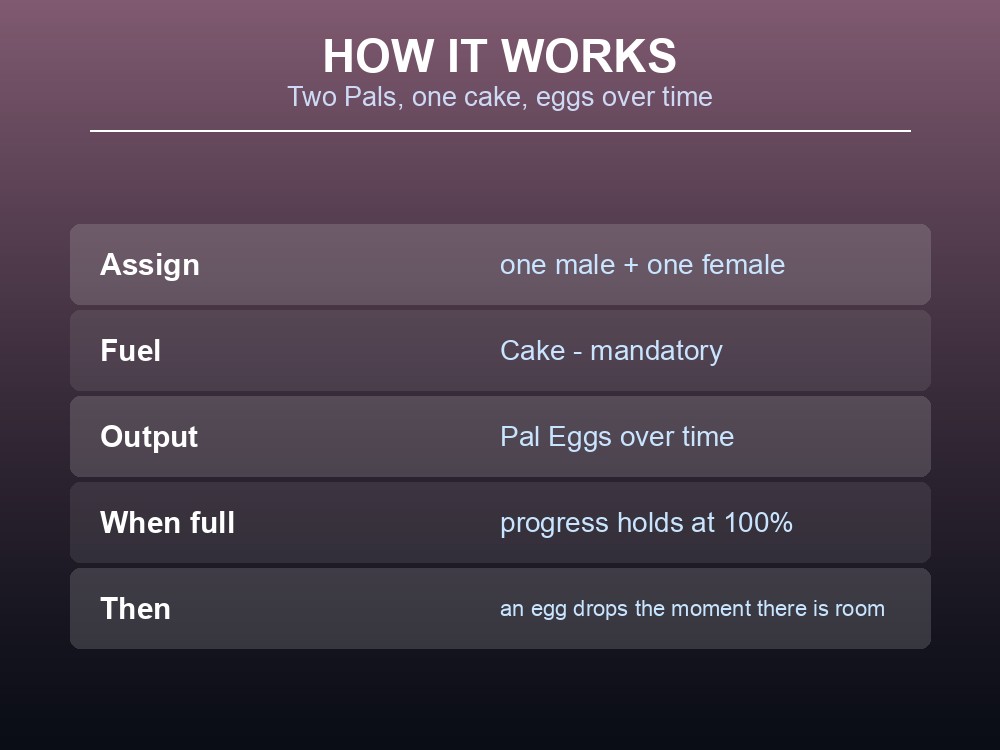
The loop is simple:
- Assign one male and one female Pal to the farm.
- Place Cake in the facility. This is mandatory — no cake, no eggs.
- Pal Eggs appear over time, with no SAN cost to the parents.
- The farm holds a maximum of 20 eggs. When full, progress holds at 100% and drops an egg the instant there is room.
That last behaviour is a quiet quality-of-life win: a full farm does not waste progress, it just pauses. But it does mean a farm you have not emptied in a while has stopped producing, so clear the grid when you pass it.
What Comes Out
Which Pal you get depends on the pairing:
- Same-species parents always produce that species. This is how you mass-produce condensing fodder — and condensing needs 48 duplicates for four stars.
- Mixed parents are resolved by CombiRank, a hidden breeding-power number running from about 20 for the rarest Pals to 3,100 for the most common. The game averages the two parents with floor((parent1 + parent2 + 1) / 2) and gives you the Pal whose CombiRank sits closest to that number.
Among Palworld 1.0's roster, Renjishi has a CombiRank of just 290 — the lowest of any documented 1.0 hatch, which makes it unusually easy to reach from mid-tier parents. It is also a Kindling Lv8 worker with 820 – 1,036 Attack, so it is a rare case of an easy target being a genuinely good Pal.
Why Breeding Beats Catching
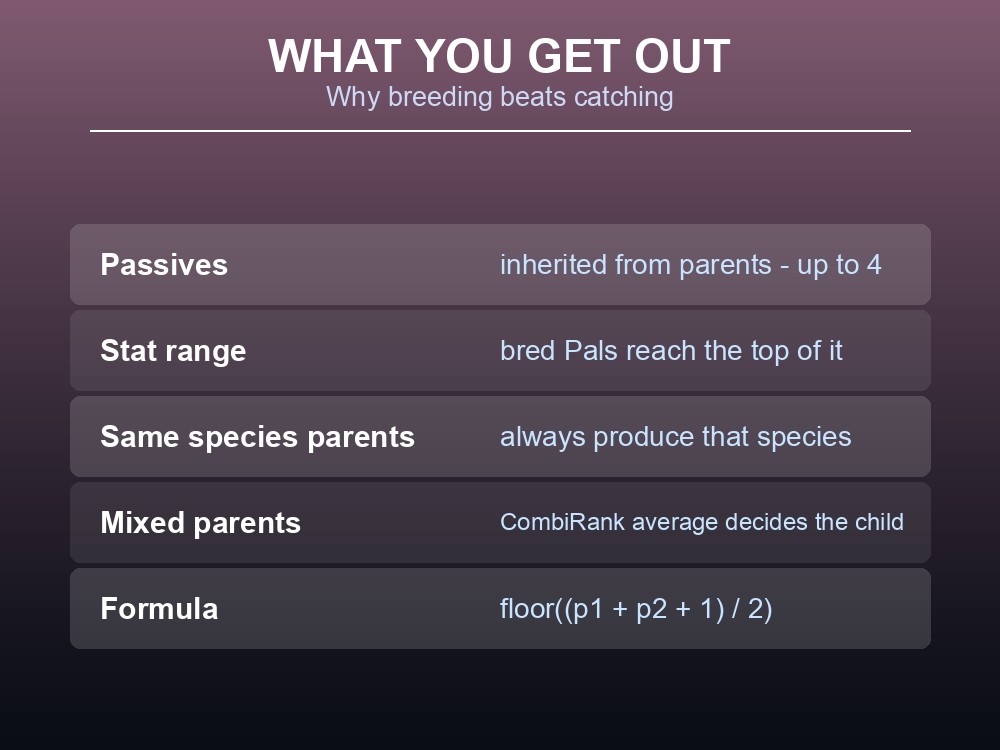
A wild Pal's passives are a random roll. A bred Pal inherits from its parents, which is the only reliable route to a Pal carrying four good passives.
Each Pal can hold 0 to 4 passive skills, and they stack unless a skill states otherwise. That is why the same species at Level 80 can differ by 50% in effective power. The passives worth breeding toward include the new World Tree Tier 5 set — Twin-Edged Holy Blade (Attack +50%), God of Destruction (Attack +40%, Defense +20%, Max Health −50%) and Demon's Hand (Work Speed +90%).
Palworld 1.0's mutation breeding goes further, unlocking passives with no other source at all:
- Idiosyncratic — Defense +25%, regeneration +50%, immune to Poison and Burn damage
- Immortality — Attack +15%, Life Steal +5%, regeneration +100%
- Skymarcher — Mounted Jump Count +2
You cannot catch these. Breeding is the only route.
The Real Gate: Cake
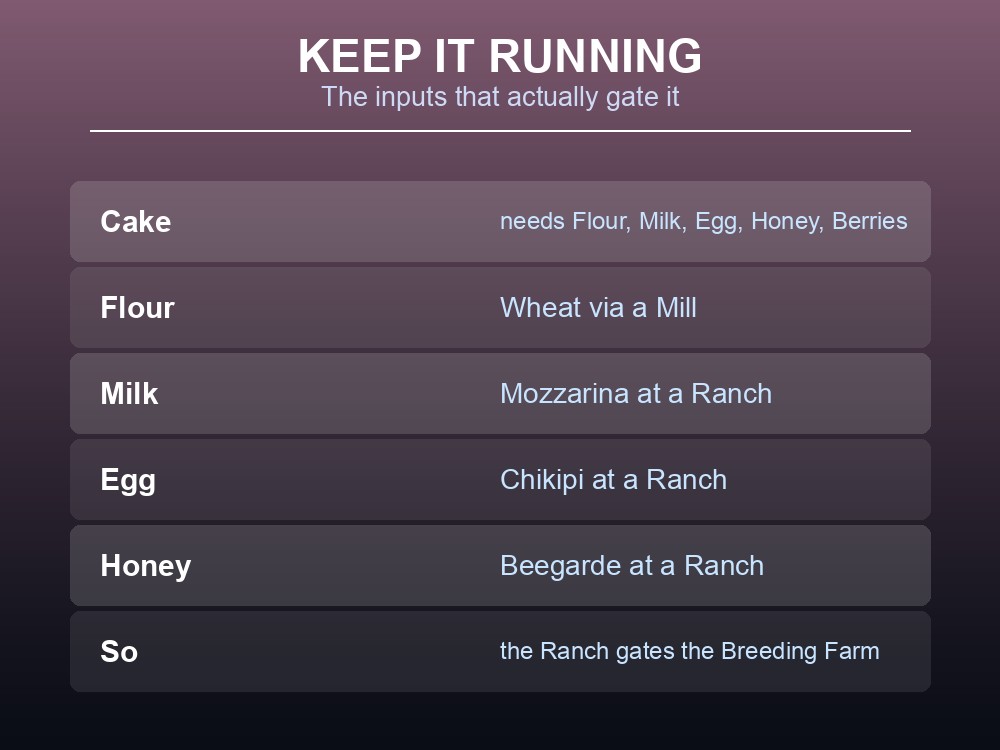
Cake is what stops most breeding operations, and Cake is a Ranch problem. Its ingredients trace back to specific Ranch Pals:
| Ingredient | Source |
|---|---|
| Flour | Wheat, milled — and Vaelet produces Wheat Seeds at a Ranch |
| Milk | Mozzarina at a Ranch |
| Egg | Chikipi at a Ranch |
| Honey | Beegarde at a Ranch |
| Berries | Farmed, or Caprity at a Ranch |
So a Breeding Farm without a properly staffed Ranch behind it will stall. Set up the Ranch first — it unlocks at Technology Level 5, fourteen levels before the Breeding Farm — and put Mozzarina, Chikipi, Beegarde and Vaelet to work.
The Ancient Kitchen (Technology Level 70) produces Cake among its 50+ dishes if you want to industrialise it later, but it needs electricity and Pals with high Kindling and Handiwork to run.
Practical tips
- No cake, no eggs. Sort the Ranch out before you build the farm.
- Breeding costs no SAN, so a pair can sit in the farm indefinitely without going miserable.
- Empty the 20-egg grid regularly. A full farm pauses production entirely.
- Same-species parents guarantee that species — the fastest way to build the 48 duplicates condensing needs.
- Mutation-exclusive passives like Idiosyncratic and Immortality have no other source. If you want them, breeding is not optional.
Running your own Palworld 1.0 server
A Breeding Farm is a timer, and timers only advance when the world is live. On a dedicated Palworld 1.0 server your farm keeps producing eggs and your incubators keep counting down while you are logged off, so a session starts with a full grid rather than an empty one. Full crossplay lets a group pool parent Pals across platforms, and one-click backups and automatic updates protect a pen that can represent weeks of pairing work.
Conclusion
The Breeding Farm unlocks at Technology Level 19 for 2 Ancient Technology Points, holds 20 eggs, and costs no SAN to run. Assign one male and one female, keep it stocked with Cake, and collect. Bred Pals inherit passives from their parents — the only reliable way to stack four, including the World Tree Tier 5 set and the mutation-exclusive passives that have no other source. The thing that actually stops most breeding operations is Cake, so build and staff your Ranch first: Mozzarina for Milk, Chikipi for Eggs, Beegarde for Honey and Vaelet for Wheat Seeds.
Want eggs waiting for you every session? Rent a Palworld server at gamever.io — instant setup, one-click backups and updates, full crossplay and 24/7 uptime. Start with a free trial and use promo code WELCOME.