
Every Merchant in Palworld & What They Sell
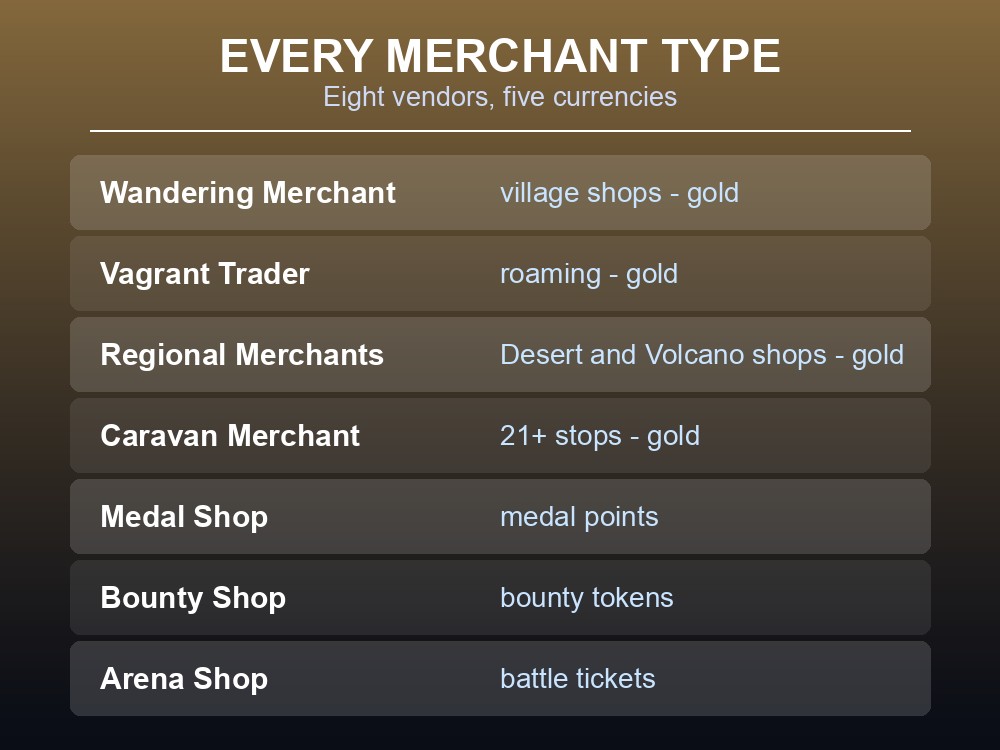
Palworld has eight distinct merchant types running five separate currencies, and most players only ever visit one of them. That is a mistake, because several materials people spend hours farming — Hardwood, Leather, ore, spheres, arrows — are simply on sale, and the gold to buy them is easier to earn than the materials themselves. Here is who sells what and when buying beats farming.
The Eight Merchant Types
| Merchant | Where | Currency |
|---|---|---|
| Wandering Merchant (Village Shop) | Settlements | Gold Coins |
| Vagrant Trader | Roams — no fixed spot | Gold Coins |
| Regional Merchants (Desert Shop, Volcano Shop) | Desert and volcanic regions | Gold Coins |
| Wandering Merchant (Wander Shop) | Roaming areas | Gold Coins |
| Caravan Merchant | 21+ registered stops | Gold Coins |
| Medal Shop | Hub area | Medal points |
| Bounty Shop | Bounty board area | Bounty tokens |
| Arena Shop | Arena | Battle Tickets |
Five of these take Gold Coins, which makes gold the practical currency of the game. The other three run closed economies you can only feed by doing their specific content.
What the Gold Merchants Sell
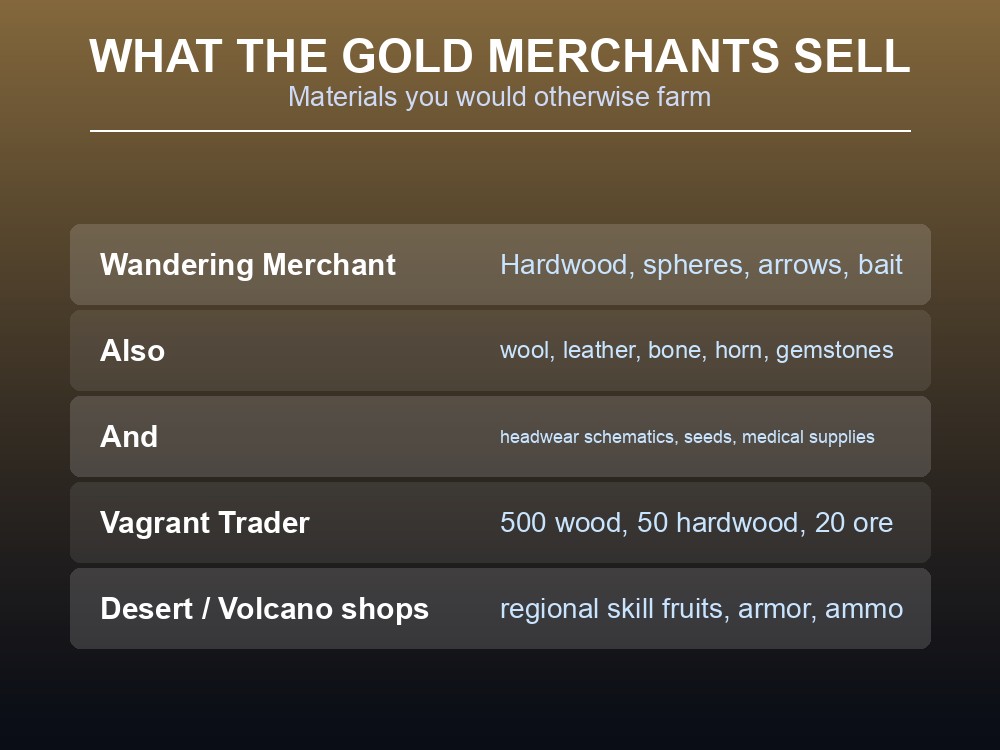
Wandering Merchant (Village Shop) — the most useful of the lot:
- Hardwood, Pal Spheres, arrows, fishing bait
- Raw materials: wool, leather, bone, horn
- Gemstones and precious creature drops
- Headwear schematics, seeds, medical supplies
Vagrant Trader — bulk basics in limited quantities: roughly 500 wood, 50 hardwood, 20 ore, plus bread.
Regional Merchants (Desert Shop, Volcano Shop) — specialised skill fruits, regional clothing schematics, armor, weapons, ammunition and location-specific materials. The skill fruit stock matters: fruits are region-locked, so a Desert Shop is a shortcut to Ground and Fire skills without hunting fruit trees.
Caravan Merchant — the widest inventory, varying by individual merchant, across at least 21 registered stops.
When Buying Beats Farming
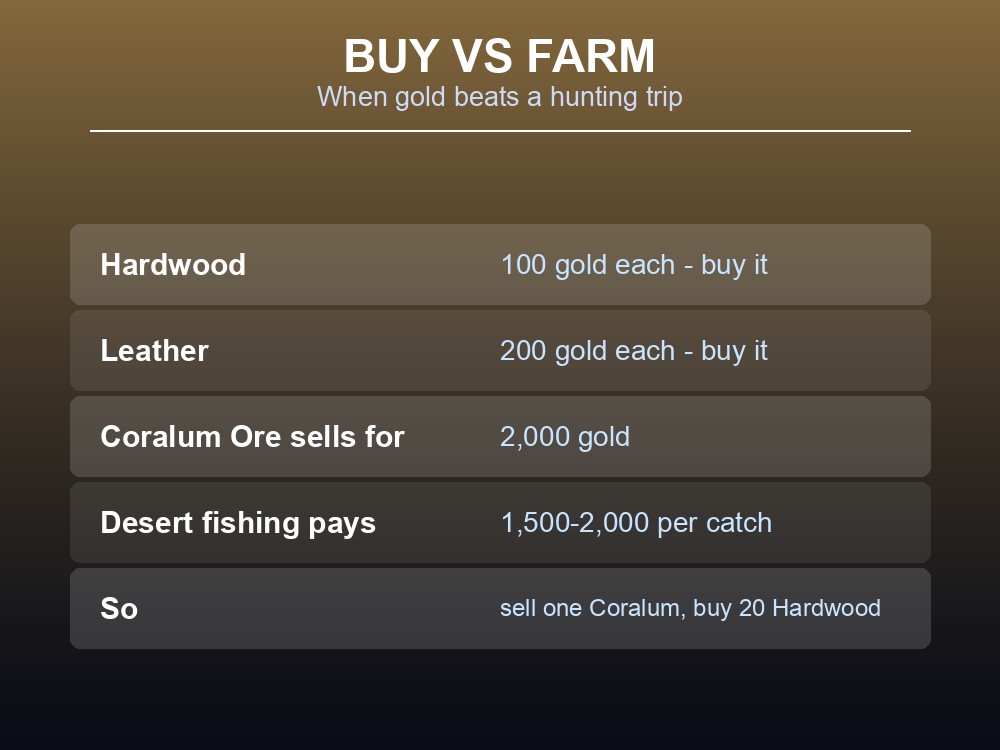
This is the part most players never run the numbers on.
| Material | Buy price | Farming alternative |
|---|---|---|
| Hardwood | 100 gold | Wumpo Botan, 2 – 5 per kill |
| Leather | 200 gold | Mammorest, 5 – 10 per kill |
| Ore | cheap | mining nodes |
Now look at the income side:
- Coralum Ore sells for 2,000 gold each — and the Powerful Fishing Magnet route yields roughly 2,000 ore in 30 minutes.
- Desert fishing pays 1,500 – 2,000 Gold Coins per catch.
- High Quality Wooden Board sells for 7,680, High Quality Cloth for 2,640, Refined Ingot for 720.
One Coralum Ore buys twenty Hardwood. If you need 130 Hardwood for the Giga Glider and Metal Bat at Technology Level 40, that is seven ore — a couple of minutes of salvage — versus a dedicated Wumpo Botan hunt.
The general rule: sell the high-value materials you produce as a by-product, and buy the low-value materials you would otherwise farm manually.
Where to Find Them
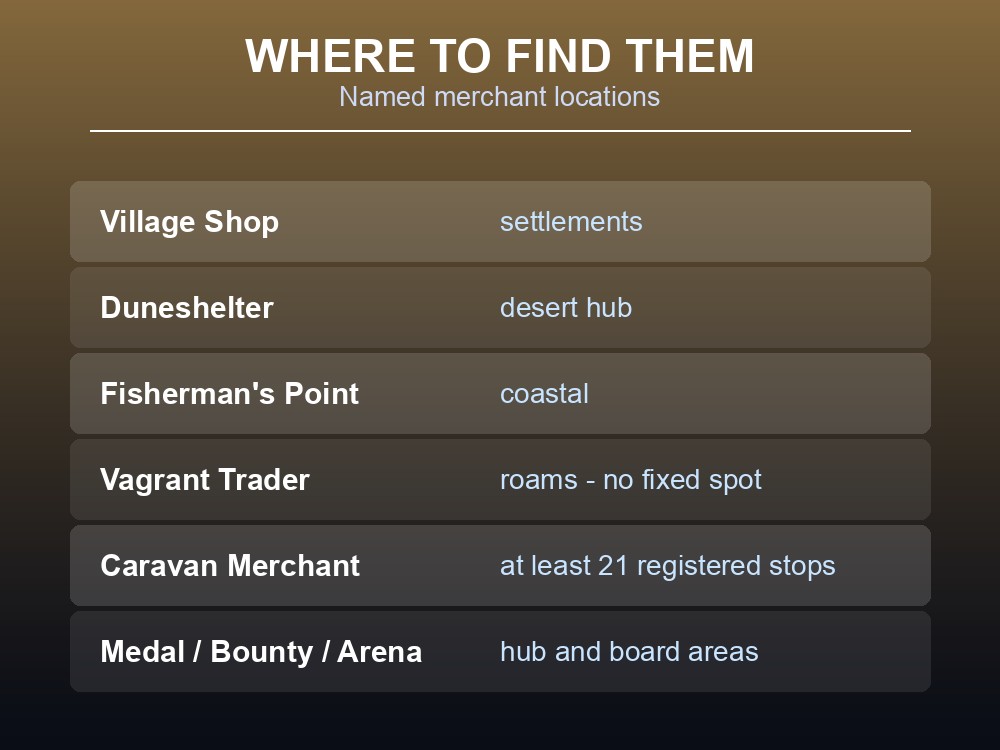
Named locations that stock materials worth buying:
- Village Shop — settlements
- Duneshelter — the desert hub
- Fisherman's Point — coastal
- Vagrant Trader — roams, so no fixed location
- Caravan Merchant — at least 21 registered stops across the map
Duneshelter and Fisherman's Point both stock Hardwood, which makes them worth a fast-travel stop when a recipe stalls.
The Three Closed Economies
The remaining merchants cannot be paid in gold, and each is tied to specific content:
- Arena Shop takes Battle Tickets, earned by climbing the Arena's Bronze-to-Legend ranks. It sells weapon and armor schematics at 600 – 1,500 tickets, Skill Fruits at 30 – 45, and Pal Implants at 50.
- Bounty Shop takes Successful Bounty Tokens, earned by capturing wanted criminals. Notably it converts 1 token into 2,000 Gold Coins, which makes bounty hunting one of the better gold routes in the game.
- Medal Shop takes medal points and sells the Mysterious Accessory Box and Mystic Accessory Box, stat-boosting fruits and work handbooks.
Practical tips
- Buy Hardwood and Leather rather than farming them. At 100 and 200 gold, both are cheaper than the trip.
- Sell Coralum Ore (2,000 each) and High Quality Wooden Board (7,680 each) — they are the best gold-per-item you produce routinely.
- Regional shops sell region-locked skill fruits. A Desert Shop saves you a fruit-tree hunt.
- Bounty tokens convert to gold at 2,000 apiece — the only currency that crosses over.
- The Vagrant Trader roams, so stock up when you find one rather than planning a return trip.
Running your own Palworld 1.0 server
Trading works best when your production is running whether or not you are logged in — you come back with materials to sell rather than an empty chest. A dedicated Palworld 1.0 server keeps your Ranch, furnaces, ponds and assembly lines producing 24/7, so the gold economy funds itself. Full crossplay lets a group pool materials and split merchant runs, and one-click backups and automatic updates keep the stockpile safe.
Conclusion
Palworld runs eight merchant types across five currencies, and five of those take Gold Coins — which makes gold the currency that actually matters. The Wandering Merchant stocks Hardwood, Leather, spheres and arrows; regional shops sell region-locked skill fruits; and the Caravan Merchant covers 21+ stops. The insight worth acting on is the price gap: Hardwood costs 100 gold and Leather 200, while a single Coralum Ore sells for 2,000 — so sell what you produce and buy what you would otherwise grind. The three closed economies (Arena, Bounty, Medal) need their own content, but the Bounty Shop converts tokens to gold at 2,000 apiece.
Want your production funding your shopping? Rent a Palworld server at gamever.io — instant setup, one-click backups and updates, full crossplay and 24/7 uptime. Start with a free trial and use promo code WELCOME.