
Chickens, Hens and Eggs in Valheim: Thirty Minutes Next to a Fire
Valheim's chicken line is the only livestock in the game that starts with a purchase rather than a capture. An egg placed near a fire hatches in thirty minutes — provided it registers as warm when you hover over it — and the first egg costs 1,500 coins from Haldor. What you get for the investment is a renewable feather supply, which matters more than the meat.
On sourcing. Iron Gate do not publish system documentation. The figures below come from the community wikis and can change with any patch.
How to Get a Chicken
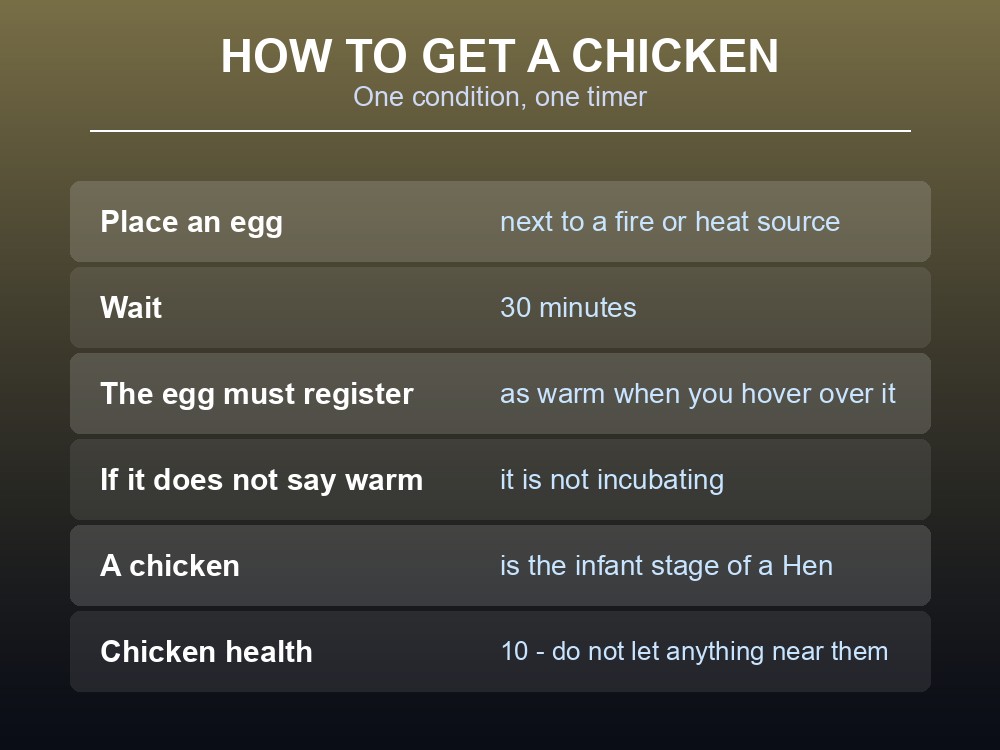
| Place an egg | Next to a fire or heat source, and under a roof |
| Wait | 30 minutes |
| Condition | The egg must register as "warm" when hovered over |
| Result | A Chicken — the infant stage of a Hen |
| Chicken health | 10 |
Shelter is a requirement, not a nicety. The wiki is specific: an egg "must be placed (dropped from inventory) near a fire or heat source and under a roof (needs shelter)" to hatch. An egg by an open campfire will not incubate no matter how long you leave it.
The "warm" check is the whole mechanic. If hovering over the egg does not say warm, it is not incubating and the thirty minutes are not running. Move it closer to the fire, get a roof over it, and check again — this is the difference between a hatched chicken and an egg that sat there all evening. Note the hovertext can take 5–10 seconds to appear.
Place eggs individually. They must be dropped one at a time, not as a stack — a stack of eggs by the fire hatches nothing.
Thirty minutes is real time, which pairs it with a fire you were keeping lit anyway. As covered in our fire sources guide, a Hearth is the sensible choice for something you want burning permanently — 1,500 durability against a Campfire's 100.
A Chicken has 10 health. That is less than almost anything in the game, and it means a single raid, a stray Greydwarf or a careless swing ends the project. Build the coop inside, behind a wall, before you buy the egg.
A Chicken grows into a Hen, which is the adult, egg-laying stage.
Where the First Egg Comes From
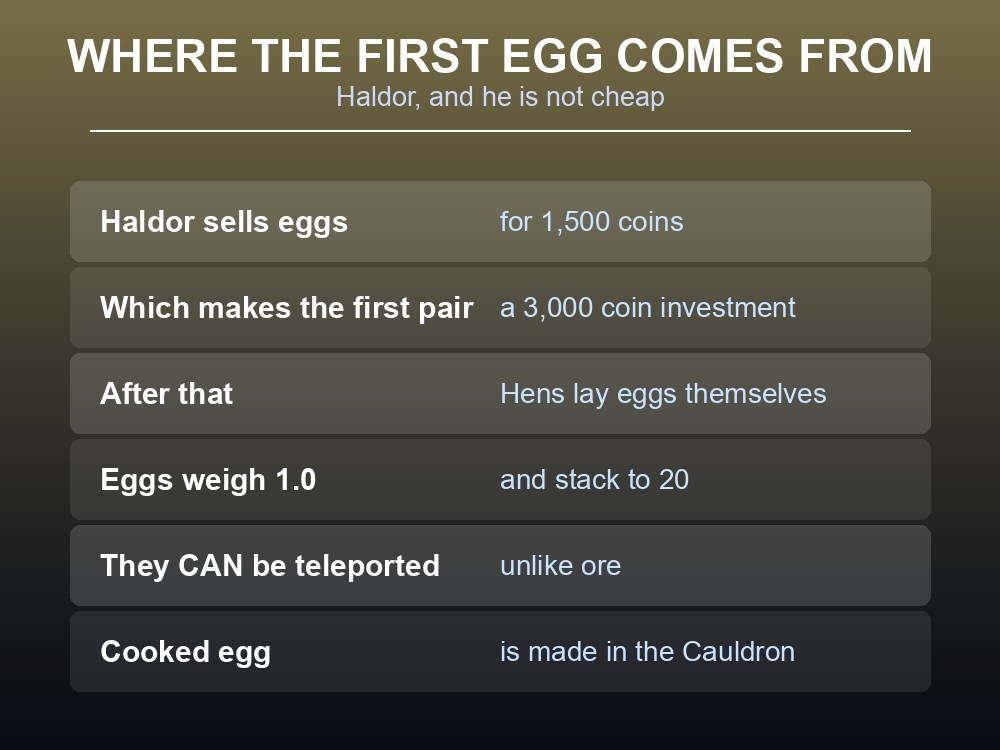
| Source | Haldor, or an existing Hen |
| Price | 1,500 coins |
| Weight | 1.0 |
| Stack | 20 |
| Teleportable | Yes |
Fifteen hundred coins is a serious purchase. For comparison, a Fishing Rod from the same trader is 350 — so an egg costs more than four rods.
And you will want more than one. A single Hen is a single point of failure with a small health pool; two or three is the sensible starting flock, which makes this a 3,000 to 4,500 coin project up front.
After that it is free. Hens lay eggs themselves, so the purchase is a one-time investment rather than a running cost. The coins buy you the loop, not the product.
Eggs can be teleported, which is genuinely useful — you can buy from Haldor and portal straight home rather than sailing back with them. And they stack to 20 at 1.0 weight, so a bulk purchase is not a carrying problem.
Note the two states. A raw Egg is a Material used in the Cauldron; a Cooked egg is a Food made from it. Buying eggs to eat is possible but expensive; buying eggs to hatch is the point.
Why Bother
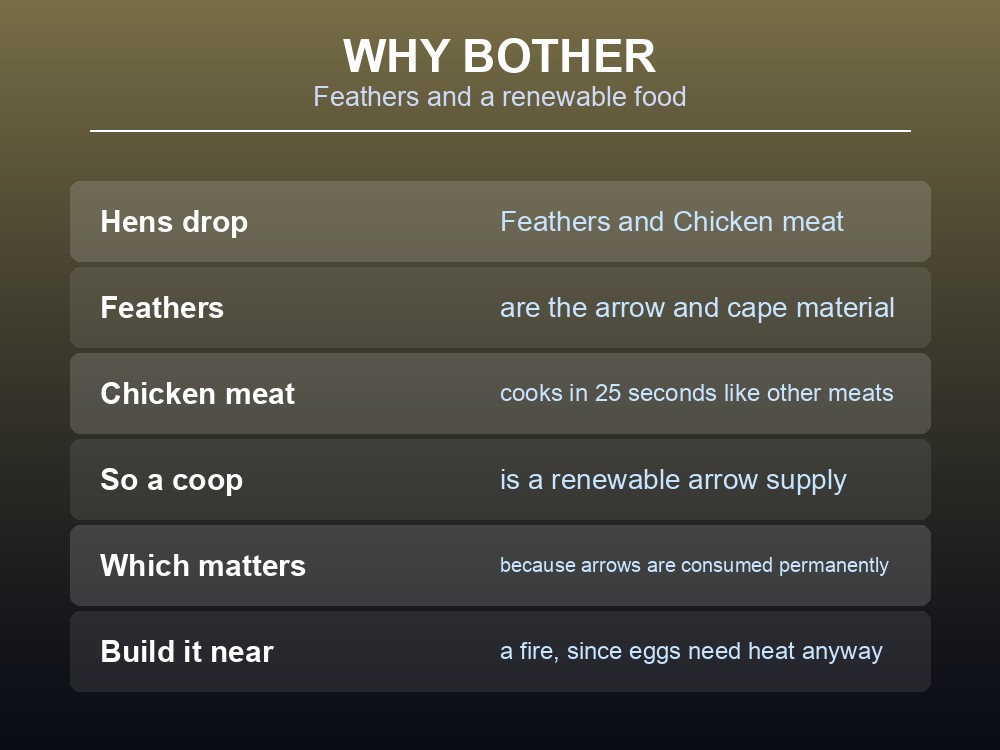
Hens drop Feathers and Chicken meat. The meat is fine — it cooks in the standard 25 seconds like every other meat. The feathers are the reason to build the coop.
Feathers are the arrow material, and as our bows guide notes, arrows cannot be retrieved — every shot is permanently consumed. An archer's real constraint is not the bow, it is the feather supply.
Before hens, feathers came from birds you had to hunt. A coop converts that into a passive supply that accumulates while you are elsewhere, in the same way the Beehive and the other passive buildings do.
Feathers are also a cape material, which puts them in the path of gear rather than only ammunition.
Build the coop next to the fire you are already keeping. The eggs need heat to incubate anyway, so a coop beside the Hearth solves both problems with one structure — and puts your most fragile livestock inside the walls rather than out in a field.
And keep the flock small but safe. Two or three hens produce eggs steadily; the risk is losing all of them at once to something that got through the door.
Practical tips
- An egg hatches in 30 minutes next to a fire or heat source.
- It must register as "warm" on hover — otherwise it is not incubating at all.
- Haldor sells eggs at 1,500 coins — more than four fishing rods.
- Buy two or three; a single Hen is one bad moment from gone.
- Chickens have 10 health. Build the coop indoors, behind a wall.
- Eggs weigh 1.0, stack to 20 and can be teleported.
- Hens drop Feathers and Chicken meat — the feathers are the point.
- Arrows are never retrievable, so a coop is a renewable ammunition supply.
Running your own Valheim server
A thirty-minute incubation and a passive feather supply both run on the world's clock, not yours — they only accumulate on a world that keeps going. A gamever Valheim server does exactly that for up to 10 players, with one-click backups so a flock bought with 4,500 coins survives a bad night.
Conclusion
Valheim's chickens start with a purchase: Haldor sells eggs at 1,500 coins, and an egg placed next to a fire hatches in 30 minutes — but only if it registers as "warm" when you hover over it, which is the check that decides whether the timer is running at all. A Chicken has 10 health and grows into a Hen, so the coop belongs indoors and behind a wall before you spend the coins. Eggs weigh 1.0, stack to 20 and can be teleported, so buying several from Haldor and portalling home is straightforward, and once you have Hens the loop is free. The reason to bother is not the meat — it is the Feathers, which are the arrow and cape material in a game where arrows are never retrievable. Build the coop beside the Hearth you already keep lit, and the incubation problem and the fire problem solve each other.
Want a flock that survives the night? Rent a Valheim server at gamever.io — instant setup, up to 10 players, one-click backups and updates, and 24/7 uptime. Start with a free trial and use promo code WELCOME.