
The Cauldron in Valheim: Ten Tin, and Everything That Is Not Grilled
The Cooking Station grills one thing at a time. The Cauldron is where every multi-ingredient recipe in Valheim actually happens — stews, jams, pies, sausages, everything with a name rather than a "cooked" prefix. It costs ten tin, it unlocks from the Forge, and it has one behaviour that confuses almost everyone the first time: it does not need a fire to be placed, only to be used.
On sourcing. Iron Gate do not publish system documentation. The figures below come from the community wikis and can change with any patch.
What the Cauldron Is
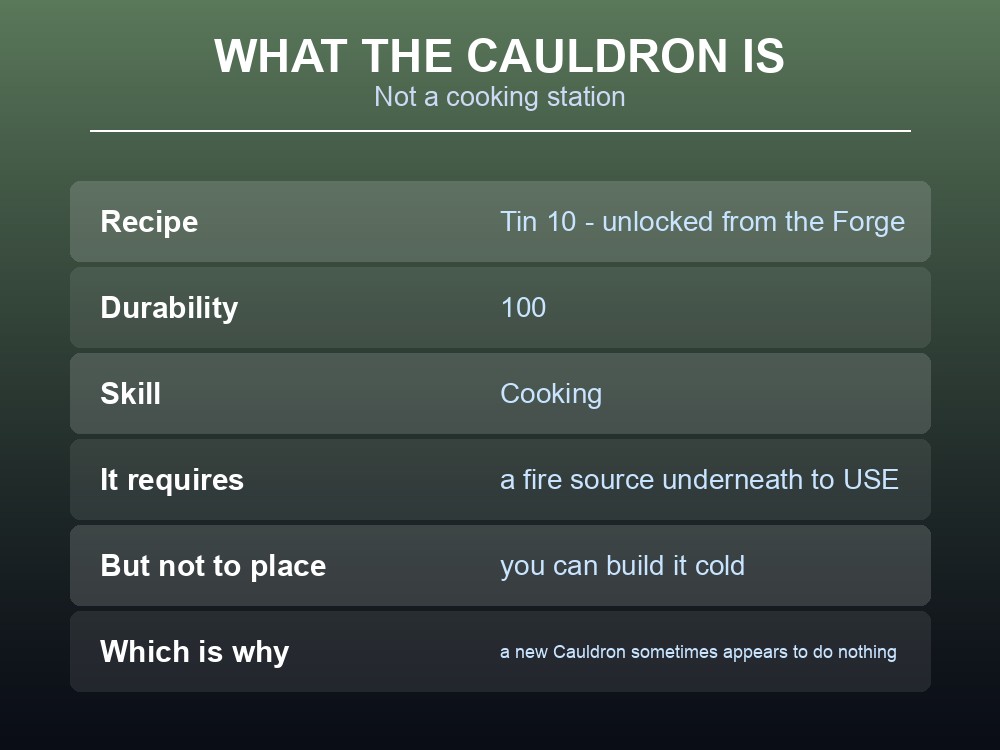
| Recipe | Tin ×10 |
| Unlocked from | The Forge |
| Durability | 100 |
| Size | 1 × 1.4 × 1 |
| Skill | Cooking |
| Requires | A fire source underneath to use |
Ten tin is a bronze-era cost, which puts the Cauldron early — you will have it long before most of the recipes it can make.
The placement quirk is worth stating clearly. The wiki notes that "a fire does not need to be present to place a Cauldron, only to use/craft with it." So a Cauldron built in an empty room places perfectly and then refuses to open a recipe list. That is not a bug and it is not a missing unlock — it is a missing campfire.
It is unlocked from the Forge, not from the Workbench, which catches out players who have a full Workbench setup and no Forge yet.
Its durability of 100 is five times the wooden Cooking Station's 20 but well below a Hearth's 1,500 — solid enough for an indoor kitchen, fragile enough to matter in a raid.
Station Against Cauldron
| Cooking Station | Cauldron | |
|---|---|---|
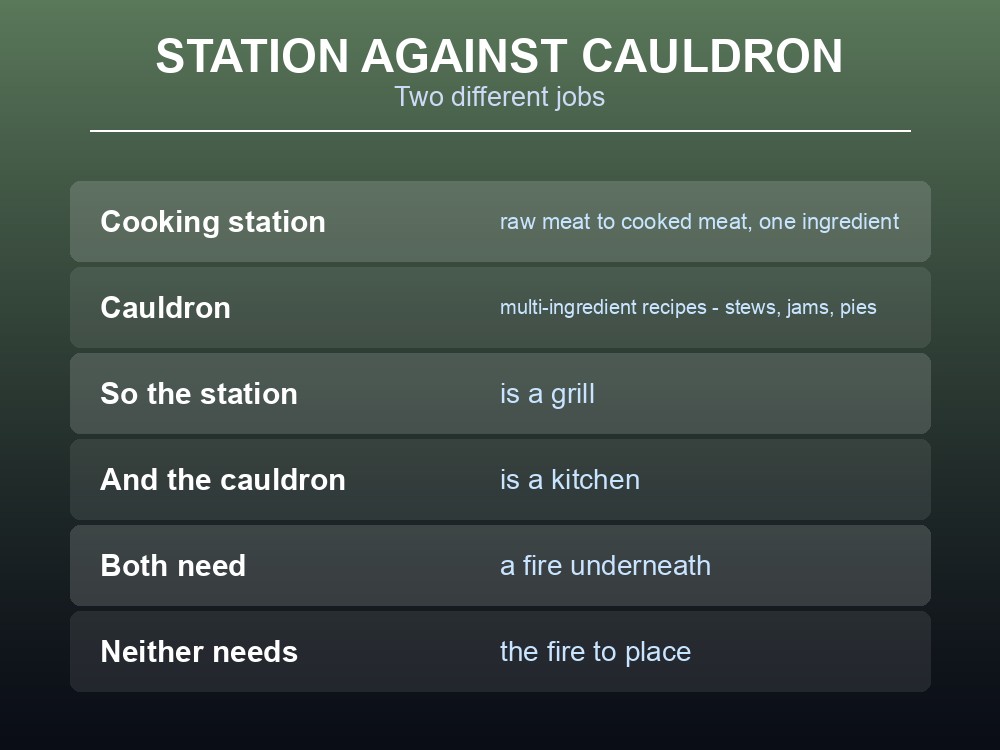
| Input | One raw ingredient | Multiple ingredients |
| Output | The cooked version | A named dish |
| Examples | Cooked boar meat, Cooked fish | Stews, jams, pies, sausages |
| Fire needed | To operate | To operate |
| Fire to place | Not required | Not required |
The simplest way to hold the distinction: the station is a grill, the Cauldron is a kitchen. Anything whose name is "cooked something" comes off the station; anything with a real dish name comes out of the Cauldron.
They are sequential, not alternative. Most Cauldron recipes take cooked meat as an input, which means the station feeds the Cauldron. A working kitchen needs both, over the same fire.
Both need a fire underneath, so a single Hearth can carry a stack of cooking stations and a Cauldron together — which is the standard Valheim kitchen layout for good reason.
And the Cooking skill applies to the Cauldron, listed on its own infobox — so the food you make here is also how that skill levels.
The Upgrade Path
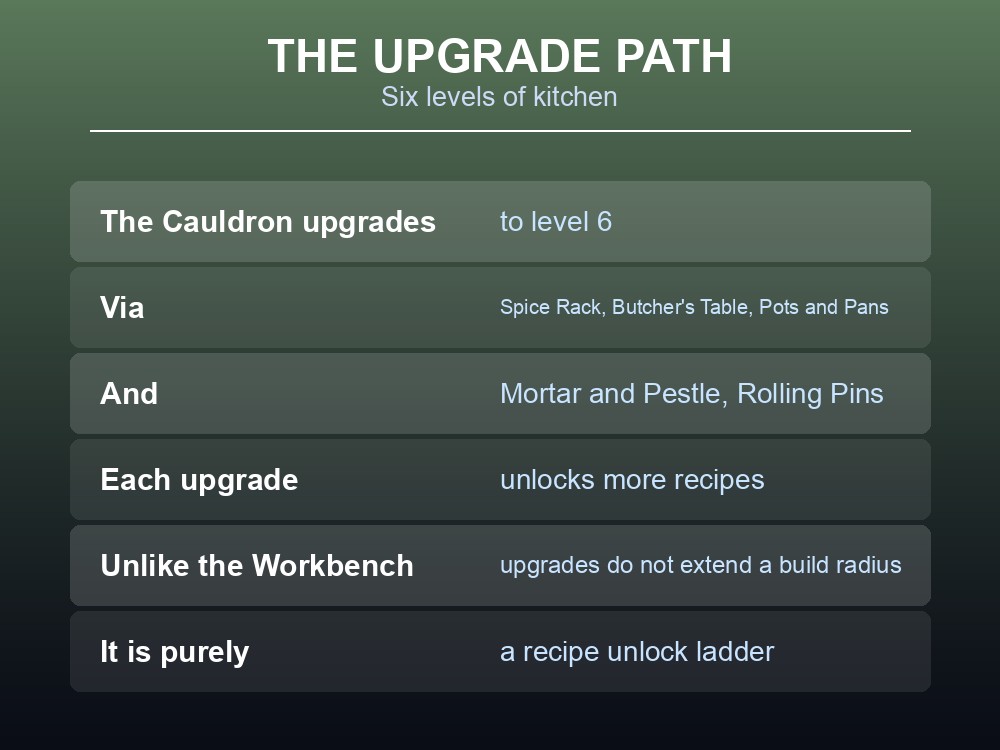
The Cauldron upgrades to level 6, via five separate structures built nearby:
| Upgrade |
|---|
| Spice Rack |
| Butcher's Table |
| Pots and Pans |
| Mortar and Pestle |
| Rolling Pins |
Each level unlocks more recipes, and that is all it does. Unlike the Workbench, whose upgrades extend its build radius by four metres each, Cauldron upgrades do not extend anything — they are a pure recipe ladder.
Which makes the upgrade order simple: build them as the materials appear. There is no reason to sequence them and no downside to having a partial set — you get whatever recipes the current level unlocks.
Six levels is more than the Workbench's five, and second only to the Forge's seven. A fully upgraded Cauldron is a real building project, and worth planning space for: five structures around one pot, all needing to be in range.
Plan the kitchen as one room. A Hearth, a row of cooking stations over it, a Cauldron beside them and the five upgrade pieces around the walls — that is the whole food economy in a single space, and it will not need rearranging later.
Practical tips
- Tin ×10, unlocked from the Forge — not the Workbench.
- A fire is needed to USE a Cauldron, not to place one.
- That is why a new Cauldron often appears to do nothing.
- The station grills; the Cauldron makes named dishes.
- They are sequential — most Cauldron recipes take cooked meat as input.
- Six upgrade levels, via Spice Rack, Butcher's Table, Pots and Pans, Mortar and Pestle, Rolling Pins.
- Upgrades unlock recipes only — they do not extend a build radius.
- Build the whole kitchen as one room around a single Hearth.
Running your own Valheim server
A six-level kitchen is five structures, a Cauldron, a Hearth and a row of stations — a room the group builds once and uses for months. A gamever Valheim server keeps it standing for up to 10 players, with one-click backups so a fully upgraded kitchen is never rebuilt.
Conclusion
The Valheim Cauldron costs Tin ×10, unlocks from the Forge, and carries 100 durability. It is where every multi-ingredient recipe happens — the stews, jams, pies and sausages that the Cooking Station cannot produce — and the two stations are sequential rather than alternative, since most Cauldron recipes take cooked meat as an input. Its one confusing behaviour is worth memorising: a fire is required to use a Cauldron but not to place one, which is why a freshly built pot in an empty room appears to be broken. It upgrades through six levels via the Spice Rack, Butcher's Table, Pots and Pans, Mortar and Pestle and Rolling Pins, and unlike the Workbench those upgrades only unlock recipes — they extend nothing. Build the Hearth, the station row, the Cauldron and its five upgrades as one room, and the food economy is finished for the rest of the save.
Want a kitchen that lasts the save? Rent a Valheim server at gamever.io — instant setup, up to 10 players, one-click backups and updates, and 24/7 uptime. Start with a free trial and use promo code WELCOME.