
Captured Cages in Palworld: 139 Entries, and a Base Upgrade at Level One
Every Palworld enemy camp has a cage, and most players smash it on the way past. There are 139 cage entries in the game data, each naming a Pal, a level band and a region — and the early ones are not filler. Subspecies appear at levels 1–10, decades below where they spawn wild, and several of the caged Pals are the base upgrades you would otherwise spend hours hunting.
How Cages Work
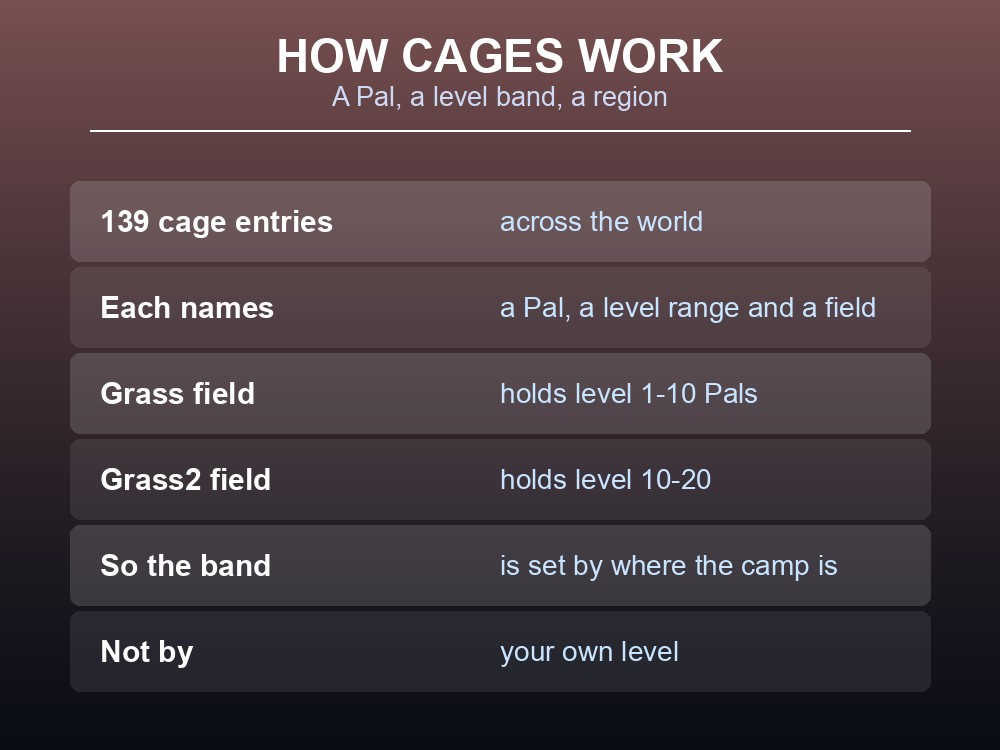
| Total entries | 139 |
| Each entry names | A Pal, a level range and a field |
| Grass field | Levels 1–10 |
| Grass2 field | Levels 10–20 |
The level band is set by the camp's location, not by you. A Grass-field cage holds a level 1–10 Pal whether you arrive at level 5 or level 50 — which means a low-level camp is a low-level Pal, and the value is in the species rather than the stats.
That is the right way to think about cages: they are a species delivery, not a power one. A level 3 Pal you can condense, breed from or assign to a base is worth exactly as much as a level 40 one for most purposes.
139 entries across the world means cages are not rare. Every camp has one, and clearing camps for their loot tables already puts you in front of them.
Check the cage before you engage. Knowing what is inside changes whether the camp is worth a detour at all.
What Is in the Early Cages
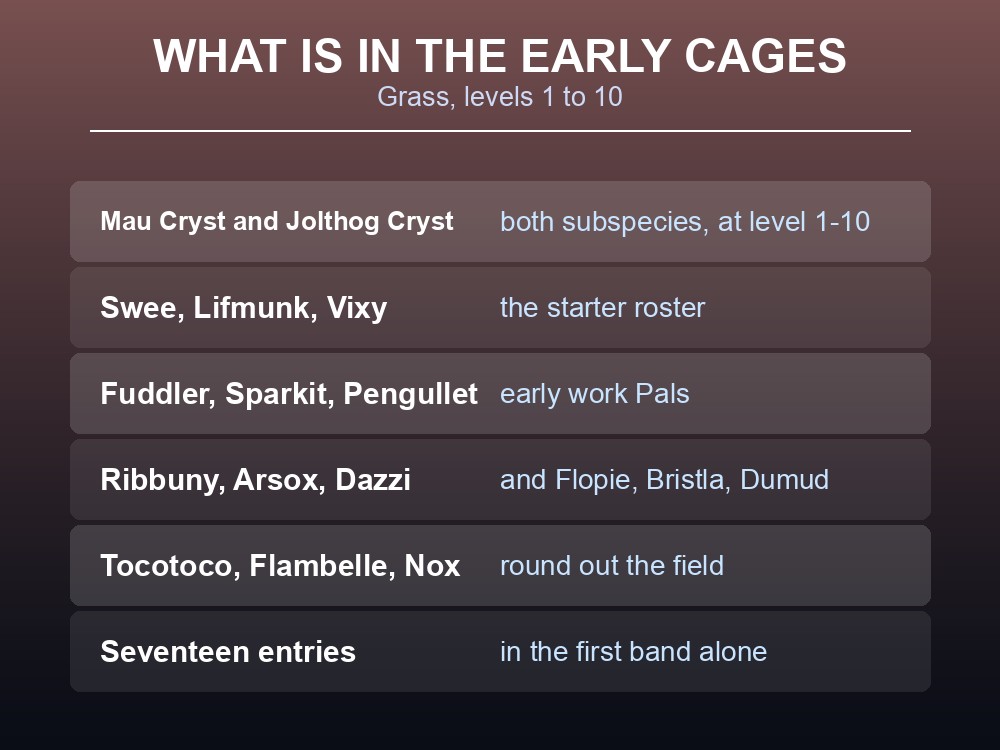
The Grass field's level 1–10 band holds seventeen entries:
Mau Cryst, Jolthog Cryst, Swee, Lifmunk, Vixy, Fuddler, Sparkit, Pengullet, Ribbuny, Arsox, Dazzi, Flopie, Bristla, Dumud, Tocotoco, Flambelle, Nox.
Two of those are subspecies, at level 1–10. Mau Cryst and Jolthog Cryst are the Ice variants — and as our unique breed pairs guide covers, the normal route to either is breeding Mau or Jolthog with a Pengullet. A cage hands you one directly, in the first ten levels.
The Grass2 band at levels 10–20 largely repeats the roster — Mau Cryst, Jolthog Cryst, Fuack, Lamball, Cattiva, Tanzee, Bristla, Ribbuny, Arsox, Dazzi, Flopie, Dumud, Tocotoco, Flambelle, Nox — with higher levels and a few additions.
So the same species appear across bands at different levels, which means if you missed one early you have another chance later at a higher level.
Why Cages Are Worth the Detour
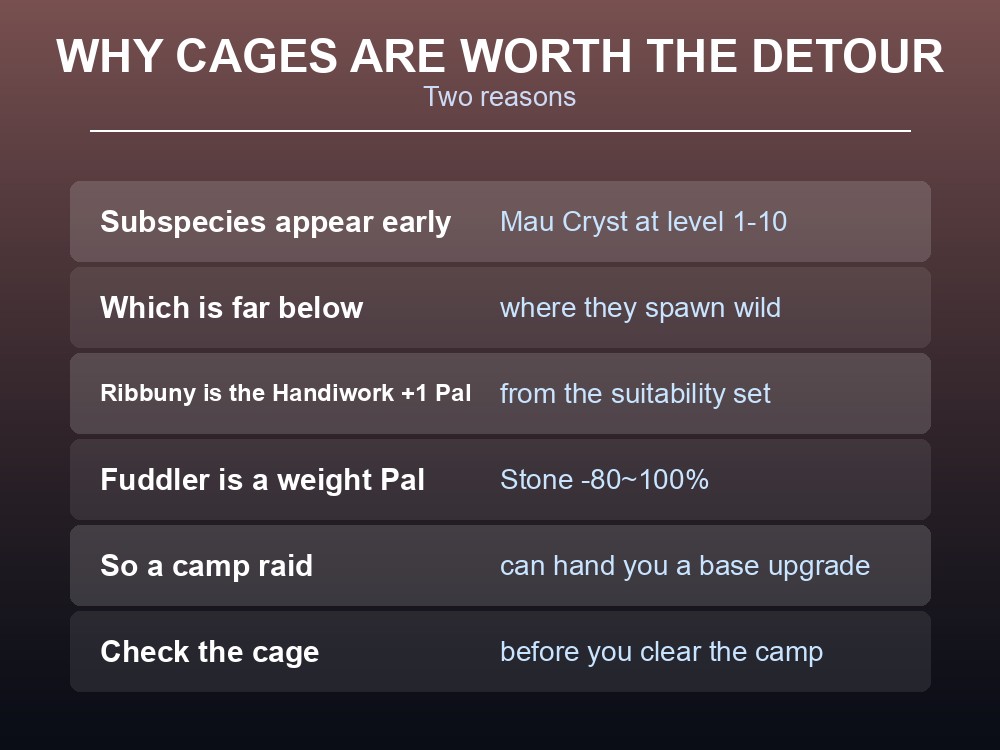
Several caged Pals are base upgrades in disguise.
| Caged Pal | Why it matters |
|---|---|
| Ribbuny | The Handiwork +1 Pal — raises Handiwork for every other base Pal |
| Fuddler | Weight Pal — Stone −80~100%, plus +30~60% mining |
| Sparkit | Second parent for Relaxaurus Lux and other Lux variants |
| Pengullet | Second parent for Mau Cryst and Jolthog Cryst |
| Dazzi | Drops Dazzi Cloud, a clothing material |
Ribbuny is the standout. It is one of the twelve Pals that raise a work suitability for your whole base, and Handiwork is the suitability that gates the most stations. Finding one in a level 1–10 cage is a genuine early-game acceleration.
Fuddler is the other one to grab. As covered in our weight Pals guide, it removes 80~100% of Stone's weight and adds +30~60% mining efficiency — solving the single most annoying problem of the early game.
And Sparkit and Pengullet are breeding components. Both appear repeatedly as second parents in the unique-pair list; neither is worth much alone and both are worth keeping.
So the rule is simple: open the cage, then decide about the camp. A camp with a Ribbuny in it is worth clearing at any point in the game, regardless of what its loot table offers.
Practical tips
- 139 cage entries, each with a Pal, a level band and a region.
- The band is set by the camp, not by your level.
- Subspecies appear at levels 1–10 — Mau Cryst and Jolthog Cryst.
- The Grass 1–10 band holds seventeen species.
- Ribbuny is the Handiwork +1 Pal — a base-wide upgrade from an early cage.
- Fuddler removes 80~100% of Stone weight and adds mining efficiency.
- Sparkit and Pengullet are breeding second parents — keep them.
- Check the cage before deciding whether the camp is worth clearing.
Running your own Palworld 1.0 server
Camps reset and cages refill on the world's clock, which only runs on a world that stays up. A gamever Palworld server keeps that map live with full crossplay, automatic updates and one-click backups, so a camp circuit is worth planning rather than repeating from scratch.
Conclusion
Palworld's captured cages run to 139 entries, each specifying a Pal, a level band and a region — with the band set by the camp's location rather than by your level, which makes cages a species delivery rather than a power one. The Grass field's level 1–10 band alone holds seventeen species, including two subspecies — Mau Cryst and Jolthog Cryst — that would otherwise need a breeding pair to obtain. Several of the caged Pals are quietly significant: Ribbuny is the Handiwork +1 Pal that raises a work suitability for your entire base, Fuddler removes 80~100% of Stone's weight and adds +30~60% mining efficiency, and Sparkit and Pengullet are the second parents behind a long list of unique breed pairs. The habit worth forming is to check the cage before deciding whether the camp is worth clearing — the loot table is rarely the best thing in a camp.
Want a camp circuit that resets? Rent a Palworld server at gamever.io — instant setup, one-click backups and updates, full crossplay and 24/7 uptime. Start with a free trial and use promo code WELCOME.