
The Mistlands in Valheim: What Lives There, What You Mine, and How to See
The Mistlands is the only Valheim biome where the terrain itself is the primary threat. Not the Seekers, not the Gjall — the mist, which is thick enough to be genuinely disorienting and which hides both the vertical drops and the things climbing them. There are exactly three tools that clear it, they work at 12, 10 and 5 metres, and choosing between them shapes how you play the whole biome. Here is what lives there, what you are mining for, and how to actually see it.
On sourcing. Iron Gate do not publish system documentation. The figures below come from the community wikis and can change with any patch.
What Lives in the Mistlands
Hostile:
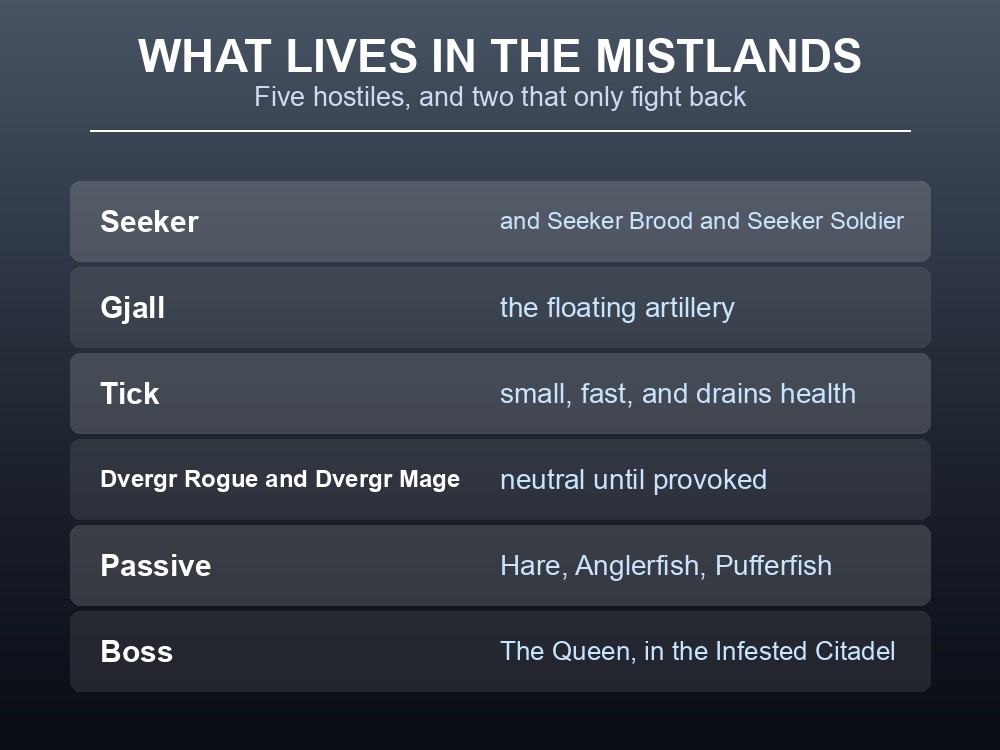
- Seeker, Seeker Brood and Seeker Soldier — the biome's signature enemy, and the source of the Seeker Soldier Trophies you need to resummon The Queen.
- Gjall — floating, and it attacks from above.
- Tick — small and fast, and it drains health.
Neutral until provoked:
- Dvergr Rogue and Dvergr Mage. They will leave you alone. Attacking them turns a whole camp hostile, and Dvergr camps are well defended.
Passive: Hare, Anglerfish, Pufferfish.
Boss: The Queen, at the top of the Infested Citadel.
The Dvergr are worth a decision rather than a reflex. Their structures hold soft tissue, blue jute, Dvergr extractors, lanterns, iron and finewood — real loot — but they are the only neutral faction in the game and they hit hard. Deciding in advance whether you are raiding them or trading the biome peacefully will save you a corpse run.
The Mist Is the Real Enemy
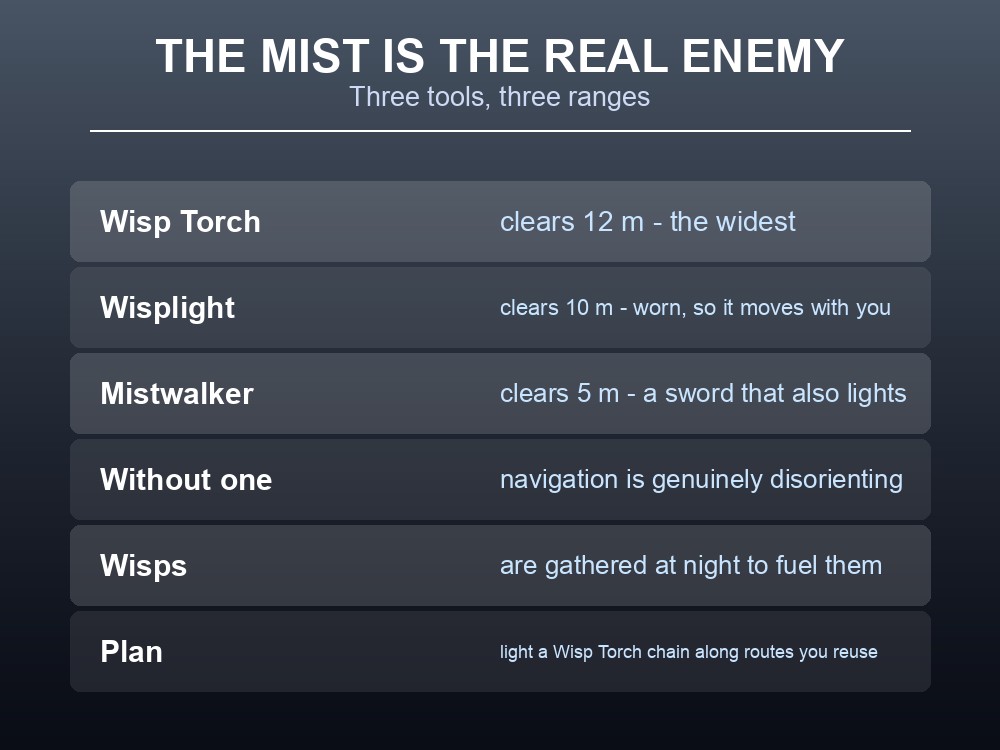
| Tool | Clears | Form |
|---|---|---|
| Wisp Torch | 12 m | Placed structure |
| Wisplight | 10 m | Worn — moves with you |
| Mistwalker | 5 m | A sword that also lights |
The Wisplight is the practical default. Ten metres is enough to navigate, it travels with you, and it leaves both hands free for a weapon and shield. The Wisp Torch clears more at 12 metres but stays where you put it, which makes it infrastructure rather than equipment.
The correct play is to use both. Wear a Wisplight for movement, and plant Wisp Torches along routes you reuse — the path from your portal to the Infested Mine, the approach to a Dvergr site. After two or three trips a lit corridor makes the biome ordinary.
The Mistwalker at 5 metres is the weakest light, but it is a Slash 75 + Frost 40 sword, so you are getting the light as a bonus on a weapon you were carrying anyway.
Wisps are gathered at night to fuel all of this, which means the Mistlands has a preparation step before it has a farming step.
What You Are Here For
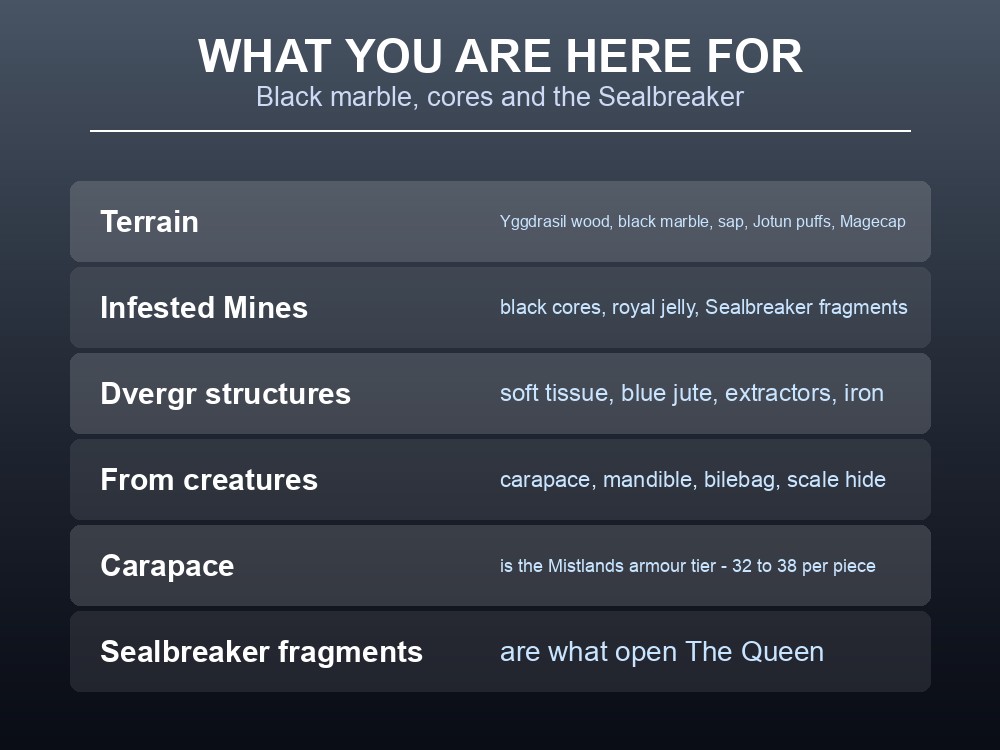
| Source | Materials |
|---|---|
| Terrain | Yggdrasil wood, black marble, stone, wood, sap, Jotun puffs, Magecap |
| Infested Mines | black cores, royal jelly, Sealbreaker fragments |
| Dvergr structures | soft tissue, blue jute, Dvergr lanterns and extractors, iron, finewood, surtling cores, copper and iron scrap |
| Creatures | carapace, mandible, bilebag, scale hide, seeker meat, hare meat |
Carapace is the headline. It is the Mistlands armour tier at 32 – 38 armour per piece, and it also makes Carapace Arrows at 72 Pierce and the Carapace Spear.
Sealbreaker fragments are the progression gate. They come from the Infested Mines, and they are what let you open The Queen — so the Mines are not optional side content.
And Eitr unlocks here. The Mistlands is where magic becomes available at all, which is why the biome carries Magecap and the Eitr refining chain. If you have any interest in playing a mage, this is the biome where that decision gets made.
How to Survive It
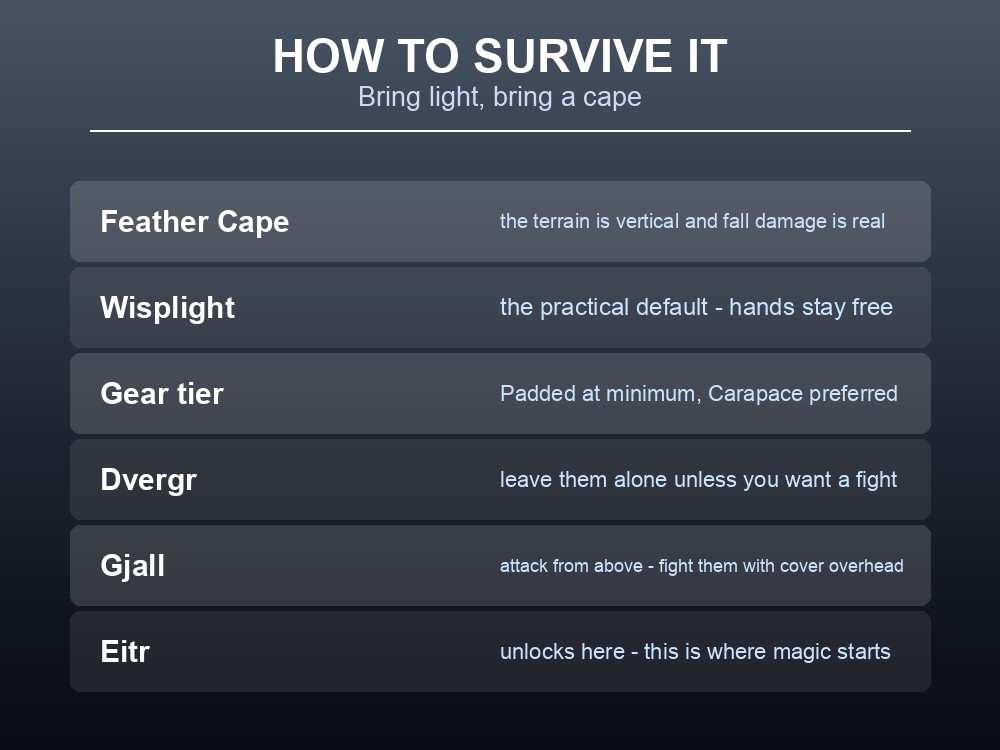
Bring a Feather Cape. The Mistlands is vertical — cliffs, viaducts, Dvergr towers — and the mist hides the edges. Fall damage kills more players here than Seekers do.
Gear tier: Padded at absolute minimum, Carapace preferred. Arriving in Iron is how the biome earns its reputation.
Fight Gjall with something overhead. They attack from above, so a viaduct, an overhang or a Dvergr structure removes their advantage entirely.
Leave the Dvergr alone unless you have committed to fighting them — and if you have, expect a camp response rather than a duel.
Set up a portal early. The Mistlands is far from your existing bases and the terrain makes overland travel slow. A forward portal beside a lit Wisp Torch turns repeat trips from expeditions into errands.
How to Approach the Mistlands
- Farm wisps at night before you go, and craft a Wisplight.
- Wear a Feather Cape — the drops are the main killer.
- Upgrade to Padded or Carapace armour first.
- Plant Wisp Torches along any route you will use twice.
- Find an Infested Mine for Sealbreaker fragments — the Queen depends on them.
- Decide about the Dvergr before you shoot one.
Practical tips
- Wisplight (10 m) for movement, Wisp Torches (12 m) for routes. Use both.
- The Mistwalker only clears 5 m, but it is a Slash 75 + Frost 40 sword.
- Dvergr are neutral — their loot is real, and so is their response.
- Gjall attack from above. Fight under cover.
- Sealbreaker fragments come from Infested Mines, and they gate The Queen.
- Eitr and magic start here. Magecap is the reason the biome grows it.
Running your own Valheim server
The Mistlands rewards infrastructure — lit routes, a forward portal, a Wisp Torch chain — and infrastructure only pays off across repeat visits. A gamever Valheim server keeps that world live for up to 10 players, so the corridor one person lit on Tuesday is still there for everyone on Thursday. One-click backups protect a biome foothold that takes real hours to establish.
Conclusion
The Mistlands is defined by the mist rather than by its monsters. Three tools clear it — the Wisp Torch at 12 m, the worn Wisplight at 10 m, and the Mistwalker sword at 5 m — and the practical answer is a Wisplight for movement plus Wisp Torches planted along routes you reuse. It holds Seekers, Seeker Soldiers, Gjall and Ticks, plus the neutral Dvergr, whose camps are worth raiding only deliberately. You are there for carapace (the 32 – 38 armour tier), black marble, black cores, and above all the Sealbreaker fragments in the Infested Mines that open The Queen — and because Eitr and magic unlock here. Bring a Feather Cape: in a vertical biome you cannot see across, falling is the most common cause of death.
Want a lit route that survives between sessions? Rent a Valheim server at gamever.io — instant setup, one-click backups and updates, and 24/7 uptime. Start with a free trial and use promo code WELCOME.