
Power Levels in Dragonwilds: The System Behind Every Fight
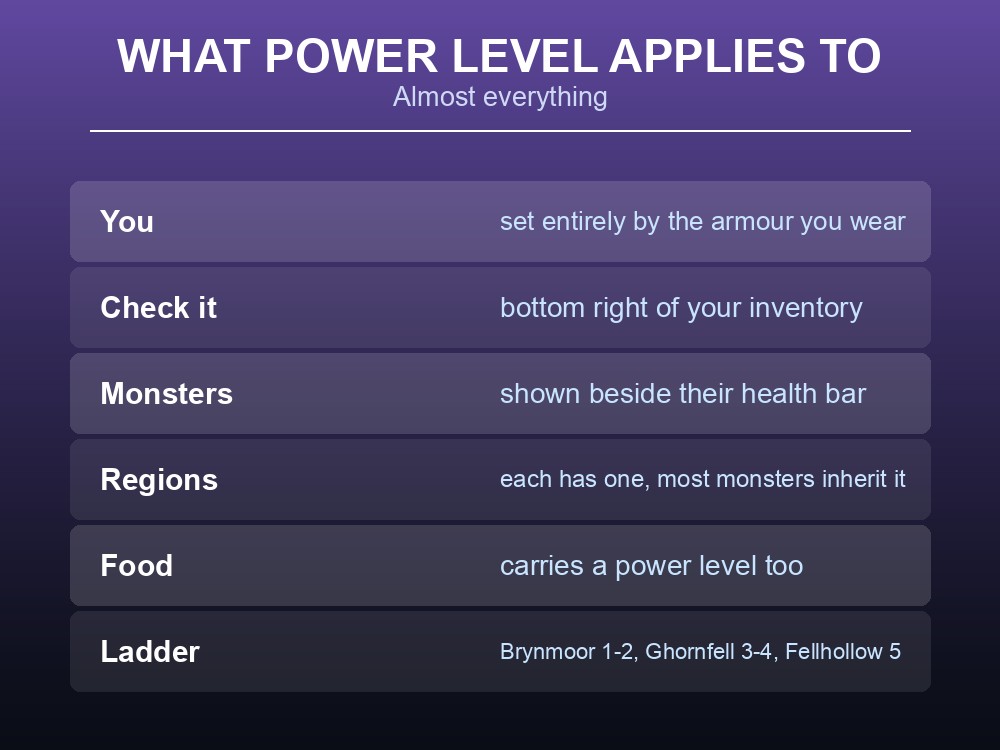
Power Level is the number that decides how hard Ashenfall hits you, and it is not set by your skills, your weapon or your progress. It is set by the armour you are wearing — and when your pieces do not match, the game averages them and rounds down. That single rule punishes the most natural thing a player does: wearing the good new helmet with the old chest and legs. Here is how the system works.
On sourcing. Jagex reference power levels constantly in patch notes but have never published the mechanics. The detail below is documented on the community RuneScape: Dragonwilds wiki, and figures can change with any patch — treat them as a working model rather than a contract.
What Power Level Applies To
Power levels are attached to almost everything, which is why the term shows up in so many different contexts:
| Thing | How it works |
|---|---|
| You | Determined by the armour you wear |
| Monsters | Shown beside their health bar |
| Regions | Each region has one, and most monsters inherit it |
| Food | Individual foods carry a power level too |
You can check your own at the bottom right of your inventory.
The region ladder is the clearest map of progression in the game:
| Region | Power level |
|---|---|
| Brynmoor | 1–2 |
| Ghornfell | 3–4 |
| Fellhollow | 5 |
| Dowdun Reach | 6 |
| Umbral Sands | 7 |
That lines up exactly with the region order — Brynmoor and Ghornfell as the starting pair, then Fellhollow behind Dragon Slayer, Dowdun Reach behind Imaru, and Umbral Sands behind the Black Knight Titan.
The Averaging Rule
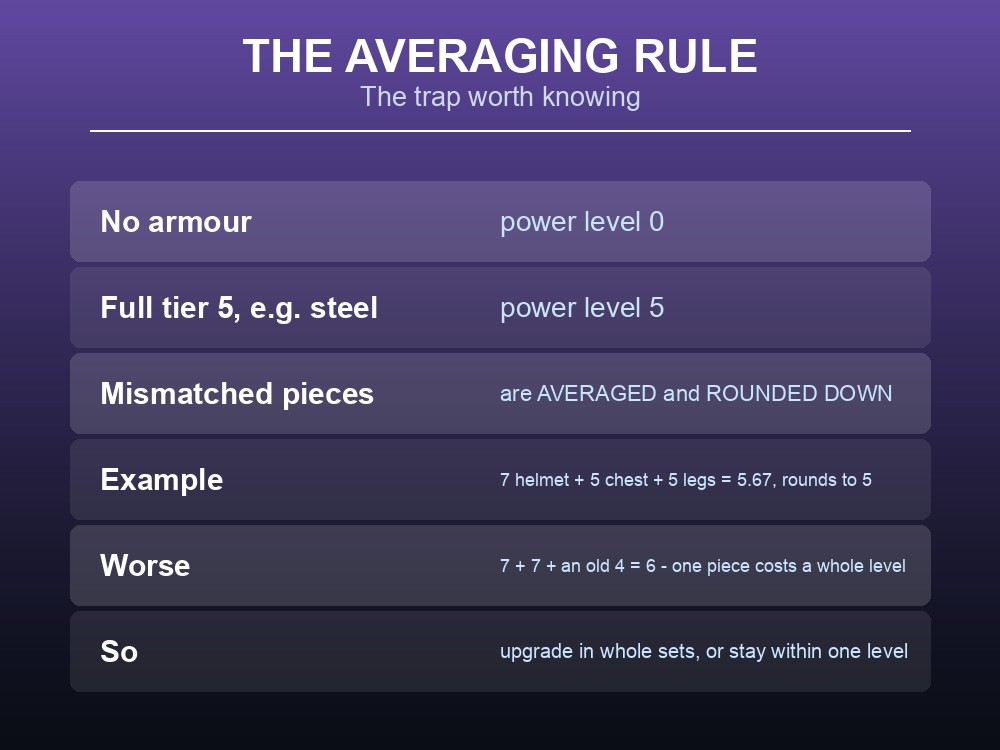
Your power level comes entirely from armour. With nothing equipped you are power level 0; wearing a full tier 5 set such as steel puts you at power level 5.
And the rule that catches people:
"In the event that the player is wearing armour of differing power levels, they are averaged and rounded down."
Work through what that means. A helmet at 7, a chest at 5 and legs at 5 average to 5.67 — rounded down to 5. Your excellent helmet bought you nothing. Worse, the reverse case: a chest and legs at 7 with an old helmet at 4 averages to 6 — one stale piece costs you a whole level.
So upgrade in whole sets, or at least keep your pieces within one level of each other. A single leftover piece is the most common reason a well-equipped player still sees a danger icon.
Individual armour pieces carry their own power level, and the crafted ladder is straightforward: Reinforced 2, Bronze 3, Iron 4, and upward through the tiers to the power level 7 sets in Umbral Sands.
Monster Health Scales With the Region
This is the mechanic that explains why the same creature feels different in different places:
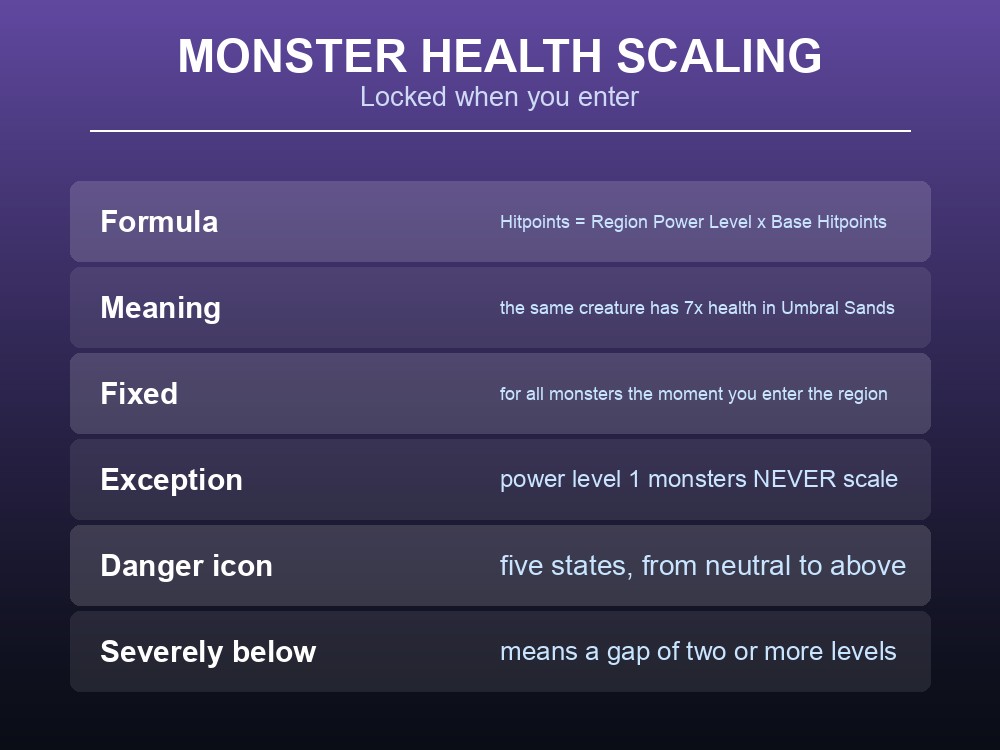
Hitpoints = Region Power Level × Monster's Base Hitpoints
A monster's health is multiplied by the power level of the region it is in — so the same base creature has seven times the health in Umbral Sands that it would at region power level 1.
Two details make this practically important:
- The value is locked when you enter the region. Hitpoints are "determined for all monsters in a region when the player enters that region" — not recalculated continuously.
- Power level 1 monsters do not scale at all. Chickens, kebbits and similar "are always at their base value, regardless of the region's power level." The trash stays trash.
The danger icon beside an enemy or zone title tells you where you stand, and there are five states:
| Icon state | Meaning |
|---|---|
| Neutral | The zone or enemy is neutral (e.g. Temple Woods) |
| Severely below | Your power level is more than one level below |
| Below | You are one level below |
| Equal | You and the enemy or zone match |
| Above | Your power level is above the zone |
"Severely below" is the one to respect. It means a gap of two or more levels — which, given health scales with region power level, means enemies with multiples of the health you are used to.
Armour Set Bonuses
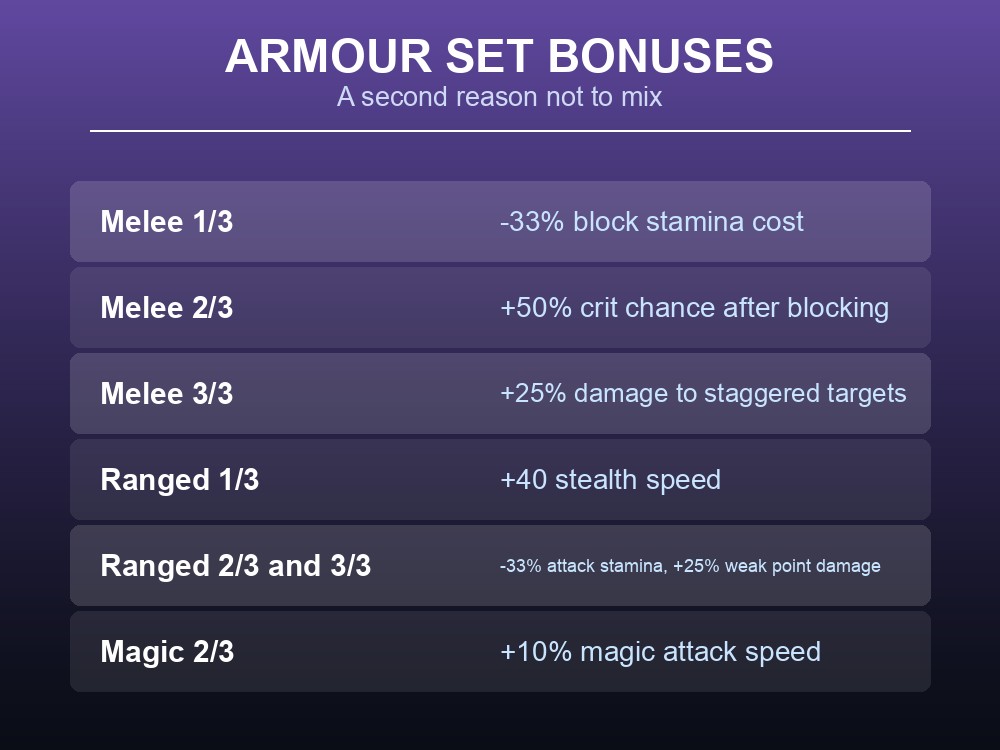
Armour is classed into the three combat styles, and wearing multiple pieces of the same class grants set bonuses — which is the second, independent reason mixing armour is a mistake.
Melee:
| Pieces | Bonus |
|---|---|
| 1/3 | −33% block stamina cost |
| 2/3 | +50% crit chance after blocking |
| 3/3 | +25% damage to staggered targets |
Ranged:
| Pieces | Bonus |
|---|---|
| 1/3 | +40 stealth speed |
| 2/3 | −33% ranged attack stamina cost |
| 3/3 | +25% weak point damage |
Magic:
| Pieces | Bonus |
|---|---|
| 2/3 | +10% magic attack speed |
The melee line is built around blocking, and it stacks with the wider combat design: cheaper blocks, then crits after blocking, then bonus damage to staggered targets. A melee player in a full set is rewarded for playing defensively and punishing.
The ranged line rewards commitment differently — stealth, cheaper attacks, then weak point damage, which pairs directly with Trick Shots and the guard-breaking bonus bows get.
Note that the magic set only lists a 2/3 bonus. We are reporting that as documented rather than assuming a 1/3 and 3/3 exist and are simply unrecorded.
Put the two systems together and the conclusion is unambiguous: mixing armour costs you power level (averaged and rounded down) and set bonuses. Wear complete sets.
Practical tips
- Your power level comes from armour only — 0 with none, 5 in a full tier-5 set.
- Mismatched pieces are averaged and rounded down. One old piece can cost a full level.
- Region power levels: Brynmoor 1–2, Ghornfell 3–4, Fellhollow 5, Dowdun Reach 6, Umbral Sands 7.
- Monster health = region power level × base health, locked when you enter the region.
- Power level 1 monsters never scale.
- "Severely below" means a gap of two or more levels. Treat it as a wall.
- Melee sets reward blocking; ranged sets reward weak points; magic gets +10% attack speed at 2/3.
- Check your power level at the bottom right of your inventory.
Running your own RuneScape: Dragonwilds server
Power level is a per-player number, which means a group arrives at a new region at different readiness — and the fix is time in the same world rather than a rushed session. A gamever Dragonwilds server keeps Ashenfall available around the clock for up to six players, so people can gear up on their own schedule, updates automatically so client and server versions never drift, and takes one-click backups before disruptive changes.
Conclusion
Power Level is Dragonwilds' universal strength scale, applied to players, monsters, regions and even food. Yours comes entirely from the armour you wear — 0 with none, 5 in a full tier-5 set — and the rule worth acting on is that mismatched pieces are averaged and rounded down, so a single outdated piece can cost you a whole level. Regions run Brynmoor 1–2, Ghornfell 3–4, Fellhollow 5, Dowdun Reach 6, Umbral Sands 7, and monster health is the region's power level multiplied by the monster's base health, fixed at the moment you enter the region — though power level 1 creatures never scale. The icon beside an enemy or zone tells you the gap, and "severely below" means two or more levels. On top of that, wearing a complete set of one combat class grants bonuses — melee builds around blocking, ranged around stealth and weak point damage, and magic gains +10% attack speed at 2/3. Both systems point the same way: wear complete, current sets.
Want time to gear up properly? Rent a Dragonwilds server at gamever.io — instant setup, one-click backups and updates, and 24/7 uptime. Start with a free trial and use promo code WELCOME.