
Portals in Valheim: Ten Characters, Case Sensitive, and the Metal Rule
Portals are the cheapest transport in Valheim — ten Greydwarf eyes, twenty Finewood and two Surtling cores — and they reshape how a world is played. Two rules decide whether your network works. Tags are case-sensitive and capped at ten characters. And no ore or metal can pass through a portal at all, which is why your base is laid out the way it is, whether you planned it or not.
On sourcing. Iron Gate do not publish system documentation. The figures below come from the community wikis and can change with any patch.
How Tags Actually Pair
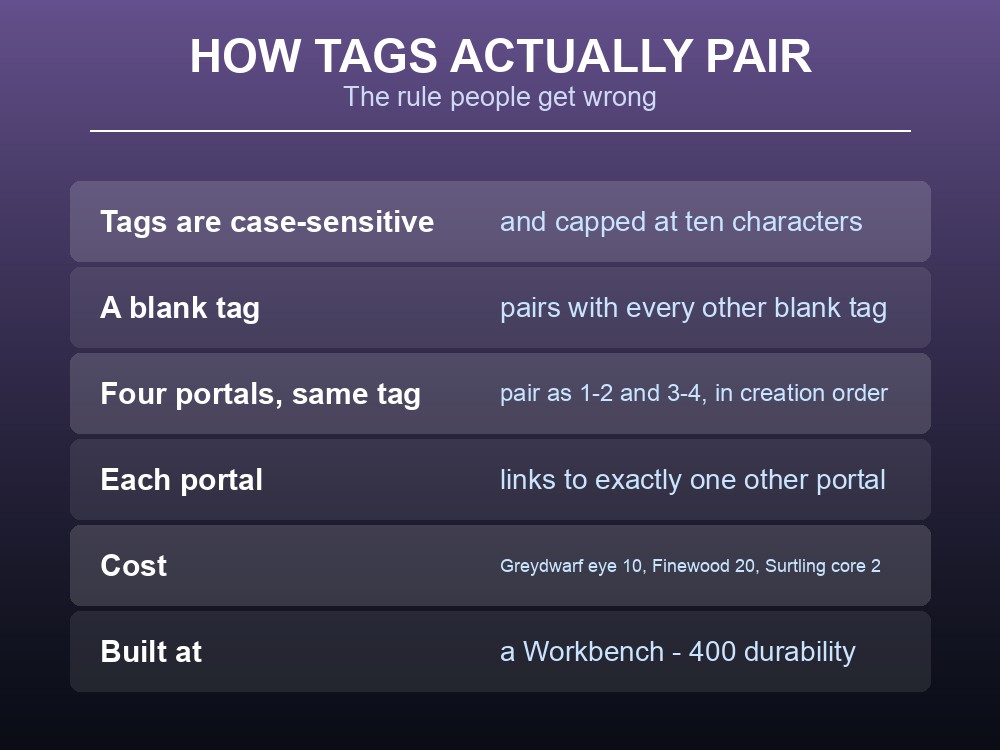
| Cost | Greydwarf eye ×10, Finewood ×20, Surtling core ×2 |
| Station | Workbench |
| Durability | 400 |
| Tag length | 10 characters |
| Case | Case-sensitive |
Case sensitivity is the most common portal bug that is not a bug. A portal tagged Mine and a portal tagged mine will never connect, and the game gives you no warning. Letters, numbers and special characters are all permitted, so pick a convention and stick to it.
A blank tag is a real tag. Portals built with no tag will pair with each other — which means the first two untagged portals you place anywhere in the world are now connected, possibly across the map from each other.
The pairing rule is the part that surprises people. If you build four portals with the same tag, they do not form a network. The first two pair with each other, and the third and fourth pair with each other, in the order the tags were set. Each portal links to exactly one other portal — there is no hub, no menu, no choice of destination.
So a working network is a set of unique tag pairs, not a shared name. swamp1, mtn, home2 — one pair each.
What Cannot Go Through
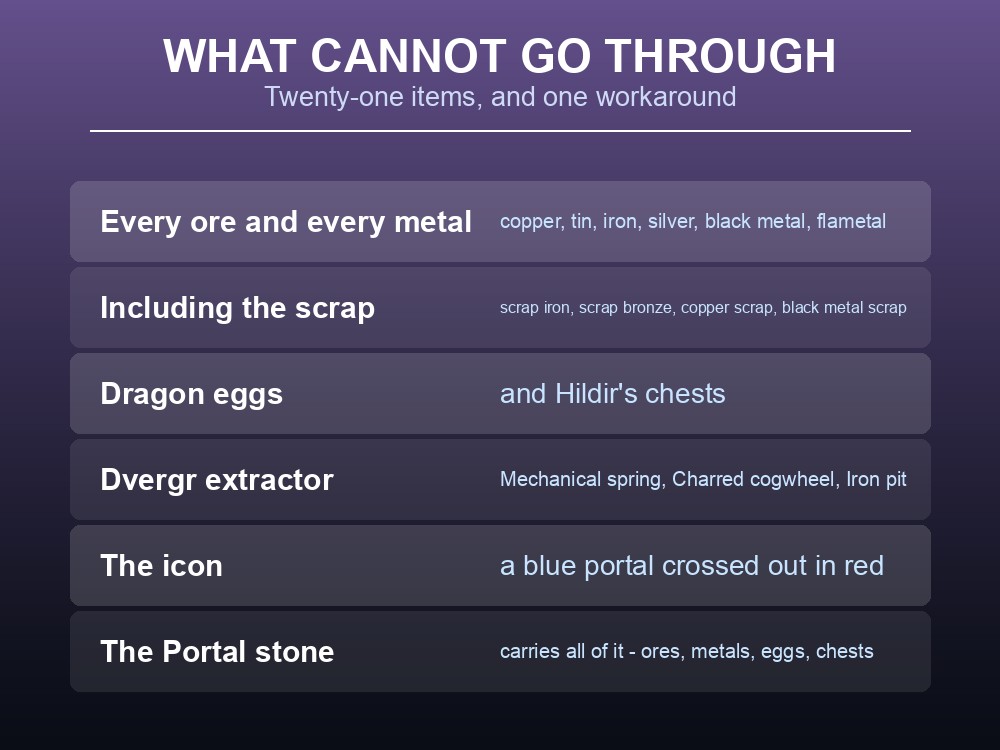
Items that block teleportation are marked with a blue portal crossed out in red. The list:
| Category | Items |
|---|---|
| Copper line | Copper, Copper ore, Copper scrap |
| Tin and bronze | Tin, Tin ore, Bronze, Scrap bronze |
| Iron | Iron, Iron ore, Scrap iron, Iron pit |
| Silver | Silver, Silver ore |
| Black metal | Black metal, Black metal scrap |
| Flametal | Flametal, Flametal ore |
| Not metal at all | Dragon egg, Dvergr extractor, Mechanical spring, Charred cogwheel, Hildir's chests |
Every ore and every smelted metal in the game is on this list. That is the rule in one sentence, and it is the single largest constraint on how a Valheim world is built.
Five items on the list are not metal, and they catch people out individually: the Dragon egg you need for Moder's altar, the Dvergr extractor the Sap extractor is built from, the Mechanical spring for siege engines, the Charred cogwheel, and Hildir's chests.
The Portal stone lifts all of it. As the wiki puts it, a Portal stone "does allow the teleportation of all items that are not possible with a standard Portal, including Ores, Metals, Dragon eggs, Hildir's chests and Mechanical springs." It is Ashlands-tier, and it is the moment the metal rule stops applying to your world.
What That Means for Your Base
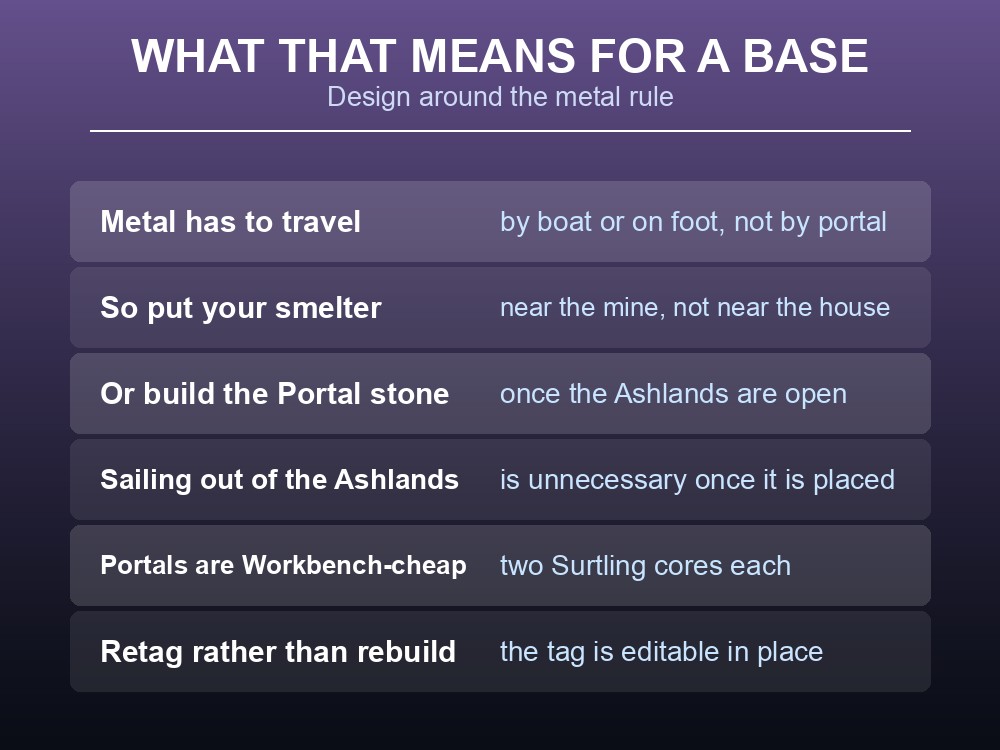
Metal travels by boat or on foot. Nothing else. That is why a Longship is not optional in the mid-game — eighteen cargo slots is the actual transport network for copper, tin and iron.
So put the smelter near the mine, not near the house. A Smelter and Charcoal Kiln built at a copper deposit turns an ore haul into an ingot haul — and while ingots also cannot teleport, they are far denser per trip. Many players run a small forward base per metal, which is a direct consequence of this one rule.
Portals are cheap enough to be disposable. Two Surtling cores and a handful of Greydwarf eyes is nothing after the Black Forest, so build them liberally — at every cave you intend to return to, every crypt cluster, every boss altar you have found with a Vegvisir.
Retag rather than rebuild. A portal's tag is editable in place, which means a two-portal pair can be repointed anywhere in your network without spending a single material. A common pattern is one permanent home portal and one roaming portal you retag as you explore.
And remember the 400 durability. Portals are destructible, and a portal at a forward base is a portal a raid can remove while you are standing on the other side of it.
Practical tips
- Tags are case-sensitive —
Mineandminenever connect.- Ten characters maximum; letters, numbers and symbols all work.
- Four portals with one tag pair as 1-2 and 3-4, not as a network.
- A blank tag is a tag — two untagged portals will find each other.
- Every ore and every metal is blocked, plus Dragon eggs, Dvergr extractors, Mechanical springs, Charred cogwheels and Hildir's chests.
- The Portal stone carries all of it — Ashlands tier.
- Retag instead of rebuilding — the tag is editable in place.
Running your own Valheim server
A portal network is a shared piece of infrastructure: one player's tag convention is everybody's, and a forward portal built during a solo session is there for the group. A gamever Valheim server keeps that network standing between sessions for up to 10 players, with one-click backups so a raid that flattens a forward base is recoverable.
Conclusion
Valheim portals cost Greydwarf eye ×10, Finewood ×20 and Surtling core ×2, and two rules decide how a network behaves. Tags are case-sensitive and capped at ten characters, a blank tag pairs with other blank tags, and four portals sharing one tag pair as 1-2 and 3-4 rather than forming a hub — each portal links to exactly one other. The second rule is the one that shapes your whole world: every ore and every metal is blocked from teleportation, along with Dragon eggs, the Dvergr extractor, Mechanical springs, Charred cogwheels and Hildir's chests. That is why metal moves by Longship and why smelters belong at the mine rather than at home — until the Portal stone, which carries all of it and is the moment the rule stops applying.
Want a portal network that survives the week? Rent a Valheim server at gamever.io — instant setup, up to 10 players, one-click backups and updates, and 24/7 uptime. Start with a free trial and use promo code WELCOME.