
Passive Inheritance Odds in Palworld: Four Skills Happens 10% of the Time
Breeding for passive skills feels random because the odds are never shown. They are published, and they are worse than most players assume: a clean four-skill inherit happens 10% of the time, while a single skill comes through 40% of the time. Understanding what those four numbers actually measure is the difference between a project that finishes and one that runs forever.
The Published Probabilities
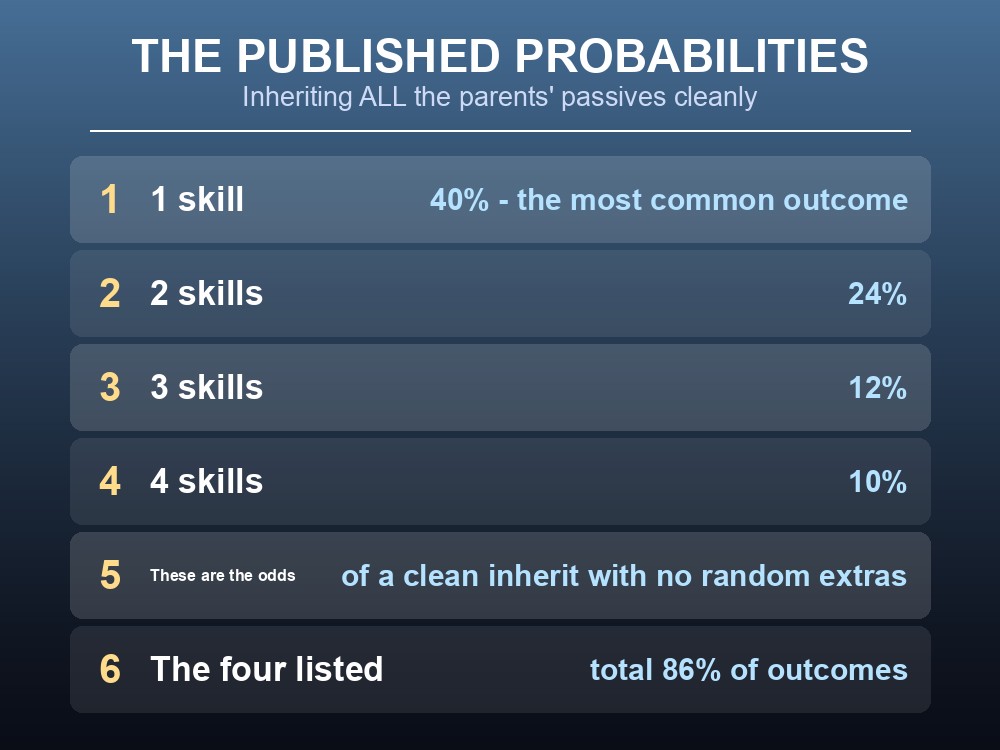
| Skills inherited | Probability |
|---|---|
| 4 | 10% |
| 3 | 12% |
| 2 | 24% |
| 1 | 40% |
The caveat matters as much as the numbers. The source states these apply to "a typical breeding scenario where the creatures you're breeding possess a set of unique passive skills. The goal is to inherit all these skills, without the introduction of any additional random skills."
So these are the odds of a clean inherit, not of "how many skills the baby has". A child could end up with four passives where two came from the parents and two arrived at random — that is a different, less useful outcome, and it is not what the 10% describes.
The four listed values total 86%, which leaves the remainder for outcomes outside that clean-inherit case.
The shape of the curve is the practical point. A single skill at 40% is four times more likely than all four at 10%, and the drop from 2 skills (24%) to 3 (12%) is a halving. Most eggs will carry one passive.
What That Means for a Project
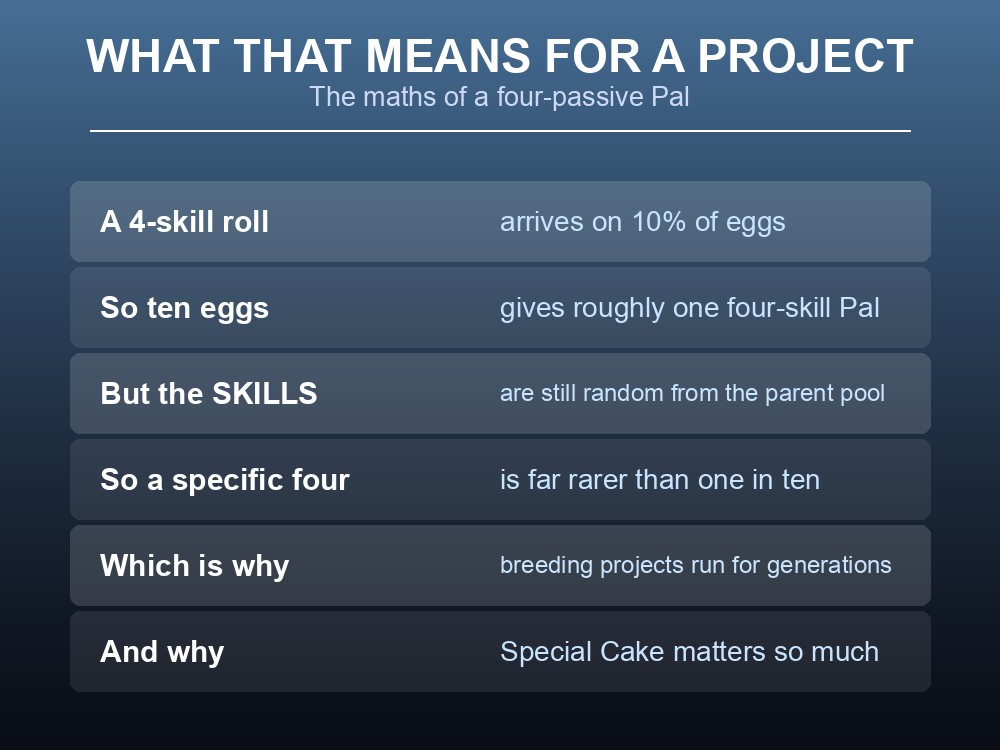
Ten percent sounds workable, and it is — for the count. Roughly one egg in ten produces a clean four-skill inherit.
But the count is not the whole problem. The four skills that come through are drawn from what the parents carry, so a specific set of four is far rarer than one in ten. If both parents carry exactly the four you want and nothing else, the 10% is the whole answer. If they carry six between them, you are also rolling on which four.
Which is why the first job in any breeding project is narrowing the parents, not rolling eggs. Two parents carrying only the target passives turn a compound problem into a single 10% roll.
And that is why projects run for generations. Each generation is spent removing unwanted passives from the pool so that the final roll is clean.
Do the arithmetic before you start. At 10% per egg and a Vegetable Cake giving two eggs a cycle, a four-skill result is about five cycles of farm time — assuming the parents are already clean.
How to Cut the Odds Down
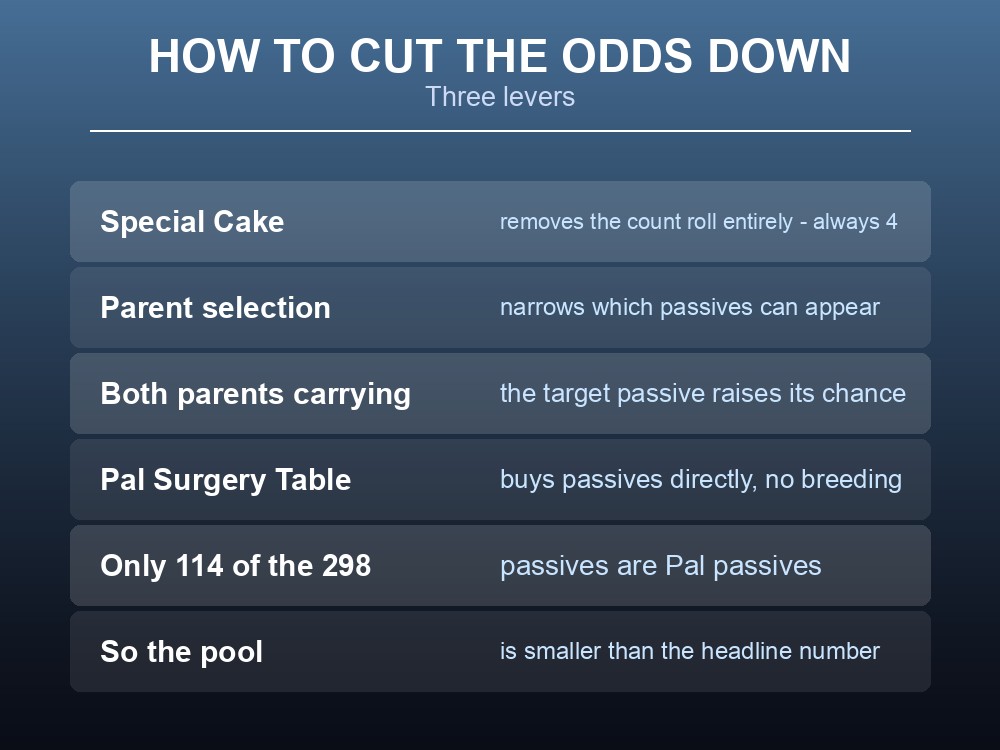
Special Cake removes the count roll entirely. As covered in our cakes guide, a Special Cake gives always 4 passives and inherits all active skills — turning the 10% into a certainty. It is the single largest improvement available, and it is why the standard workflow is to hunt with one cake and finish with another.
Parent selection is the other half. Since the inherited skills come from the parents, every unwanted passive on a parent is a way for the roll to go wrong. Breeding intermediate generations purely to strip passives is not wasted time — it is the work.
And the pool is smaller than it looks. As our passive catalogue sets out, Palworld lists 298 passive skills but only 114 are Pal passives — so a random passive is drawn from 114, not 298. That is a meaningfully better denominator than the headline number suggests.
The Pal Surgery Table is the non-breeding route. It buys passives directly, which sidesteps the inheritance roll completely — worth comparing against five cycles of farm time before you commit to breeding at all.
Combine all three and the project changes shape: clean parents, a Special Cake, and surgery for anything stubborn. That is a short project. Rolling basic cakes at unfiltered parents is not.
Practical tips
- Published odds: 4 skills 10%, 3 skills 12%, 2 skills 24%, 1 skill 40%.
- These are odds of a CLEAN inherit — no additional random skills.
- The four values total 86%; the rest falls outside that case.
- A single passive at 40% is the most common outcome by far.
- A specific four is rarer than 10% unless the parents are already clean.
- Strip unwanted passives in intermediate generations — that is the real work.
- Special Cake makes four passives certain, removing the roll.
- Random passives are drawn from 114 Pal passives, not 298.
Running your own Palworld 1.0 server
A generational breeding project is measured in weeks, not evenings, and every generation has to survive to the next session. A gamever Palworld server keeps your farm and Pal box persistent with full crossplay, automatic updates and one-click backups.
Conclusion
Palworld publishes its passive inheritance odds, and they are worth knowing before a project starts: four skills at 10%, three at 12%, two at 24% and one at 40% — with the important caveat that these describe inheriting all the parents' passives cleanly, without additional random skills, rather than simply how many the baby ends up with. The four values total 86%. The practical consequence is that a single passive is four times more likely than all four, and that a specific four is rarer than 10% whenever the parents carry passives you do not want — which is why the real work of breeding is stripping the parent pool across intermediate generations. Three levers cut the problem down: a Special Cake makes four passives certain, clean parents turn a compound roll into a single one, and the Pal Surgery Table buys passives outright. Random passives are drawn from 114 Pal passives, not the 298 headline figure.
Want a project that spans weeks? Rent a Palworld server at gamever.io — instant setup, one-click backups and updates, full crossplay and 24/7 uptime. Start with a free trial and use promo code WELCOME.