
Palworld 1.0 Egg Guide: Which Egg Hatches Which Pal
Hatching eggs is the quietest way to add Palworld 1.0's new Pals to your Paldeck — no Level 79 Alpha fight, no coordinate hunting, just an incubator and patience. The problem is that most parent-pair breeding combos for the 1.0 Pals are not documented yet, so you cannot look up "A + B = Renjishi". What you can do is target the right egg. This guide maps every documented egg type to the 1.0 Pals it hatches, and explains how to read an egg's name so you know what is inside before it cracks.
How Egg Names Work
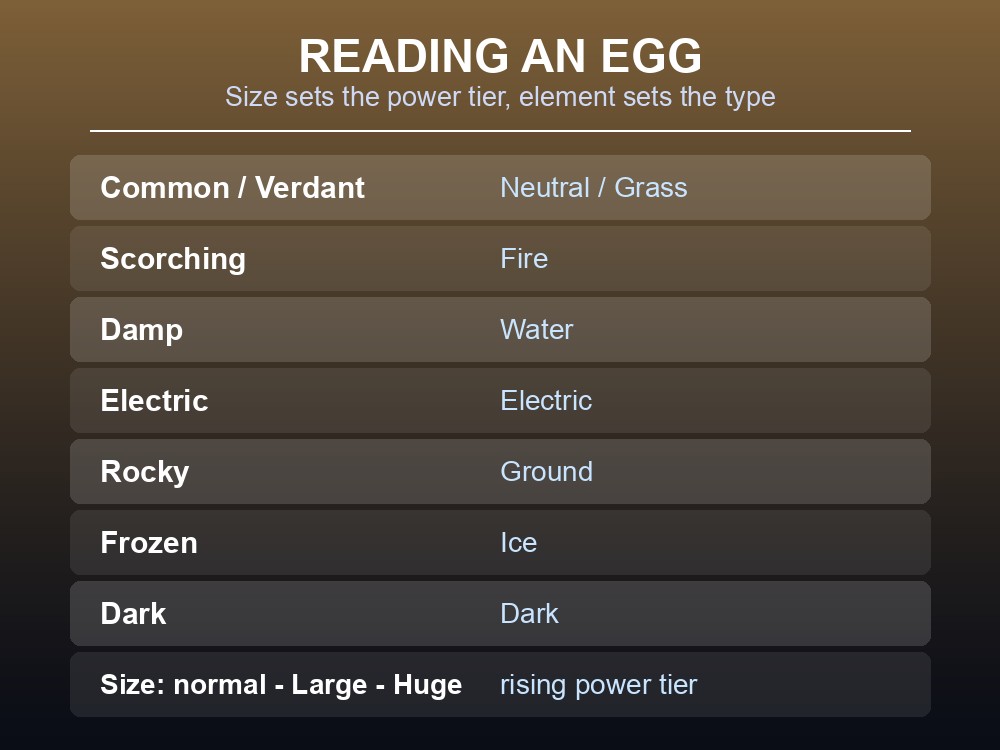
An egg's name tells you two things, and once you see the pattern you can predict any hatch:
- The element word sets the Pal's type: Common → Neutral, Verdant → Grass, Scorching → Fire, Damp → Water, Electric → Electric, Rocky → Ground, Frozen → Ice, Dark → Dark.
- The size prefix sets the power tier: plain egg → Large → Huge, in rising order.
This holds across every documented 1.0 hatch. A Large Scorching Egg produces a strong Fire Pal; a plain Rocky Egg produces an early-game Ground Pal.
The one exception worth knowing: elemental variants hatch from their base form's egg type, not from an egg matching their own element. Petallia Ignis is a Fire Pal, but it comes from a Huge Verdant Egg — because base Petallia is Grass. Expect the same logic for other Ignis, Cryst, Lux, Noct, Terra and Primo variants.
Every Documented Hatch
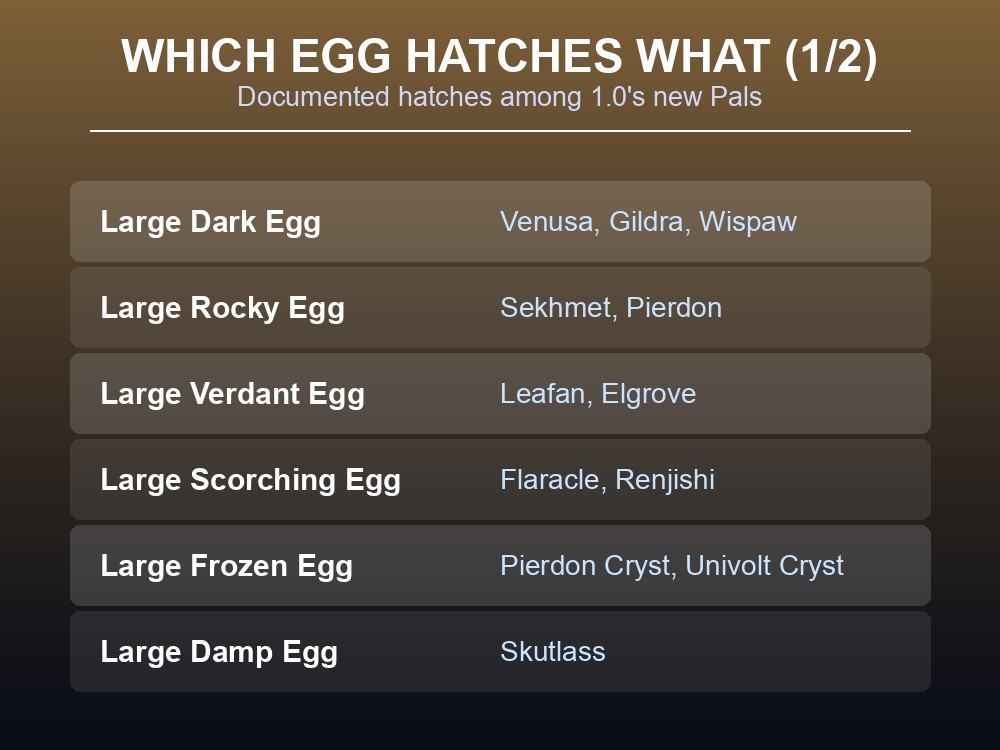
Large eggs
| Egg | Hatches | CombiRank |
|---|---|---|
| Large Dark Egg | Venusa | 970 |
| Gildra | 1,170 | |
| Wispaw | 2,250 | |
| Large Rocky Egg | Sekhmet | — |
| Pierdon | 1,110 | |
| Large Verdant Egg | Leafan, Elgrove | — |
| Large Scorching Egg | Renjishi | 290 |
| Flaracle | — | |
| Large Frozen Egg | Pierdon Cryst, Univolt Cryst | — |
| Large Damp Egg | Skutlass | 1,420 |
Huge eggs
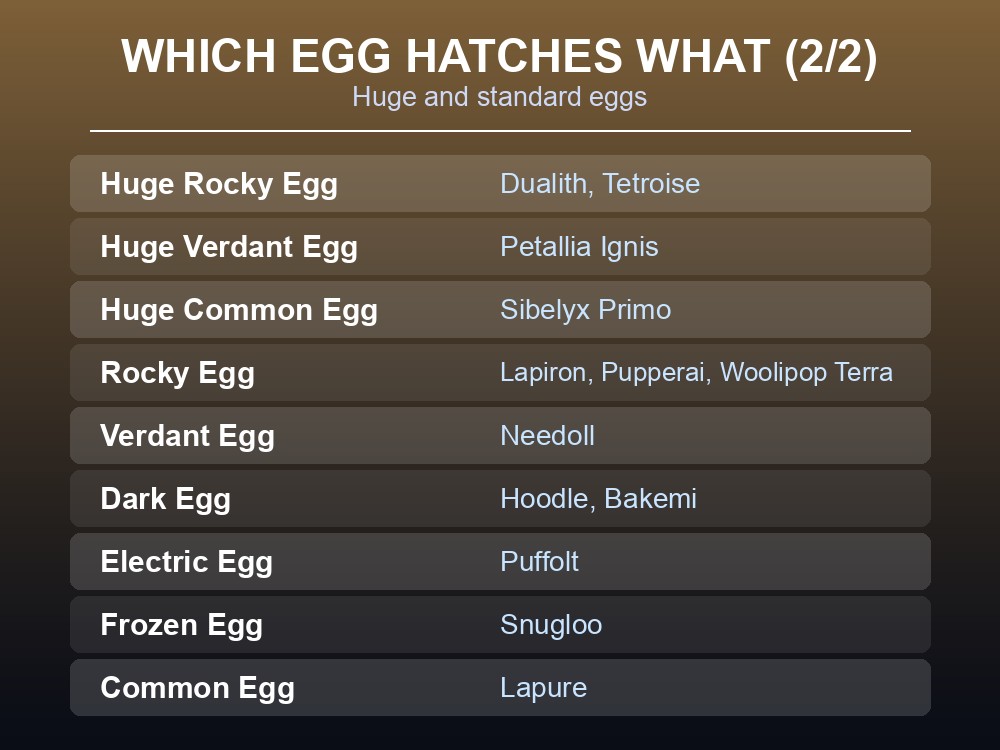
| Egg | Hatches | CombiRank |
|---|---|---|
| Huge Rocky Egg | Dualith, Tetroise | — |
| Huge Verdant Egg | Petallia Ignis (Fire variant) | 820 |
| Huge Common Egg | Sibelyx Primo | — |
Standard eggs
| Egg | Hatches | CombiRank |
|---|---|---|
| Rocky Egg | Lapiron, Pupperai, Woolipop Terra | — |
| Verdant Egg | Needoll | — |
| Dark Egg | Bakemi | 1,540 |
| Hoodle | 1,770 | |
| Electric Egg | Puffolt | 2,360 |
| Frozen Egg | Snugloo | — |
| Common Egg | Lapure | 810 |
What CombiRank Actually Tells You
Every Pal has a CombiRank value — a hidden breeding-power number that runs from about 20 for the rarest Pals up to 3,100 for the most common in 1.0's data — and it is what makes breeding predictable at all.
For any pair that is not a same-species pairing or one of the game's fixed special combos, the game averages the two parents with the formula floor((parent1 + parent2 + 1) / 2) and hands you the Pal whose CombiRank sits closest to that number, breaking ties toward the lower-priority Pal. Same-species parents simply produce that species.
Two practical consequences:
- A low CombiRank means an easy target. Renjishi at 290 is the lowest of any documented 1.0 hatch, which means comparatively low-ranked parents can average into it — a striking result for a Pal that also happens to be one of the update's hardest hitters (820 – 1,036 Attack) and its best Kindling Lv8 worker.
- A high CombiRank means hard to reach by accident. Puffolt at 2,360 and Wispaw at 2,250 sit near the top of the documented range, so you will not stumble into them from mid-tier pairs.
The rest of the documented 1.0 ranks, for reference: Hoodle 1,770 · Bakemi 1,540 · Skutlass 1,420 · Gildra 1,170 · Pierdon 1,110 · Venusa 970 · Petallia Ignis 820 · Lapure 810 · Renjishi 290.
The Honest Caveat: Parent Combos Are Not Documented
For the large majority of Palworld 1.0's new Pals, no specific A + B parent pairing is published yet. That includes Ophydia, Solmora, Solenne, Tropicaw, Dualith and most of the World Tree roster — the data confirms the egg type and the CombiRank, but not a recipe.
So the practical breeding workflow right now is:
- Identify the egg type your target hatches from, using the tables above.
- Breed pairs whose average CombiRank lands near your target, then check what egg the Cake Farm produces.
- Collect that egg type in the wild too. Eggs spawn as world pickups, and a Large Scorching Egg found in a volcanic zone is the same egg your farm would produce.
Do not wait for a combo list to appear before you start breeding. Targeting the egg type gets you most of the way there.
Which Eggs Are Worth Chasing
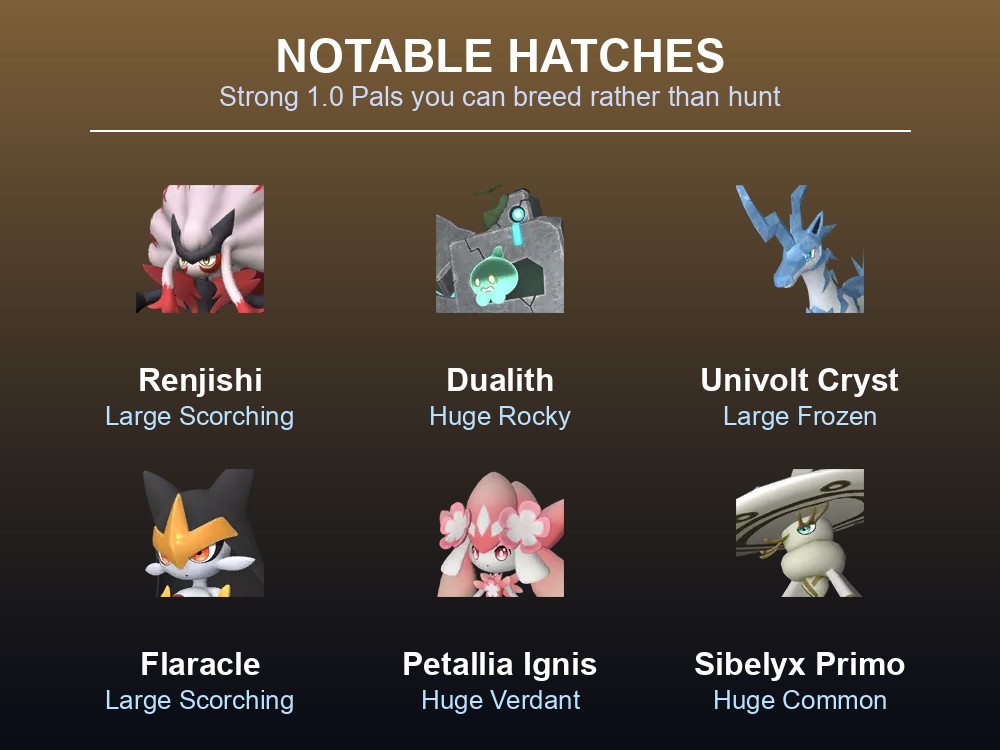
- Large Scorching Egg — the best value in the game right now. It hatches Renjishi (Kindling Lv8, 820 – 1,036 Attack) and Flaracle (Kindling Lv7, 850 – 1,075 Attack), and Renjishi's CombiRank of 290 makes it unusually reachable.
- Huge Rocky Egg — hatches Dualith, which covers five base jobs (Mining Lv6, Transporting Lv6, Lumbering Lv5, Planting Lv3, Gathering Lv3) and is rideable.
- Large Frozen Egg — hatches Univolt Cryst, whose partner skill converts your attack type to Ice and adds 5 – 20% Attack while mounted. That is the cheapest answer to a Dragon-heavy endgame.
- Large Dark Egg — three hatches from one egg type (Venusa, Gildra, Wispaw). Gildra brings a self-revive and Wispaw improves back-throw capture rates.
- Rocky Egg — the early-game pick. Pupperai spawns at Level 2 – 4 anyway, but a Rocky Egg is a free path to Lapiron and Woolipop Terra, and Woolipop Terra reduces Base Pal hunger depletion by 15 – 25%.
Practical tips
- Every egg type has a preferred incubation temperature, and hitting it grants an incubation speed bonus. Scorching eggs want heat, Frozen eggs want cold — place the incubator in a matching biome or next to a heating or cooling source.
- Elemental variants come from the base form's egg. If you are hunting an Ignis, Cryst or Lux variant, work out what the base Pal is and target that egg type.
- Hatch, do not just catch, when you want passives. A bred Pal inherits from its parents, so breeding is how you get a Level 80 Pal at the top of its stat range rather than the bottom.
- Pick up every egg you walk past. Eggs are free Paldeck entries and free condensing fodder, and the wild ones cost you nothing but inventory weight.
- CombiRank is averaged, not added. Two very high-ranked parents will not produce something above both of them.
Running your own Palworld 1.0 server
Breeding is the part of Palworld that most rewards a world that never sleeps. On a dedicated Palworld 1.0 server your Cake Farm keeps producing and your incubators keep counting down while you are logged off, so eggs are ready when you next sit down rather than hours away. Full crossplay lets your group pool parents and share a breeding pen across platforms, and one-click backups plus automatic updates protect a pen that may represent weeks of pairing work.
Conclusion
Egg names in Palworld 1.0 are a readable code: the element word gives you the type, the size prefix gives you the tier, and elemental variants hatch from their base form's egg — which is why the Fire-typed Petallia Ignis comes out of a Huge Verdant Egg. Parent-pair combos for the new roster are still undocumented, so target the egg type and use CombiRank averages instead. The best egg to chase is the Large Scorching Egg: it hatches Renjishi and Flaracle, two of the update's strongest Pals, and Renjishi's CombiRank of just 290 makes it the most reachable good Pal in the game.
Want your incubators running around the clock? Rent a Palworld server at gamever.io — instant setup, one-click backups and updates, full crossplay and 24/7 uptime. Start with a free trial and use promo code WELCOME.