
CombiRank in Palworld: The Hidden Number That Decides Every Breeding Pair

Palworld breeding is not random. Every Pal carries a hidden "breeding power" value — CombiRank — and the child is decided by a formula you can compute in your head: average the two parents, find the Pal closest to that number. Which means every pairing outside the 162 special combinations has a predictable, single answer. And it produces one hard limit: you can never breed a Pal rarer than your rarest parent.
What CombiRank Is

| Pals with a rank | 297 |
| Direction | Lower is rarer and more powerful |
| Published range | Under 800 up to 3,100 |
Lower means better, which is the opposite of most stat conventions and the first thing to internalise. The wiki puts it plainly: "The lower the number the more rare or powerful the Pal is."
Read a sample and the ordering is obvious:
| Pal | Rank |
|---|---|
| Relaxaurus Lux | 770 |
| Wumpo | 830 |
| Grizzbolt | 1,020 |
| Mossanda | 2,060 |
| Pengullet | 2,960 |
| Green Slime, Cave Bat | 3,100 |
One caveat worth flagging. The Breeding Farm page's prose says breeding power is "a hidden number between 10 and 1500", but the published table runs to 3,100. The two disagree, and the table is the one that matches the current roster — the prose appears to predate the game's later Pals. Use the table.
How Breeding Uses It
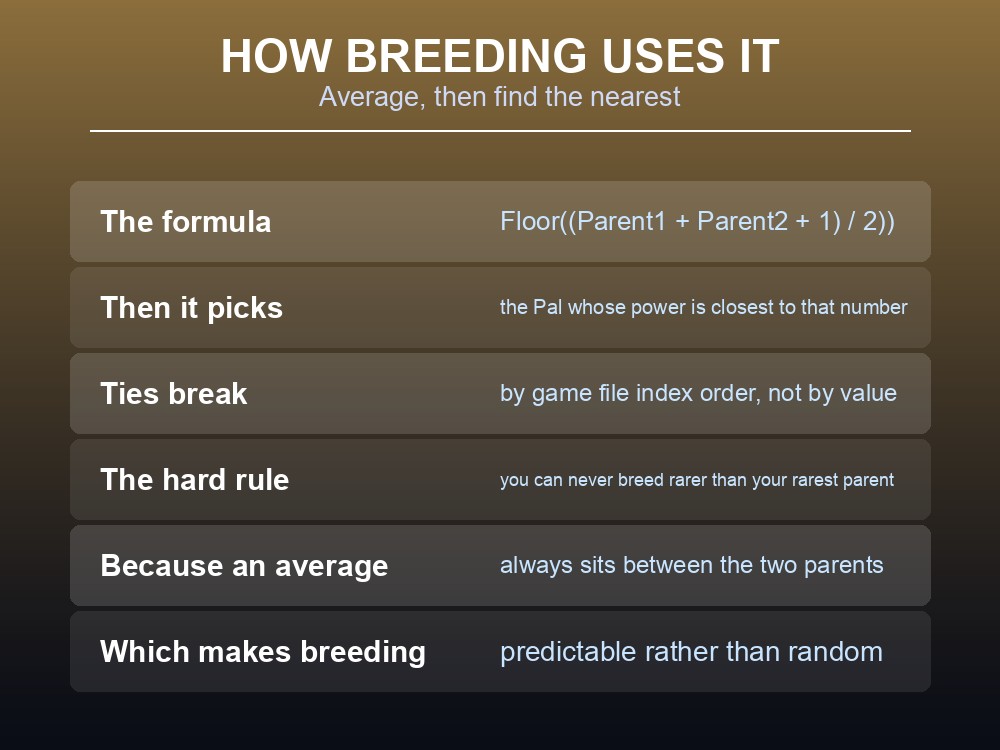
The formula is published exactly:
Floor((Parent1 Power + Parent2 Power + 1) ÷ 2) = Baby Power
In words: add both parents' ranks, add one, halve it, round down. Then the game picks the Pal whose power is closest to that number.
The worked example from the wiki: if the baby power comes out at 1015, and the nearest values are 1010 (Felbat) and 1020 (Robinquill), the result is Robinquill.
And the tie-break is not what you would guess. 1015 is exactly between the two, and the winner is decided by which Pal comes first in the game files' index — not by rounding up, not by rarity. Robinquill wins because it is indexed first.
That makes non-unique breeding fully deterministic. Same two parents, same child, every time. There is no roll to reroll — if you got a Pal you did not want, the answer is different parents, not another egg.
The exception is the 162 unique breed pairs, which override the formula entirely. Check that list first; if your pair is on it, the arithmetic does not apply.
The Rule That Falls Out of It
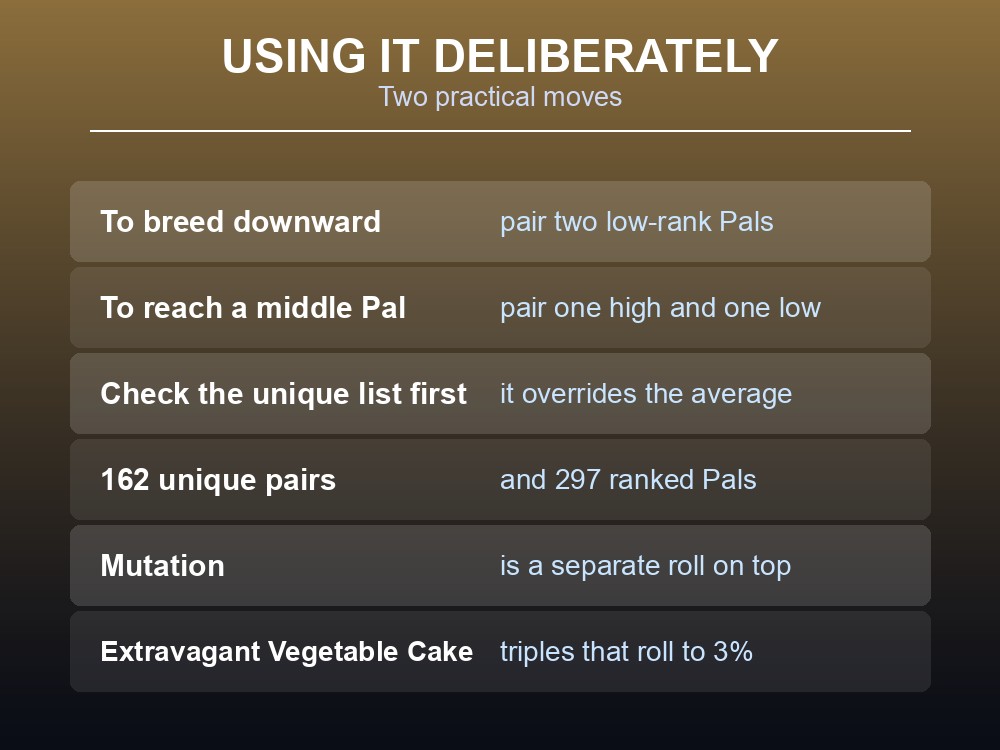
Because the result is always an average, it always sits between the two parents. The wiki states the consequence directly: "you can never breed a Pal stronger/rarer than your strongest/rarest parent."
That is the single most important fact about Palworld breeding, and it kills a whole category of plan. You cannot pair two mid-tier Pals and work upward toward a legendary. The rarest Pal you own is a ceiling, and breeding only ever moves you within the range you already have.
So breeding is for filling gaps, not for climbing. Its uses are:
- Reaching a Pal between two you own — pair one high-rank and one low-rank Pal to land in the middle.
- Duplicating downward — two low-rank parents produce a low-rank child.
- Hitting a specific target — compute the average you need and work backwards to the parents.
To go rarer than anything you own, you have to catch it, hatch it or fight for it. As our egg type guide covers, a Huge Dark Egg is one of the few routes to a legendary that does not require already having one.
Mutation is a separate roll on top, and it is the one thing that can produce something outside the expected result. The baseline is 1%, and an Extravagant Vegetable Cake triples it to 3%.
Practical tips
- 297 Pals carry a CombiRank, and lower is rarer.
- The formula is Floor((P1 + P2 + 1) ÷ 2), then the nearest Pal to that number.
- Ties break by game file index order, not by value or rarity.
- Non-unique breeding is deterministic — the same parents always give the same child.
- You can never breed rarer than your rarest parent.
- Check the 162 unique pairs first — they override the formula.
- The published table runs to 3,100, despite prose claiming a 10–1500 range.
- Mutation is a separate 1% roll, tripled to 3% by an Extravagant Vegetable Cake.
Running your own Palworld 1.0 server
A breeding plan is a chart of ranks and a farm running across many sessions. A gamever Palworld server keeps your Pal box, your farm and your world persistent with full crossplay, automatic updates and one-click backups, so a multi-generation project actually finishes.
Conclusion
Palworld breeding runs on CombiRank, a hidden "breeding power" on each of 297 Pals where lower means rarer and more powerful — from Relaxaurus Lux at 770 up to the slimes at 3,100. The formula is published exactly: Floor((Parent1 + Parent2 + 1) ÷ 2), after which the game picks the Pal whose power is closest, breaking ties by game file index order rather than by value. That makes every non-unique pairing deterministic: the same two parents always produce the same child, so a disappointing result needs different parents rather than another egg. And because the result is always an average, the wiki's own consequence holds — you can never breed a Pal rarer than your rarest parent. Breeding fills gaps in a roster; it does not climb one. Note also that the page's prose claims a 10–1500 power range while the table itself runs to 3,100 — trust the table.
Want a breeding project that finishes? Rent a Palworld server at gamever.io — instant setup, one-click backups and updates, full crossplay and 24/7 uptime. Start with a free trial and use promo code WELCOME.