
Wind, Rain and Cinders: Valheim's Weather and What It Costs You
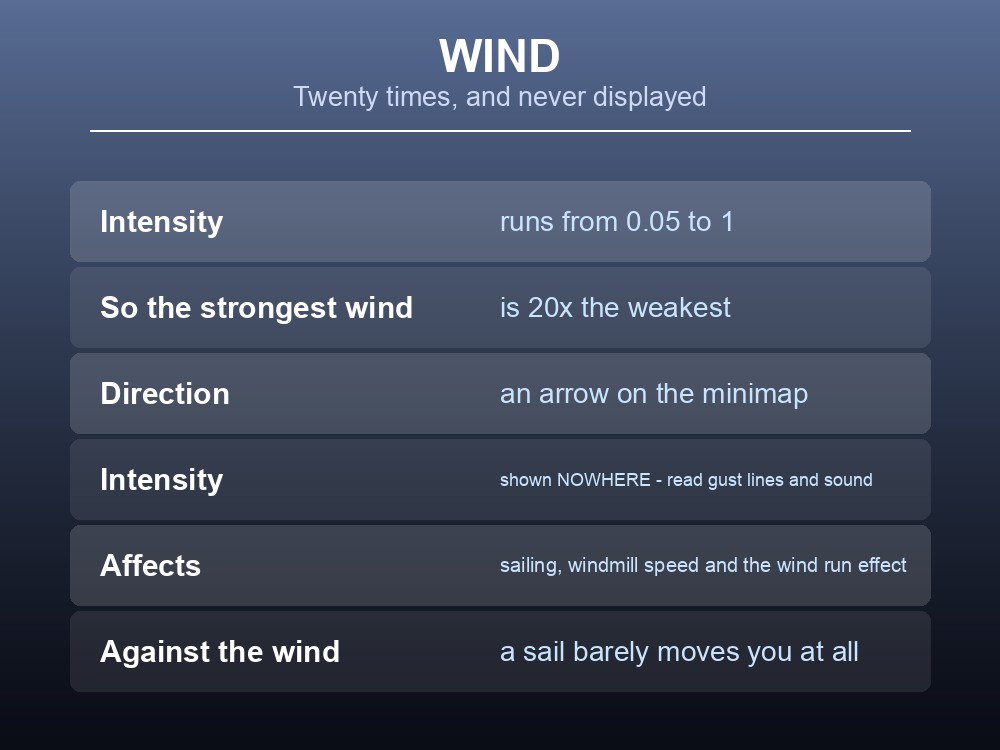
Valheim's wind runs from 0.05 to 1 — meaning the best sailing conditions are twenty times stronger than the worst — and the game never shows you the number. You get an arrow for direction on the minimap and nothing at all for intensity, which is why a crossing that took eight minutes yesterday takes half an hour today. Rain quietly erodes your buildings, fog cripples your windmills, and in the Ashlands the sky sets your house on fire. Here is what weather actually does.
On sourcing. Iron Gate do not publish these figures. The values below come from the community Valheim wiki, and can change with any patch.
Wind
Intensity ranges from 0.05 to 1 — "the strongest possible wind is 20 times stronger than the weakest."
Direction is shown as an arrow in the lower-left of the minimap. Intensity is not shown anywhere. You read it from sound, gust lines and leaves blowing through the world.
Wind affects three systems:
| System | Effect |
|---|---|
| Sailing | Speed and whether you can make headway at all |
| Windmill | Processing speed |
| Wind run effect | Movement |
Sailing against the wind is not merely slow — it is close to impossible. "If the wind is blowing against the player's intended direction of travel, it becomes impossible to move a boat forward with the sail unfurled, and it can only crawl forward at the lowest speed."
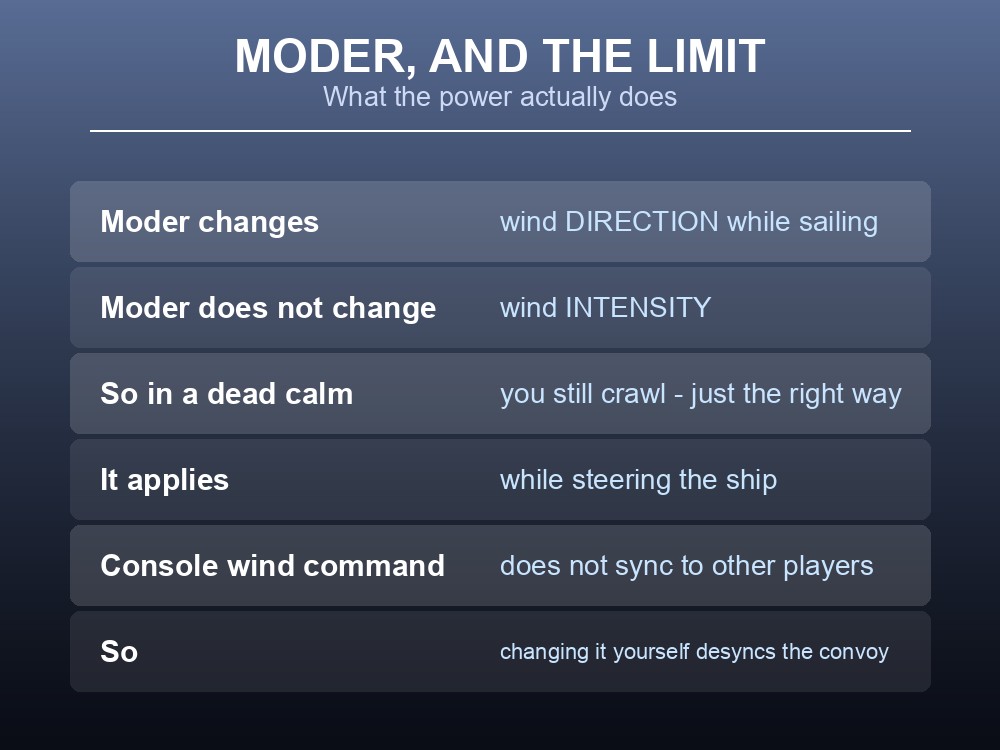
Moder's Forsaken power is the answer, and its limits are precise: it "changes the wind direction while sailing (while steering the ship), but not wind intensity." So Moder guarantees a favourable direction, never a fast one. In a 0.05 wind you will still crawl — just in the right direction.
One multiplayer caveat: "The wind console command doesn't change wind direction for other players in multiplayer." Changing it for yourself desyncs the fleet.
Rain and Weathering
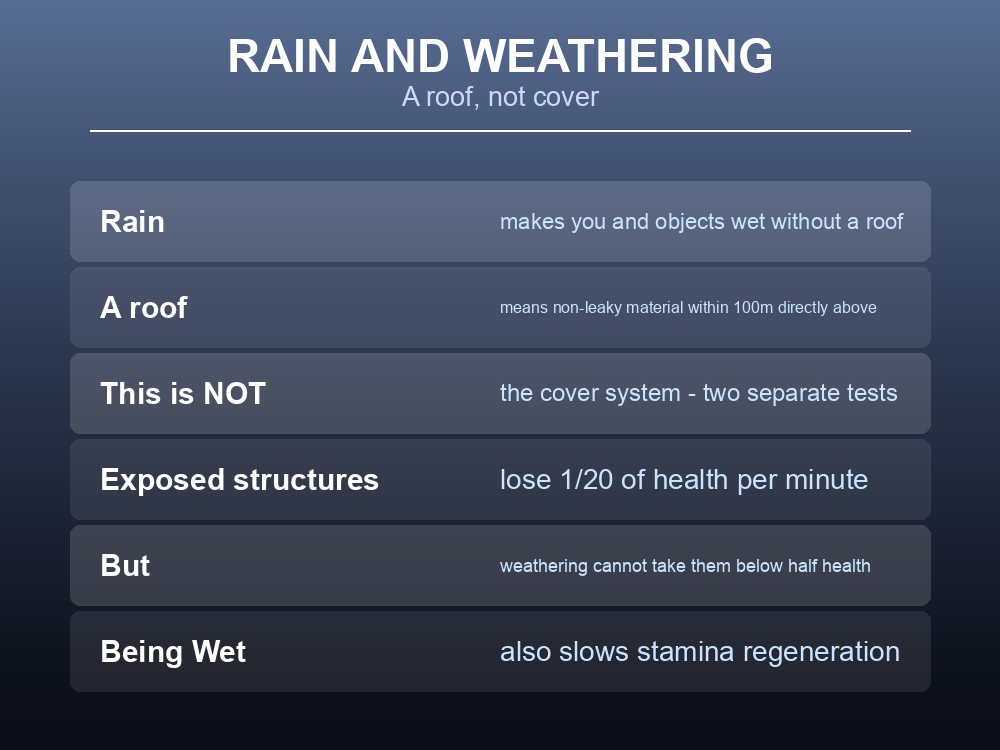
Rain makes you and your objects wet unless there is a roof — and "roof" has a specific definition here:
"A roof will protect from rain if it is within 100 meters directly above the center of the object in question."
And this is explicitly not the cover system. "This is not the same as the Shelter Effect — shelter checks that a player is mostly enclosed in all directions, whereas rain can only be deterred by a non-'leaky' object directly above."
So a roof on tall posts stops rain but may fail the 70% cover a workbench needs, while a sealed room with a leaky roof passes cover and still gets you wet. Two systems, two tests.
Weathering is real damage, with a floor:
- Structures exposed to rain or still water take 1/20 of their health per minute.
- They cannot be reduced below half health by weathering alone.
- They visibly wear as damage accumulates.
That floor is the reassuring part — rain will never destroy a building. But a structure sitting at half health is one raid away from gone, which is the real cost of an unroofed outpost.
Being Wet also slows stamina regeneration, which compounds with Cold and Freezing. In the Swamp, where it always rains, that is a permanent tax.
Fog and Cinder Rain
Fog appears in several biomes, notably the Ocean and the Plains, and it does two things:
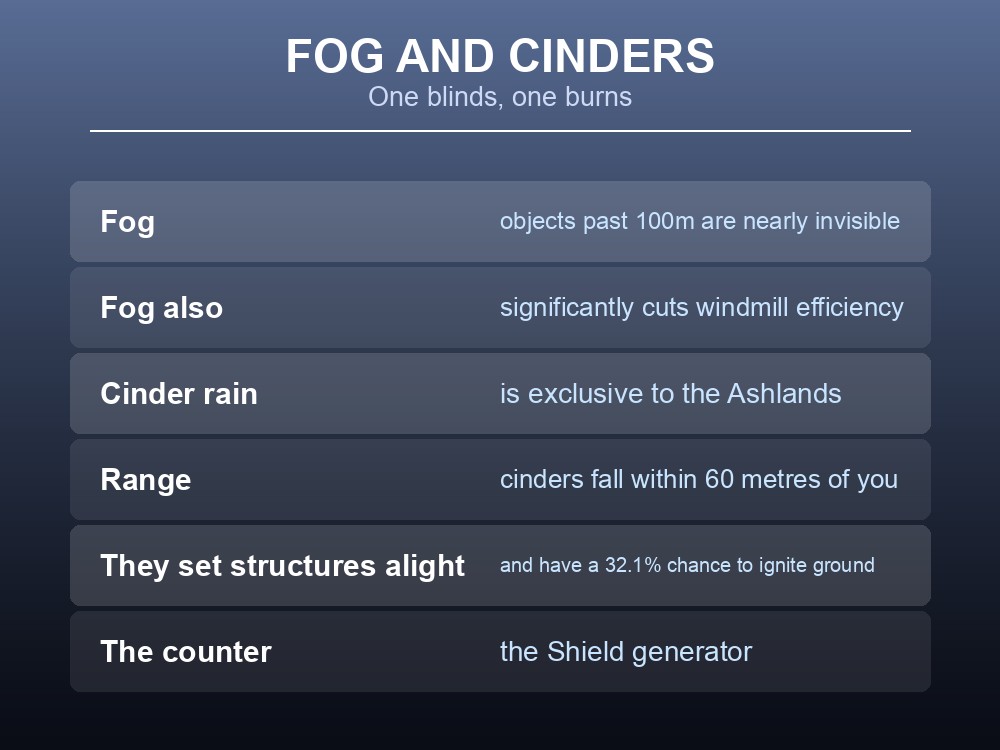
- Visibility collapses — "objects over 100m away being nearly impossible to see." The wiki's own example: a Fuling tower is roughly visible at 30 m and "almost completely shrouded" at 80 m.
- Windmills lose significant efficiency.
That second effect surprises people. Fog is not only a visibility problem; it is a production problem, and a windmill in a foggy Plains base underperforms one in clear Meadows.
Cinder rain is exclusive to the Ashlands and is the most destructive weather in the game:
| Property | Detail |
|---|---|
| Range | Cinders fall within 60 metres of the player |
| On structures | They set them on fire |
| On ground | 32.1% chance to set the ground alight for 30 seconds |
| Counter | The Shield generator |
| Volume | Depends on the current weather |
A 32.1% chance per cinder to start a ground fire, falling continuously across a 60-metre radius, is why unprotected Ashlands construction does not survive. The Shield generator is not optional there — it is the building permit.
Planning Around Weather
Five habits that follow from the numbers:
- Roof every structure you care about, even open-sided. A roof within 100 m directly above stops weathering entirely — and weathering runs at 3% of health per minute.
- Carry Moder for any long crossing. It fixes direction, which is the difference between sailing and not sailing; it will not fix a dead calm.
- Read the leaves, not the minimap. Direction is displayed, intensity is not — gust lines and sound are your only gauge.
- Do not site a windmill in a fog biome. Plains and coastal fog measurably cut output.
- In the Ashlands, build the Shield generator first. Cinders damage structures before you have finished them.
On a shared server, weather is world state and everyone gets the same conditions — so a group crossing together shares the wind. The one exception is the console wind command, which changes it only for the person who ran it, and will desync a convoy.
And weather interacts with the sleeping rules. Rain makes you Wet, and being wet blocks sleeping entirely — so a group arriving home in a storm has to dry off at a fire before anyone can skip the night.
Practical tips
- Wind runs 0.05 to 1 — the strongest is 20× the weakest, and intensity is never displayed.
- Sailing into the wind with sail unfurled barely moves you at all.
- Moder fixes wind direction while sailing — but not intensity.
- Rain needs only a roof within 100 m directly above, which is not the same as cover.
- Weathering costs 1/20 of health per minute but stops at half health.
- Fog cuts visibility past 100 m and reduces windmill efficiency.
- Ashlands cinders fall within 60 m, ignite structures, and have a 32.1% chance to set the ground alight for 30 s.
- The Shield generator is the counter to cinder rain.
Running your own Valheim server
Weather is world state shared by everyone on it, and long crossings are exactly the kind of thing a group plans around a persistent world rather than a session that ends when the host logs off. A gamever Valheim server keeps that world running around the clock for up to 10 players, takes one-click backups, and updates automatically so client and server versions never drift apart.
Conclusion
Valheim's wind intensity runs from 0.05 to 1 — a twentyfold range that the interface never shows you, leaving gust lines and sound as your only gauge — and it drives sailing, windmill output and the wind run effect. Sailing into the wind is close to impossible, and Moder's power fixes direction while sailing but not intensity. Rain makes objects wet unless a non-leaky roof sits within 100 metres directly above — a different test from the cover system — and weathers exposed structures at 1/20 of their health per minute, stopping at half health. Fog past 100 metres blinds you and cuts windmill efficiency. And in the Ashlands, cinders fall within 60 metres, set structures alight, and have a 32.1% chance of igniting the ground for 30 seconds — which makes the Shield generator a prerequisite for building there at all.
Want the crossing planned around the world, not the host's schedule? Rent a Valheim server at gamever.io — instant setup, one-click backups and updates, and 24/7 uptime. Start with a free trial and use promo code WELCOME.