
Where Valheim's Enemies Actually Come From: Spawn Zones Explained
Valheim spawns creatures in a ring 40 to 80 metres around a player — never closer. The map is divided into 64 × 64 metre zones, each zone runs its own spawners every four seconds while a player is in it, and every spawn attempt has to clear a list of nine separate checks before anything appears. Understanding that list tells you exactly why a cleared area stays clear, why terraforming does not stop spawns, and why the greydwarves keep arriving from the same direction.
On sourcing. Iron Gate do not publish this. The details below come from the community Valheim wiki, and can change with any patch.
The Spawn Loop
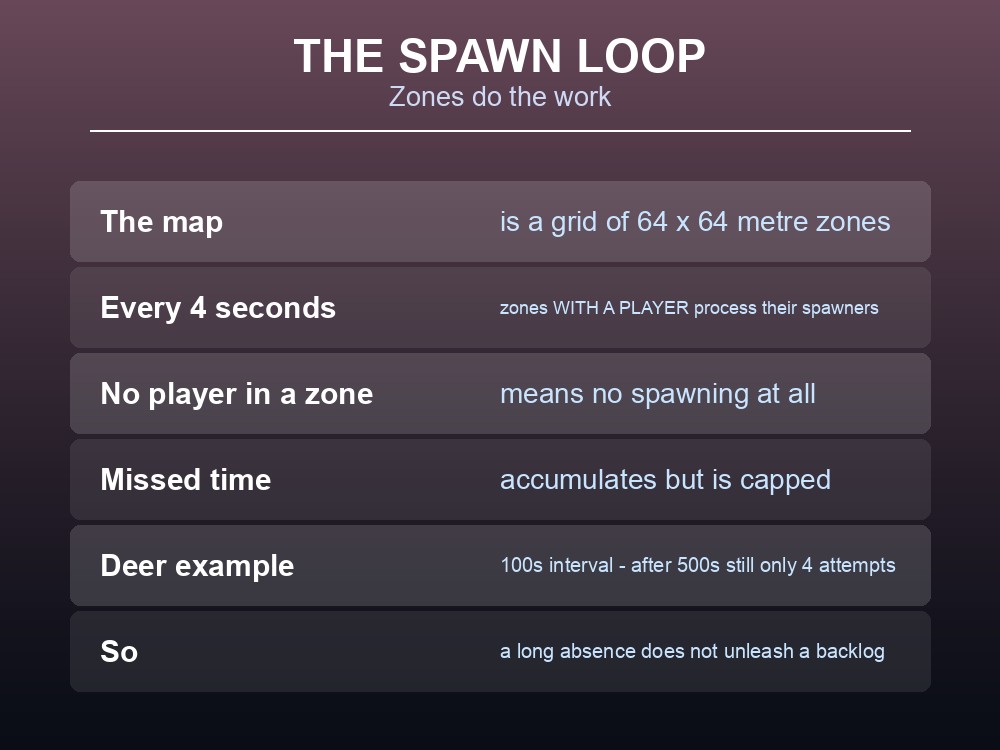
The map is a grid of 64 × 64 metre zones, with 0,0 at the centre of the first zone.
"Every 4 seconds, zones with a player process their spawners."
No player in the zone means no spawning at all. That is the foundation of every quiet-base strategy.
Each spawner has its own interval, and missed time accumulates — up to a cap:
The wiki's example: Deer have a 100-second spawn interval. After 250 seconds, 2 attempts are made. After 500 seconds, only 4 — "because the limit is 4."
So leaving an area and returning does not unleash a backlog. The catch-up is bounded, which is why a long absence does not produce a horde on arrival.
The Nine Checks
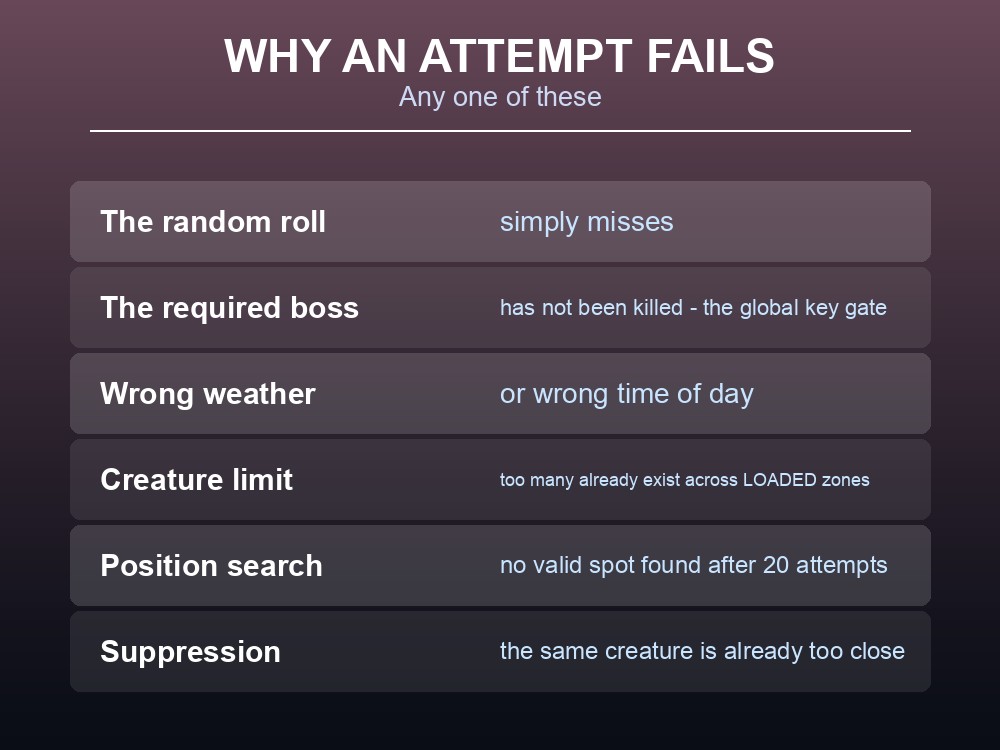
A spawn attempt fails if any of these is true:
| Check | Fails when |
|---|---|
| Random roll | The roll simply misses |
| Boss gate | The required boss has not been killed |
| Weather | Wrong weather for that spawner |
| Time of day | Wrong time |
| Creature limit | Too many of the same creature already exist in loaded zones |
| Position search | No valid position found after 20 attempts |
| Suppression | The same creature is already too close to the chosen spot |
The boss gate is the mechanism behind global keys. Killing a boss flips a flag that unlocks spawners world-wide — which is why a newcomer joining an advanced server meets enemies their gear cannot handle.
The creature limit counts across all loaded zones, not per zone. Clearing greydwarves in one direction genuinely reduces pressure in another, because they share a cap.
What Makes a Position Valid
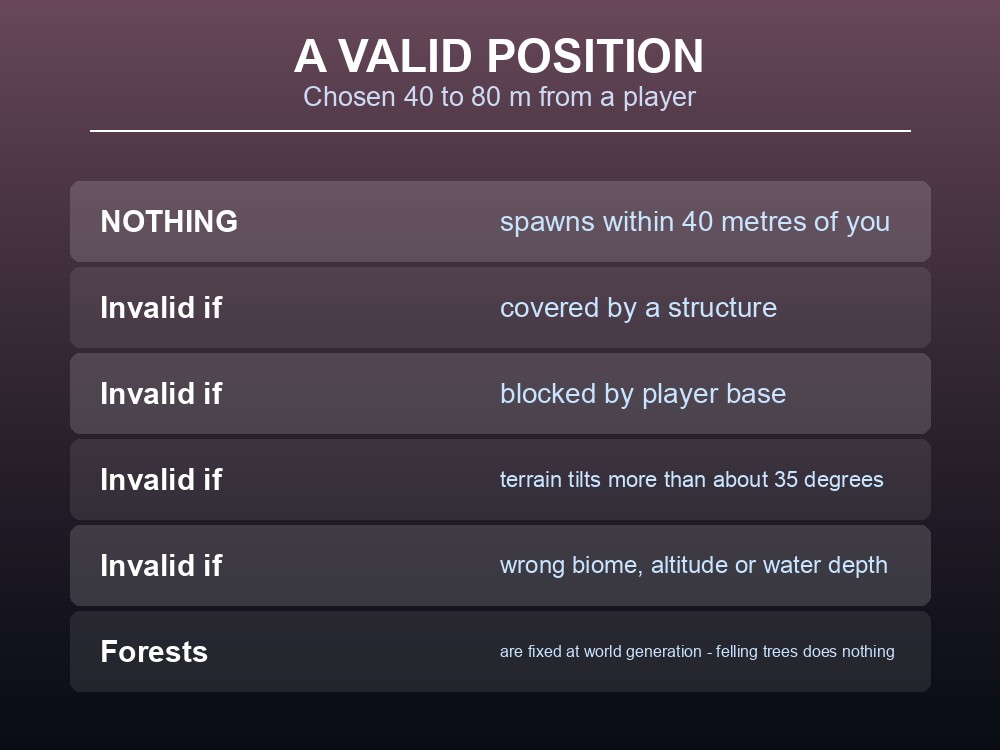
A spawn position is picked randomly between 40 and 80 metres of a random player in the zone, then rejected if:
- The biome is wrong, or the zone has multiple biomes where a full biome is required.
- It is covered by a structure.
- It is blocked by player base.
- The altitude is wrong.
- The terrain angle is wrong — max tilt 35 degrees by default.
- The water depth is wrong.
- A player is within 40 metres.
- It is not inside a forest, where a forest is required.
Three of these are directly actionable.
The 40-metre exclusion means you are always the safe centre. Nothing spawns on top of you — it spawns in a ring and walks in. That is why standing still feels safe and travelling feels dangerous.
Player base blocks spawns, which is the mechanic behind campfire perimeters — and it is the same 20-metre radius from about thirty structures.
And the forest rule is fixed at world generation. "Forests are determined on world generation, terraforming or the amount of planted trees have no effect." You cannot create or destroy a forest for spawn purposes. Clear-cutting a Black Forest does not stop greydwarf spawners; it only removes the trees.
Terraforming is not a spawn blocker either — "Terraforming with a Cultivator, Hoe or Pickaxes does not directly block spawning but affects terrain altitude and angle." It works indirectly, by pushing the ground past the 35-degree tilt limit or changing altitude — which is why steep artificial slopes around a base do suppress spawns, just not for the reason people assume.
Using the System
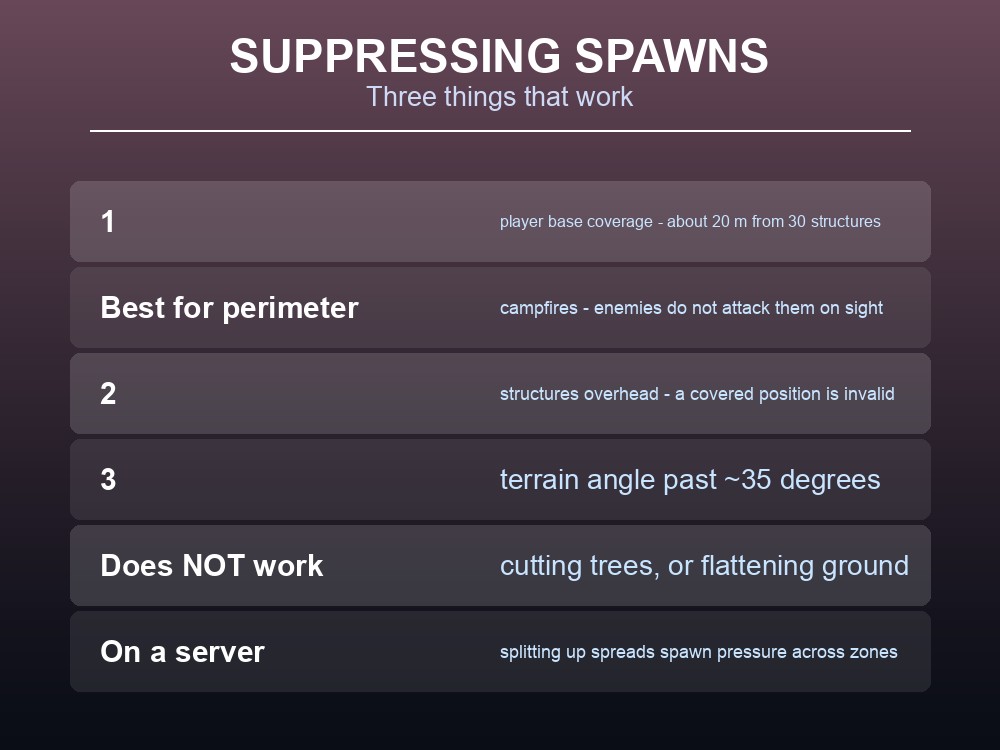
Three genuine ways to stop spawns, ranked by reliability:
- Player base coverage. Roughly thirty structures project 20 metres of it; campfires, bonfires and braziers are the ones enemies will not attack on sight, which makes them the right choice for a perimeter.
- Structures overhead. A covered position is invalid — flooring over an area works.
- Terrain angle. Anything past about 35 degrees of tilt fails the check. Raised or dug embankments help.
What does not work: cutting down trees, and terraforming flat ground in the hope it counts as "developed".
On a shared server there is one more lever most groups miss. Because spawners only run in zones containing a player, and positions are chosen relative to a random player in that zone, splitting up spreads spawn pressure across more zones — while everyone standing in one place concentrates it in one.
And the creature limit is shared across loaded zones, so a group actively clearing one area is measurably reducing spawns for everyone else nearby.
Practical tips
- Spawn positions are chosen 40–80 m from a player. Nothing spawns closer than 40 m.
- Zones are 64 × 64 m and only process spawners while a player is inside.
- Missed spawn time accumulates but is capped — long absences do not produce a backlog.
- The creature limit is shared across all loaded zones.
- Player base blocks spawns; structures overhead block them; terrain over ~35° blocks them.
- Cutting trees does nothing — forests are fixed at world generation.
- Terraforming only works indirectly, via altitude and slope.
- Splitting the group spreads spawn pressure across more zones.
Running your own Valheim server
Spawn behaviour is world state — boss flags, cleared areas, base coverage — and it only makes sense on a world that persists between sessions rather than one that lives inside a single player's game. A gamever Valheim server keeps it running around the clock for up to 10 players, takes one-click backups, and updates automatically so client and server versions never drift apart.
Conclusion
Valheim divides the map into 64 × 64 metre zones, processes each zone's spawners every 4 seconds while a player is in it, and picks spawn positions randomly between 40 and 80 metres from a player — so nothing ever spawns within 40 metres of you. Attempts fail on any of nine checks, including the boss gate that global keys control, a creature limit shared across all loaded zones, and a 20-attempt cap on finding a valid position. A position is invalid if it is covered by a structure, inside player base, steeper than about 35 degrees, at the wrong altitude, or outside a required forest — and that last one is fixed: forests are decided at world generation, so felling trees changes nothing. Terraforming does not block spawns directly, only through the altitude and slope it creates. The reliable suppressors are player base coverage, structures overhead and steep terrain, in that order.
Want the cleared ground to stay cleared between sessions? Rent a Valheim server at gamever.io — instant setup, one-click backups and updates, and 24/7 uptime. Start with a free trial and use promo code WELCOME.