
What Death Actually Costs in Valheim (All Six Death Penalty Settings)
Everyone knows Valheim punishes death. Very few groups know what the number actually is. On the default setting you lose 5% of every skill level — which, because levels get exponentially more expensive, works out at roughly an eighth of all the experience you have ever earned in each skill. Eight hours of grinding, and a death costs you one. Here is exactly what each of the six settings takes, and the mechanics around your tombstone that decide whether a bad night is recoverable.
On sourcing. Iron Gate expose the settings but do not publish the numbers. The figures below come from the community Valheim wiki, and can change with any patch.
The Six Settings
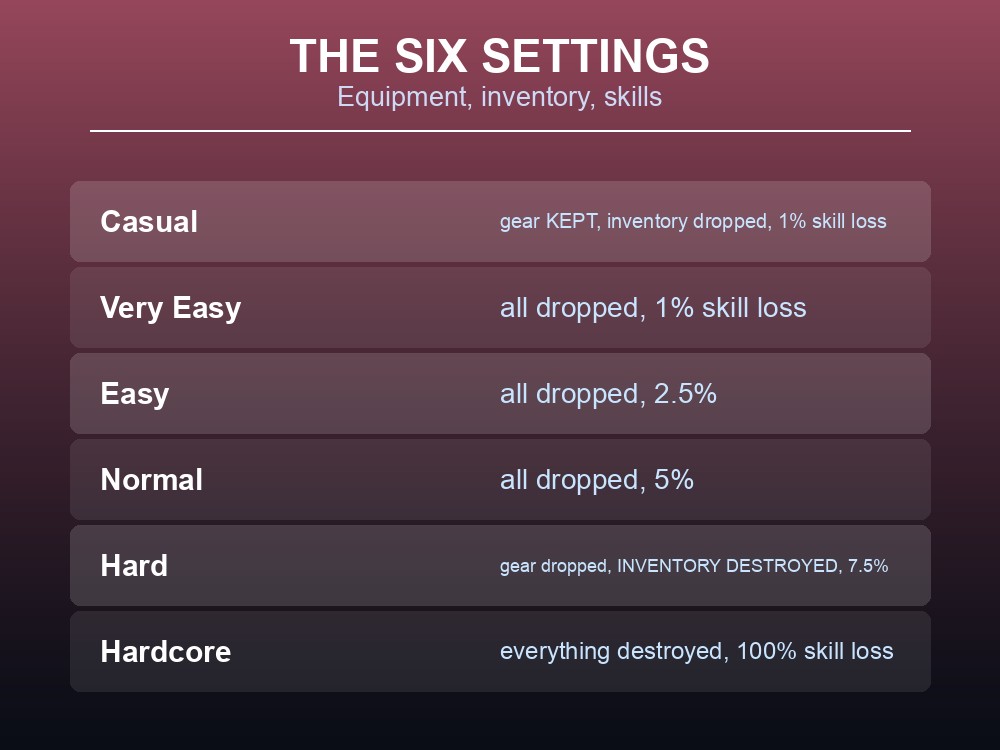
| Setting | Equipment | Inventory | Skill loss |
|---|---|---|---|
| Casual | Kept | Dropped | 1% |
| Very Easy | Dropped | Dropped | 1% |
| Easy | Dropped | Dropped | 2.5% |
| Normal | Dropped | Dropped | 5% |
| Hard | Dropped | Destroyed | 7.5% |
| Hardcore | Destroyed | Destroyed | 100% |
Three of these are genuinely different games, not difficulty tweaks:
Casual is the only setting that keeps your equipped gear. Everything else in your inventory drops, but what you were wearing and holding stays on you. For a group that plays irregularly, this is the single most forgiving option — you can always fight your way back to the tombstone, because you still have your armour and weapon.
Hard destroys your inventory permanently. Equipped items drop into a tombstone, but everything else is simply gone. There is no corpse run for a full load of ore.
Hardcore takes everything, including all skills. 100% skill loss — not a reduction, a reset.
Very Easy is a strange middle option: it drops everything Casual would keep, but applies the same 1% skill loss. If your group's pain point is skills rather than gear, Very Easy costs nothing extra over Casual; if it is gear, Casual is strictly better.
How Skill Loss Really Works
The headline percentage understates the damage, and here is why.
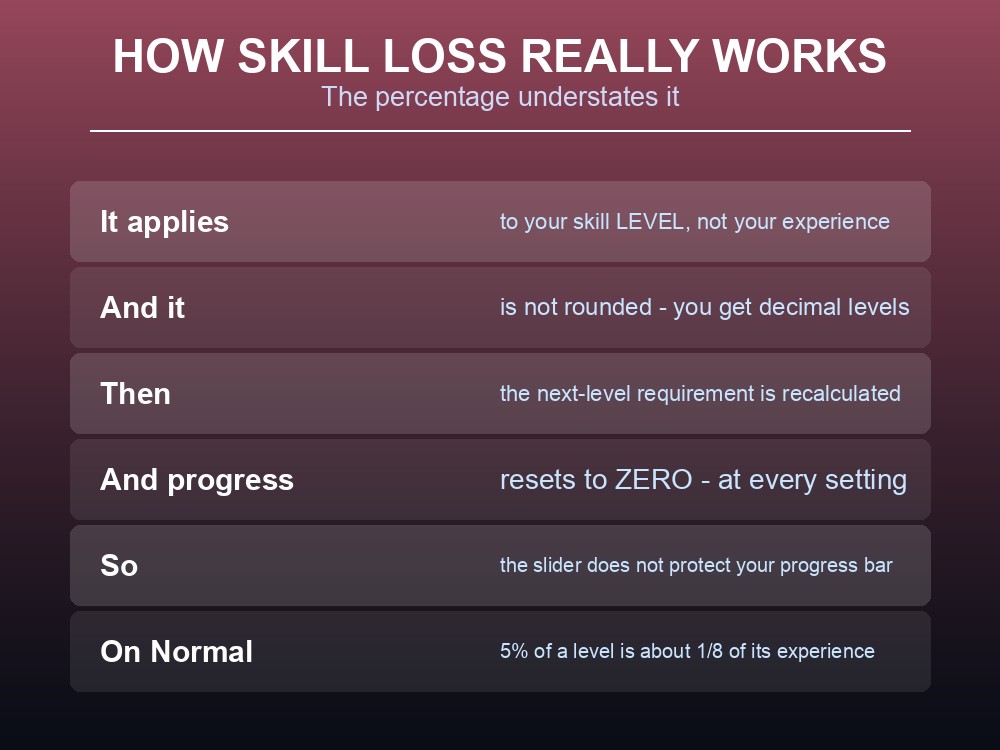
The percentage applies to your skill level, not your experience — and it is not rounded, producing decimal levels the game otherwise never uses.
Then comes the part nobody accounts for:
Every skill's next-level requirement is recalculated for the new, reduced level, and progress is set to zero — and this progress loss is not affected by the death penalty setting.
So the death penalty slider does not protect your progress bar. Even on Casual at 1%, every partially-completed level in every skill resets to zero.
The wiki's worked example makes it concrete. A player with Run at 70, halfway to 71, dies on Easy (2.5%):
- 2.5% of 70 is lost → the effective level becomes 68.25, displayed as 68.
- The experience needed for 69.25 is recalculated.
- Progress toward it is set to 0 — the half-level is gone regardless of setting.
And on Normal, the compounding is severe. Because levels cost exponentially more as they rise, losing 5% of your level is approximately losing 1/8 of all experience earned in that skill. Iron Gate's own maths, as the wiki puts it: "spending eight hours grinding the desired skill, death will mean the loss of one hour."
The Ten-Minute Grace Period
Valheim gives you a genuine safety net after a death, and most players do not know it exists.
| Effect | Duration | What it does |
|---|---|---|
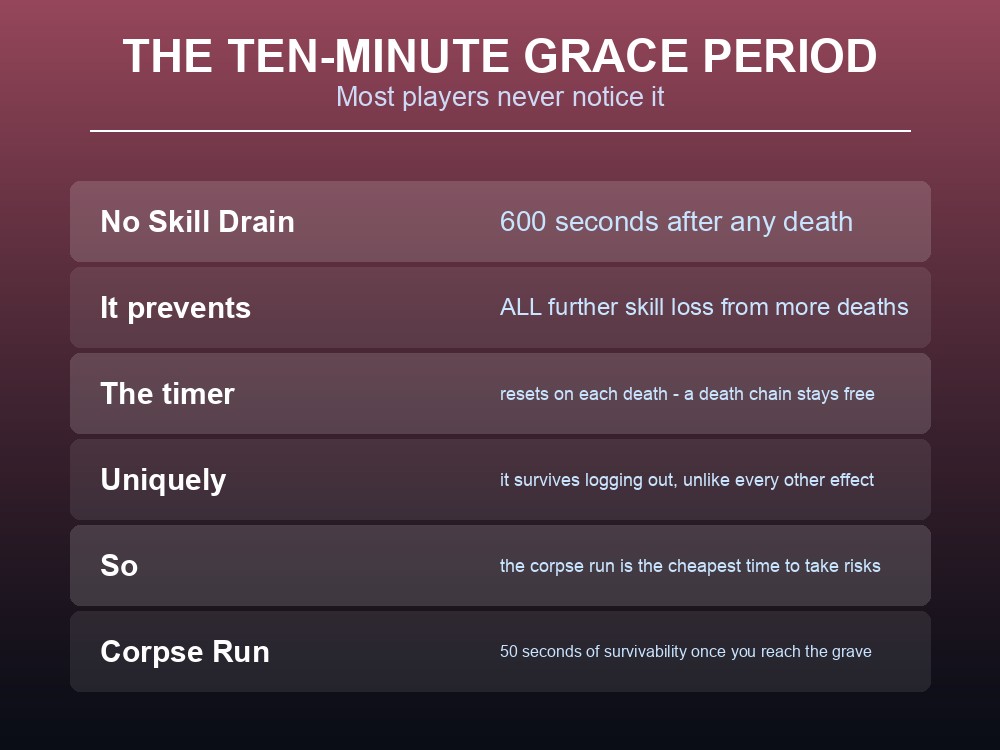
| No Skill Drain | 600 seconds (10 minutes) | Prevents all further skill loss from additional deaths |
| Corpse Run | 50 seconds | Applied when you fully empty your gravestone — −75% run/jump stamina, +5 HP/sec, +150 carry weight, 0.5× physical damage |
No Skill Drain changes how you should behave after dying. The first death costs you skills; for the next ten minutes, further deaths cost you nothing in skills at all. So the corpse run is the moment to take risks — pushing through the enemies that killed you is cheaper now than it will ever be.
The timer resets on each death, so a chain of deaths inside the window stays free.
And it survives logging out. The wiki flags this as unique: "Unlike all other effects which fade after the player logs out, the No skill drain effect still remains with the character until its duration is over." If a bad fight ends your evening, the grace period is still running when you come back — provided you return within ten minutes.
Corpse Run is the reward for reaching your tombstone — 50 seconds of improved survivability, specifically to get you away from whatever is still standing over your body.
Here is exactly what those 50 seconds give you:
| Effect | Value |
|---|---|
| Run stamina | −75% |
| Jump stamina | −75% |
| Health regeneration | +5 per second |
| Carry weight | +150 (up to 600 with a Megingjord) |
| Physical damage taken | 0.5× against blunt, slash and pierce |
And there is a condition almost nobody knows: the buff only fires if you empty the grave completely. Leave a single item behind and Corpse Run never activates — so grabbing your weapon and running is the worst possible move, because you get neither the gear nor the buff.
A player who died with an empty inventory leaves no tombstone at all, and therefore gets no Corpse Run either.
Read the damage line again, because it reframes the whole mechanic. Halved physical damage plus 5 health per second plus 75% cheaper running is not a consolation prize — it is the strongest defensive window in the game, and it exists precisely to let you fight your way back out of wherever you died.
Tombstones, and What Servers Should Know
The tombstone rules are more forgiving than reputation suggests — with one exception that matters on a shared world:
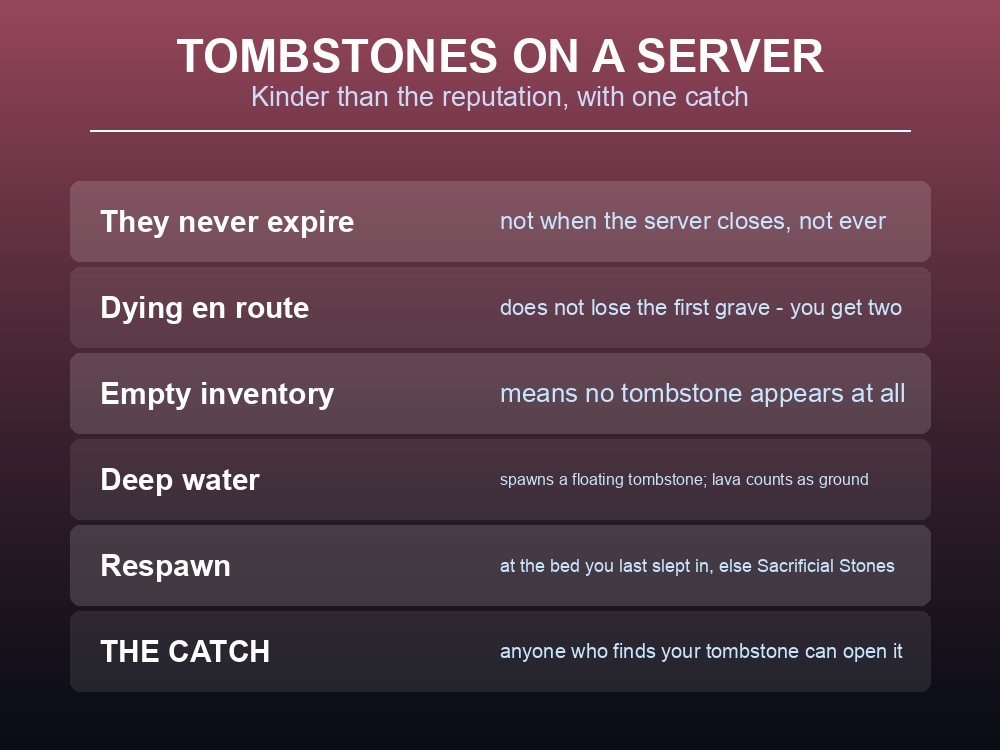
- Your tombstone is accessible by anyone who finds it. It carries your name, but not a lock. On a server with strangers, that is the real risk of dying, not the skill loss.
- Tombstones do not expire. They survive the server being closed and being left alone indefinitely. There is no timer racing you.
- Dying on the way to your tombstone does not lose the first one. You simply have two. Items are not destroyed by a failed corpse run.
- No tombstone appears if you die with an empty inventory — so a deliberate naked run leaves nothing behind.
- The map is marked with a skull and bones, noting the day you died.
- Deep water spawns a floating tombstone; lava counts as ground, so a grave will sit on top of it.
- Collecting it auto-transfers items if you have room; if not, nothing moves and you transfer manually.
Respawn is at the bed you last slept in — or the Sacrificial Stones if you have no bed or it was destroyed. On a shared server, "everyone should sleep in a bed at the new base" is a practical instruction, not flavour.
Setting the penalty on a dedicated server is done the same way as any world modifier — via command line parameters, or through the in-game console. The rule that catches people out is that applying a preset overwrites every modifier you set individually, so choose the preset first and tune afterwards.
Practical tips
- Normal is 5% of every skill level — roughly 1/8 of all experience in each skill.
- Casual is the only setting that keeps equipped gear.
- Hard destroys your unequipped inventory permanently. Hardcore wipes skills entirely.
- Progress toward the next level always resets to zero, whatever the setting.
- No Skill Drain lasts 10 minutes and persists through logout — the corpse run is the cheapest time to take risks.
- Corpse Run gives 50 seconds of improved survival after you collect your grave.
- Tombstones never expire, and dying en route does not lose the first one.
- Anyone can open your tombstone — the real risk on a public server.
Running your own Valheim server
Death penalty is a world setting, which means it is a decision your group makes once and lives with — and on a dedicated server it is applied through the server's configuration rather than renegotiated whenever someone hosts. A gamever Valheim server keeps that configuration and your world stable around the clock for up to 10 players, takes one-click backups before changes, and updates automatically so client and server versions never drift apart.
Conclusion
Valheim's death penalty runs across six settings, and they differ in three independent ways: what happens to equipped gear, what happens to the rest of your inventory, and how much skill you lose. Casual is the only one that keeps equipped gear (1% skill loss); Normal drops everything and takes 5%; Hard destroys your unequipped inventory and takes 7.5%; Hardcore destroys everything and takes 100%. The percentage understates it, because progress toward your next level always resets to zero regardless of setting, and because exponential level costs mean 5% of a level is roughly an eighth of the experience behind it — "eight hours grinding… death will mean the loss of one hour." The counterweight is the No Skill Drain effect: ten minutes during which further deaths cost no skill at all, persisting even through a logout, plus 50 seconds of Corpse Run once you reach your grave. And the tombstone rules are kinder than their reputation — they never expire, and dying on the way does not lose the first one — with one exception worth planning for: anyone who finds your tombstone can open it.
Want the settings decided once and left alone? Rent a Valheim server at gamever.io — instant setup, one-click backups and updates, and 24/7 uptime. Start with a free trial and use promo code WELCOME.