
Valheim World Seeds: What They Control, and Which Ones Are Worth Using
A Valheim seed decides your entire map before you take a single step — and choosing one deliberately is the cheapest optimisation available to a group starting fresh. With 1.0 arriving on 9 September and Iron Gate recommending a new playthrough, this is the one decision worth making before anyone spawns in. Here is what a seed actually controls, the caveat that catches people, and the community seeds that have held up.
On sourcing. Seed behaviour is documented by Iron Gate only in passing. The seed list below comes from the community Valheim wiki, and seeds are version-dependent — see the warning below.
What a Seed Is
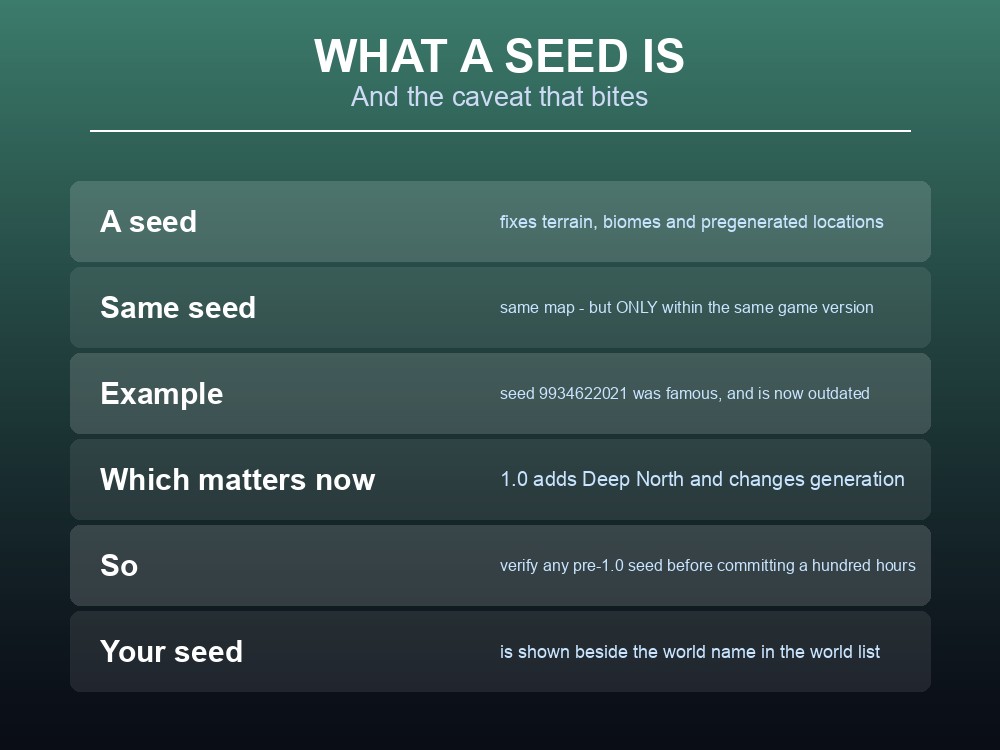
"A world seed is a map seed used to initialize Valheim's pseudorandom number generator that determines how a world is generated. All worlds generated from the same seed will have the same layout for any given game version."
Read the last five words carefully — for any given game version. A seed that produced a perfect starting island in one patch can produce something different after an update that changes world generation. The wiki already flags one: seed 9934622021 was famous for having all five early biomes on the first island, and is now marked "(outdated, now a cute small island with meadow, small black forest and little mountain)".
That is the single most important caveat for right now. Valheim 1.0 adds the Deep North and changes generation. Any seed recommendation written before 9 September — including the list below — should be verified in 1.0 before a group commits a hundred hours to it.
Where to enter it: the world creation dialog has a seed field beneath the name field, prefilled with a random value you can replace. Existing worlds show their seed next to the name in the world list, so you can always recover it.
Seeds Worth Knowing
| Seed | What it gives you |
|---|---|
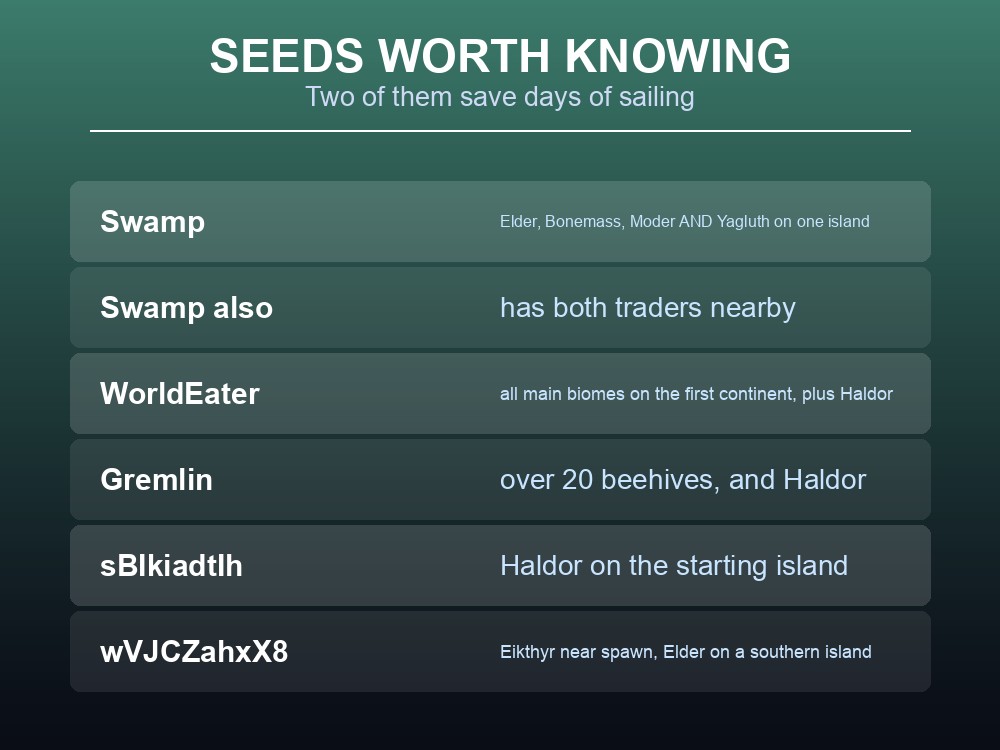
Swamp | The Elder, Bonemass, Moder and Yagluth all on one island, within a minute's run of each other — plus Haldor and Hildir nearby and several Leviathans around spawn |
WorldEater | All main biomes on the first continent, including Haldor |
Gremlin | Over 20 beehives and Haldor on the first continent |
sBIkiadtIh | Haldor on the starting island, with Black Forest, Swamp and Mountains close |
42069lolxd | Haldor reachable by following the coastline south |
wVJCZahxX8 | Meadows start with Black Forest either side and a Mountain west; Eikthyr near spawn, The Elder on a southern island |
maypoleplz | A maypole west on the starting continent |
jWM4fqFdSm | Two maypole locations close together southwest of spawn |
Swamp is the outlier and it is worth understanding why. Four bosses on one island, both traders nearby — it collapses an enormous amount of sailing out of a playthrough. For a group that plays irregularly, that is the single biggest time saving a seed can offer.
Haldor's location is the other thing worth seeding for. The trader sells items you cannot craft, and finding him is otherwise a genuinely random search — WorldEater, Gremlin and sBIkiadtIh all place him on or near the first continent.
And beehives are a real economy. Gremlin's twenty-plus removes the usual hunt for queen bees entirely.
What a Seed Does Not Change
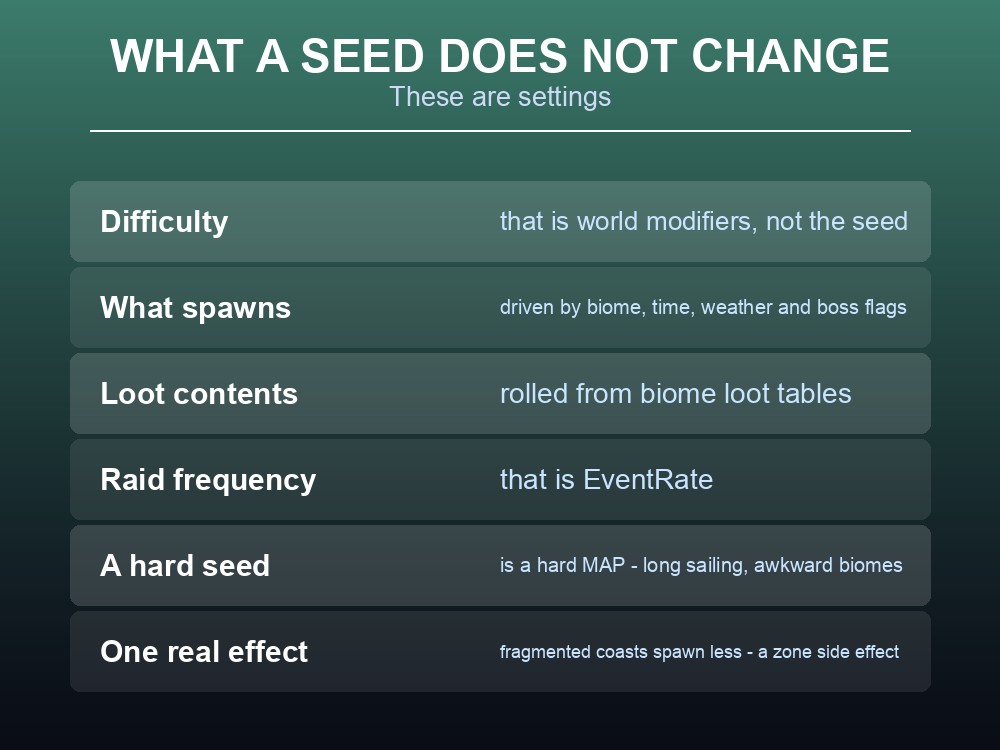
A seed controls terrain, biome placement and where pregenerated locations sit. It does not control:
- Difficulty. That is world modifiers — combat, death penalty, resources, raids and portals.
- What spawns. Spawners are driven by biome, time, weather and boss flags, not by the seed.
- Loot contents. Chests roll from biome-appropriate loot tables.
- Raid frequency. That is
EventRate, a modifier.
So a "hard seed" is a hard map — long sailing, awkward biome placement, distant bosses — not a harder game. If you want a harder game, that is the Combat and Death Penalty modifiers, which have published numbers.
One genuine interaction is worth noting. Because spawn positions must match the required biome, and zones with multiple biomes fail the "full biome" check, seeds with heavily fragmented coastlines produce measurably fewer spawns in the mixed areas. A patchwork map is a quieter map — not by design, but as a side effect of the zone system.
Choosing a Seed for a 1.0 World
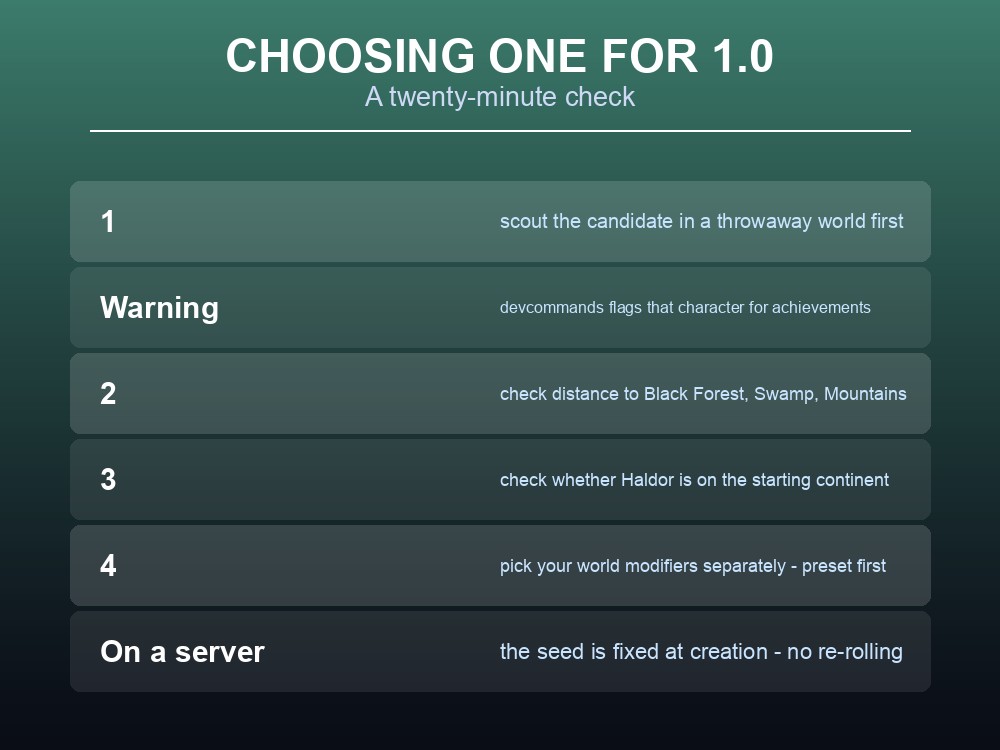
A workable process for a group starting fresh on 9 September:
- Create a throwaway world with the candidate seed and fly over it with
devcommandsandflybefore committing. Note that this flags the character and world for achievements — so use a separate character you do not care about. - Check the four things that matter most: distance to the Black Forest, whether Haldor is on the starting continent, how far the Swamp is, and whether the Mountains are reachable without a long crossing.
- Decide your world modifiers separately — and remember a preset overwrites every modifier you set individually, so choose the preset first.
- Re-verify any pre-1.0 seed. Generation changes with updates; the list above predates the Deep North.
- Write the seed down. It is shown beside the world name in the world list, but a server world is easier to recreate if you have it recorded.
On a dedicated server the seed is fixed at world creation, and changing it means a new world — there is no re-rolling. That makes the throwaway-world check genuinely worth the twenty minutes.
And remember Iron Gate's own 1.0 guidance: they "recommend that you start a new playthrough", and already-explored terrain will not generate the Deep North properly — so this is the moment when seed choice actually matters, rather than something to regret later.
Practical tips
- A seed fixes the map — but only within one game version. Verify old seeds in 1.0.
Swampputs The Elder, Bonemass, Moder and Yagluth on one island, with both traders nearby.WorldEater,GremlinandsBIkiadtIhplace Haldor on the first continent.Gremlinhas over 20 beehives.- Seeds do not change difficulty, spawns, loot or raids — those are world modifiers.
- Scout a candidate in a throwaway world first, with a character you do not mind flagging.
- The seed is shown beside the world name in the world list.
- On a server the seed is fixed at creation — there is no re-rolling.
Running your own Valheim server
A seed is a decision you make once and live with for the life of the world, which makes it worth taking on a server where that world is backed up, always available and not tied to one person's machine. A gamever Valheim server gives you that from the first minute, with one-click backups and automatic updates so client and server versions never drift apart.
Conclusion
A world seed initialises Valheim's map generation, and the same seed produces the same layout — but only within the same game version, which is why seeds recommended before 1.0 on 9 September need re-checking afterwards. It controls terrain, biome placement and pregenerated locations; it does not control difficulty, spawn behaviour, loot tables or raid frequency — those are world modifiers. Among community seeds, Swamp is the standout, placing The Elder, Bonemass, Moder and Yagluth on a single island with Haldor and Hildir close by; WorldEater puts all main biomes and Haldor on the first continent; and Gremlin adds over 20 beehives. Scout any candidate in a throwaway world before committing — and note that using devcommands to do so flags that character and world for achievements, so use one you do not mind losing.
Want the world you chose to still be there in a year? Rent a Valheim server at gamever.io — instant setup, one-click backups and updates, and 24/7 uptime. Start with a free trial and use promo code WELCOME.