
V Rising Blood Types and Blood Quality Explained
Blood is V Rising's core survival resource, and the wiki opens with a blunt warning: "You will slowly lose health and ultimately perish if you run out of blood." Feeding on a victim fills your Blood Pool toward its 10-liter cap and imprints that victim's blood type on you, from Creature to Draculin, with bonus strength tied to blood quality, a percentage rolled per victim. This guide covers how the pool drains and fails, what the eight blood types grant per tier, the math behind quality scaling, and how to store and manage blood later on. Note up front: the source page has no separate stats infobox for Blood — everything below comes from its written sections, so treat anything not explicitly quoted as undocumented, not assumed.
The Blood Pool: Capacity, Drain, and Running Dry
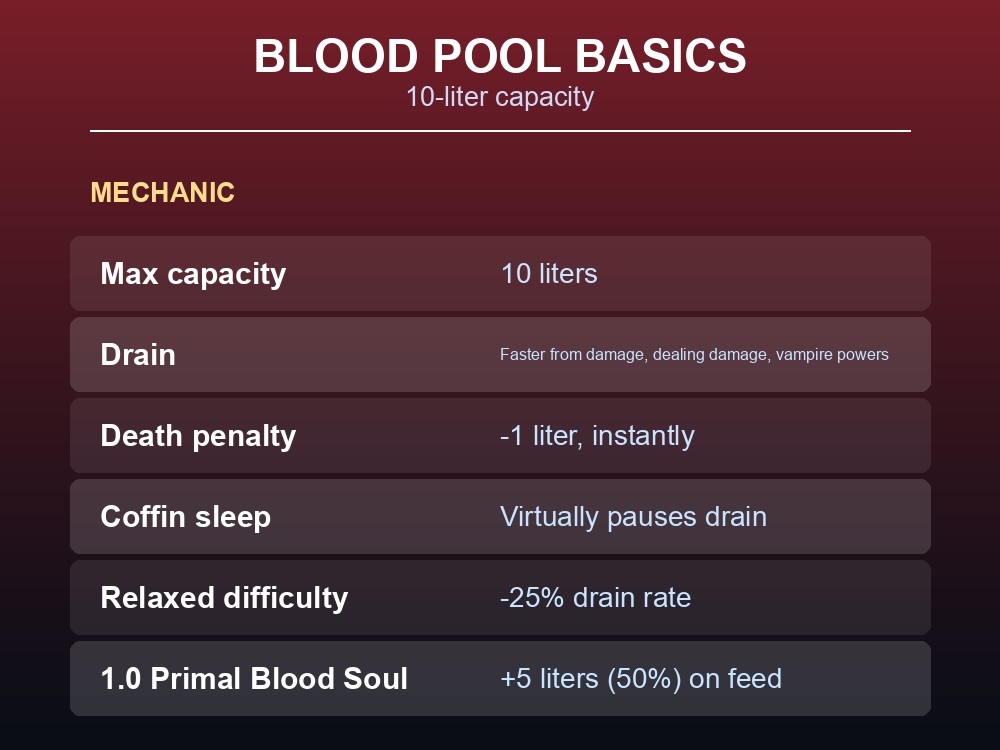
Feeding on a blood-carrying victim refills your Blood Pool to its 10-liter maximum and overwrites your blood type with theirs. The pool then drains "slowly over time, and faster when dealing & taking damage or using particular vampire powers such as Blood Mend or Expose Vein." Dying costs a flat 1 liter, regardless of how much remained. Sleeping in a Coffin "virtually pauses" drain, and Relaxed Difficulty cuts the drain rate by a flat 25%.
Running a non-frailed pool dry doesn't kill you outright — it reverts you to 1 liter of Frailed blood, the zero-bonus state pictured above. Only if that frailed pool also empties does health start depleting toward 1 HP, and feeding on any blood at that point, any type or quality, immediately restores regen.
One mechanic is new to 1.0: previously there was no way to top up your current pool short of feeding fresh. As of 1.0, feeding on a defeated Primal Blood Soul — from a Tier 2 Rift Incursion in the Ruins of Mortium, or summoned at a Stygian Summoning Circle — refills the current pool by 5 liters, exactly 50% of the cap, without changing your type.
Eight Blood Types and Their Quality Tiers
Beyond the zero-bonus Frail type, the wiki documents eight blood types — Creature, Worker, Brute, Rogue, Warrior, Scholar, Mutant, and Draculin — each carrying five tiers (I–V). Quality unlocks tiers at fixed thresholds from the page's own Threshold Percentages table: Tier I at 1%, Tier II at 30%, Tier III at 60%, Tier IV at 90%, and Tier V at 100%, echoed in the intro: "Tier IV Blood Pool powers will only be unlocked by draining a 90%+ blood quality victim."
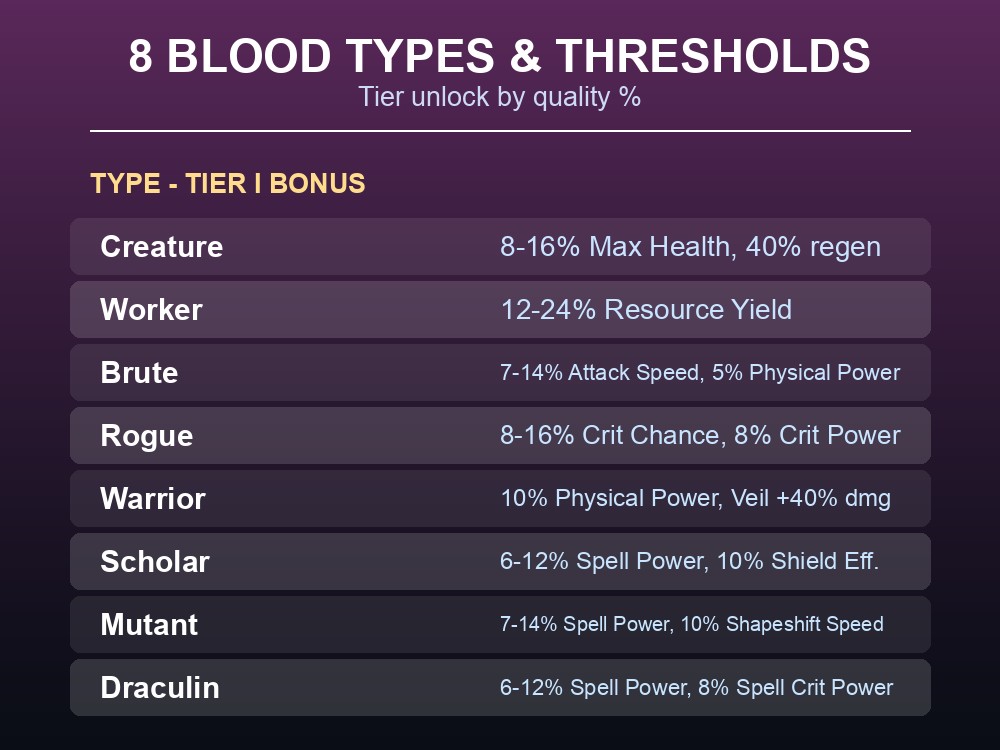
Tier I sets each type's identity: Creature grants "8-16% Increased Maximum Health and 40% increased health regeneration," Worker grants "12-24% Increased Resource Yield," Rogue grants "8-16% Increased Physical Critical Chance and 8% increased Physical Critical Power." Higher tiers turn mechanical: Creature's Tier IV reads "Bite heals you for 5% of your maximum health and temporarily increases your attack speed and physical damage output by 25%," while Worker's Tier IV is a proc, "3% Chance to instantly destroy a resource node and trigger a burst of speed." Every type's Tier V uses identical wording: "Boost all above effects by 20% and increases the maximum cap of blood effects with an equal amount" — it amplifies the four unlocked tiers rather than adding a new one.
How Blood Quality Scales the Bonus (With the Math)
The ranges above aren't random. The Bonus Scaling section explains: "For tiers I - III, at least one variable is proportional to the quality of the given blood, down to a minimum of half the max potential bonus" — the low end of any range is always exactly half the high end, scaling linearly with quality.
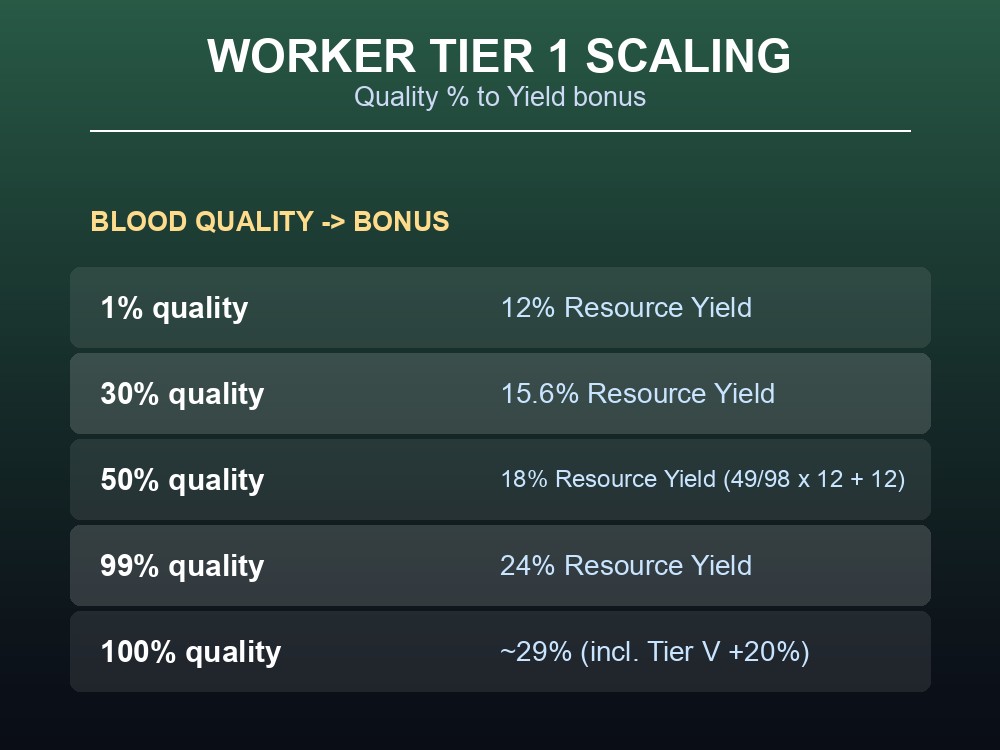
The source walks Worker's Tier 1 Resource Yield bonus through five points: 12% at 1% quality, 15.6% at 30%, 18% at 50%, 24% at 99%, and "~29%" at 100% once the Tier V +20% boost folds in. The 50% figure checks out by hand: the bonus spans a 12-point range (12% to 24%) over 98 points of quality (1% to 99%). Quality 50 sits 49 points above the floor, so 49 ÷ 98 = 0.5 of the way up; 0.5 × 12% = 6%, plus the 12% floor, lands exactly on the source's 18%. Tiers IV and V are flat procs and flat multipliers, not scaled ranges — don't expect those to move with quality the way Tier I–III does.
Storing, Detecting, and Managing Blood
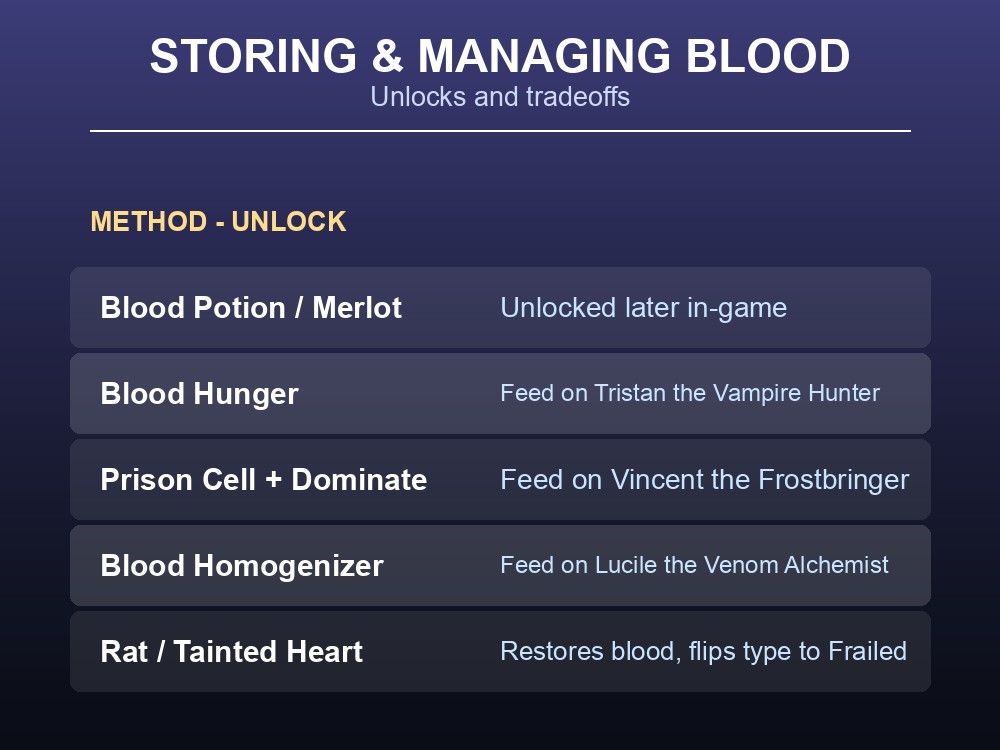
Mousing over a victim shows its blood type and quality before you feed; after feeding on the V Blood Carrier Tristan the Vampire Hunter, Blood Hunger makes that passive, "displaying the blood type icon and percentage over all victims' heads." For storage, "later on in the game" you unlock Blood Potion and Blood Merlot to bank blood for later. Feeding on Vincent the Frostbringer unlocks Prison Cells, which paired with Dominate let you imprison a high-quality victim and "repeatedly extract" potions from them. Feeding on Lucile the Venom Alchemist unlocks the Blood Homogenizer, fusing one potion's trait into another — if the secondary potion is 90% or higher quality, its Tier IV bonus infuses too, not just the trait.
Not every option is a clean upgrade: eating a Rat or Tainted Heart restores "a small amount" of blood but flips your type to Frailed, "losing all blood type bonuses." One thing the source leaves open: "servants increase in power and effectiveness with blood quality level," but it defers to a separate Servants page for specifics — the exact servant scaling curve is undocumented here.
Sleep in a Coffin before logging off to pause drain instead of bleeding down in the background. Skip the Rat/Tainted Heart snack if you're holding a good blood type — it wipes every bonus. Bank 90%+ quality potions for the Blood Homogenizer, since only a 90%+ secondary potion carries its Tier IV bonus into a fusion. Switch to Blood Hunger once unlocked instead of mousing over targets one at a time.
Running your own V Rising server
Clan blood management gets easier with a dedicated server — running a Prison Cell rotation, queuing the Blood Homogenizer, and farming Primal Blood Soul refills all go faster when world state persists between sessions. A gamever V Rising server keeps everything saved and running whether or not everyone's online at once. Get your own V Rising server set up in minutes — use code WELCOME for a discount on your first month.
Conclusion
Blood is more than a health bar in V Rising: the 10-liter pool, its drain triggers, and its frailed-blood fallback set the pace of play, while eight blood types across five tiers — unlocked at 1%/30%/60%/90%/100% — turn every feed into a build choice. Quality isn't cosmetic; the Bonus Scaling math moves Tier I–III bonuses on a linear curve, with Tier V amplifying whatever's unlocked by a flat 20%. Once Blood Hunger, Prison Cells, and a Blood Homogenizer are online, managing blood becomes an active supply chain — servant scaling aside, which the source defers elsewhere.