
The Ten Lotuses in Palworld: The Flowers Behind Every Permanent Stat Boost

Palworld's permanent Pal stat boosts come from Remedies and Elixirs, and both run on flowers. There are ten Lotuses — five stats in two sizes — and every one carries the same warning in its description: "extremely difficult to obtain."
The small ones make Remedies. The large ones make Elixirs. And the sale values tell you exactly how the game rates them: 2,000 gold for a small Lotus, 3,000 for a large one.
All Ten Lotuses
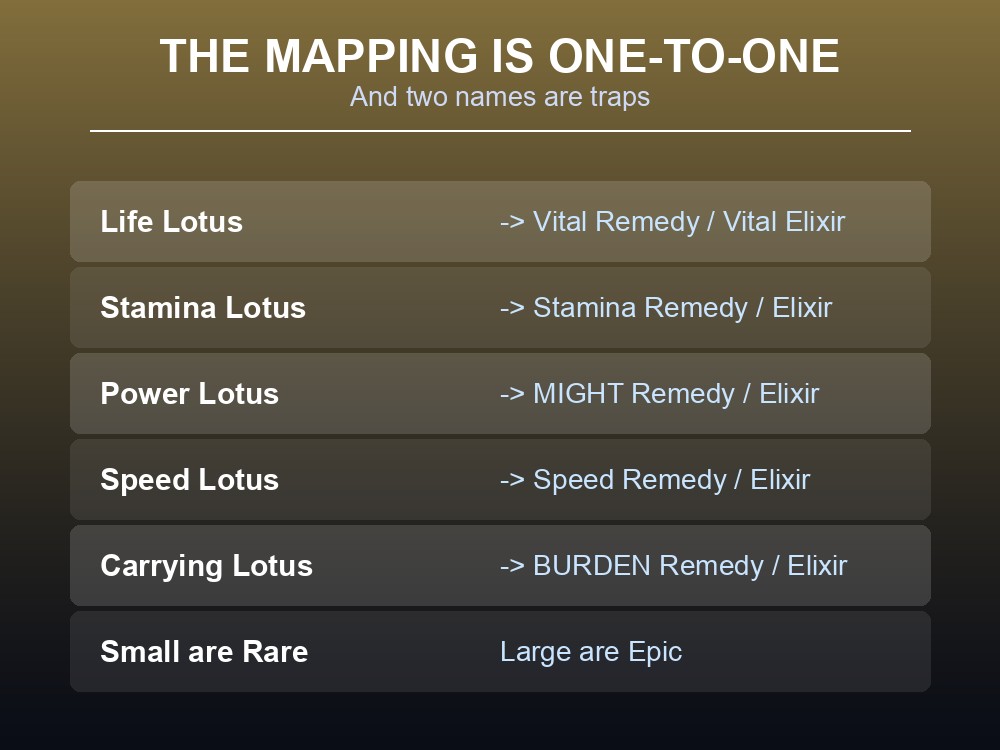
| Lotus | Size | Rarity | Sell | Makes |
|---|---|---|---|---|
| Life Lotus (S) | Small | Rare | 2,000 | Vital Remedy |
| Stamina Lotus (S) | Small | Rare | 2,000 | Stamina Remedy |
| Power Lotus (S) | Small | Rare | 2,000 | Might Remedy |
| Speed Lotus (S) | Small | Rare | 2,000 | Speed Remedy |
| Carrying Lotus (S) | Small | Rare | 2,000 | Burden Remedy |
| Life Lotus (L) | Large | Epic | 3,000 | Vital Elixir |
| Stamina Lotus (L) | Large | Epic | 3,000 | Stamina Elixir |
| Power Lotus (L) | Large | Epic | 3,000 | Might Elixir |
| Speed Lotus (L) | Large | Epic | 3,000 | Speed Elixir |
| Carrying Lotus (L) | Large | Epic | 3,000 | Burden Elixir |
The mapping is one-to-one and completely regular. Each stat has exactly one small and one large flower, and each flower feeds exactly one consumable — there is no substitution and no shared ingredient.
The names do not match the products. Power Lotus makes a Might Remedy, and Carrying Lotus makes a Burden Remedy — two places where searching for the obvious name finds nothing.
They are colour-coded. Life Lotus is "a small green flower"; Carrying Lotus is "a large purple flower".
What They Are Worth Against What They Make
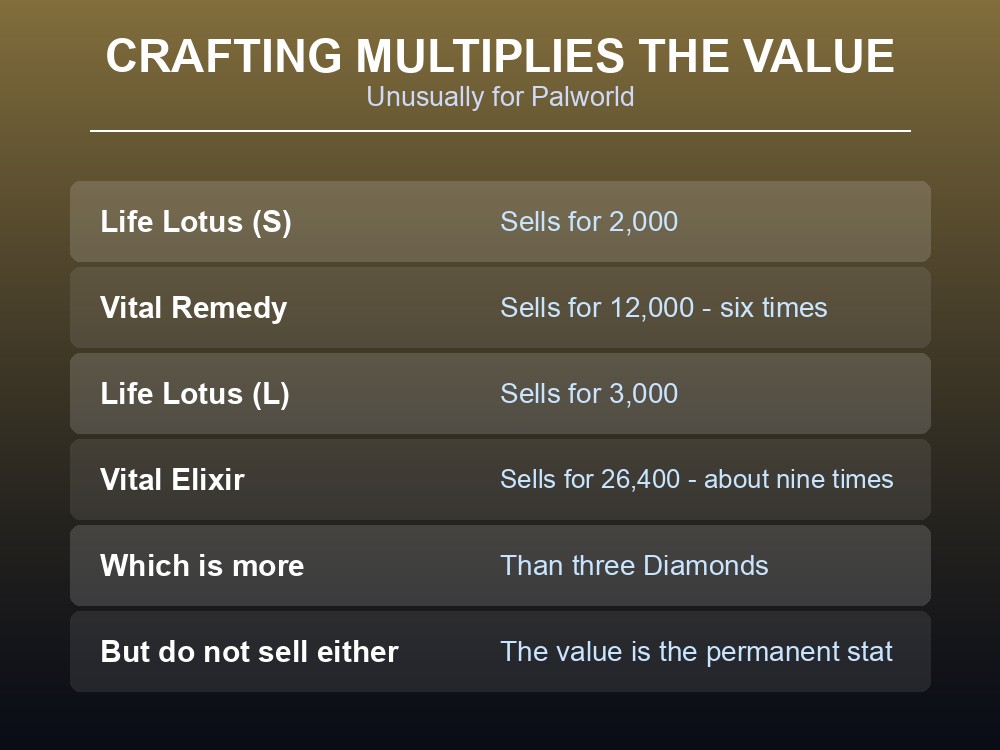
| Item | Sell value |
|---|---|
| Life Lotus (S) | 2,000 |
| Vital Remedy | 12,000 |
| Life Lotus (L) | 3,000 |
| Vital Elixir | 26,400 |
Crafting multiplies the value six-fold on the small line — a 2,000-gold flower becomes a 12,000-gold Remedy — and roughly nine-fold on the large one, 3,000 to 26,400.
That is unusual in Palworld's economy, where most crafted goods sell for a fraction of their inputs. Remedies and Elixirs are the rare case where processing before selling is strictly better.
But do not sell either. The reason the numbers matter is comparison: a Vital Elixir's 26,400-gold sale value tells you what the game thinks a permanent stat point is worth, and it is more than three Diamonds.
Selling a Lotus at 2,000 is the worst option available — below its crafted value, below its use value, and equal to a single Ruby.
Why the Supply Is the Real Problem
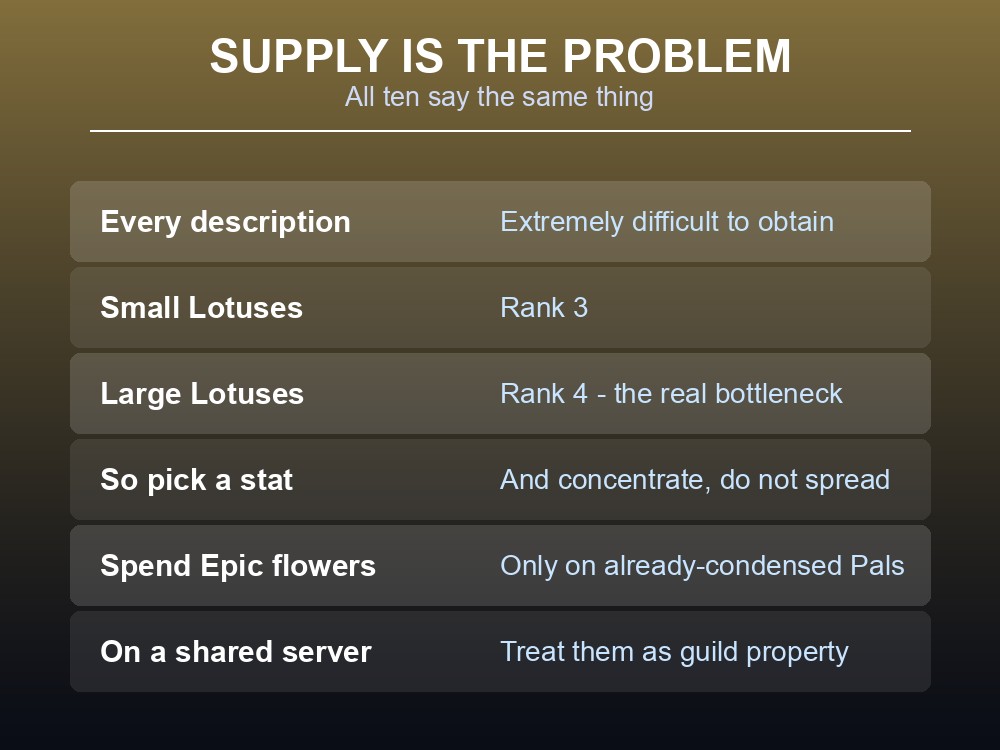
Every one of the ten says "extremely difficult to obtain." That is not standard Palworld phrasing; it appears on this family specifically, and it is the design telling you that permanent stat boosts are meant to be rationed.
Two consequences follow:
- Plan which stat you are boosting before you have the flowers. Ten separate supply lines, each scarce, means opportunistic crafting produces a scattered set of half-boosted Pals.
- The large flowers are the bottleneck, not the small ones. Epic rarity against Rare, for the Elixir line that actually matters at endgame.
Rank tells you something too. The small Lotuses are Rank 3; the large ones are Rank 4 — an internal tier that tracks their scarcity rather than their sale price.
How to Use Them
- Never sell a Lotus. At 2,000 or 3,000 gold it is worth a fraction of what it makes, and gemstones fill the same role for gold without any opportunity cost.
- Decide the stat first. With five lines and scarce inputs, the difference between a strong Pal and a mediocre one is whether you concentrated or spread.
- Carrying and Power are the two that change play. Carrying capacity is a permanent quality-of-life fix; attack is the one everything else compounds with.
- Save large Lotuses for Pals you have already condensed. Spending an Epic flower on a Pal you will later replace is the most expensive mistake available in this system.
- Check the names. Power Lotus makes Might Remedy, Carrying Lotus makes Burden Remedy — the recipe list does not read the way you expect.
On a shared server, treat Lotuses as guild property. Ten scarce lines and a permanent effect is exactly the shape of a resource that should be allocated rather than claimed.
Running your own Palworld 1.0 server
Permanent stat boosts accumulate across weeks of play, which needs a world that holds its Pals and its chests. A gamever Palworld server keeps it persistent with full crossplay, automatic updates and one-click backups.
Conclusion
Palworld's permanent Pal stat system runs on ten Lotuses — five stats in two sizes — and every one is described as "extremely difficult to obtain." The mapping is strictly one-to-one: the five small, Rare, 2,000-gold flowers make the Vital, Stamina, Might, Speed and Burden Remedies, and the five large, Epic, 3,000-gold ones make the matching Elixirs. Two names are traps — Power Lotus makes Might Remedy and Carrying Lotus makes Burden Remedy — so searching for the obvious name finds nothing. The economics are unusual for Palworld: crafting multiplies value six-fold on the small line (2,000 to a 12,000-gold Vital Remedy) and about nine-fold on the large (3,000 to a 26,400-gold Vital Elixir), where most crafted goods sell for less than their inputs. That figure is a benchmark, not an invitation — a Vital Elixir is worth more than three Diamonds, and its real value is the permanent stat. With ten scarce lines, the winning approach is to pick a stat and concentrate, and to spend the Epic flowers only on Pals you have already condensed.
Want a world where the collection actually accumulates? Rent a Palworld server at gamever.io — instant setup, full crossplay, automatic updates, one-click backups and 24/7 uptime. Start with a free trial and use promo code WELCOME.