
The Player Utility Partner Skills in Palworld: The Pals That Do Something to You
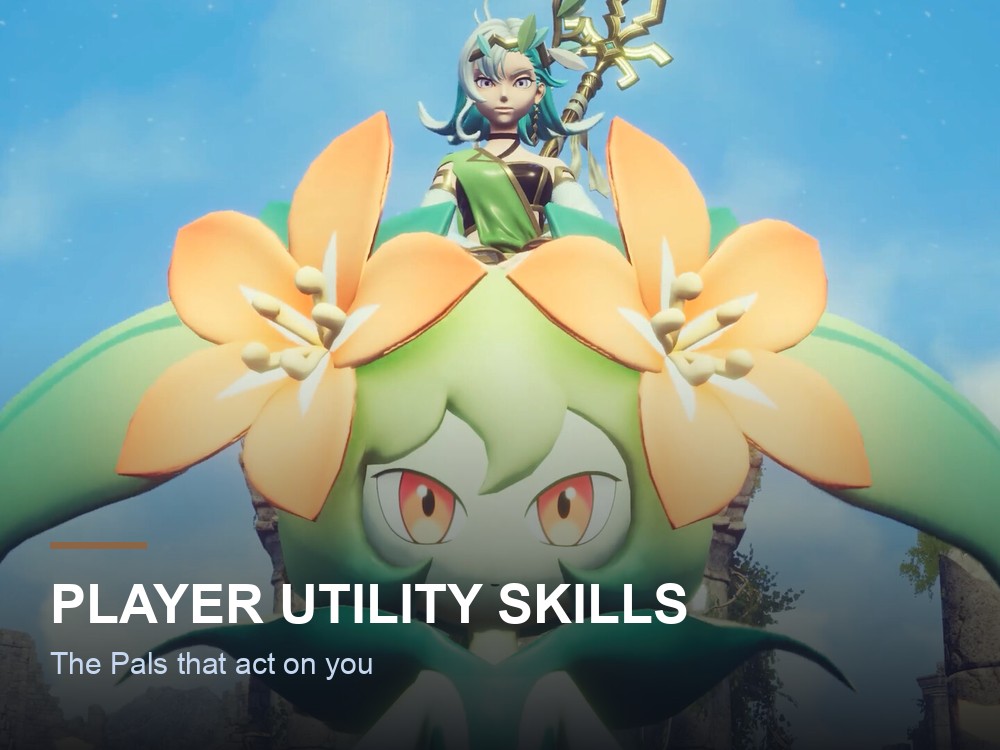
Palworld sorts its 299 partner skills into categories, and the most overlooked is Player Utility — Pals whose skill does something to you rather than to the enemy or the base. They turn into shields, ride on your head with a submachine gun, carry your supplies, or lay eggs at a ranch. Several are among the first four Pals in the game, which is why most players never look at them again.
What Player Utility Means
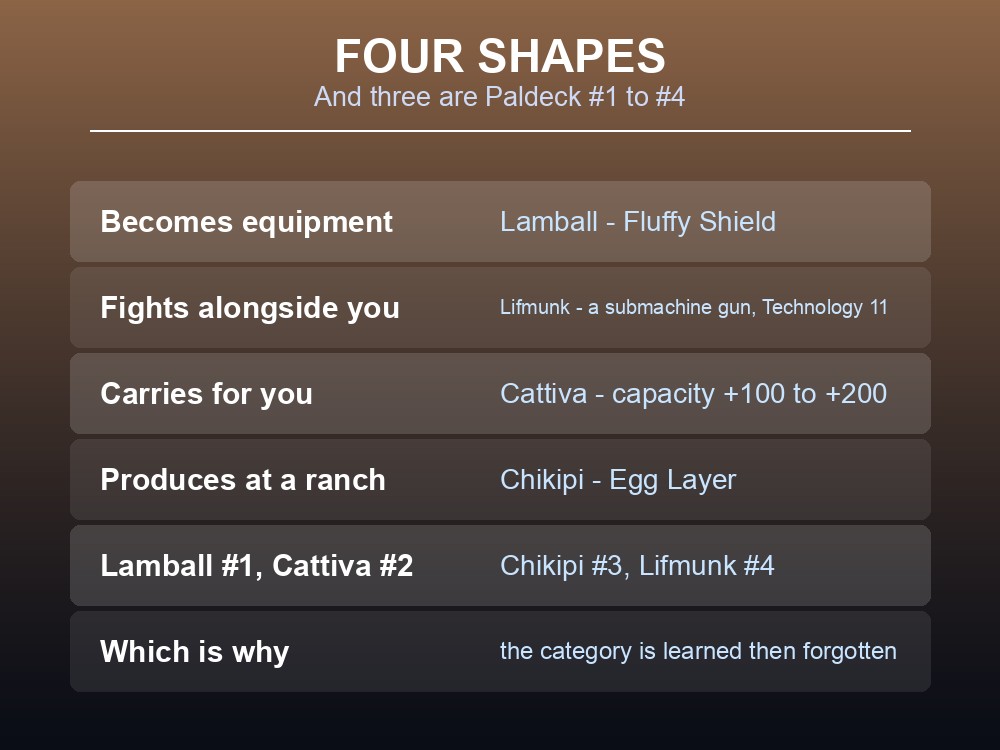
The category collects skills that fall into four rough shapes:
| Shape | Example | What it does |
|---|---|---|
| Becomes equipment | Lamball — Fluffy Shield | Equips to the player and becomes a shield |
| Fights alongside you | Lifmunk — Lifmunk Recoil | Leaps onto your head and fires a submachine gun |
| Carries for you | Cattiva — Cat Helper | Max carrying capacity +100~200 |
| Produces at a ranch | Chikipi — Egg Layer | Sometimes lays an Egg when assigned to a Ranch |
Three of those four are the first four Pals in the Paldeck — Lamball is #1, Cattiva #2, Chikipi #3 and Lifmunk #4. The game front-loads the category so heavily that players learn it in the first ten minutes and then move on to mounts.
The Ones Worth Keeping
Cattiva (#2) — Cat Helper. Increases the player's max carrying capacity by (100~200), and does not stack. Read through the partner skill ladder, that is 100 at partner skill Lv1 and 200 at Lv5 — a fixed climb, not a roll.
Carrying capacity is the constraint that never goes away in Palworld, because ore, ingots and building materials are heavy and bases are far apart. A #2 Pal you caught in the first five minutes stays relevant for the entire run.
Lunaris (#82) sits at the top of the same line with (300~600) — three times Cattiva's floor and three times its ceiling — plus spheres that home in on Pals. If carrying capacity is the problem, Lunaris is the answer and Cattiva is the early stand-in.
Lifmunk (#4) — Lifmunk Recoil. Leaps onto the player's head and uses a submachine gun to follow up your attacks, unlocked at Technology 11. It is a damage skill attached to a rarity 1 Pal with food intake 1 — the cheapest resident you can keep — which makes it one of the best value-per-upkeep partners in the game.
Lamball (#1) — Fluffy Shield. Equips to the player and becomes a shield. Also sometimes drops Wool when assigned to a Ranch, so the same Pal covers a combat slot and a production slot depending on where you put it.
The Ranch Overlap
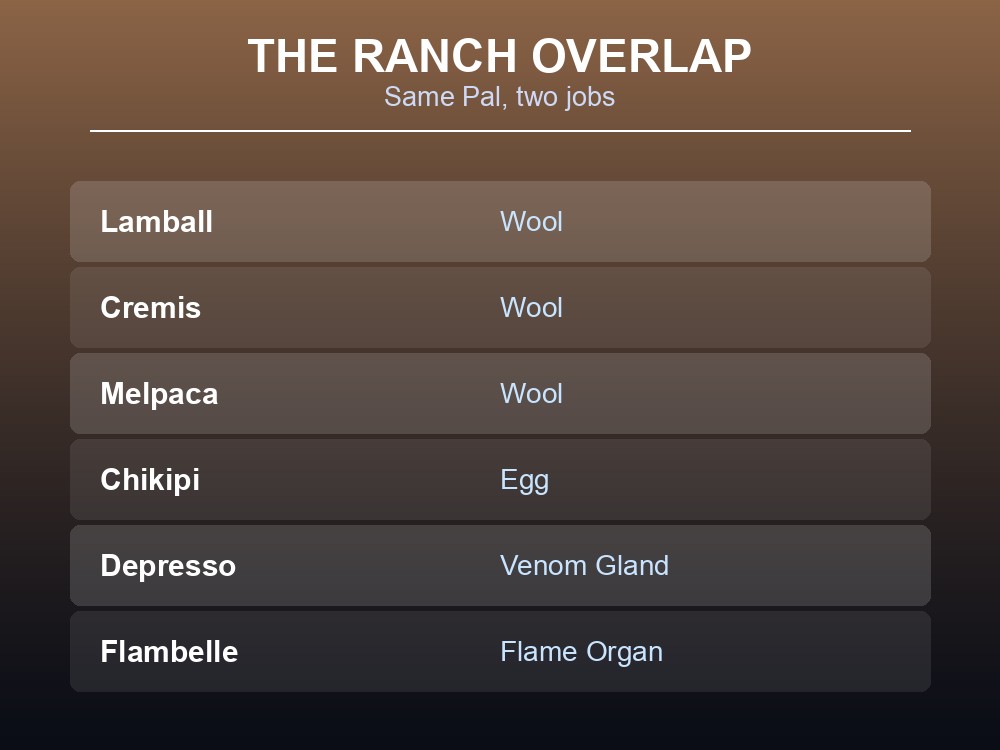
A large share of the Player Utility list carries a second clause: "Sometimes drops X when assigned to Ranch."
| Pal | Partner skill | Ranch output |
|---|---|---|
| Lamball #1 | Fluffy Shield | Wool |
| Chikipi #3 | Egg Layer | Egg |
| Cremis #8 | Fluffy Wool | Wool |
| Depresso #16 | Caffeine Inoculation | Venom Gland |
| Melpaca #20 | Pacapaca Wool | Wool |
| Flambelle #25 | Magma Tears | Flame Organ |
That dual role is the category's real value. A Pal in your party is doing its partner skill; the same Pal on a Ranch is producing a material. You are choosing between two jobs, not gaining one.
Depresso is the standout oddity. Its partner skill increases its own Movement Speed and Work Speed by (100~900)% — the widest ladder in the game, running from +100% at partner skill Lv1 to +900% at Lv5 — and it separately produces Venom Gland at a ranch. A Pal whose value is almost entirely locked behind condenser investment, sitting at Paldeck #16.
Why the Category Gets Forgotten
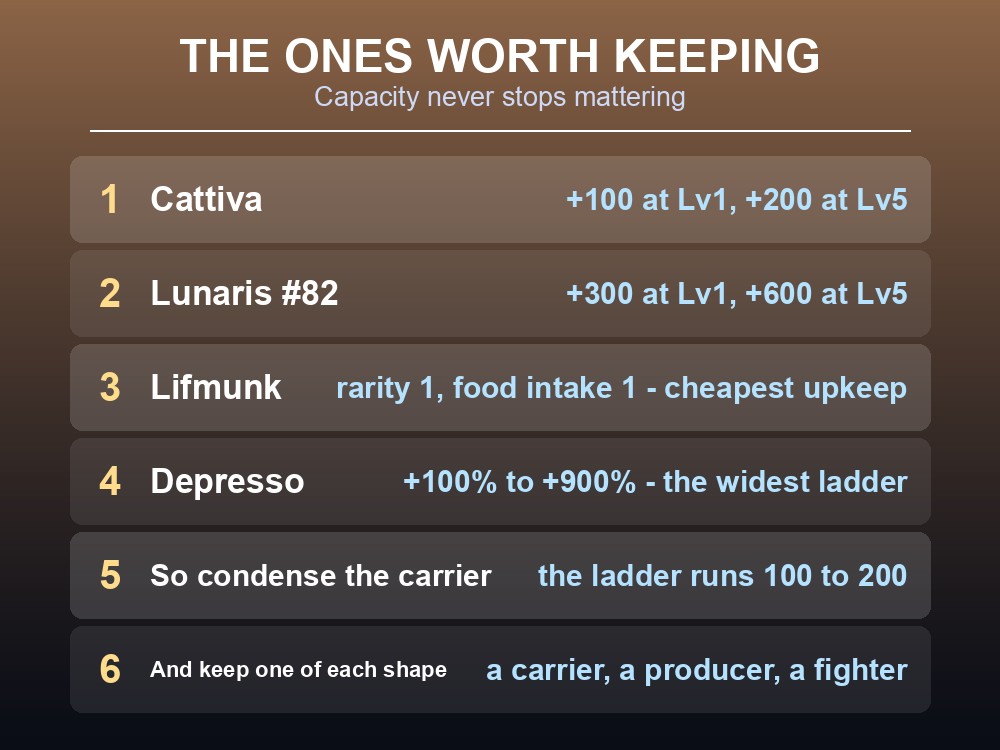
The Player Utility Pals are early, common and low-rarity, and Palworld's progression pulls attention toward mounts, work suitability and combat stats instead. That is a reasonable priority — but it means three things get left behind:
- Carrying capacity never stops mattering, and Cattiva and Lunaris are the only real answers.
- Ranch production is passive income that requires no fighting and no travel.
- Partner skill level applies here too. Every parenthesised range in the category is a five-step condenser ladder, so a Cattiva you have condensed is worth double one you have not.
The practical advice: keep one of each shape. A carrier, a ranch producer, and whatever combat partner suits your build — and condense the carrier, because that ladder runs from 100 to 200.
Running your own Palworld 1.0 server
Ranch production runs whether or not you are logged in, which is the clearest argument for a world that never stops. A gamever Palworld server keeps it persistent with full crossplay, automatic updates and one-click backups.
Conclusion
Palworld's Player Utility partner skill category collects the Pals whose skill acts on you rather than on enemies or the base, and it takes four shapes: becoming equipment (Lamball's Fluffy Shield), fighting alongside you (Lifmunk's head-mounted submachine gun at Technology 11), carrying for you (Cattiva's +100~200 capacity), and producing at a ranch (Chikipi's Egg Layer). Three of those four are Paldeck #1 through #4, which is why the category is learned in the first ten minutes and forgotten immediately after. The one that never stops mattering is carrying capacity — Cattiva gives 100 at partner skill Lv1 rising to 200 at Lv5, and Lunaris (#82) triples both ends at (300~600). A large share of the list carries a second clause for ranch output — Wool from Lamball, Cremis and Melpaca, Eggs from Chikipi, Venom Gland from Depresso, Flame Organ from Flambelle — which means the same Pal does one job in your party and a different one on a ranch. And Depresso holds the widest ladder in the game at (100~900)%, making it the Pal most dependent on condenser investment.
Want a ranch producing overnight? Rent a Palworld server at gamever.io — instant setup, one-click backups and updates, full crossplay and 24/7 uptime. Start with a free trial and use promo code WELCOME.