
The Palpedia in Palworld 1.0: Habitat Lookup and the First-Five Capture Bonus

The Palpedia looks like a collection log and is mostly used as one, which means most players never notice that it is also a habitat search tool and the source of a stacking EXP bonus that does not stop at the first capture. New species pay a bonus. So do the first five captures of the same species — which changes how you should treat the third, fourth and fifth Lamball you walk past.
What the Palpedia Records
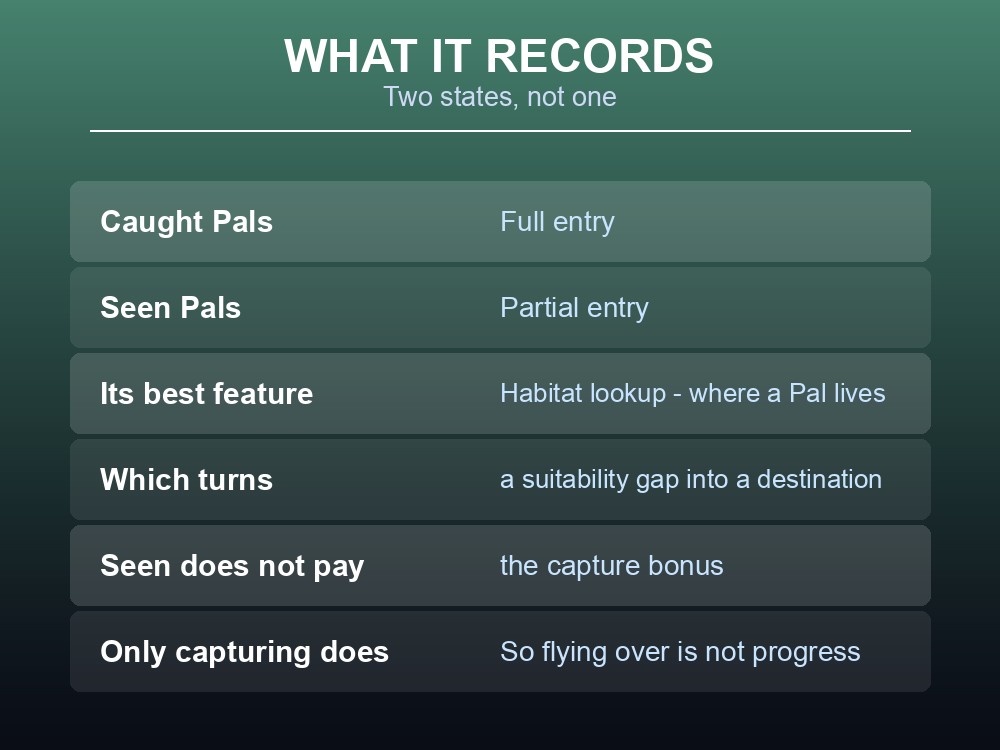
Open it from the menu and it records information about Pals you have caught or seen. Those are two separate states and the distinction is doing real work: a Pal you have merely encountered enters the book with partial information, while a Pal you have caught fills the entry out.
The function that earns its place in your routine is the habitat lookup — the Palpedia lets you research where a given Pal lives. That turns "I need a Pal with Watering Lv.3" from a wiki search into an in-game query, and it is the fastest way to plan a catching trip around a base bottleneck rather than around whatever you happen to run into.
The Capture Bonus
The rule is short and worth quoting exactly:
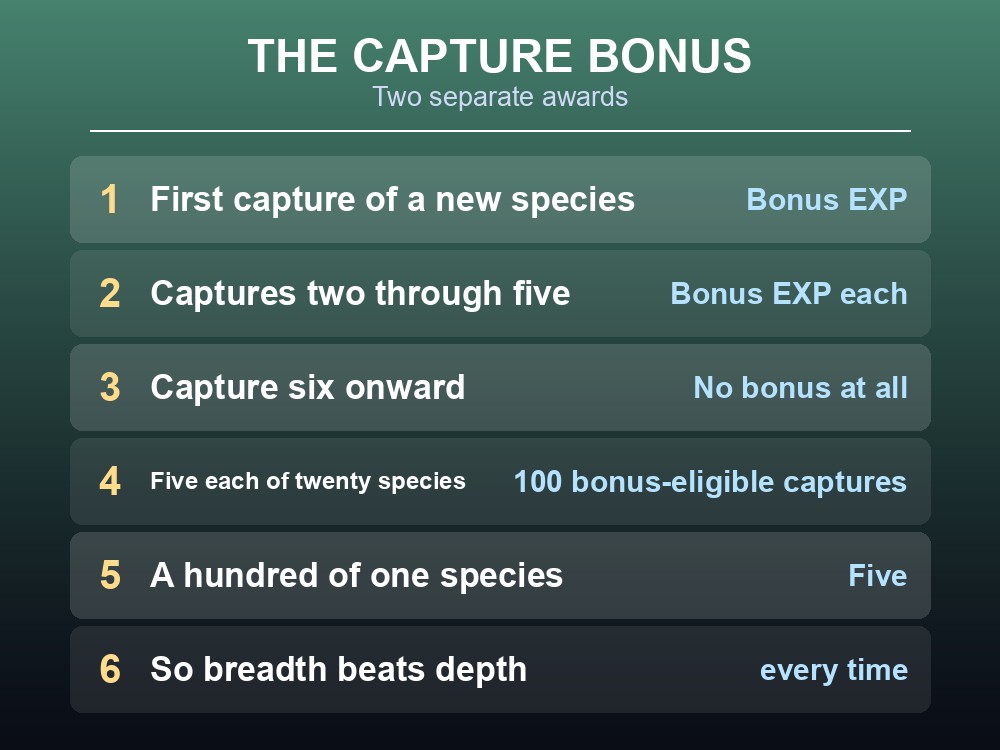
You will earn Bonus EXP when you capture a new species. Bonus EXP is also given for the first 5 times you capture a Pal of the same species.
Two separate awards, and the second one is what people miss:
- New species. The first capture of a species you have never caught pays a bonus.
- Captures two through five of that same species. Each of these also pays bonus EXP.
After the fifth capture of a species, the bonus stops. Every capture beyond that is worth the Pal itself and nothing more.
Why the First Five Change Your Routing
This single rule reshapes early and mid-game play more than its wording suggests.
Breadth beats depth, up to a point. Catching five each of twenty species pays out on 100 bonus-eligible captures. Catching a hundred of one species pays out on five. In the early game, when a Pal Sphere is cheap and your level is the actual bottleneck, the correct behaviour is to catch every species you meet, five times each, and not to grind any single one.
It pairs with the duplicate economy rather than fighting it. Duplicates are already the input to the Pal Essence Condenser, which raises a Pal's rank and can enhance its Partner Skill. So the first five captures of a species pay you twice — bonus EXP now, condenser material later. There is no tension between "level up" and "build a good Pal" in that window.
It stops mattering at exactly five. Once a species is past its fifth capture, further captures of it are worth only their condenser value and their sell price. That is the point to move to a species you have not exhausted, which in practice means moving to a new region.
Seen is not caught. Flying over a Pal enters it in the Palpedia but does not pay the capture bonus. The book filling itself in is not progress toward the EXP.
Working It Into a Session
A practical routine that follows from the mechanics:
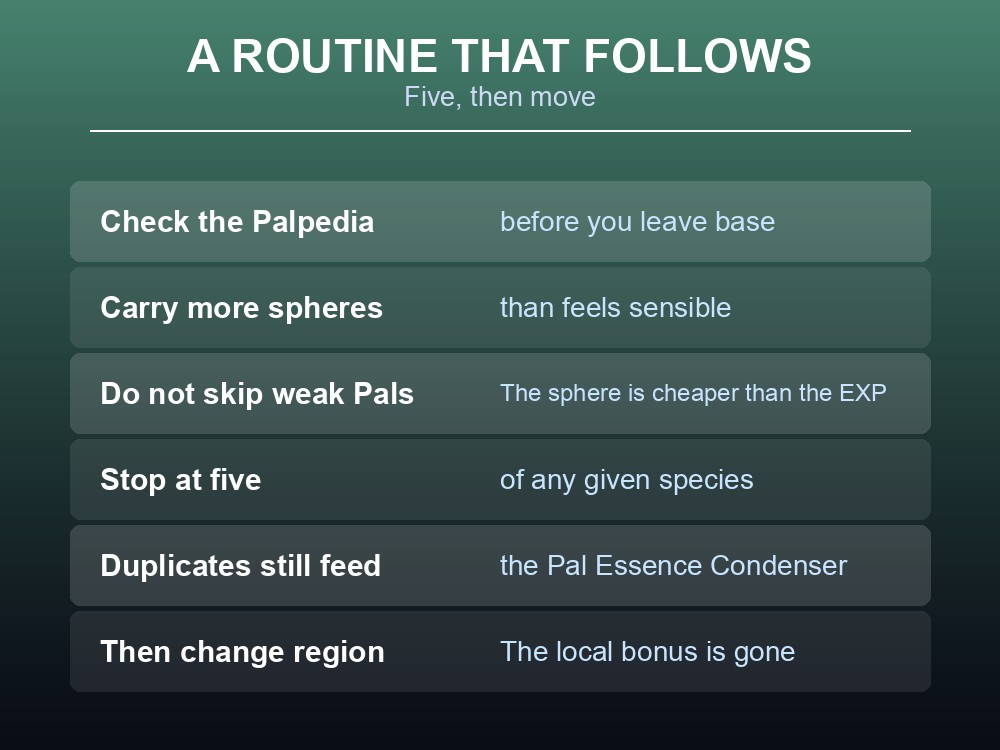
- Check the Palpedia before you leave base. Look up the species you need for a work suitability gap, and go where it lives rather than hoping.
- Carry more spheres than you think you need. The bonus is per capture, and you are aiming for five of everything in a region, not one.
- Do not skip the weak ones. A low-level Pal you will never use still pays a new-species bonus and four follow-up bonuses. The sphere is cheaper than the EXP is valuable.
- Track which species you have hit five times. The Palpedia does not surface a counter for this directly, so the practical proxy is: if you already have five of something in the Palbox, stop catching it.
- Move regions when a region is exhausted. Once the local species list is at five apiece, the bonus in that area is gone entirely, and travelling is worth more than farming.
Running your own Palworld 1.0 server
Filling a Palpedia is a lot of ground covered, and it goes far faster when a group splits the map and shares one Palbox. A gamever Palworld server keeps that world persistent with full crossplay, automatic updates and one-click backups.
Conclusion
The Palpedia records every Pal you have caught or seen — two distinct states — and its most underused feature is habitat lookup, which turns a work-suitability gap into a destination instead of a wiki search. Its EXP rule is the part that changes behaviour: capturing a new species pays Bonus EXP, and so do the first five captures of that same species. After the fifth, the bonus stops entirely. That makes breadth strictly better than depth in the window where levelling is your bottleneck — five each of twenty species is a hundred bonus-eligible captures, while a hundred of one species is five — and it pairs cleanly with the Pal Essence Condenser, which wants those same duplicates. Merely seeing a Pal fills in the book but pays nothing, so the routine that works is: look up what you need, carry more spheres than feels sensible, catch everything five times including the species you will never use, and move regions the moment the local list is exhausted.
Want to fill the book as a group? Rent a Palworld server at gamever.io — instant setup, one-click backups and updates, full crossplay and 24/7 uptime. Start with a free trial and use promo code WELCOME.