
The Factorio Main Bus: How to Lay Out, Space and Split a Central Belt Line
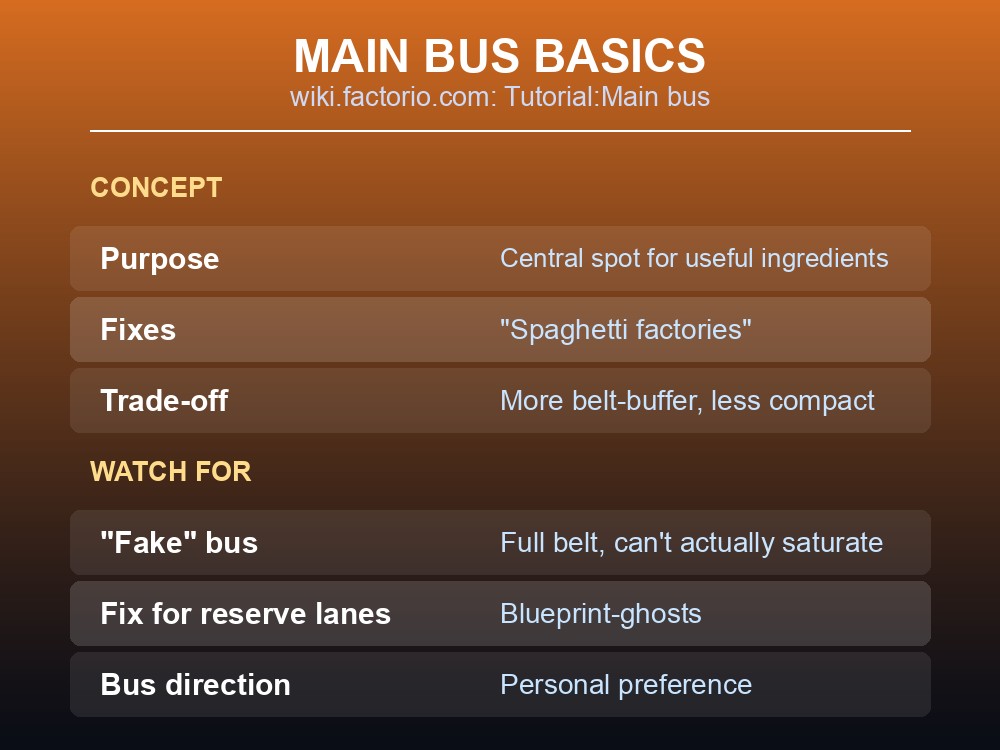
A main bus is a deliberate choice to put your most-used ingredients on one central line of belts and build everything else off it. The wiki's framing: the concept "is to put the most used and useful ingredients in a central spot to use for assembling machines," a "good measure to combat 'spaghetti factories' as it forces someone to plan a structured layout." It costs more belt-buffer and a less compact base, but it's the standard middle step between an unplanned early game and a robot- or train-based one. This guide covers what a bus is, what goes on it, how to space it, and how to split a belt off without losing throughput.
What a Main Bus Actually Is
Most buses start the same way: smelting iron, copper and steel, then "over time and distance gain more and more different items." Whether to use one at all is usually decided before a map starts, or at the latest at the first row of furnaces.
A documented trap is the "fake" bus: a belt wider than your production can saturate. A line that isn't moving but looks full is deceptive — "these belts can't carry the amount they lead one to believe they can." The one legitimate reason to build one anyway is reserving room for expansion, using blueprint-ghosts so the reserved lanes can't fill with unwanted items. Bus direction, and even an occasional corner bus, come down to personal preference and monitor orientation more than any hard rule.
What People Actually Put on a Bus
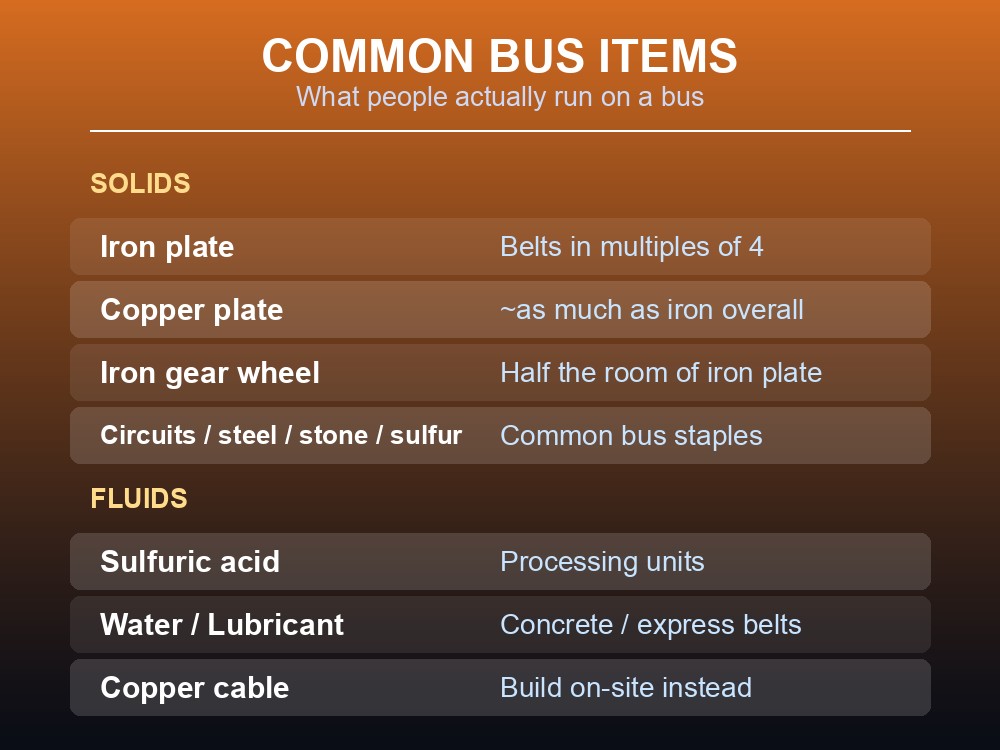
Bus contents are explicitly "a personal preference," but the wiki lists what people actually run: belts of iron plates — "usually a multiple of four as that is the length one underground belt can pass under" — roughly as much copper plate overall as iron, iron gear wheels (which "take up half as much room than iron plates"), electronic circuits, advanced circuits, steel plates, processing units, batteries, plastic bars (sometimes swapped for the coal that makes them), stone (for production science packs and bricks), and sulfur (for the chemical science pack).
Fluids ride alongside in pipes: sulfuric acid for processing units, water for concrete, and lubricant for express belts and the electric engine units the utility science pack needs.
One documented exception: copper cable is a poor bus candidate, since it "consume[s] more space on a belt than in the form of copper plates" — build it on-site instead.
Spacing, Width and Grouping Limits
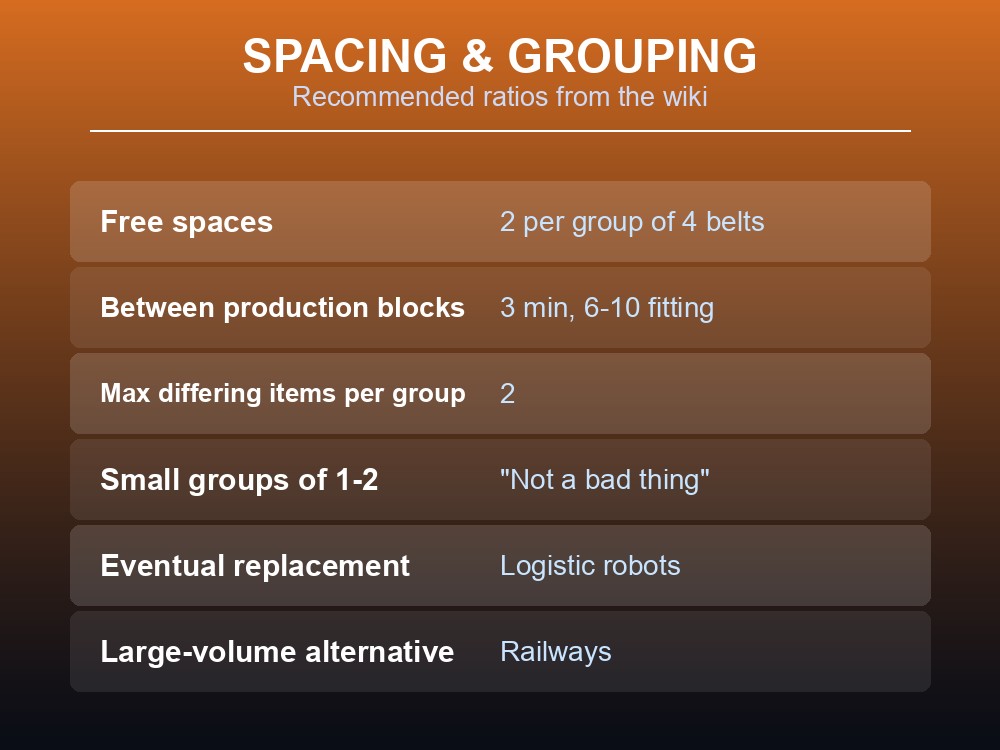
Putting every possible item on the bus produces "a huge wide bus with a lot of belt-buffer," including standing output lanes nobody draws from — those usually belong in chests instead. Width becomes a real problem fast, which is why some players build off only one side until they're sure they won't need the rest.
Two numbers do the actual work. Leave space between belt groups of the same item — "two free spaces for every group of four belts," a 2:4 ratio, i.e. one open lane per two belt lanes. Leave space between production blocks beside the bus too: "at least three, six to ten is fitting," reserved for crossing belts and later expansion. On grouping, mixing differing items "can cause problems when splitting them off," so cap any group at two differing items — smaller groups of one or two are "not a bad thing."
A bus isn't permanent, either. Once logistic robots arrive, some players move items by robot instead and "eventually phase out the main bus entirely," though robots "require a lot more resources and knowledge of the game." For very large volumes the alternative is railways, sometimes replacing belts with train stations feeding small logistic networks — one cited Reddit post also describes cargo wagons raising throughput and shrinking a bus, a technique the wiki links to rather than details itself.
Splitting a Belt Off the Bus
Drawing straight off the bus works but makes for an impractically long bus; it's sometimes still done for a single item like pipe (needing only iron plates) feeding a personal chest. Normally you split a belt away to feed a sub-factory instead.
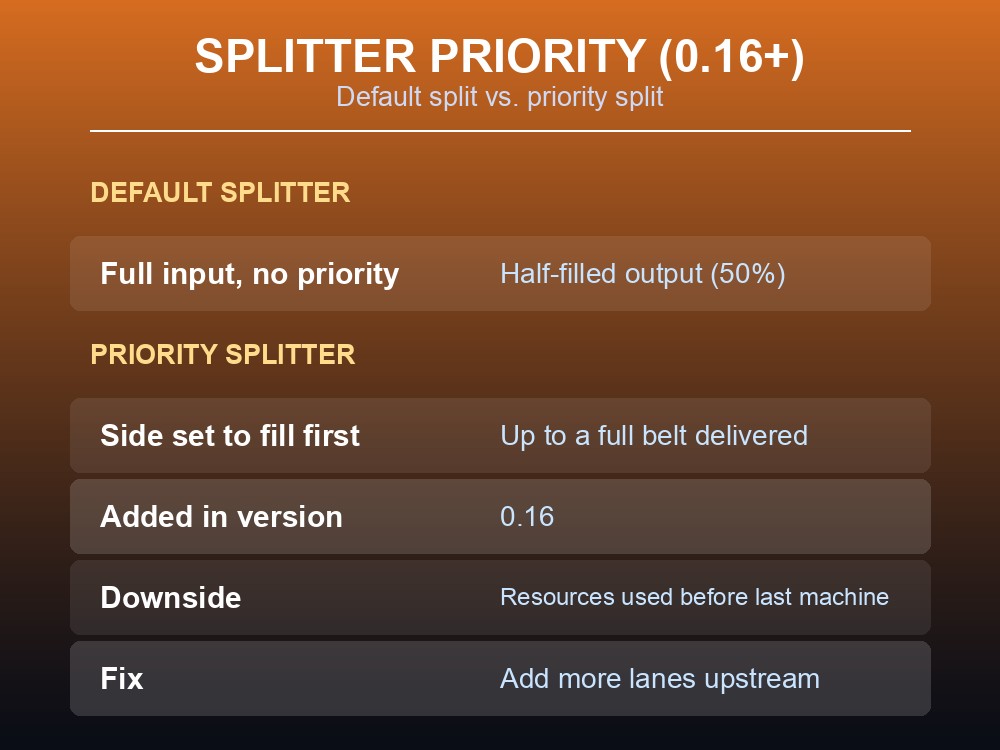
The default case is worth doing the arithmetic on: "a single splitter with a single full input belt will by default split off a half-filled belt" — 50% of that lane's throughput, not a full one. Splitter priorities, added in version 0.16, change that: setting priority on one side lets you pull a fully saturated belt off the bus while the rest continues down the line — "up to a full belt can be delivered." The documented downside is resources running out before every downstream machine is fed, fixed by adding more lanes earlier in the chain, not by rebalancing the shortage.
Non-priority split-off designs exist too, for 2-wide and 4-wide buses, drawing from every belt and lane roughly equally instead. A lane-balancer added after a split-off is usually unnecessary: if the split is already saturated, or the upstream build is inherently balanced, it just pauses half the production for no gain. The source documents these trade-offs without picking one "best" design — which family suits your base stays undocumented beyond that.
Practical tips
- Decide bus vs. no-bus before the map (or your first furnace row) — it's a layout commitment.
- Watch for a "fake" bus: a belt your production can't saturate looks full without moving that much.
- Build copper cable on-site, not on the bus — it costs more belt space than copper plate.
- Leave two free lanes per four belts of one item, and at least three (six to ten is fitting) tiles between production blocks.
- Cap split-off groupings at two differing items per group.
- Set splitter priority (0.16+) for a fully saturated split-off belt instead of the default half-filled one.
Running your own Factorio server
A main bus only pays off if the save it's built on sticks around. A gamever Factorio server keeps that world running continuously while your group iterates on bus width and splitter layouts together, takes scheduled backups before a big bus rebuild, and lets you roll back cleanly if a priority-splitter change starves a downstream factory instead of feeding it.
Conclusion
A main bus trades more belt-buffer and less compactness for a factory that doesn't turn into spaghetti, built from whatever mix of iron, copper, circuits and fluids you choose to run centrally. The two numbers worth remembering: two free lanes per four belts of one item, and at least three (six to ten is fitting) tiles between production blocks. The one mechanic worth remembering: a plain splitter gives only a half-filled split-off belt by default, while a priority splitter (0.16+) can deliver a fully saturated one. None of this is permanent — robots and railways are the documented next steps once a bus gets too wide to manage.
Want a factory that stays online while you rebuild the bus for the third time? Rent a Factorio server at gamever.io — automatic backups, easy rollbacks, and a free trial with promo code WELCOME.