
The Camel in Minecraft: Dashing, Two Riders, and Where to Find It
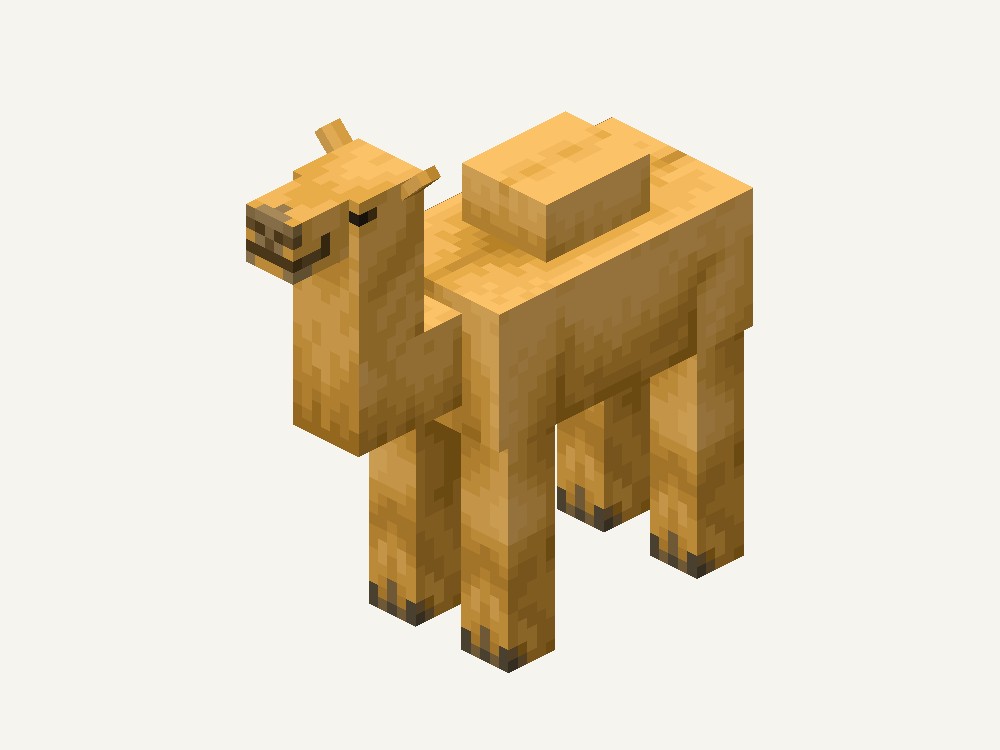
Per the wiki, "a camel is a large passive mob found in deserts and desert villages. They can be saddled and ridden by up to two players at once." Camels were announced at Minecraft Live 2022 (October 15, 2022) and added in the Trails & Tales Update: Java Edition 1.20 — available without the experimental data pack from snapshot 23w12a — and Bedrock Edition 1.20.0, per the sourced wiki listing. That two-rider capacity, paired with a burst-dash ability and several sourced movement quirks, is what makes the camel worth a dedicated look.
Where to Find a Camel
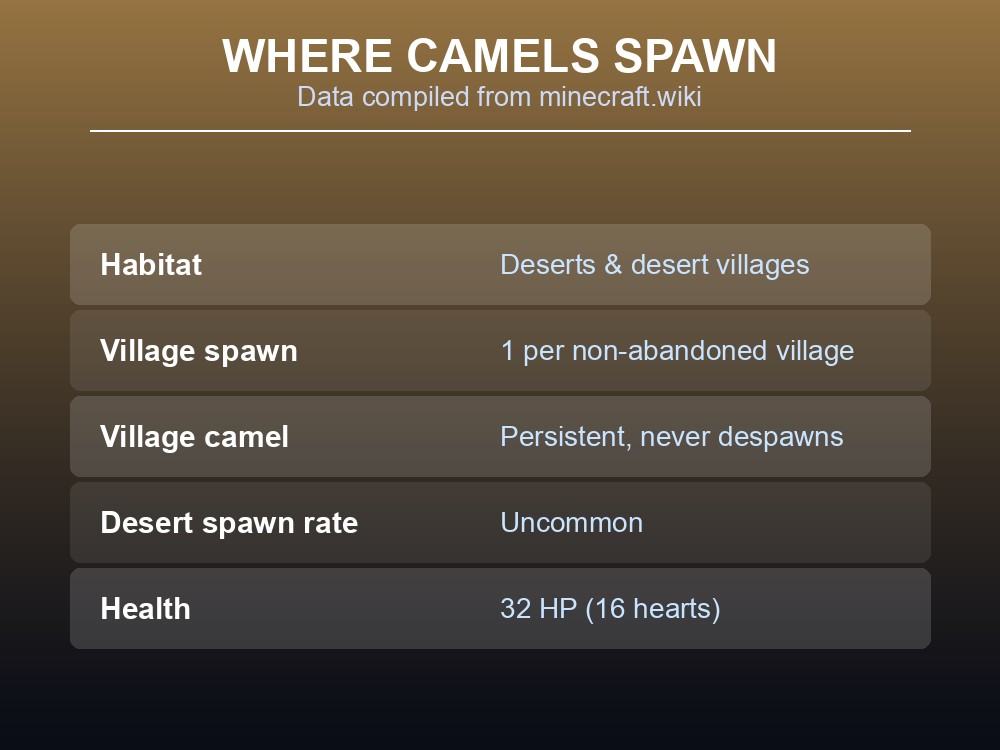
Camels spawn uncommonly in deserts on their own, but the more reliable source is structural: the wiki states, "one camel spawns in the center of each desert village during world generation that is not abandoned. This camel is persistent and does not despawn." A non-abandoned desert village is close to a guaranteed camel, without needing to search the open desert at all.
Health-wise, the camel's infobox lists health = 32. In hearts (each heart equals 2 HP), that's 32 ÷ 2 = 16 hearts, matching the wiki's own "16 hearts" note on the same listing.
Two Riders and the Dash Ability
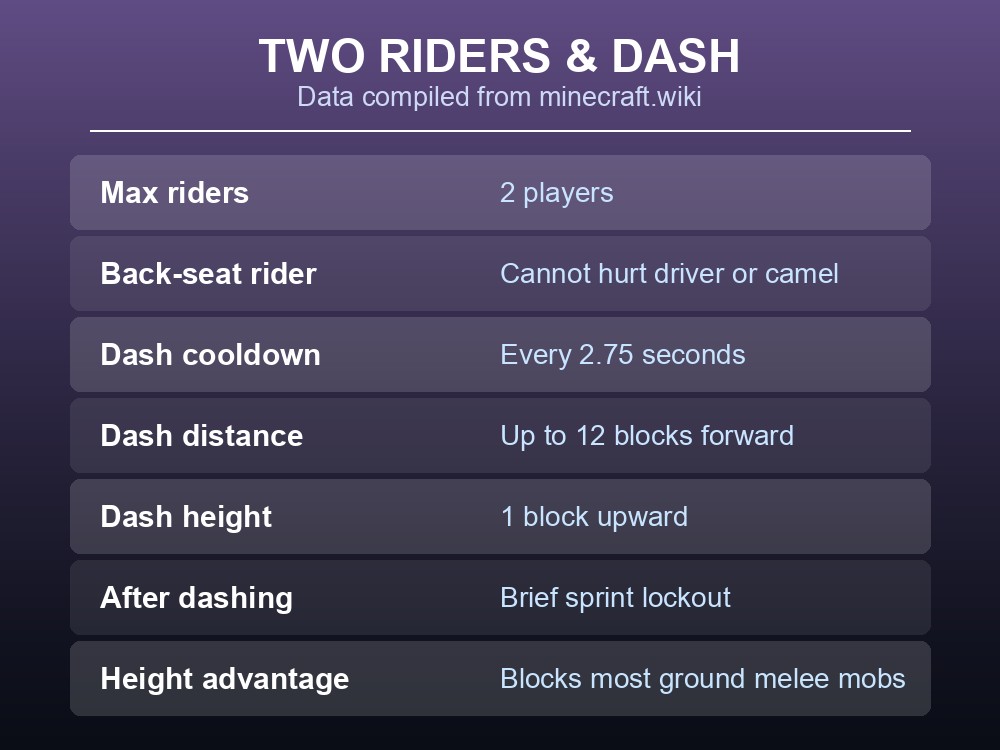
The camel's signature trait is right in the wiki's own description: "up to two players can ride one camel. While riding, the player in the back seat cannot hurt the player driving or the camel itself." The driver controls it, and the passenger rides along without being able to attack the driver or the mount.
A saddled camel can also dash. Per the wiki: "camels can dash every 2.75 seconds. When dashing, the camel launches up to 12 blocks forward and one block upward. For a short time after dashing, the camel cannot sprint." That's a 2.75-second cooldown per dash, each one covering up to 12 blocks forward and 1 block up, with a sprint lockout afterward whose exact duration is not documented in our source.
There's a defensive payoff to riding one, too: "camels are tall enough that most melee hostile mobs such as zombies, vindicators, hoglins, silverfish, endermites and golden sword-wielding piglins cannot reach mounted players to attack them." The listed exceptions are spiders, wolves, slimes, and magma cubes, which can still land hits because they jump or climb.
Saddling, Taming, and Breeding
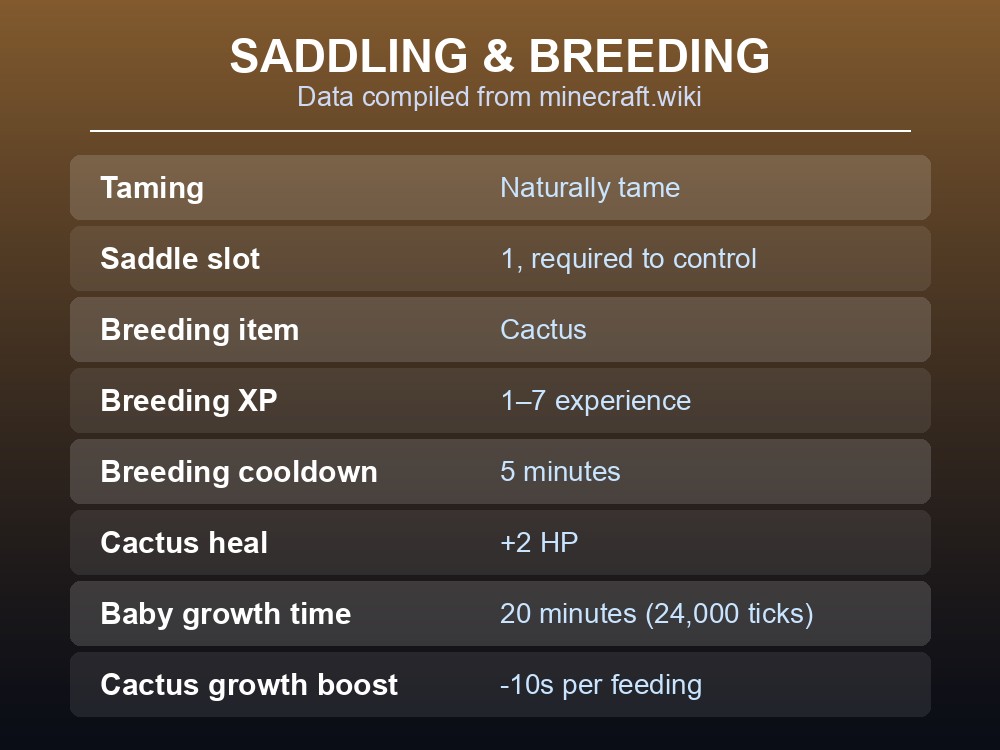
Camels are naturally tame, per the wiki, but a saddle is required before one can be steered. The source states: "camels have one slot in their inventory for equipping a saddle. A saddle can be placed on a camel by holding it and then using it on the camel, or by accessing its inventory." Once saddled, a player controls it with directional controls, jump, and the mouse.
Breeding uses cactus. The wiki states, "a player can breed camels by using cactus. After breeding, a baby camel spawns and 1-7 experience is generated. The parents cannot be bred again for 5 minutes." Feeding a cactus outside of breeding also heals a camel by 2 health points, per the sourced facts.
"Baby camels cannot be equipped or ridden," per the wiki, and they take 24,000 ticks to grow into adults. At 20 ticks per second, that's 24,000 ÷ 20 = 1,200 seconds, or 1,200 ÷ 60 = 20 minutes. Each cactus fed shaves 10 seconds off that timer, so clearing the full wait on cactus alone takes 1,200 ÷ 10 = 120 cacti. Baby camels follow adults, per the source.
Movement, Fall Safety, and Getting Around
Camels have a listed top walking speed of 3.885 blocks/s, and can manually sprint at 8.203 blocks/s by double-tapping forward or holding sprint. Dividing the two: 8.203 ÷ 3.885 ≈ 2.11, so sprinting covers ground a little over twice as fast as walking, per these figures. The source also notes camels are less maneuverable than other mounts, with slower turning and strafing.
One ability is described directly against other named mounts. Per the wiki: "camels have the unique ability to step up 1.5 blocks, allowing them to surmount fences and walls with ease. This is in contrast to horses, donkeys and mules, which can't automatically step up more than one block without jumping."
They also have a resting animation: a camel "wanders aimlessly, avoiding hazards and obstacles, and occasionally sits for two to seven seconds before standing up again," and can't be pushed while sitting.
Fall safety follows the same pattern as its health. Camels can fall 6 blocks safely before taking damage, versus 3 blocks for most mobs, per the source — 6 ÷ 3 = 2× the safe distance. Beyond that, camels take 0.5 damage per block instead of 1, half the normal rate. A riding entity takes the same fall damage as the camel carrying it.
Practical tips
- A non-abandoned desert village guarantees a persistent camel — check there before searching the open desert.
- 32 health = 16 hearts, and camels tolerate double the safe fall distance (6 blocks vs. 3) at half fall-damage per block.
- Dash every 2.75 seconds for up to 12 blocks forward and 1 block up — the sprint lockout afterward has no stated duration in our source.
- A saddle is required to control a camel, even though it's naturally tame per the wiki.
- Feeding cactus breeds camels (1-7 XP, 5-minute parent cooldown) and heals 2 HP outside of breeding.
- Baby camels take 20 minutes to grow; each cactus fed cuts 10 seconds, so 120 cacti clears the wait entirely.
Running your own Minecraft server
Desert villages with a persistent camel spawn are part of the world your server generates — and per the wiki, that spawn only exists in villages that are "not abandoned," so a stable, always-on shared world matters for finding one reliably. A gamever Minecraft server stays online 24/7 so everyone in the group can go camel-hunting, or ride double through the desert, whenever they're free.
Conclusion
The camel's core numbers, per the wiki: 32 health (16 hearts), a 2.75-second dash cooldown covering up to 12 blocks forward and 1 block up, two-player riding capacity, a 3.885 blocks/s walking speed topping out at 8.203 blocks/s sprinting (about 2.11× faster, computed), a 1.5-block step-up over fences and walls, and double the safe fall distance of most mobs (6 vs. 3 blocks) at half the fall-damage rate (0.5 per block vs. 1). One spawns persistently in every non-abandoned desert village, it needs a saddle — with no taming process described — to ride, and cactus both breeds it (1-7 XP, 5-minute cooldown) and heals it (+2 HP). Growing a baby from scratch on cactus alone works out to 120 cacti to clear the full 20-minute timer. The exact length of the post-dash sprint lockout is not documented in our source, described only as "a short time."
Ready to go camel-hunting with friends? Rent a Minecraft server at gamever.io — instant setup, one-click backups and updates, and 24/7 uptime. Start with a free trial and use promo code WELCOME.