
The Armadillo in Minecraft: Scutes, Rolling Up, and Where to Find It
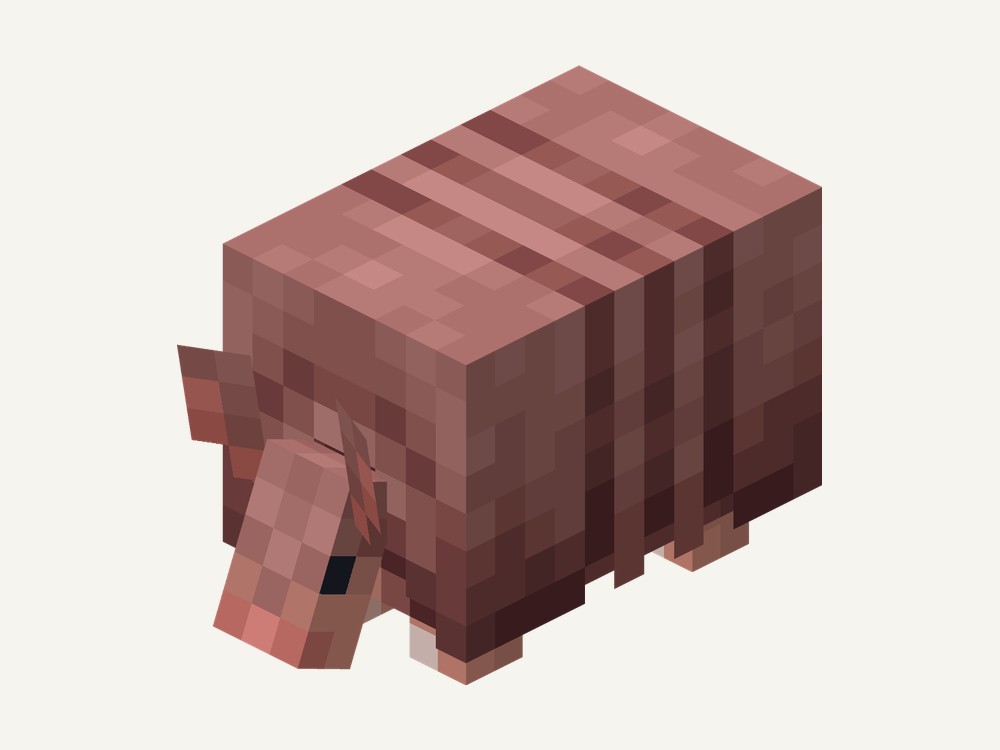
The armadillo is a passive mob found in badlands and savannas, per the wiki, and it rolls up in response to being hurt or being near undead mobs or players that are sprinting or mounted — while curled up, it takes less damage. Stated exactly as the source does: "It is the only source of armadillo scutes." Those scutes are the only ingredient the wiki ties to wolf armor. The mob was added to Java Edition in version 1.20.5 (snapshot 23w51a) and reached Bedrock Edition in 1.20.80 without an experimental toggle, after winning the 2023 Mob Vote at Minecraft Live 2023, per the wiki.
What Is an Armadillo, and Where Do You Find One?
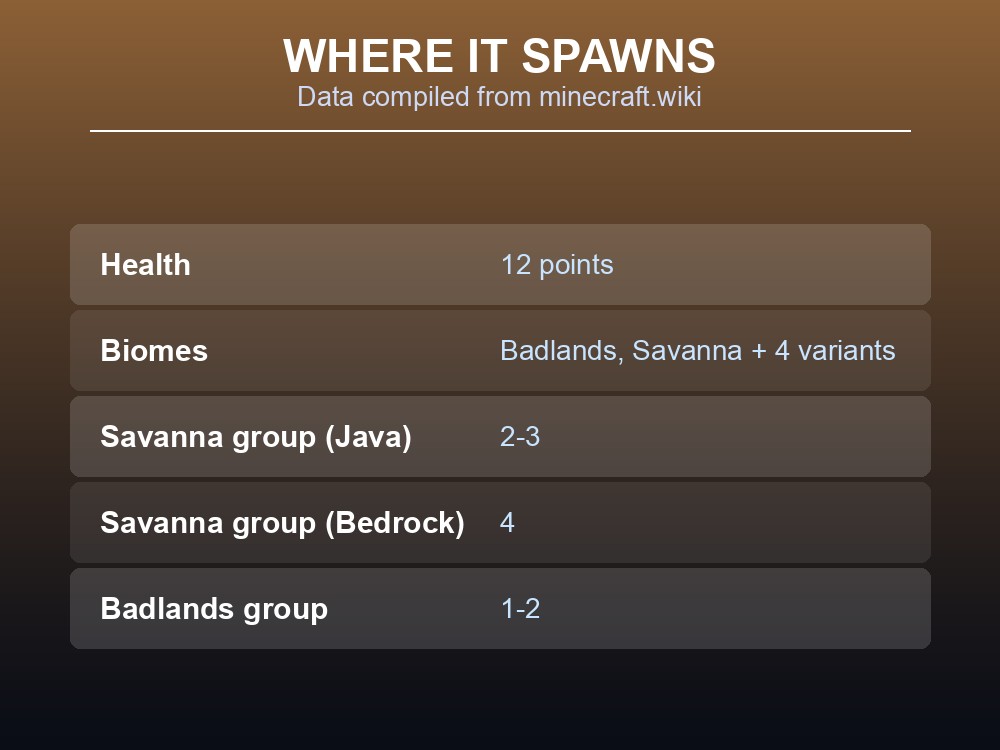
An armadillo has 12 health points, and it spawns in six named biomes: Badlands, Eroded Badlands, Savanna, Savanna Plateau, Windswept Savanna, and Wooded Badlands. Group size depends on the biome type and edition: savannas produce groups of two to three on Java or four on Bedrock, while badlands produce smaller groups of one to two on either edition. As arithmetic, Bedrock's savanna group size is exactly double Java's low end — 4 versus 2.
Passive means it won't attack, but it isn't defenseless: hurting it, getting near an undead mob, or approaching while sprinting or riding anything all trigger the shell response covered next.
Rolling Up: Shell Defense and the Spider Repel

When hurt, confronted by undead, or confronted by a sprinting or mounted player, an armadillo hides in its shell. While rolled up, incoming damage is reduced by the wiki's own formula: (original damage − 1) ÷ 2. Worked out, a hit that would deal 5 damage becomes (5 − 1) ÷ 2 = 2 damage; a hit that would deal 9 becomes (9 − 1) ÷ 2 = 4 damage. The armadillo unrolls once it detects no threats for 3 seconds (60 ticks).
There's a side effect to being unrolled: spiders and cave spiders flee from an armadillo when within 6 blocks of it, but per the wiki this "only takes effect when the armadillo is not rolled up in its shell." The repel effect and the damage-reducing shell are mutually exclusive — an armadillo can't scare off nearby spiders and be hiding from damage at the same moment.
Breeding and Baby Armadillos
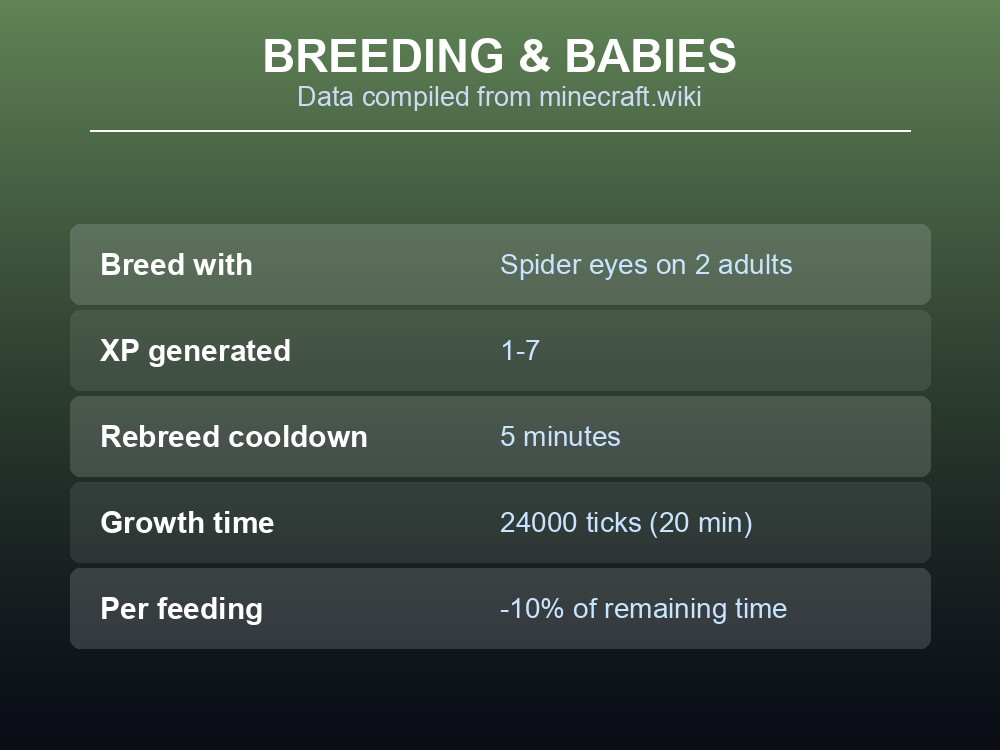
Breeding two armadillos is done by using spider eyes on two of them. That produces a baby armadillo and generates 1–7 experience, and afterward "the parents cannot be bred again for 5 minutes," per the wiki.
Babies follow adults automatically, and any armadillo will follow a player holding spider eyes within 10 blocks on Java or 16 blocks on Bedrock. A baby takes 24,000 ticks (20 minutes) to grow into an adult, and each spider-eye feeding "takes 10% off the remaining time." As an example: from the full 20 minutes remaining, one feeding removes 10% of that — 2 minutes — leaving 18 minutes; a second feeding then removes 10% of the new remaining time, 1.8 minutes, leaving 16.2 minutes. Each feeding shaves a smaller absolute amount, since the 10% is recalculated against whatever time is left, not the original 20 minutes.
Scutes, Brushing, and Wolf Armor
Armadillos shed scutes passively: the wiki states an armadillo "drops 1 armadillo scute every 5–10 minutes," describing the rate as "similar to the rate at which chickens lay eggs." A faster, active method exists too. If a player or dispenser uses a brush on an armadillo, it drops 1 scute immediately. Brushing costs 16 durability points per use, and per the wiki, "an unenchanted brush can obtain 4 (Java) / 5 (Bedrock) armadillo scutes before breaking."
The brush is crafted from a feather, a copper ingot, and a stick, and outside of armadillos it's also used in archaeology, to excavate suspicious sand and suspicious gravel.
Scutes have one documented crafting purpose: wolf armor, equippable on a wolf to protect it from damage. The exact number of scutes the wolf-armor recipe itself consumes is not documented in our source — that specific crafting count isn't in the facts available here. What is documented is repair math: an armadillo scute used directly on a wolf already wearing wolf armor restores 8 points of durability, while repairing wolf armor with scutes in an anvil restores 16 points. As a ratio, 16 ÷ 8 = 2 — anvil repair restores exactly twice the durability per scute compared with a direct scute use on the wolf.
Practical tips
- Six spawn biomes — Badlands, Eroded Badlands, Savanna, Savanna Plateau, Windswept Savanna, Wooded Badlands — in groups of 1–2 (badlands) or 2–3 Java / 4 Bedrock (savanna).
- Rolled-up damage reduction is (original damage − 1) ÷ 2 — a 9-damage hit becomes 4 while the shell is up.
- The spider-repel effect (6 blocks) only works while unrolled, not while hiding in the shell.
- Breed with spider eyes; each growth feeding removes 10% of the baby's remaining time, not a flat chunk of the original 20 minutes.
- Passive scute drops come every 5–10 minutes; a brush gets one scute per use and lasts 4 (Java) / 5 (Bedrock) uses unenchanted.
- Anvil-repaired wolf armor recovers 2x the durability (16 points) of a scute used directly on a wearing wolf (8 points) — but the wolf-armor craft's own scute cost isn't documented in our source.
Running your own Minecraft server
Tracking down armadillos across multiple badlands and savanna biomes, then keeping a stable of bred wolves in matching armor, is easier with a dedicated world your whole group logs into instead of everyone hunting solo. Server-side config is where a gamever Minecraft server pays off here: server.properties settings control render/simulation distance so a shared badlands base doesn't lag out, and admin/console commands like /give are useful for testing spider-eye breeding cooldowns or wolf-armor repair math without a full farming loop first. Migrating an existing world onto a server works the same as always — just make sure everyone's client is on a version that has armadillos before you go looking together.
Conclusion
Everything documented about the armadillo comes down to a small set of numbers: 12 health, six spawn biomes, group sizes of 1–2 (badlands) or 2–3 Java / 4 Bedrock (savanna), a rolled-up damage formula of (original damage − 1) ÷ 2, a 6-block spider repel that only works unrolled, a 20-minute baby growth timer reduced 10% of the remaining time per feeding, passive scute drops every 5–10 minutes, and a brush that yields 4 (Java) / 5 (Bedrock) scutes before breaking. Scutes feed into wolf armor, and while the source documents the 8-point (direct) and 16-point (anvil) repair figures precisely, it does not document the scute count the initial wolf-armor craft requires — that stays an open gap rather than a guess.
Ready to hunt down your own armadillo herd? Spin up a Minecraft server at gamever.io — instant setup, one-click backups, and 24/7 uptime. Start with a free trial and use promo code WELCOME.