
Rust Breach and Clear: How Tool Cupboard Upkeep Now Scales With Group Size
On September 3, 2026, Facepunch's Breach and Clear update introduced a mechanic called Upkeep Group Scaling. In Facepunch's own words, "Tool Cupboard upkeep now scales with the number of players connected to a base: smaller groups may avoid the added tax, while larger clans pay extra resources as more players are authed." In practical terms, the wood, stone, metal, and HQM your TC eats per protection cycle now depends on how many players it treats as part of your group — not just on the size of your base. This article walks through the tax tiers, exactly who the game counts toward your group, and two worked examples straight from the devblog's own math.
What Breach and Clear Changed
Before Breach and Clear, Tool Cupboard upkeep was a flat resource cost tied only to what was built inside its radius — how many players held keys or auth on that TC never mattered. Upkeep Group Scaling changes that by layering a percentage tax on top of the normal upkeep bill, and the size of that tax climbs the more players are counted as part of the base's group. Physgun's coverage of the patch confirms this tax applies to "wood, stone, metal, and HQM owed per protection cycle" — so every upkeep resource is affected, not just one material.
The Tax Tiers, Tier by Tier
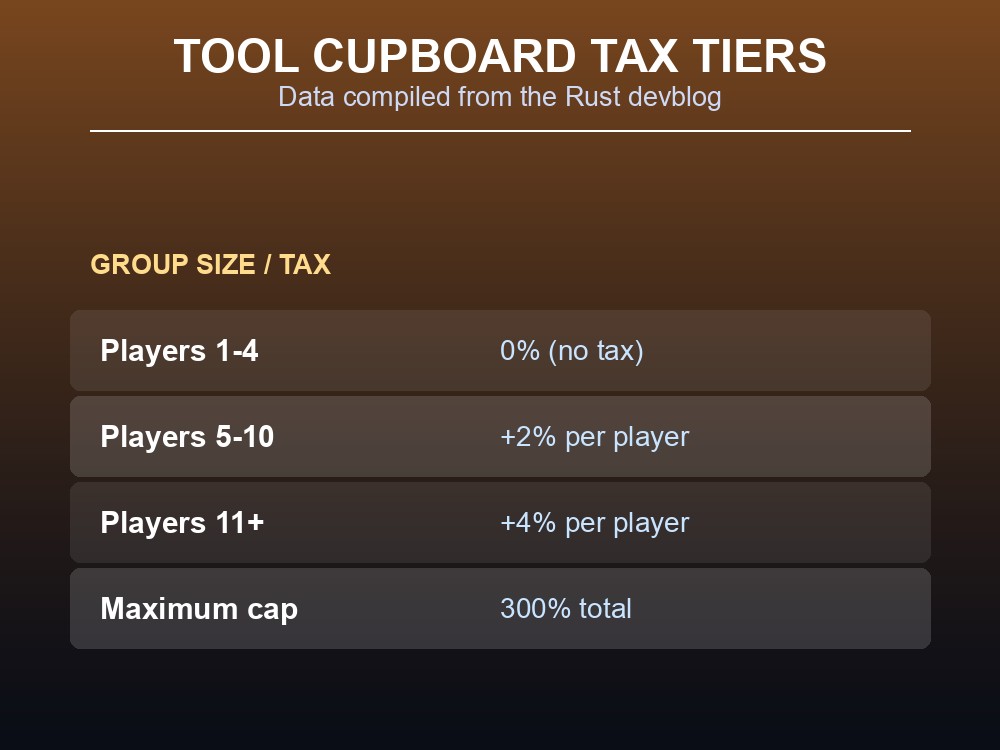
The devblog lays out the scaling in four explicit bands:
- Players 1–4: "First 4 players incur no tax (0% extra upkeep)."
- Players 5–10: "Next 6 players (players 5-10) incur 2% tax per player."
- Players 11+: "Subsequent players (11+) incur 4% tax per player."
- Cap: "Maximum tax amount of 300%."
So a solo base or a small four-player group pays exactly what it always paid — the scaling only starts biting once a fifth player is counted into the group, and it accelerates again once you cross ten.
Who Actually Counts Toward Your Group Size
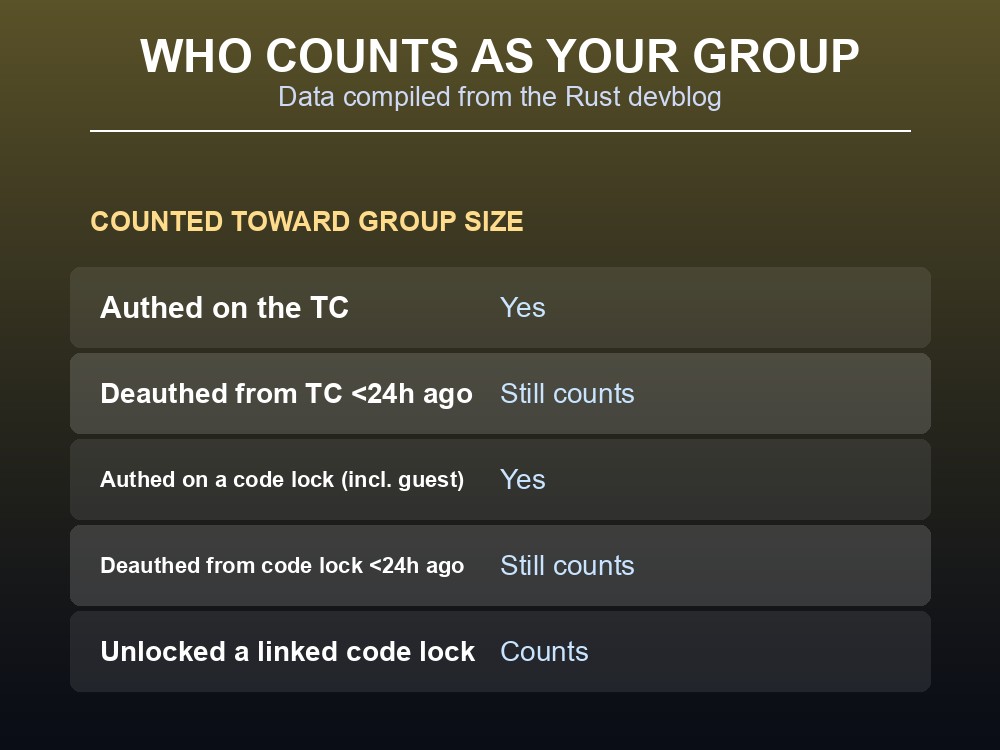
This is the part most players will get wrong if they only skim the tier numbers, because "group size" isn't just your TC auth list. Per the devblog, the following all count:
- Any players directly authed on the TC.
- Any players deauthed from the TC within the last 24 hours — they still count.
- Any players authed on a code lock in the base, including guest code access.
- Any players deauthed from a code lock within the last 24 hours — same 24-hour carryover.
- Physgun adds a further wrinkle: "Anyone who unlocks a code lock tied to your TC counts toward your group size for upkeep purposes, whether or not they are on the TC's auth list directly."
The 24-hour window works on a rolling basis: per the devblog, "players stop counting toward the upkeep multiplier only after 24 hours have passed since they were deauthed from the TC or a linked code lock." That means kicking someone off your auth list right before a wipe or a raid doesn't immediately shrink your tax bracket — the game keeps them on the books for a full day.
Worked Examples: 6 vs. 12 Authed Players
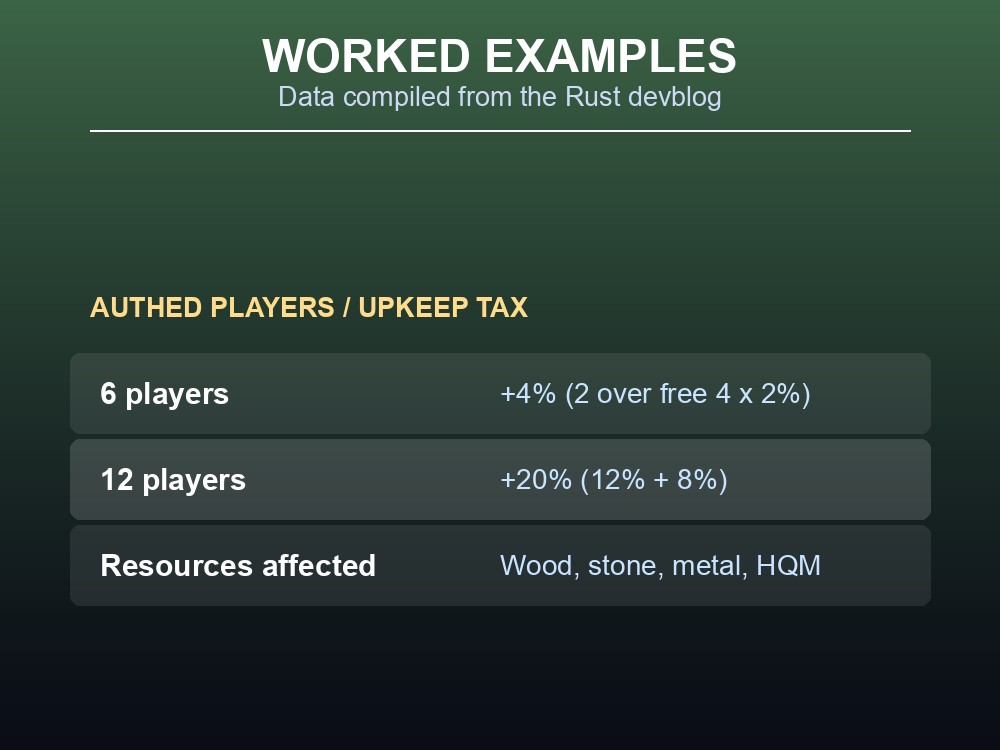
The devblog gives two concrete examples, and the arithmetic checks out against the tier table above:
- 6 players authed: the first 4 are free, leaving 2 players in the 5–10 tier at 2% each → 2 × 2% = +4% upkeep. That matches the devblog's own figure: "A TC with 6 players authed has +4% upkeep (2 players over the free 4, at 2% each)."
- 12 players authed: players 5 through 10 (6 players) fall in the 2% tier → 6 × 2% = 12%. Players 11 and 12 (2 players) fall in the 4% tier → 2 × 4% = 8%. Total: 12% + 8% = +20% upkeep. Again, this matches the devblog directly: "A TC with 12 players has +20% upkeep (players 5-10 at 2% = 12%, players 11-12 at 4% = 8%)."
What the sources reviewed here don't spell out is whether that percentage tax applies uniformly across every material (wood, stone, metal, and HQM equally) or whether some resources scale differently from others — the devblog and Physgun's summary both confirm all four materials are affected, but neither gives a per-material formula. Whether the 300% cap is a single aggregate ceiling or tracked per material is likewise undocumented in what's available here — treat both as open questions rather than assume an answer.
Quick tips: Keep your TC auth list as lean as your build actually needs — every additional authed player past 4 has a real resource cost now. Remember that deauthing someone doesn't help your tax bracket for a full 24 hours, so plan roster changes ahead of a wipe rather than in the middle of one. Don't forget that a code lock in the base counts too, including guest code access — it can push your group size (and your tax) higher than your TC auth list alone suggests. Budget for extra wood, stone, metal, and HQM as your authed roster grows past the free tier, since all four materials are factored into the tax.
Running your own Rust server
If you're testing how Upkeep Group Scaling plays out with your own clan's roster, the easiest way is on a server you control, where you can watch the actual upkeep math change as you auth and deauth players. Renting a dedicated Rust server from gamever gets you a clean vanilla or modded instance with full admin access, one-click wipes for testing new group sizes, and support that's actually current on patches like Breach and Clear. Spin one up and use code WELCOME for a discount on your first month.
Conclusion
Breach and Clear's Upkeep Group Scaling turns Tool Cupboard upkeep from a flat building cost into a per-clan tax: free for the first four authed players, 2% per player from five to ten, 4% per player from eleven up, capped at 300%. The counting rules matter as much as the tiers themselves — TC auth, code lock auth (guest codes included), and a 24-hour carryover after deauth all feed into your group size. Large clans should expect a real jump in wood, stone, metal, and HQM upkeep costs going forward, and the devblog's own 6-player and 12-player examples show exactly how fast that tax compounds once you cross the free tier.