
Rust Breach and Clear: How Red Keycard Monument Blockers Work
Facepunch's Breach and Clear update, shipped 3 September 2026, quietly changed how fast a solo or small group can get into a monument's red keycard loot. The devblog describes monument blockers as "a new obstacle added to monuments with red keycard puzzle rooms, intended to slow down early access to the loot at those monuments." They're not a new puzzle, a new door, or a new keycard tier — they're a chunk of destructible cover sitting between raiders and the room, and they change the early-wipe math at every red-card monument on the map.
What Monument Blockers Are
Monument blockers show up next to red-card puzzle rooms at monuments, not inside them. Facepunch's own framing of the purpose is plain: monument blockers are "intended to slow down early access to the loot at those monuments." The devblog doesn't specify a time window or exactly which players it's aimed at beyond that, and it doesn't give an exact list of which monuments got blockers — the facts available here don't name specific monuments either, so treat "every red-card monument" as the documented scope rather than a confirmed per-monument list.
Where Blockers Show Up
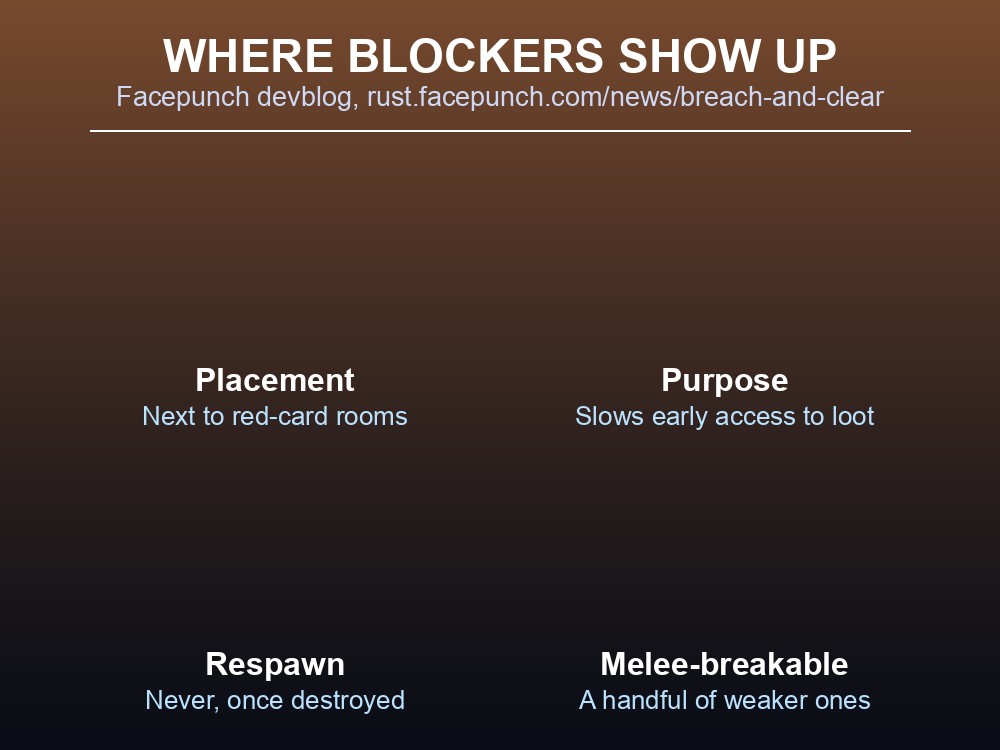
Both the devblog and a wipe-notes recap agree on placement: blockers sit "next to red-card rooms," guarding the approach rather than replacing any existing puzzle mechanic. That means the keycard reader, the puzzle logic, and the loot itself are unchanged — you still need the red keycard to open the room once you've dealt with the blocker outside it. Nothing in the sourced material says blockers appear at monuments without a red keycard room, so this looks like a red-card-specific addition, not a general monument change.
How to Destroy a Blocker
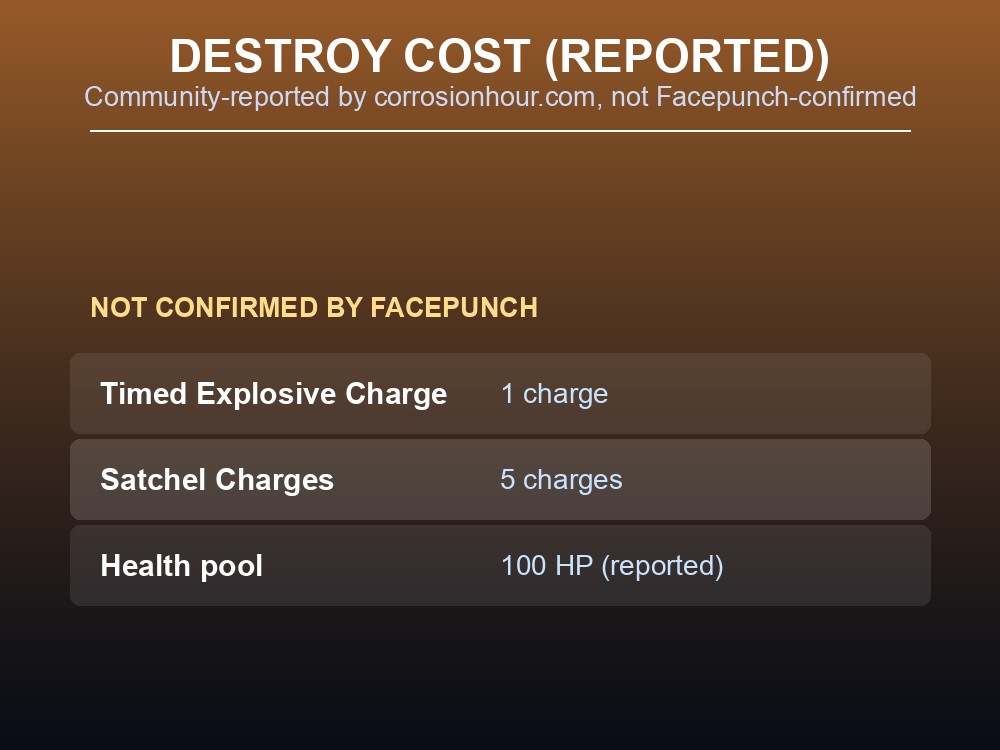
Facepunch's own wording is deliberately vague on the numbers: blockers "require a significant amount of damage to destroy" and are "destroyed with explosives." The devblog also confirms "a handful of weaker monument blockers can be destroyed by melee" — so not every blocker demands a full explosives run, though the devblog doesn't say which specific monuments get the melee-breakable variant.
For the actual numbers, the only source available is corrosionhour.com, not Facepunch — so treat the following as community-reported, not confirmed by Facepunch, and subject to change:
- 1 Timed Explosive Charge, or
- 5 Satchel Charges, to destroy a single blockade
- A 100-point health pool
If that reported 100 HP figure holds, 5 satchel charges landing full damage would be the kind of "significant damage" the devblog is describing in vaguer terms — but since neither the per-charge damage nor the HP figure comes from Facepunch, that's an inference from an unconfirmed number, not a devblog-verified calculation.
The Decay Timer If You Wait
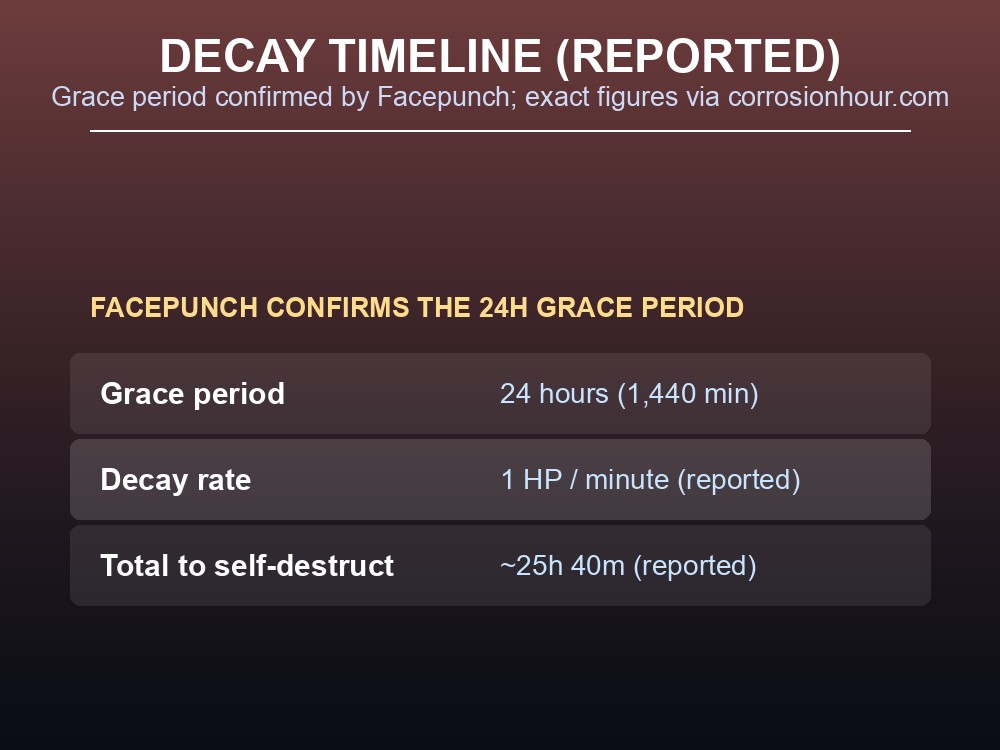
One thing the devblog does confirm directly: "if not destroyed within the first 24 hours, they start to decay." Once destroyed — by any method — a blocker "won't respawn." So a group that clears a blocker on day one doesn't need to worry about it regenerating before the next wipe.
corrosionhour.com adds the exact figures behind that 24-hour line: a 1,440-minute (24-hour) grace period, then 1 health lost per minute once it expires. Again, these specific numbers are community-reported only — the devblog states the 24-hour grace period qualitatively but not the per-minute decay rate. Doing the arithmetic on the reported figures: at 1 HP/minute, a reported 100-HP blocker would need 100 more minutes (1 hour 40 minutes) to decay to zero after the 24-hour grace period ends — a reported ~25 hours 40 minutes total from spawn to self-destruction if nobody touches it.
Bring explosives, not just guns, to a red-card monument you're planning to hold early. Since blockers don't respawn once down, a group that clears one on day one of a wipe has effectively banked that access for the rest of it — unless the reported 24-hour decay clock is what removes it for everyone first.
Running your own Rust server
If you're testing how Breach and Clear plays out with your own group — timing a raid on a blocker, checking whether your server's monuments got the melee-breakable variant, or just running wipes on your own schedule instead of waiting on a public server's cycle — a dedicated Rust server puts that control in your hands. Config files, launch arguments, admin commands, PvP settings, and world migration to a new server are all straightforward to manage once it's up.
Spin up a Rust server built for the current update, invite your group, and set your own wipe schedule. New customers get their first server free with code WELCOME.
Conclusion
Breach and Clear's monument blockers are a confirmed, live change to how red keycard monuments play in early wipe: an obstacle next to the puzzle room, destroyed mainly with explosives (a few weaker ones by melee), gone for good once destroyed, and decaying on its own after 24 hours if nobody deals with it. The specific numbers — 1 Timed Explosive Charge or 5 Satchel Charges, a 100 HP pool, 1 HP/minute decay — come from corrosionhour.com's reporting, not from Facepunch directly, so treat them as a useful planning estimate rather than a guaranteed patch value until Facepunch confirms them.