
Project Zomboid Generators Guide: Fuel, Power, and the Shutoff
A generator is, per the wiki, simply "a device used to provide electricity using gasoline," and there are 4 types: Lectro-Max (Red), Premium Technologies (Yellow), ValuTech (Blue), and Old (Yellow, with a large circular section) — "Each type differs in sound, weight, and reliability." Regardless of type, every generator powers a 20-tile radius cylinder centered on itself, reaching 3 floors above and 3 floors below. This guide covers that range, the actual fuel math behind how long a tank lasts, and the connect/refuel/shutoff sequence for running one safely. Worth noting: the source page itself flags that it "was last updated for an older version of the current build (42.13.1)... information on this page may be inaccurate" against the current 42.20.4 — treat the figures below as a documented baseline, not a guarantee against the latest patch.
How Far a Generator's Power Actually Reaches
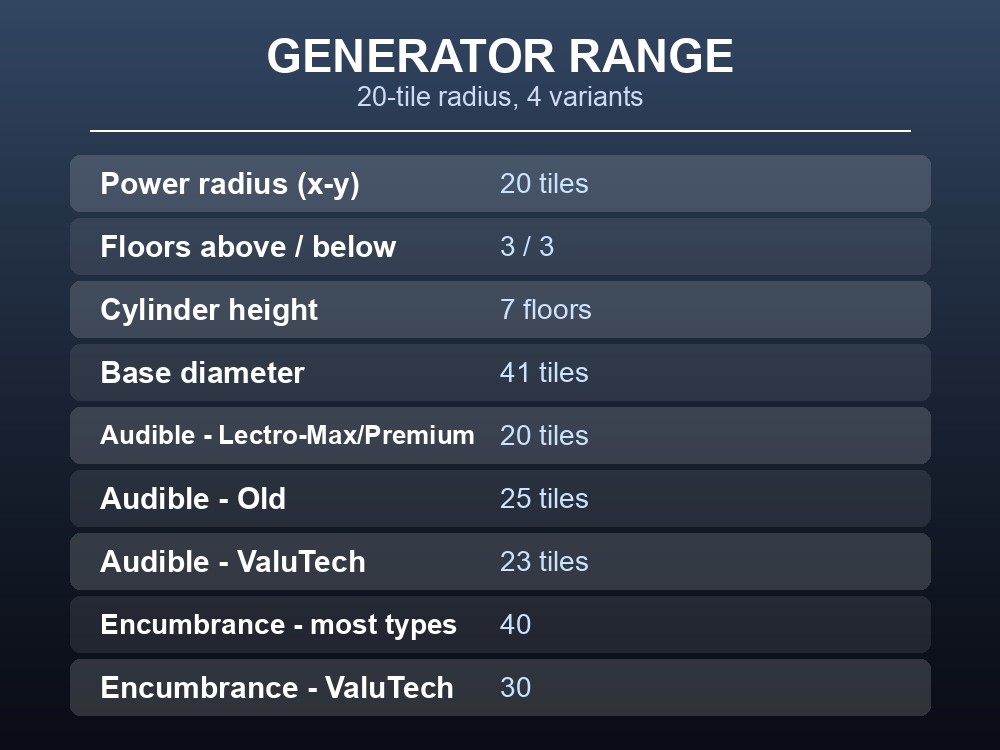
The wiki states it precisely: "The range (radius) is 20 tiles on the x-y plane, as well as 3 floors above and below (forming a cylinder centered on the generator with a height of 7 and a base diameter of 41)." That's checkable arithmetic — 3 floors above, plus the generator's own floor, plus 3 floors below, equals a height of 7; and 20 tiles out in every horizontal direction, plus the center tile, equals a base diameter of 41 (20 + 20 + 1).
Carrying one matters too: generators "can be picked up with the context menu, but do not go into a player's inventory. Instead they must be carried," which encumbers the player and blocks attacking. "All generators except the ValuTech variant have an encumbrance of 40, with the ValuTech having 30" — ValuTech is the lightest to haul.
Noise is a separate radius from power, and it doesn't match every variant: "Lectro-Max and Premium Technologies generators can be heard from a base radius of 20 tiles, with Old generators having an audible range of 25 tiles and ValuTech having a range of 23 tiles." So an Old generator's noise carries 5 tiles past its own power radius (25 vs. 20), and ValuTech's carries 3 tiles past its (23 vs. 20).
Fuel Consumption and the Runtime Math
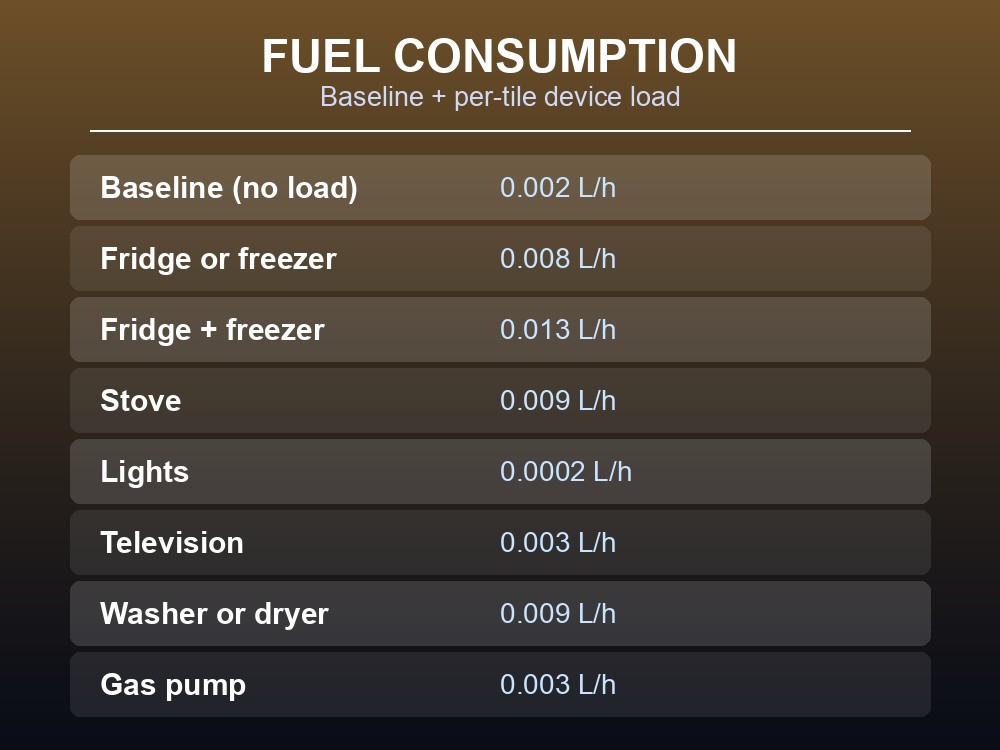
Idle draw is small but non-zero: "The baseline fuel consumption of a generator running with no load placed on it is 0.002 L/h." Every powered device inside the 20-tile radius adds to that, at a documented per-tile rate — fridge or freezer 0.008 L/h, fridge+freezer 0.013 L/h, stove 0.009 L/h, lights 0.0002 L/h, television 0.003 L/h, washer or dryer 0.009 L/h, and gas pump 0.003 L/h. The wiki's own example shows the "per tile" scaling: "a popsicle freezer is 2 tiles and uses 0.016 L/h" — that's 2 × 0.008 L/h = 0.016 L/h, confirmed.
The runtime formula given: "amount of fuel remaining / power demand = runtime," fuel in liters, demand in L/h, runtime in in-game hours. The wiki's worked example: "A popsicle fridge (0.016 L/h), television (0.003 L/h), 6 lamps (0.0012 L/h), and the base consumption (0.002 L/h) would equal a total fuel consumption of 0.0222 L/h, so a full generator of 10 liters would run for about 450 in-game hours (18.7 days)." Checking the pieces: 6 lamps at 0.0002 L/h each is 6 × 0.0002 = 0.0012 L/h, and 0.016 + 0.003 + 0.0012 + 0.002 = 0.0222 L/h total. Divide the tank: 10 L ÷ 0.0222 L/h ≈ 450.5 hours, and 450 ÷ 24 ≈ 18.7 days — both match. Right-click a generator and select "Generator Info" for the live total load instead of estimating.
Connecting It, Refueling It, and Shutting It Down Safely

A generator only powers anything once it's "placed on the ground, connected, fueled, and turned on." Connecting requires a skill check: "Players need level 3 electrical, or level 2 with the Inventive Trait, the electrician or engineer occupation, or to have read the How to Use Generators magazine to connect a generator" — done through the "Connect Generator" context-menu option. Fuel goes in via "Add Fuel," and "the tank of a generator can take up to 1 gas can's fuel and can only be filled while the generator is off. There is no option to siphon fuel back out of a generator, but the fuel will stay in it if you pick it up and move it later."
The shutoff is the actual safety mechanism, not just distance: running a generator inside an occupied structure means its "exhaust will negatively impact character health very quickly down to 1. Leaving the structure will halt the damage, but the structure will not be safe until the generator is turned off." Stepping outside stops the damage but doesn't clear the room — only switching it off does that. (This source is the Generator item page specifically; it doesn't cover a separate, wider base-game utility/grid shutdown timer, so that's undocumented here and not something this guide claims to answer.)
Condition matters for the same reason: "Each generator variant has a different chance of durability loss, with the ValuTech variant having the highest chance to degrade. When a generator drops below 20% condition it can break, if it reaches 0% condition it can catch fire or in rarer cases explode setting fire to everything around it and killing anyone nearby with a hit-kill." Listed durability (higher is better): Premium Technologies 36, Lectromax 30, Old 25, ValuTech 24 — the variant most prone to degrading also has the lowest durability of the four. Repairs use "1 × Scrap Electronics (4% + (0.5 * electrical skill level)% repaired)" — so at, say, electrical level 5 that's 4% + (0.5 × 5)% = 4% + 2.5% = 6.5% restored per Scrap Electronics spent.
- Always turn a generator off before refueling — the tank "can only be filled while the generator is off."
- Never run one inside a room you're occupying: exhaust drops health "down to 1," and the room stays unsafe until you flip the switch, not just when you leave.
- The "Generator Working In Exterior" custom sandbox setting lets a generator power a separate building — useful for a gas station's pumps.
- Generators are most often found in warehouses, garages, tool sheds, and self storage facilities, plus guaranteed spawns like the military blockade near Louisville, Echo Creek festival zone, and Doe Valley Secret Bunker.
- You can't siphon fuel back out once it's added, so fill to what you'll actually burn, not past it.
Running your own Project Zomboid server
This math still applies once you're not playing alone — a shared base means more devices competing for the same 20-tile radius, and a persistent world means that 0.0222 L/h example keeps ticking whether anyone's logged in or not. A server you control sets its own restart schedule instead of losing progress to someone else's, and keeps the same save running for your whole group between sessions. Get your own Project Zomboid server running in minutes, with code WELCOME for a discount on your first month.
Conclusion
Everything a generator does comes down to numbers the wiki documents: a 20-tile, 7-floor-tall power cylinder; a 0.002 L/h idle draw plus per-device per-tile costs; a 1-gas-can tank you can only fill while it's off; and a durability table that explains why ValuTech burns out first. Run the runtime formula on your own base's device list before building around a generator, and remember the shutoff — not just distance — is what actually makes a running one safe to be near.