
Project Zomboid Carpentry Guide: Leveling and Building
Carpentry is Project Zomboid's wood-construction crafting skill, tracked internally under the skill ID Woodwork, and its in-game tooltip sums it up in one line: "Allows the building of wooden constructions." Per pzwiki.net, "the carpentry skill is one of the most important skills, focusing on everything from safehouse defense and handmade furniture to even completely custom-built structures, all made from wood." This guide covers what the skill modifies, how to boost your starting level and XP rate, the documented path from level 0 to 10, and the multi-stage building, plastering, and painting mechanics it gates — all sourced from the wiki's Carpentry page, which itself flags a caveat: it was "last updated for an older version of the current build (42.18.0)" against a current stable of 42.20.4, so "information on this page may be inaccurate."
Effects and Starting-Level Bonuses
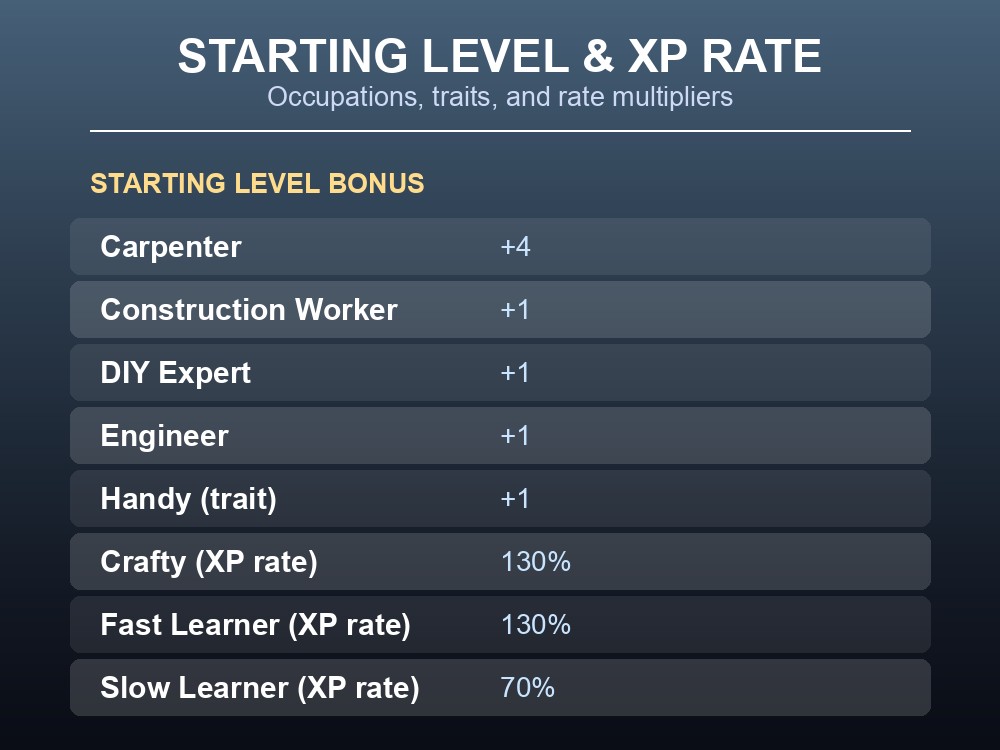
Beyond unlocking builds, carpentry's documented effects include "better-looking constructions, higher HP constructed items (such as log walls), faster building times, or even crafted spear durability." Four occupations set your starting level: Carpenter (+4), Construction Worker (+1), DIY Expert (+1), and Engineer (+1). One trait, Handy (+1), does the same. Three other traits change your XP rate instead: Crafty and Fast Learner both raise it to 130%, while Slow Learner drops it to 70%. Five carpentry skill books also "further increase the multiplier for experience gain" (exact percentage undocumented), covering levels 1-10 in pairs: Carpentry I "A Guide to Nailing" (1-2), II "Carpentry, Woodcraft Style" (3-4), III "Hand Crafted Shelving and Storage" (5-6), IV "Making Your Own Cabin From Scratch" (7-8), and V "Site Joinery and Architectural Carpentry" (9-10).
Leveling Carpentry from 0 to 10
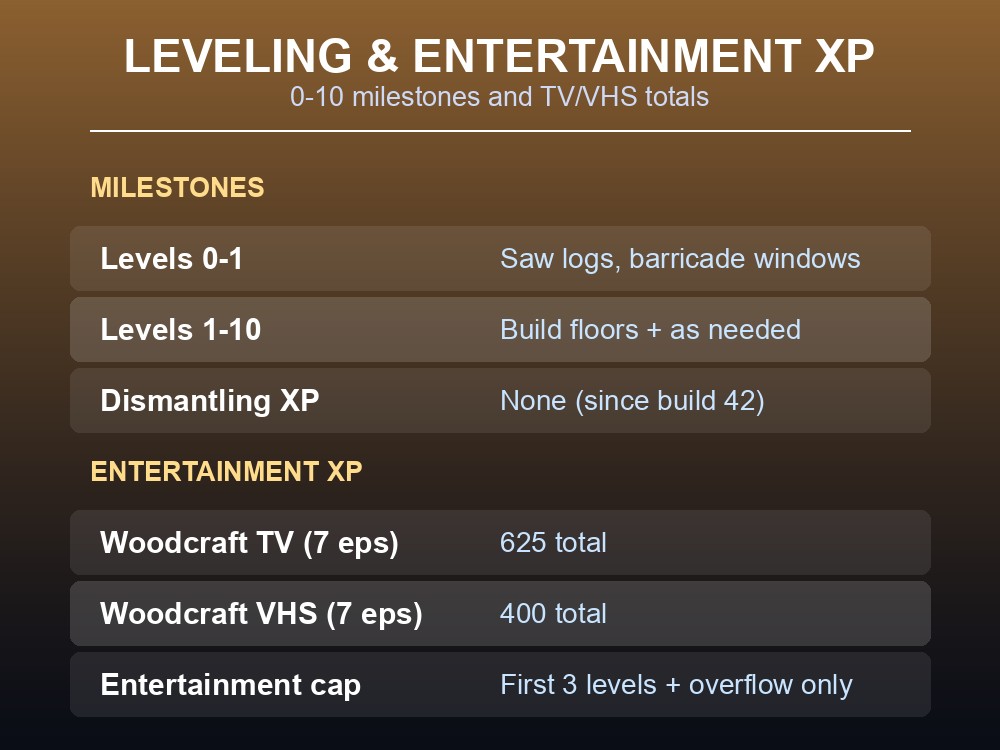
The wiki gives only two broad milestones: "Levels 0-1: Saw logs into planks, and barricade windows," then "Levels 1-10: Build wooden floors and other things you need." It also flags a change worth knowing: "Dismantling no longer gives experience since build 42." The listed XP-granting actions are sawing logs, dismantling wooden furniture (sandbox setting required), building from the building menu, crafting certain items, and barricading windows/doors with planks — plus, per the wiki, "other actions may also provide carpentry XP, but these are the most common."
Entertainment XP is documented but capped: "Entertainment gains are limited to the first 3 levels and any overflowing XP amount." Summing the wiki's own numbers, the seven Woodcraft episodes on Life and Living TV total 75+75+100+75+112.5+75+112.5 = 625 XP, plus a separate +37.5 from an Exposure Survival episode. The seven Woodcraft VHS tapes add 62.5+50+50+75+37.5+62.5+62.5 = 400 XP, plus 212.5 more from three Exposure Survival VHS episodes.
For an actual route, the wiki calls its own method "one of the best methods to level carpentry" starting from 0 XP with no boosts: early on, gather carpentry books, watch every Woodcraft TV episode, and saw logs into planks (three planks and XP per log). Mid-to-high levels, keep watching Woodcraft but only use VHS tapes after reading the matching book — "otherwise you are wasting XP" — then build walls, since nails give "a significant amount of XP." The wiki also names a plank shortcut: "McCoy Logging Co. The main warehouse has numerous planks in the crates," letting you skip straight to building.
Multi-Stage Building, Plastering, and Painting
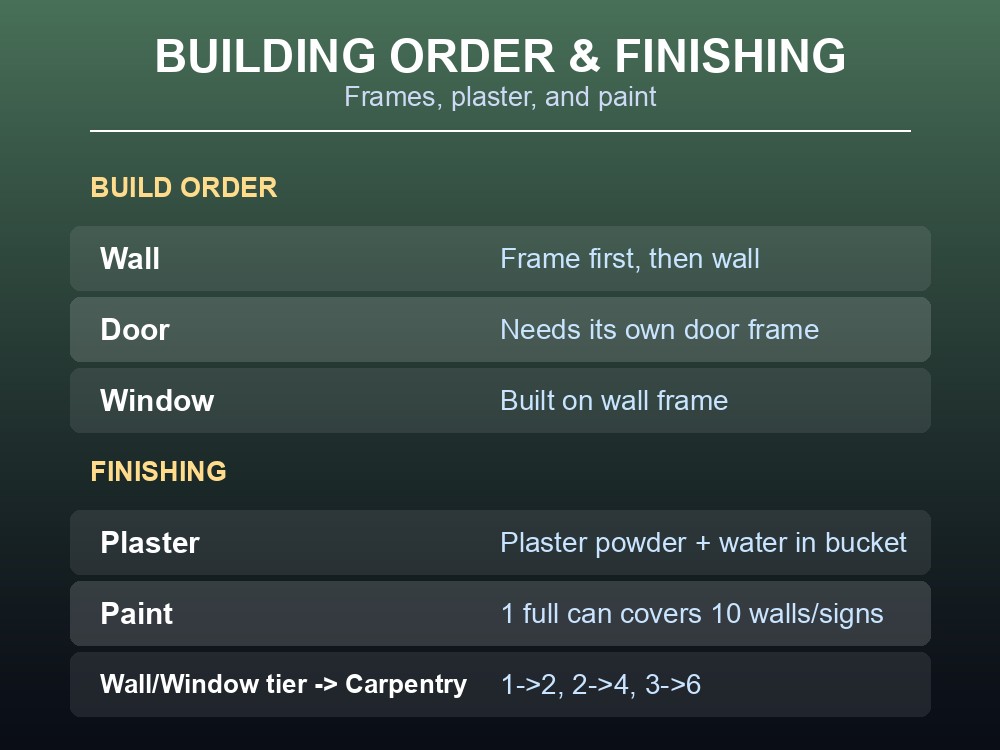
The most common multi-stage builds are the wooden wall and window: a wall frame goes up first (and "zombies can climb through wall frames" while unfinished), before a wall is built on top of it. Doors need their own wooden door frame rather than a wall frame, while windows are built directly onto the wall frame. Finishing takes two more steps: a bucket of plaster, mixed from a bag of plaster powder and water, is applied to a built wall by right-clicking it with the bucket in your main inventory; once plastered, a wall can be painted, and one full can of paint covers up to ten walls or signs before becoming an empty, water-collecting bucket. The wiki also pairs three unlabeled "Wall/Window level" tiers — 1, 2, 3 — with Carpentry levels 2, 4, and 6, without explaining what each tier unlocks; that context is undocumented on the page.
Crafting and Building Recipes Carpentry Unlocks
The wiki's crafting and building tables list dozens of recipes; a few illustrate the level gating rather than reproducing the full list. Sawing a Log into 3 Planks needs no carpentry level and gives 5 XP. On the building side, a Wooden Coffin (4 Planks + 4 Nails) needs Carpentry 4 for 40 XP, and the Craftsman Composter recipe (4 Planks + 4 Nails) needs Carpentry 6 for 60 XP. Some log-built structures — Log Fence, Log Wall, Wide Log Gate, Log Doorframe, built from Logs plus a rope-type material (Rag, Twine, Rope, or Sheet Rope) — list no skill requirement or workstation at all, only a flat 5-10 Carpentry XP award.
Quick tips
- Grab a Carpenter background (+4) or the Handy trait (+1) before spending points elsewhere if leveling carpentry matters to your build.
- Crafty/Fast Learner push XP rate to 130%; Slow Learner drops it to 70% — check your traits before assuming a "normal" grind speed.
- Match each skill book to its level range before burning VHS tapes — a mismatched tape "wastes XP," per the wiki.
- Build the wall frame before the wall (and the door frame before a door) — zombies can climb through an unfinished frame.
- Plaster before you paint: bag of plaster powder + water in a bucket, then right-click the built wall.
Running your own Project Zomboid server
Carpentry's building side — wall frames, plastering, painting, multi-stage construction — is a lot more useful with a persistent base your group can keep improving between sessions. Running your own Project Zomboid server means the walls, frames, and paint jobs you put up stay standing for everyone to log back into, instead of resetting with a local save. Get one running with gamever and use promo code WELCOME for a discount on your first server.
Conclusion
Carpentry (skill ID Woodwork) governs building speed and construction HP, and the wiki documents concrete ways to boost it: up to +4 starting level from the Carpenter occupation, a 130% XP-rate bump from Crafty or Fast Learner, and five skill books covering levels 1-10. The leveling path itself is thin on hard milestones (0-1: saw planks and barricade; 1-10: build floors and whatever you need) but rich in entertainment XP — 625 from Woodcraft TV, 400 from Woodcraft VHS — and a wiki-endorsed power-leveling route built around books, TV, and wall-building for nails. On the building side, frames come before walls, doors need their own frame type, plastering requires mixed plaster powder, and one can of paint covers ten walls or signs. Where the source doesn't give a number — skill-book percentages, exact disassembly-yield modifiers, or what the "Wall/Window level" tiers unlock — this guide says so rather than guessing.