
Palworld's Element Distribution: Dark Has 70 Pals, Dragon Has 25
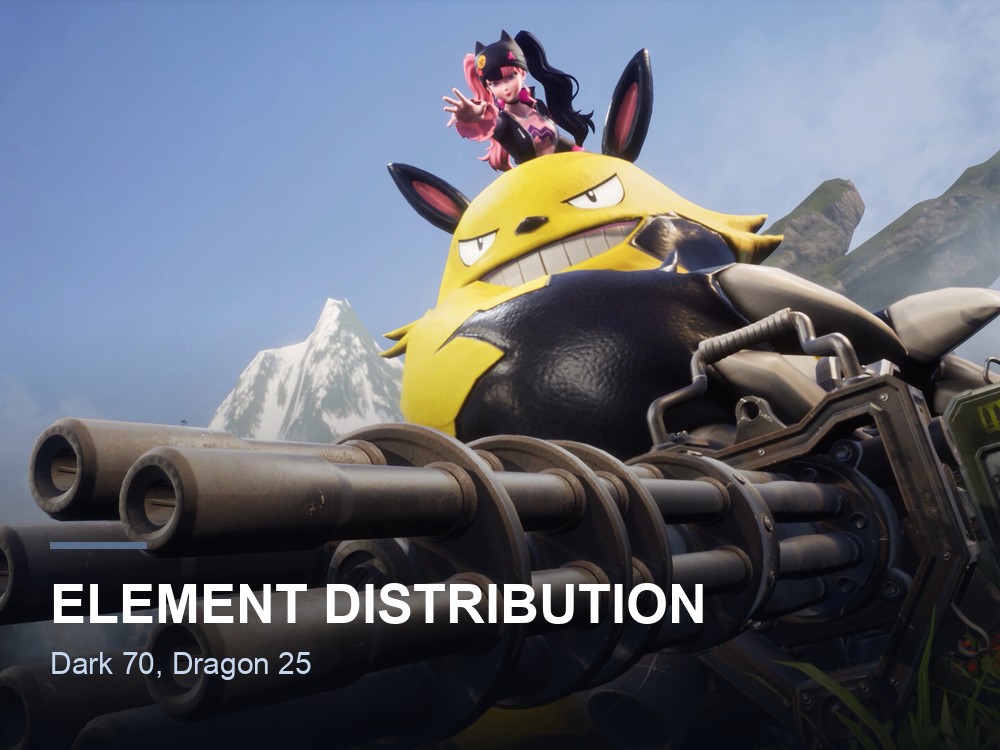
Palworld's nine elements are not evenly stocked. Dark has 70 Pals. Dragon and Electric have 25 each. That is a 2.8-to-1 spread across the roster, and it quietly shapes everything downstream — which elements you can build a themed team from, which type advantages you will meet most often, and which drop-rate booster is worth catching first.
The Full Distribution
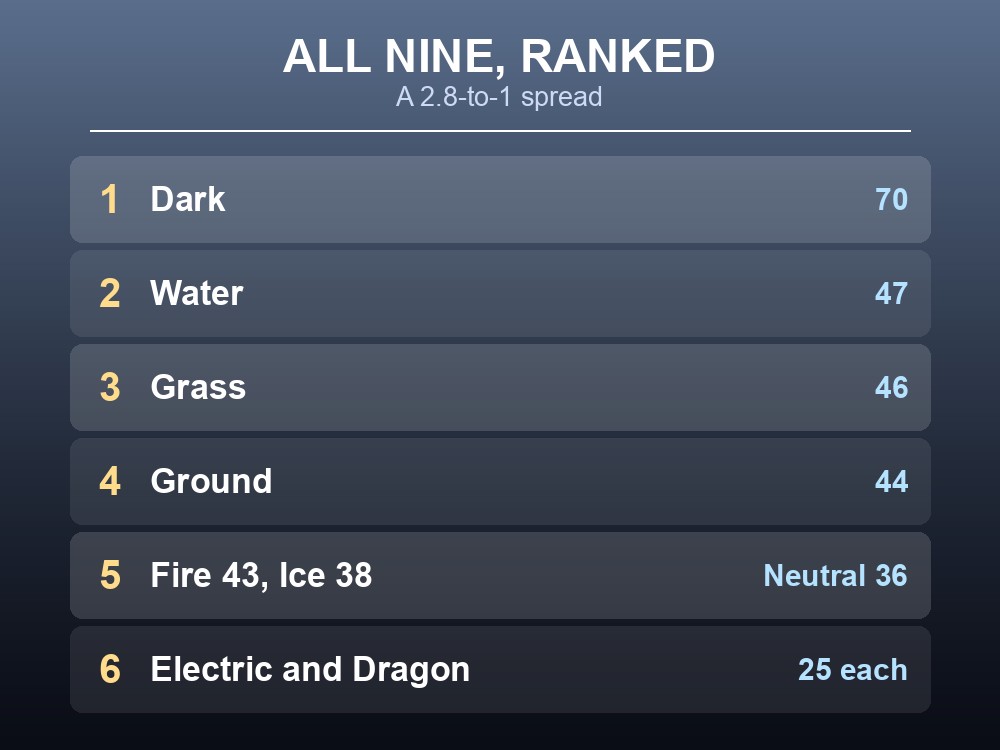
| Element | Pals |
|---|---|
| Dark | 70 |
| Water | 47 |
| Grass | 46 |
| Ground | 44 |
| Fire | 43 |
| Ice | 38 |
| Neutral | 36 |
| Electric | 25 |
| Dragon | 25 |
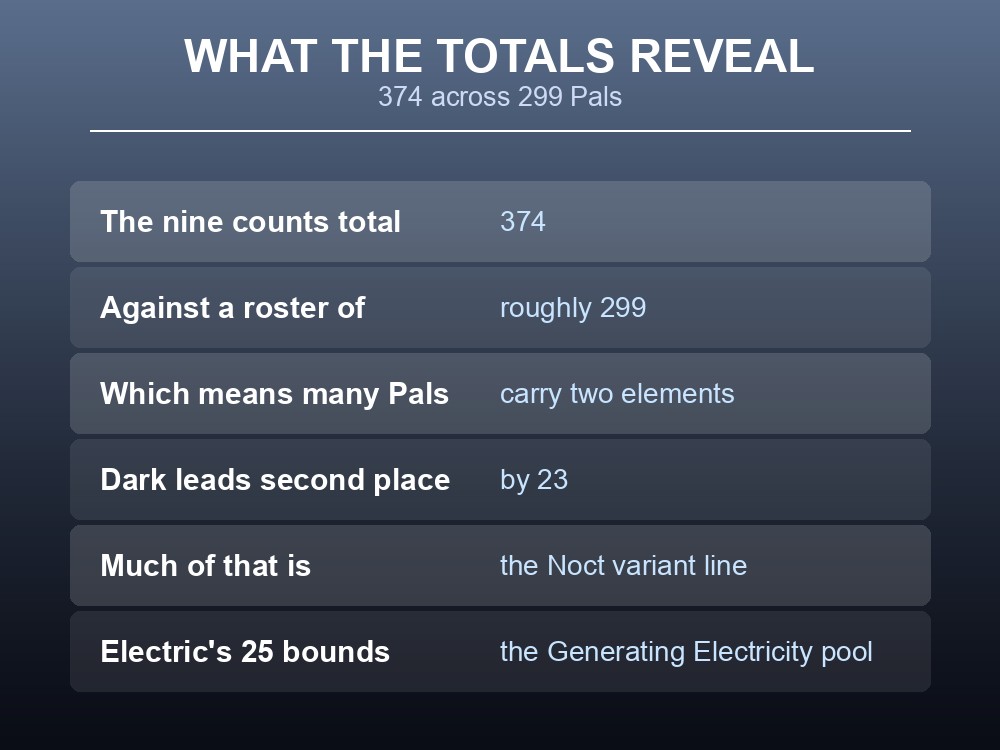
These counts total 374 across a roster of roughly 299 Pals, which tells you something on its own: a substantial number of Pals carry two elements and are counted under both. Dragon/Water, Ice/Dragon, Water/Fire and Dark/Electric pairings are all common.
Dark's 70 is the outlier. It has 23 more than second-place Water and nearly three times as many as Dragon or Electric. Much of that comes from the Noct variant line — Palworld's elemental variants systematically add Dark typings to existing species, so every Noct in the game is another entry in this column.
Why the Bottom of the List Matters More
Electric and Dragon tie at 25, and they are the two elements where a narrow roster has real consequences.
Electric is the element that runs your base. Generating Electricity is a work suitability, and the number of Pals that carry it is bounded by the number of Electric Pals — so with only 25 in the pool, the good electricity workers are a short list. Orserk at Generating Electricity Lv8 is the ceiling, and there is no deep bench behind it.
Dragon is the element with the highest average stats and the fewest members. That makes Dragon Pals disproportionately valuable per head — Jetragon, Frostallion, Astegon, Orserk, Quivern, Jormuntide are all Dragon or part-Dragon, and all sit near the top of their categories.
The practical read: a small element pool means less redundancy. If the one good Ice cooler is not available to you, there are 38 Ice Pals to look through. If the one good Electric generator is not, there are 25.
What This Does to Type Coverage
Because Dark is the most common typing, the element that counters it is the most broadly useful attack type you can carry — and the element Dark counters is the one you will most often be resisted by.
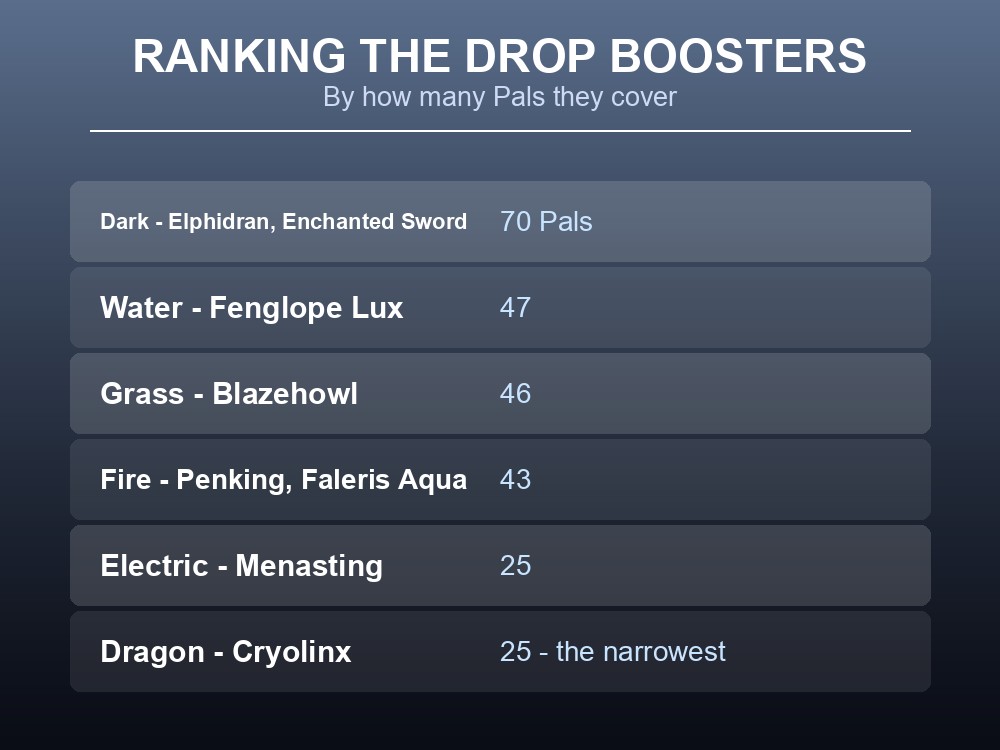
The drop-rate boosters make this concrete. Palworld has one booster per element, each giving 40% at partner skill Lv1 rising to 80% at Lv5:
| Booster element | Pals it boosts | Pool size |
|---|---|---|
| Dark (Elphidran, Enchanted Sword) | Dark Pals | 70 |
| Water (Fenglope Lux) | Water Pals | 47 |
| Grass (Blazehowl) | Grass Pals | 46 |
| Ground (Vaelet) | Ground Pals | 44 |
| Fire (Penking, Faleris Aqua) | Fire Pals | 43 |
| Ice (Faleris) | Ice Pals | 38 |
| Neutral (Katress, Blazehowl Noct) | Neutral Pals | 36 |
| Electric (Menasting) | Electric Pals | 25 |
| Dragon (Cryolinx) | Dragon Pals | 25 |
The Dark booster covers 70 Pals; the Dragon booster covers 25. If you are choosing which booster to catch and condense first, Elphidran or Enchanted Sword applies to nearly three times as many targets as Cryolinx does.
That is the ranking nobody publishes, and it falls straight out of the element counts.
What It Does Not Tell You
Being careful about the limits of this data: element count is not element power. Dragon has the fewest Pals and some of the strongest, and Dark has the most and a very wide quality range.
It also is not a spawn-rate table. A Pal existing in the roster and a Pal being common in the world are different things — a Lucky Pal appears at 0.1% per wild spawn regardless of its element, and Alphas have fixed locations.
Read it as a roster census, which is what it is: how many entries carry each typing, useful for planning coverage and for judging which boosters and which work suitabilities have depth behind them.
Running your own Palworld 1.0 server
Building a themed team means catching across a whole element, and that goes far faster with a group splitting the roster in one shared world. A gamever Palworld server keeps it persistent with full crossplay, automatic updates and one-click backups.
Conclusion
Palworld's nine elements are stocked very unevenly: Dark 70, Water 47, Grass 46, Ground 44, Fire 43, Ice 38, Neutral 36, Electric 25, Dragon 25 — a 2.8-to-1 spread from top to bottom. Those figures total 374 across a roster of roughly 299, which shows how many Pals carry two elements and are counted twice. Dark's lead of 23 over second place comes substantially from the Noct variant line, which systematically adds Dark typings to existing species. The bottom of the list matters more than the top: Electric's 25 bounds the pool of Generating Electricity workers, where Orserk at Lv8 is the ceiling with no deep bench, and Dragon's 25 concentrates the game's strongest Pals into its smallest element. The clearest practical use is ranking the drop-rate boosters — each gives 40% at Lv1 rising to 80% at Lv5, but the Dark booster applies to 70 Pals and the Dragon booster to 25, so Elphidran or Enchanted Sword covers nearly three times as many targets as Cryolinx. This is a roster census, not a spawn table or a power ranking.
Want a roster split across a group? Rent a Palworld server at gamever.io — instant setup, one-click backups and updates, full crossplay and 24/7 uptime. Start with a free trial and use promo code WELCOME.