
How Weapons and Damage Work in 7 Days to Die
7 Days to Die does not have one "weapons" list — it has five of them, one per character attribute. The wiki defines weapons plainly: "Weapons are items whose primary function is to help the player to deal with zombies, animals and possibly other players as well." Every weapon slots into one of three main categories — the wiki's own wording: "Weapons can be divided into three main categories: melee, ranged and explosives." — and then into one of five attribute groupings, each tied to specific perks that improve that weapon class specifically. This guide uses only what the wiki's Weapons page states outright, and flags anywhere its data didn't survive cleanly. (The page's infobox carries no additional structured values beyond the article text — undocumented.)
Five Attributes, Each Locked to Its Own Perks
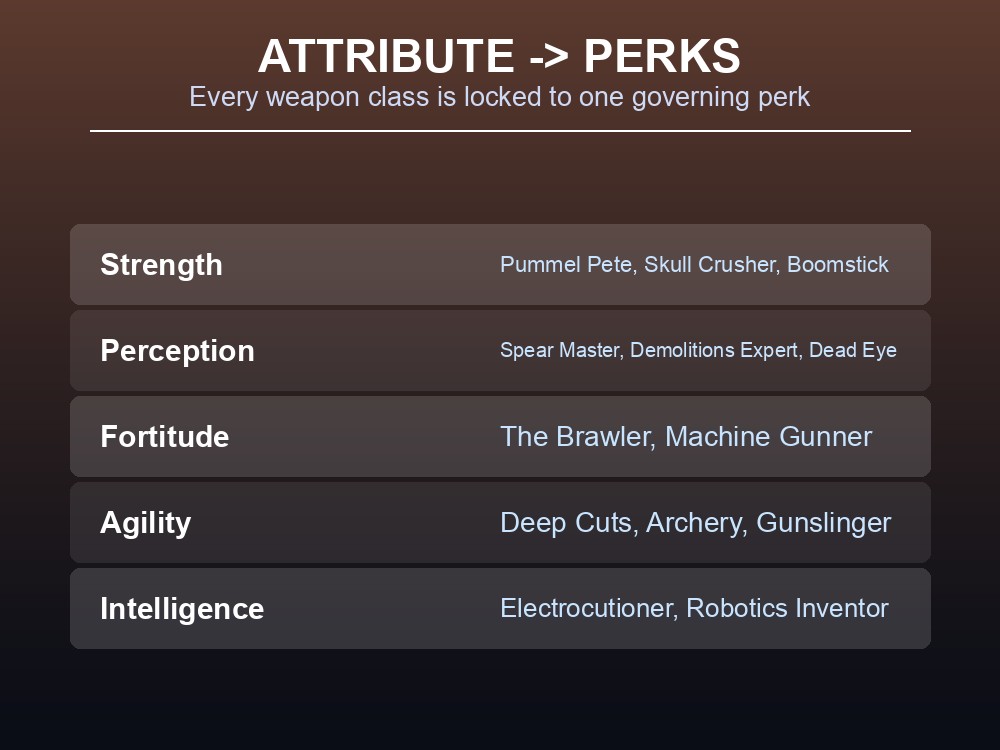
The page's own contents list exactly five top-level categories, in this order: Strength, Perception, Fortitude, Agility, Intelligence. The wiki also states: "Every attribute has at least one melee and ranged weapon covered under them." Under each, a distinct perk governs each class:
- Strength — Clubs, Bats and Sledgehammers (Pummel Pete governs clubs/bats; Skull Crusher governs sledgehammers) and Shotguns (Boomstick).
- Perception — Spears (Spear Master), Explosives (Demolitions Expert), Rifles (Dead Eye).
- Fortitude — Knuckles (The Brawler), Machine Guns (Machine Gunner).
- Agility — Knives (Deep Cuts), Archery (the Archery perk), Handguns and the SMG-5 (Gunslinger).
- Intelligence — Batons (Electrocutioner), Robotic Turrets (Robotics Inventor).
That's twelve named weapon classes, each pinned to one governing perk.
Melee, Ranged, Explosives, and the Magnitude Star System
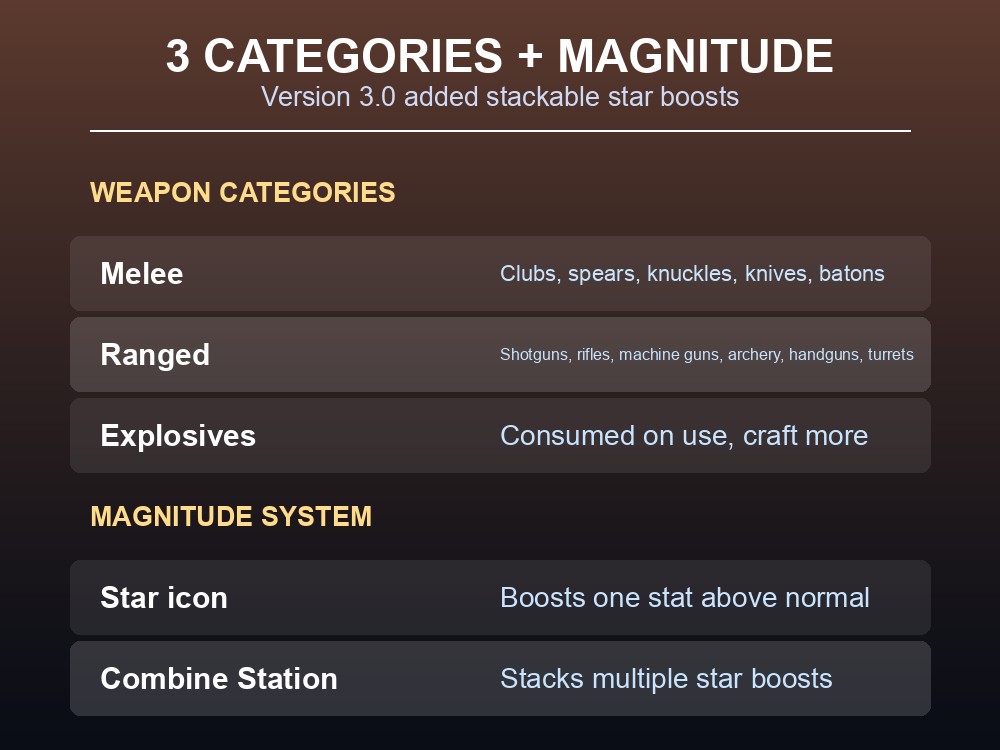
Melee weapons trade speed for power: clubs and bats "offer a balance between attack speed and damage," while sledgehammers "deal the most melee damage of all weapons in a single hit, but trade the power to the very slow attack speed. One misplaced hit could cost the player their life." Ranged weapons trade range for other costs — rifles "offer the longest range a weapon has with a high damage per bullet" but suffer "the slow attack speed and small magazine capacity," while shotguns' "power falls off quite fast when the range between the player and the target increases." Explosives "offer a way to take out many enemies at the same time" but are "consumed in the process, forcing the player to craft more of them much like ammunition." One wrinkle: "Even though mines are unlocked by the Demolitions Expert perk, they don't benefit from it any other way."
Layered on all three is a system the wiki dates precisely: "With the release of Version 3.0, the Magnitude system was added. This made it so all weapons found in loot have a chance to have a star icon on them. This boosts a stat on them, making them stronger in that stat than the item normally would be. You can combine and stack these boosts using a Combine Station." In plain terms: a starred drop beats the same unstarred weapon in one stat, and a Combine Station stacks multiple starred boosts — the source does not say which stat(s) can carry a star or how large the boost is, so treat those specifics as undocumented.
What Each Weapon Class Trades Off
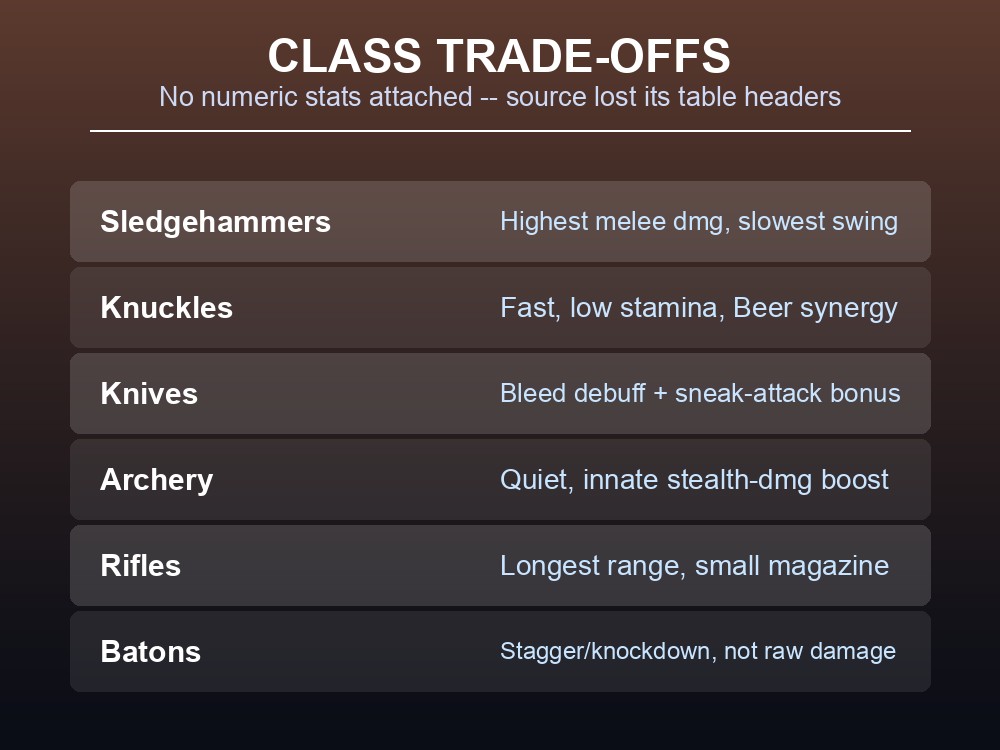
Each class page also lists named items — Wooden Club under Strength, Lever-Action Rifle under Rifles, Compound Crossbow under Archery, among others. Important gap: the source's per-weapon stat tables (Entity Damage, stamina cost, hit range, attacks per minute, durability, reload/magazine figures) lost their column alignment when this page's text was captured — each weapon's row runs together as an unlabeled string of numbers, with no reliable way to map a figure to its column for that weapon. This article therefore does not attribute any specific damage, durability, stamina, reload, or magazine number to any named weapon — treat every such figure as undocumented until the tables are re-verified with headers intact.
What the source does state reliably, in prose, is each class's qualitative trade-off. Knuckles "have quite small range and damage per attack, but offer a fast attack speed and low stamina cost," with "a notable synergy with Beer, which temporarily gives them the highest damage output of any melee weapon." Knives "offer a lower range and damage per attack, but higher attack speed and debuffs such as bleeding that deal damage." Knives also have "boosted damage when hitting zombies that are unaware of the player." Archery is "a quiet and efficient way to deal with zombies and other enemies" that must "reload after every shot" but carries "an innate boost to stealth damage." Batons stand out: "the Pipe Baton's regular attack causes zombies to stagger instantly and its power attack is an instant knockdown against all but the most tough zombies," while "the Stun Baton goes further by electrocuting and shocking zombies, making them stunned for a while." Robotic Turrets are "a unique portable weapons... placed to attack on their own," pairing with the Stun Baton for "a solid DPS to enemies."
Practical tips
- Pick a weapon class by the perk tree you're already investing in — its whole kit is locked to one attribute's perk, per the source.
- Sledgehammers hit hardest per swing but punish a miss badly — the wiki calls a bad swing something that "could cost the player their life."
- Spears can no longer be thrown as of Alpha 21, per the source — treat them as melee-only now.
- A starred (Magnitude) drop beats an unstarred one in whatever stat it boosts, and a Combine Station lets you stack more than one star.
- Don't trust a specific damage/durability number for a named weapon pulled from a scraped table without headers — verify against the live wiki table first.
Running your own 7 Days to Die server
Weapon balance, perk requirements, and Magnitude all read from shared server-side config files (items.xml, progression.xml, and related loot tables), so a dedicated server is where a group agrees on drop rates and gear pacing. A gamever 7 Days to Die server keeps those files reachable for tuning, runs 24/7 so loot and Blood Moon timers keep advancing while players are offline, and takes automatic backups before anyone edits a shared config. Spinning one up takes minutes, with a free trial via promo code WELCOME.
Conclusion
Every weapon in 7 Days to Die sits inside one of three categories — melee, ranged, explosives — and one of five attribute groups, each governed by its own named perk, from Pummel Pete's clubs and bats to Robotics Inventor's turrets. The Version 3.0 Magnitude system layers a stackable star bonus on top via a Combine Station, though the source doesn't specify which stats can carry a star. What this guide leaves out matters just as much: the source's per-weapon damage, durability, and reload figures lost their table structure in extraction, so no specific number is pinned to any named weapon here — a gap to close against the live wiki tables, not a detail to guess at.