
How Valheim Actually Calculates Damage (And Why Your Numbers Swing So Much)
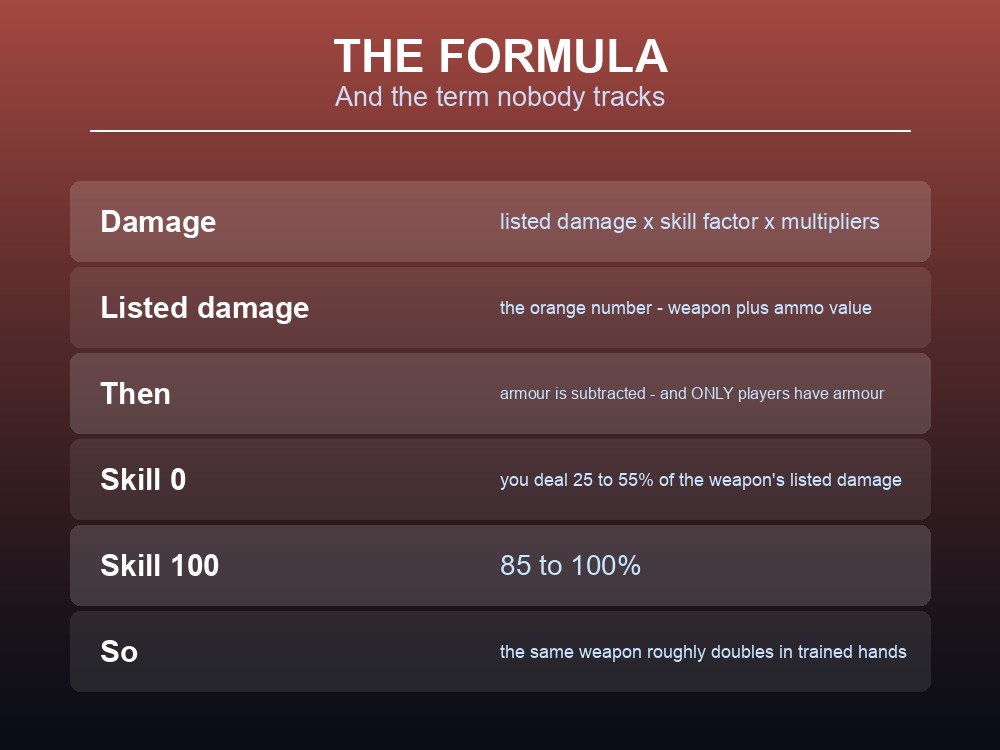
The same weapon, the same enemy, and wildly different numbers — that is not randomness, it is five multipliers stacking. The biggest of them is your weapon skill, which takes you from dealing 25–55% of a weapon's listed damage at skill 0 to 85–100% at skill 100. A fresh sword in trained hands roughly doubles the output of the same sword in untrained ones. Here is the whole calculation, and the three parts of it you can actually control.
On sourcing. Iron Gate do not publish combat maths. The formulas below come from the community Valheim wiki, and can change with any patch.
The Formula
Damage = listed damage × skill factor × multipliers
| Term | What it is |
|---|---|
| Listed damage | The orange number on the tooltip — weapon value + ammo value |
| Skill factor | Your weapon skill, as a fraction |
| Multipliers | Backstab × stagger × attack bonus × multitarget penalty × damage type |
Then armour is subtracted — and only players have armour. Enemies do not, which is why creature health scales instead.
The skill factor is the part nobody accounts for:
| Weapon skill | Minimum damage | Maximum damage |
|---|---|---|
| 0 | 25% of listed | 55% of listed |
| 50 | ~55% | ~78% |
| 100 | 85% | 100% |
That yellow range in parentheses on your tooltip is the skill factor made visible. It narrows and rises as you level, which is why a weapon feels unreliable early and consistent later — the swing between your worst and best hit shrinks from 30 percentage points to 15.
Practical consequence: switching weapon class is expensive. A brand-new Black Metal sword used at Swords skill 10 can easily out-damage nothing at all — you are throwing away half the weapon.
The Five Multipliers
| Multiplier | Value |
|---|---|
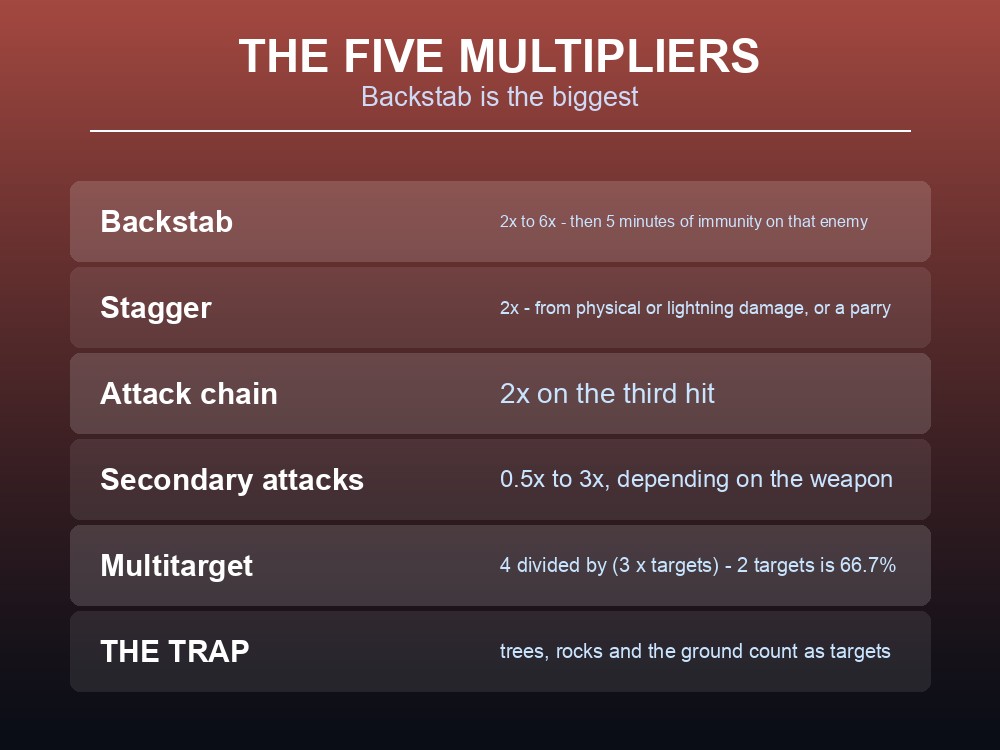
| Backstab | 2× to 6×, shown on the weapon tooltip |
| Stagger | 2× — a staggered enemy takes double damage |
| Attack chain | 2× on the third hit of a chain |
| Secondary attacks | 0.5× to 3×, depending on the weapon |
| Multitarget penalty | 4 ÷ (3 × targets) |
| Damage type | 0% to 200% — see below |
Backstab is the largest single multiplier in the game, and it has a rule that stops you farming it: backstabbing an enemy grants it backstab immunity for five minutes. One opener per enemy, then fight normally. Players cannot be backstabbed.
Stagger doubles damage and stops the enemy acting, and it is caused by physical and lightning damage or by a successful parry. Stagger duration varies per enemy and follows its animation speed. Players can be staggered too, but do not take the extra damage.
The multitarget penalty catches people out, because of what counts as a target:
| Targets hit | Damage each |
|---|---|
| 2 | 66.7% |
| 3 | 44.4% |
| 4 | 33.3% |
| 5 | 26.7% |
Total output still rises — about 33% more than a single-target hit — but per enemy it falls fast.
And here is the trap: trees, rocks and the ground count as targets. "This often causes reduced damage when attacking enemies on higher ground." If a fight uphill feels weak, you are splitting your swing with the terrain.
Damage Types, Resistance and Armour
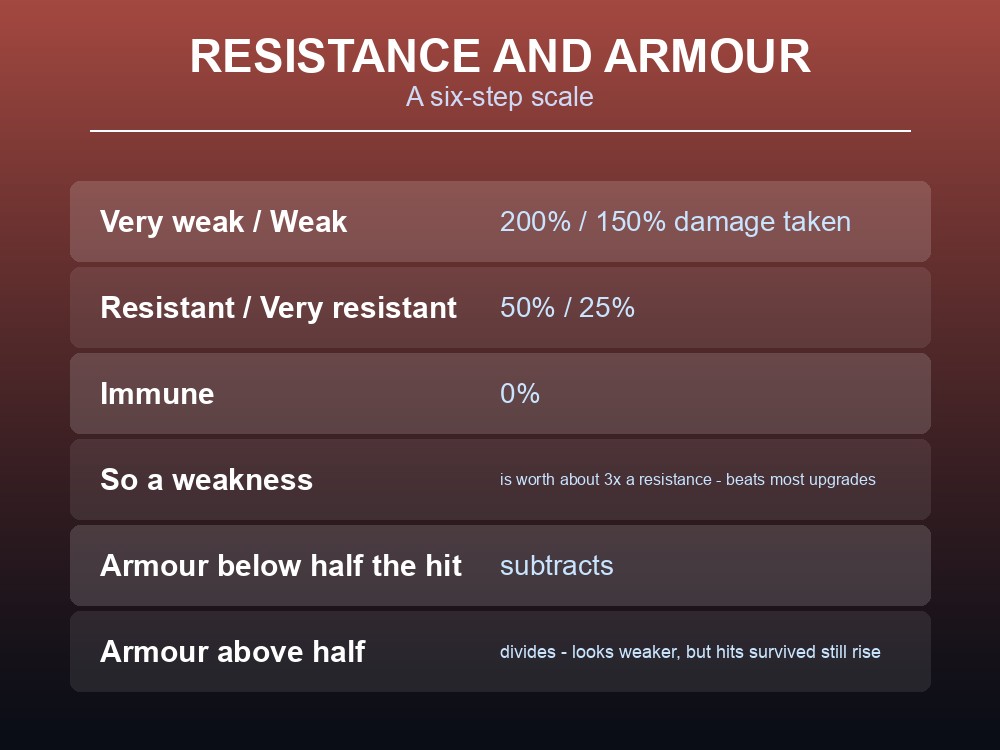
Resistance is a six-step scale, not a percentage:
| Level | Damage taken |
|---|---|
| Very weak | 200% |
| Weak | 150% |
| Neutral | 100% |
| Resistant | 50% |
| Very resistant | 25% |
| Immune | 0% |
Hitting a weakness is worth more than a weapon tier. The gap between weak (150%) and resistant (50%) is a threefold difference — larger than most upgrades will ever give you.
Armour Changes Those Multipliers
The table above is the base case. Armour bends it — in both directions.
| Tier | Base | With armour synergy |
|---|---|---|
| Very weak | 200% | 200 – 400% |
| Weak | 150% | 150 – 225% |
| Resistant | 50% | 25 – 50% |
| Very resistant | 25% | 6.25 – 25% |
Maximum synergy is reached when your armour is at least half the incoming raw damage — the same threshold that governs blocking, where a shield above half the hit switches to the quadratic formula.
What that means in practice is a compounding effect. A resistance you already have becomes far stronger once your armour crosses that line: very resistant falls from 25% to 6.25%, which is a four-fold further reduction on top of the resistance itself. Against an attack you resist, adequate armour is not additive — it multiplies.
It cuts the other way too. Very weak doubles again, from 200% to 400%, so an enemy that is weak to your damage type takes even more once your armour is up — the synergy applies to damage you deal as well as damage you take.
The practical rule: armour tier matters most where a resistance already exists. Upgrading armour inside a biome whose damage you already resist compounds; upgrading it against something you are neutral to is linear.
Armour works in two regimes, and this is the part worth understanding:
- If armour is less than half the raw damage:
health lost = damage − armour - If armour is more than half the damage:
health lost = (damage ÷ (armour × 4)) × damage
So armour stops subtracting and starts dividing once it passes half the incoming hit. That looks like diminishing returns, and the wiki makes the important correction: "The formula for diminishing returns is still fair from the perspective of effective HP" — the number of hits you survive keeps rising at the same rate. More armour is never wasted; it simply stops looking dramatic on the damage numbers.
With multiple damage types, order matters. Resistances apply per type first, then armour applies to the total. The wiki's worked example: 100 fire + 100 blunt, with fire resistance and 75 armour → fire halves to 50, the total becomes 150, armour removes 75 → 25 fire and 50 blunt land.
Blocking vs Dodging
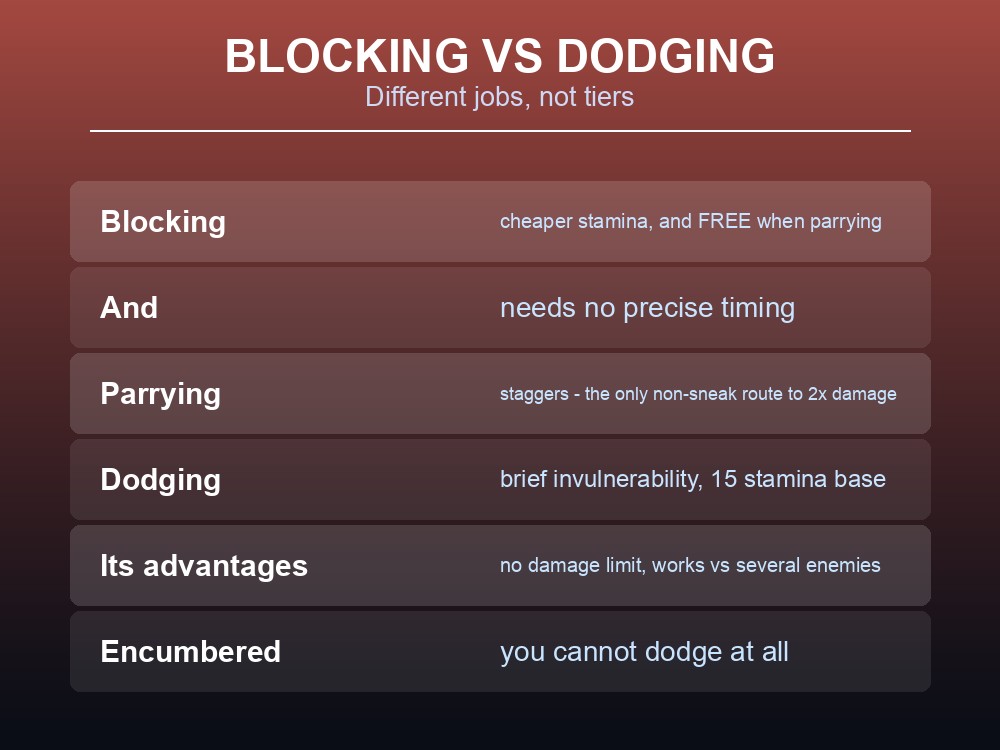
Blocking runs through the same armour formula, using your block value instead. Its advantages are concrete:
- Cheaper stamina — and free when parrying.
- No precise timing needed.
- Parrying staggers, which doubles your follow-up damage.
Dodging makes you briefly invulnerable and ignores most damage entirely. Its costs and advantages:
| Dodge | Detail |
|---|---|
| Base cost | 15 stamina |
| Dodge skill | Reduces the cost by up to 50% |
| Successful dodge | Returns half the stamina |
| Gear speed penalty | Increases cost by the same percentage — −20% speed means +20% cost |
| Asksvin cloak | −15% |
| Berserkir mead | −80% |
| Encumbered | Cannot dodge at all |
Dodging wins where blocking breaks down: there is no damage limit, it works against several enemies for the same stamina, and it lets you choose a direction to reposition.
Blocking wins on economy and reliability — and the parry stagger is the only route to the 2× damage multiplier that does not require sneaking.
One more line that matters on a server, and it mirrors the creature-scaling rule: enemies deal 4% more damage for each additional player within 200 metres of the target. Note the radius — 200 metres for damage, against 100 metres for the health and damage scaling on creature level. Two different ranges, two different systems.
Practical tips
- Weapon skill takes you from 25–55% of listed damage to 85–100%. Sticking with one class beats switching.
- The yellow range on the tooltip is your skill factor — it narrows as you level.
- Backstab is 2× to 6×, then the enemy is immune to it for 5 minutes.
- Staggered enemies take double damage — parrying is the reliable way to cause it.
- Trees, rocks and the ground count as multitarget hits. Fighting uphill costs damage.
- Weakness vs resistance is a 3× swing — bigger than most gear upgrades.
- Armour never stops helping; past half the hit it divides instead of subtracting.
- Enemies gain +4% damage per extra player within 200 m — a different radius to creature scaling.
Running your own Valheim server
Damage maths rewards specialising — a party where each player has pushed one weapon skill hits far harder than one where everyone swaps constantly — and specialising only pays off when the same group returns to the same world. A gamever Valheim server keeps that world online around the clock for up to 10 players, takes one-click backups, and updates automatically so client and server versions never drift apart.
Conclusion
Valheim's damage is listed damage × skill factor × multipliers, minus armour — and only players have armour. The skill factor is the dominant term nobody tracks: 25–55% of a weapon's listed damage at skill 0, rising to 85–100% at skill 100, which is why the same weapon feels unreliable early and precise later. On top sit backstab (2–6×, then five minutes of immunity), stagger (2×, from physical or lightning damage or a parry), a 2× third hit in an attack chain, secondary attacks at 0.5–3×, and a multitarget penalty of 4 ÷ (3 × targets) in which trees, rocks and the ground count as targets — the reason uphill fights feel weak. Damage type is a six-step scale from 200% to 0%, making a weakness worth roughly three times a resistance. Armour subtracts below half the incoming hit and divides above it, which looks like diminishing returns but keeps your survivable hit count rising at the same rate. And defensively, blocking is cheaper and parrying grants the stagger multiplier, while dodging has no damage ceiling and costs 15 stamina before modifiers.
Want a world where specialising pays off? Rent a Valheim server at gamever.io — instant setup, one-click backups and updates, and 24/7 uptime. Start with a free trial and use promo code WELCOME.