
How to Use Wood Spikes for Base Defense in 7 Days to Die
Wood Spikes are 7 Days to Die's earliest defensive trap, and the wiki doesn't hedge about that role: "Spike traps are your first and earliest line of defense. They slow down and damage enemies. Place them using the secondary action." This guide is built entirely from the wiki's Wood Spikes page — its infobox and its prose — covering what the trap costs, how its three-stage damage system actually works, and the documented upgrade path to Iron Spikes. That page documents only this one trap type in structured detail, so anything about other trap categories in the game (turrets, electric fences, and the rest) is outside what this article can confirm from its source and isn't covered here.
What Wood Spikes Do and What They Cost
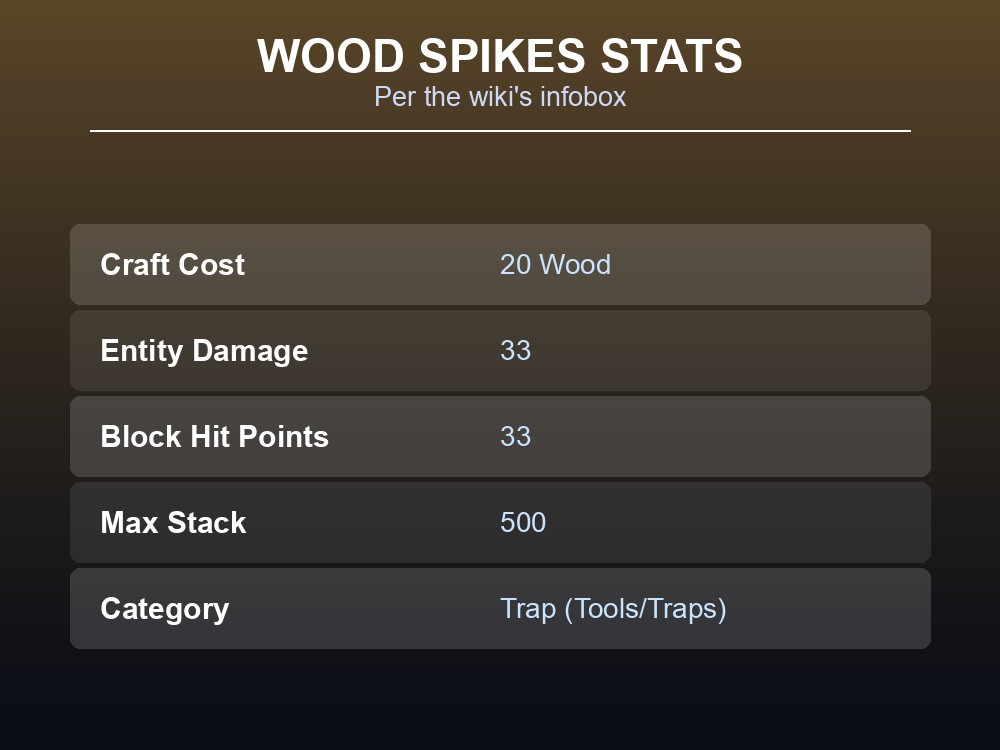
Wood Spikes sit in the wiki's Tools/Traps group under the Trap category. Beyond the "first line of defense" line above, the wiki also describes what they actually do to a target: "Wood Spikes are a trap used to defend structures by impaling zombies, humans, and animals."
A batch costs 20 Wood — "Wood Spikes are crafted using 20 Wood as shown below," per the page — and a single inventory stack holds up to 500 of them, per the infobox's Stack field, so material cost is the real limit on how many you can carry to a build site, not inventory space. Each placed spike deals 33 damage to whatever steps on it (the wiki's Entity Damage stat), and the block itself carries 33 Hit Points of its own before it can be smashed outright — the infobox's durability field lists the same 33. The infobox leaves its Block Damage field blank, so how Wood Spikes perform against structures rather than living targets is undocumented.
You also can't drop them anywhere: per the page's History section, "As of Alpha 4, Wood Spikes must be placed on a solid Block." The infobox's obtain flags — ob_craft, ob_scavenge, and ob_cheat are each set to 1 — show three routes to getting them: crafting, finding them as loot, and console/cheat spawn, though no loot-table odds are given for the scavenge route.
The Three-Stage Damage System
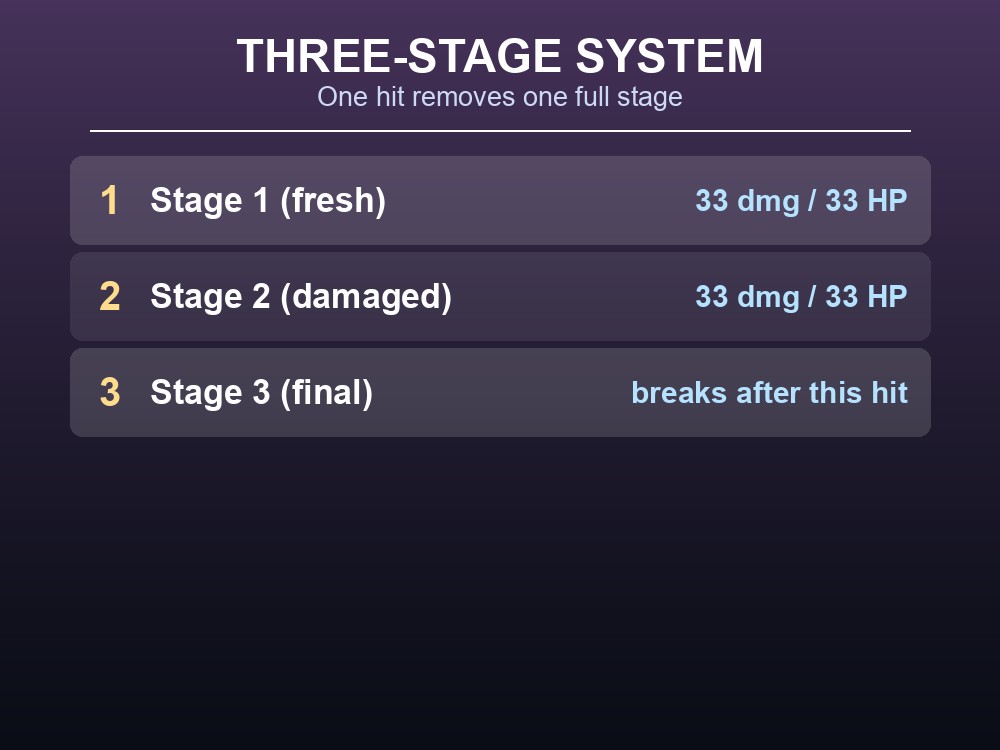
The wiki is specific about how damage works on a Wood Spike, and it isn't a simple HP bar: "They have 3 stages that each deal 33 damage and have 33 hit points, but anything that steps into the trap will break a stage regardless of how many hit points the trap has. Each stage looks more broken than the last, but has the same stats." One hit removes one entire stage, not 33 points off some deeper pool. A later History note confirms the current version caps that at three total hits: "Wood Spikes now appear to only have three stages of disrepair, always going down one level when hitting a zombie, thus only being able to land three hits on a zombie before breaking" — worded by the wiki itself as true "as of at least Alpha 18."
Repairing costs 5 Wood per stage, and the page states that "when repaired, all broken stages are fixed at once" in a single action rather than one stage at a time. Repairing a spike from fully broken (all 3 stages down) works out to 3 × 5 = 15 Wood — shown as arithmetic, since the wiki doesn't state that total directly.
One figure doesn't line up cleanly: the infobox separately lists a cumulative_durability of 198, and 198 ÷ 33 = 6, double the three stages the current page text describes. The page's History section notes repairs "originally" stepped through "5 stages" before Alpha 15.1, so the 198 figure and that 5-stage wording likely carry over from an older version of the item. The wiki doesn't reconcile these numbers with the current three-stage description, so treat three stages as the current mechanic and the 198/5-stage figures as leftover history.
Upgrading to Iron Spikes and the Alpha Cost History
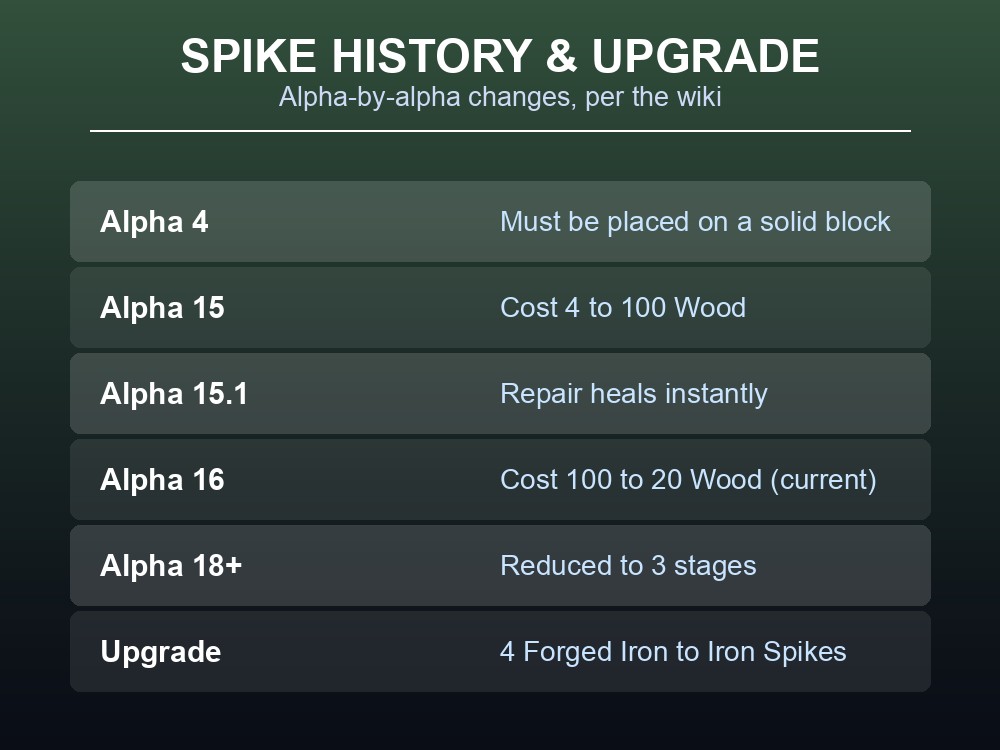
Wood Spikes have an upgrade path, stated plainly on the page: "Wood Spikes can be upgraded to Iron Spikes, which deal more damage and have a higher durability, with 4 Forged Iron." The page gives no specific damage or Hit Point numbers for Iron Spikes itself — those figures are undocumented here, so treat "more damage" and "higher durability" as the wiki's own comparative wording, not a stat you can plan a defense around yet.
The current 20-Wood craft cost hasn't been stable across the game's history. Quoting the History section directly, in order: Alpha 4 — "Wood Spikes must be placed on a solid Block." Alpha 15 — the price "changed from 4 to 100 wood," at which point "Wood Log Spikes (which have since been removed from the game) became the cheap, viable alternative with a material cost of 20 wood." Alpha 15.1 — repairs stopped stepping through multiple stages and started healing fully in one action. Alpha 16 — "price of wood spikes went from 100 to 20 wood," landing on the 20-Wood cost the page still lists today. Alpha 18 or later — the trap dropped to the three-stage system covered above.
So the 20-Wood price you'll pay right now is actually the second time the game has settled on that exact number, with a 100-Wood version and a since-removed Wood Log Spikes item briefly covering the gap in between.
Practical tips
- Wood Spikes are a first line of defense, not a wall replacement — the wiki's own framing: "your first and earliest line of defense."
- Layer them: "For survivors staying in a house, a good strategy is to surround it by a few layers of spikes."
- They matter most against runners: "Spike traps can be helpful when dealing with running zombies, as the spikes slow them down and can dismember them."
- Budget 3 hits per spike before it breaks, and 5 Wood per broken stage to repair it (15 Wood if all three stages are gone).
- Low material cost keeps them relevant past the early game too — the wiki calls them effective "while still being effective in late-game defenses."
Running your own 7 Days to Die server
None of this changes with a dedicated server, but the stakes do — a base ringed with Wood Spikes only holds if the whole group agrees on the layout, and repairing a damaged ring after every horde night is a recurring Wood cost the group has to budget for together. A gamever 7 Days to Die server keeps the world running 24/7 so a base's spike ring stays standing, and repairable, between sessions instead of resetting on restart, gives every player in the group console access to place and repair traps without waiting on a single admin, and takes automatic backups before a big Blood Moon push in case a defense line gets overrun. Renting one takes a few minutes, and new servers come with a free trial using promo code WELCOME.
Conclusion
Wood Spikes are simple by design: 20 Wood to craft, 33 damage and 33 Hit Points per placement, and a three-stage break where one hit removes one full stage — three hits and the trap is gone unless you spend 5 Wood per stage (15 Wood total) to repair it. The 20-Wood price is actually a return trip, not a first try: the wiki's own Alpha 4 through Alpha 18 history shows the game tried a 100-Wood cost and a since-removed cheaper alternative before landing back where it started. From here, the documented upgrade path leads to Iron Spikes for 4 Forged Iron, though the wiki doesn't give Iron Spikes its own numbers yet — check its own stats before relying on that comparison.