
How to use wax to preserve copper items in Minecraft 1.21.9
The Copper Age update transforms copper into one of the most dynamic materials in Minecraft’s building ecosystem. Once a simple decorative metal, copper now ages over time, reacting to the game’s random tick system and gradually turning from bright orange to teal green. While this oxidation adds realism and character, it can also threaten visual consistency across large builds or complex machinery. Waxing provides the definitive countermeasure, allowing players to freeze copper at any stage of its lifespan. Through honeycomb application, builders gain complete aesthetic control, preserving architectural designs and maintaining their metallic sheen indefinitely.
Apply honeycomb directly
Waxing begins with the most fundamental interaction in Minecraft 1.21.9: applying honeycomb to a copper surface. Players can obtain honeycomb by harvesting it from bee nests or hives using shears, making it a renewable and sustainable material for preservation. Once honeycomb is in hand, the process is instantaneous - right-clicking on any unwaxed copper block triggers a faint sparkle effect that confirms the block’s surface has been sealed. From that moment, oxidation stops entirely, regardless of the surrounding conditions. The copper will no longer advance through its color stages, remaining permanently fixed at the visual state it was in when waxed.
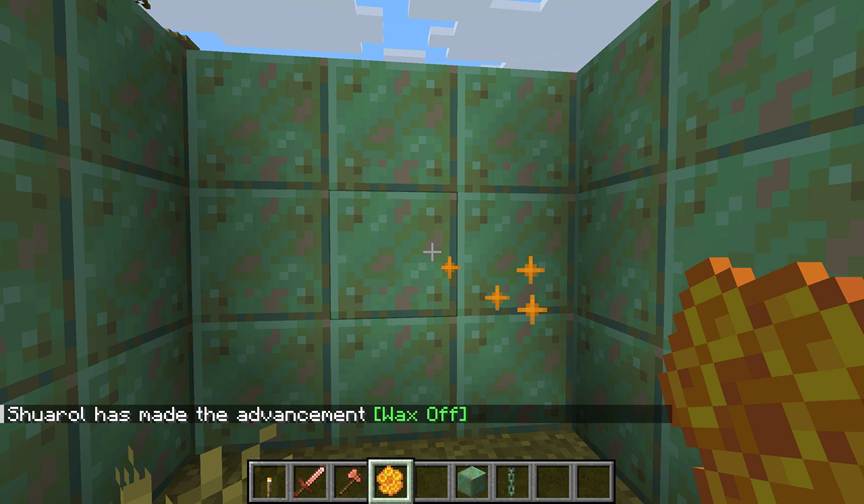
For players who prefer precision, the same result can be achieved via crafting. Combining a copper block of any oxidation level with a honeycomb on a crafting table produces a waxed variant of that block. This approach is particularly useful for mass production, as it eliminates the need to manually treat each block after placement. In large-scale architectural projects or redstone installations, this can save considerable time while ensuring that the final structures remain visually stable. Waxed copper is functionally identical to unwaxed copper, meaning it retains all redstone conductivity, decorative properties, and crafting compatibility while remaining immune to environmental decay.
Control oxidation behavior
Oxidation in Minecraft does not depend on weather, altitude, or biome. Instead, it is controlled by random ticks - an internal timing system that randomly selects blocks in the world to update. On average, a copper block has a small but constant probability of progressing to the next oxidation stage during each tick. When grouped together, copper blocks also influence one another’s rate of change: clusters of less-oxidized blocks slow the process for the entire group, while isolated blocks tend to age faster.
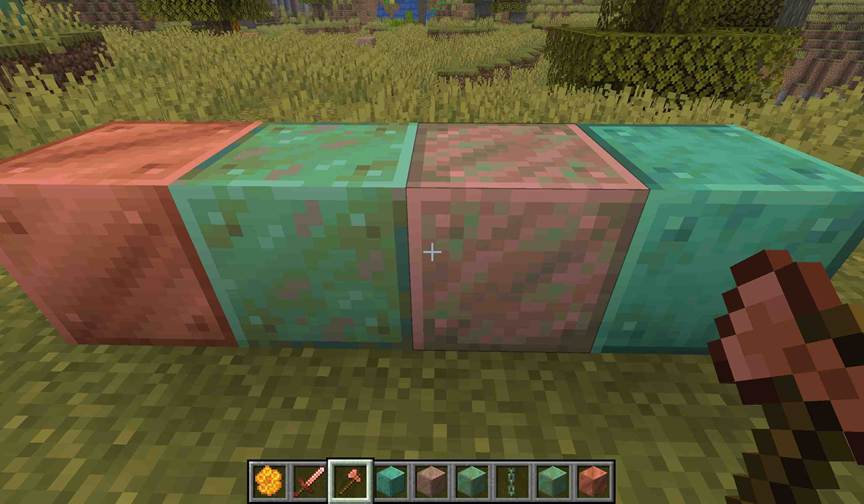
This mechanic introduces a new layer of environmental design strategy. Builders who wish to manage oxidation naturally can space blocks at least four apart to ensure independent aging. Conversely, players looking to maintain a controlled gradient across a structure - such as a weathered roof or aged monument - can use clustering to synchronize oxidation levels. However, waxing remains the only way to guarantee total stability. Once applied, honeycomb prevents all further progression, effectively removing the block from the random tick system and preserving it permanently.
Reverse oxidation using tools
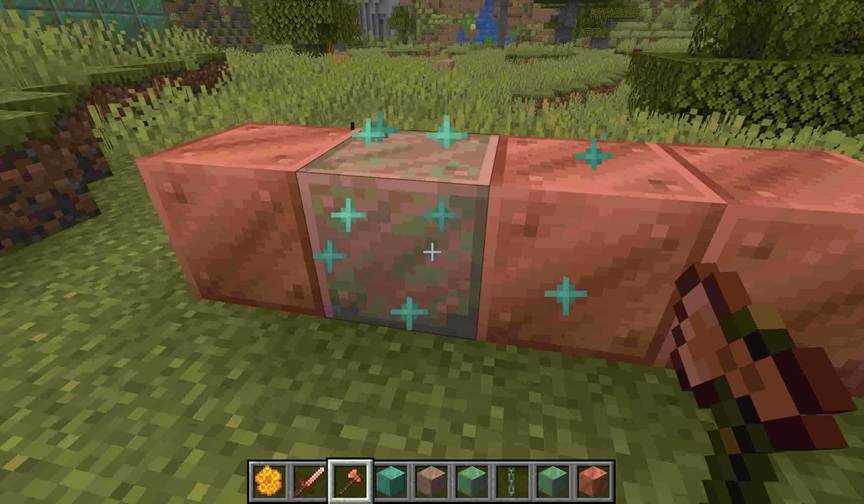
Waxing can be undone, and oxidation can be reversed at any time. Striking a copper block with an axe initiates a two-phase process. The first strike removes any applied wax, re-exposing the copper to environmental change. Subsequent strikes then reduce the oxidation stage step by step, gradually returning the block to its pristine metallic state. This interaction is both functional and aesthetic, giving players a tool-based method of restoration that parallels real-world metalworking.
Lightning provides a more dramatic alternative. When a lightning bolt strikes a copper block - directly or via a lightning rod - the impact instantly removes all oxidation and can extend to nearby blocks within a small radius. In Java Edition, this mechanic follows a random walk pattern, meaning that up to forty surrounding blocks may be partially or fully cleansed during a single event. Builders often use this as a natural maintenance system, integrating lightning rods into their copper structures to create cyclical “storm cleaning” effects that restore luster while enhancing the environmental realism of their worlds.
Preserve all copper variants
Minecraft 1.21.9 expands waxing functionality to every copper-based object in the game. Beyond standard blocks, players can now preserve copper chains, grates, trapdoors, lanterns, doors, chests, and even copper golem statues. Each of these items follows the same oxidation logic as full blocks, progressing through unoxidized, exposed, weathered, and oxidized stages. The honeycomb interaction works identically across all of them, ensuring unified visual behavior throughout complex builds that use mixed copper components.
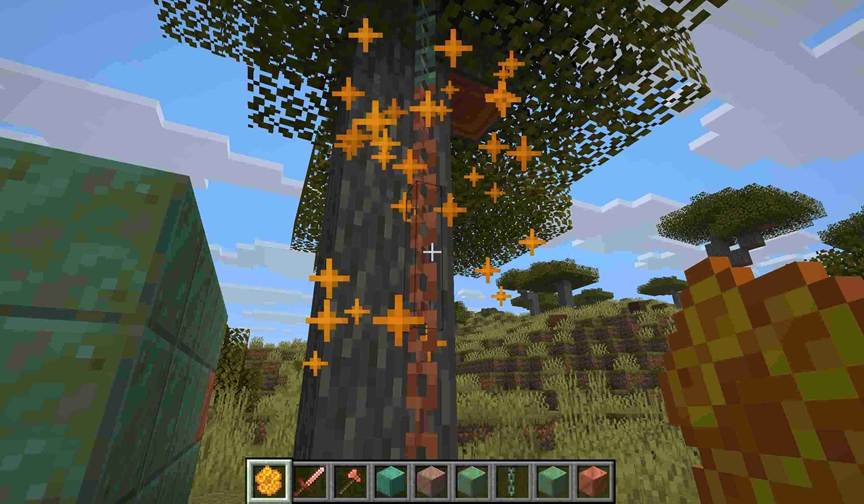
This expansion has major implications for aesthetic consistency. Previously, builders faced challenges maintaining uniform coloration across multi-material copper installations. Now, entire builds - from industrial factories to ornamental cathedrals - can remain frozen in a chosen color scheme without requiring periodic maintenance. The effect is particularly striking in redstone-heavy bases, where oxidized copper might otherwise desynchronize textures or visually fragment machinery layouts.
Design with permanence
Waxing is not simply a technical convenience; it is a creative instrument. The deliberate contrast between waxed and unwaxed copper allows players to design with time itself as a visual variable. Waxed copper communicates precision and order - suitable for modern, futuristic, or mechanical builds - while unwaxed copper evokes decay, age, and organic transformation. By combining both, players can narrate the passage of time within a single structure, embedding history and entropy directly into their architecture.
The waxing system in Minecraft 1.21.9 therefore represents more than an update to block behavior; it is a creative philosophy. It merges chemical realism with artistic intent, granting players the agency to sculpt both structure and lifespan.