
How to Treat Wounds and Injuries in Project Zomboid
Project Zomboid's in-game tooltip sums up the First Aid skill in one line: it "increases the available information for injuries, and the quality of medical treatments" — but it doesn't heal you faster on its own. The wiki is explicit about the one myth to drop first: "Contrary to popular belief, first aid does not make wounds such as scratches or lacerations heal faster." What First Aid actually buys you is longer-lasting bandages, faster-healing fractures, better wound diagnosis, and quicker hands during treatment. Below is what the skill changes level by level, how to actually level it, and the real treatment steps for every injury type the wiki documents — scratches, deep wounds, fractures, burns and bites.
What First Aid Actually Changes
First Aid is a Survivalist-category skill (skill ID Doctor) that, per its own infobox, makes a character "perform medical actions faster, bandages and poultices last longer." As level rises, the game also improves splint effectiveness, fracture healing speed, and the ability to evaluate the severity of wounds and infections — meaning higher-level characters get more accurate information about how bad an injury actually is. Experience is earned only by treating injuries — either your own or another player's — not by any passive activity. One more caveat worth carrying into every fight: First Aid does not change the chance of zombification from a zombie scratch or bite. That risk is fixed regardless of skill level; First Aid only affects how well you manage the wound itself.
First Aid Level Effects
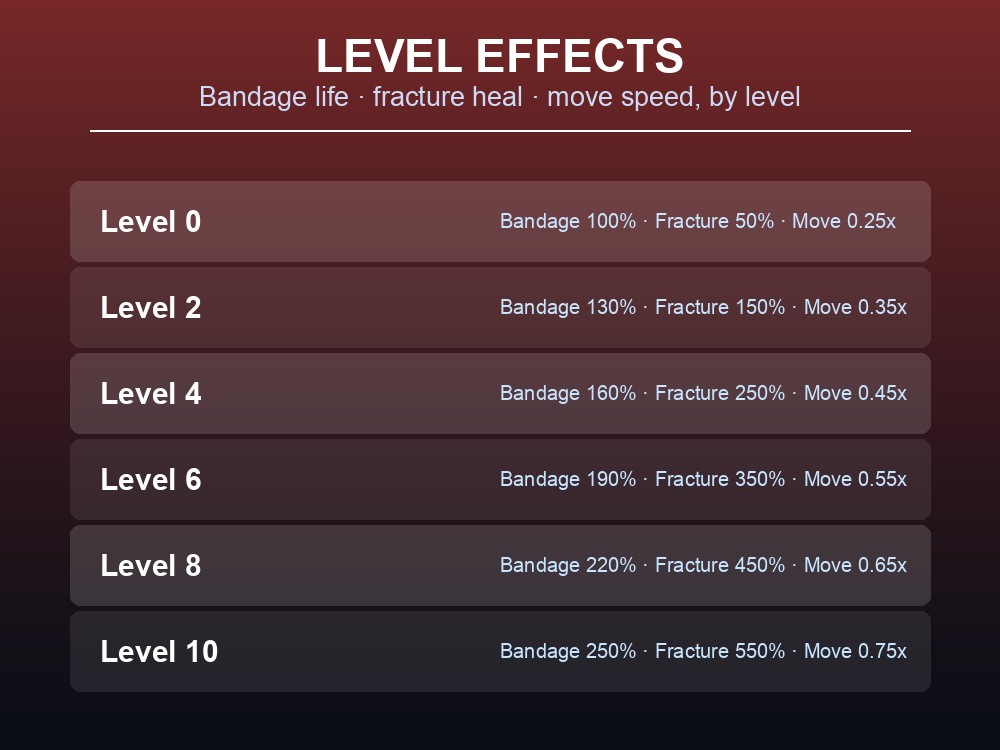
The wiki's level table runs from 0 to 10 across three tracked stats. Bandage life multiplier goes from 100% at level 0 to 250% at level 10 — a bandage lasts 2.5x longer before going dirty (250 ÷ 100 = 2.5). Fracture healing speed multiplier goes from 50% at level 0 to 550% at level 10 — that's 11x faster (550 ÷ 50 = 11) than an untrained character's baseline. The fracture combat/run speed modifier, which sets how much movement and combat ability you keep while splinted, climbs from 0.25 at level 0 to 0.75 at level 10. The wiki cross-confirms one of these numbers directly in its Splint section: "In combination with level 4 First Aid, fractures heal 250% faster" — matching the level-4 row of the table exactly.
How Players Level First Aid
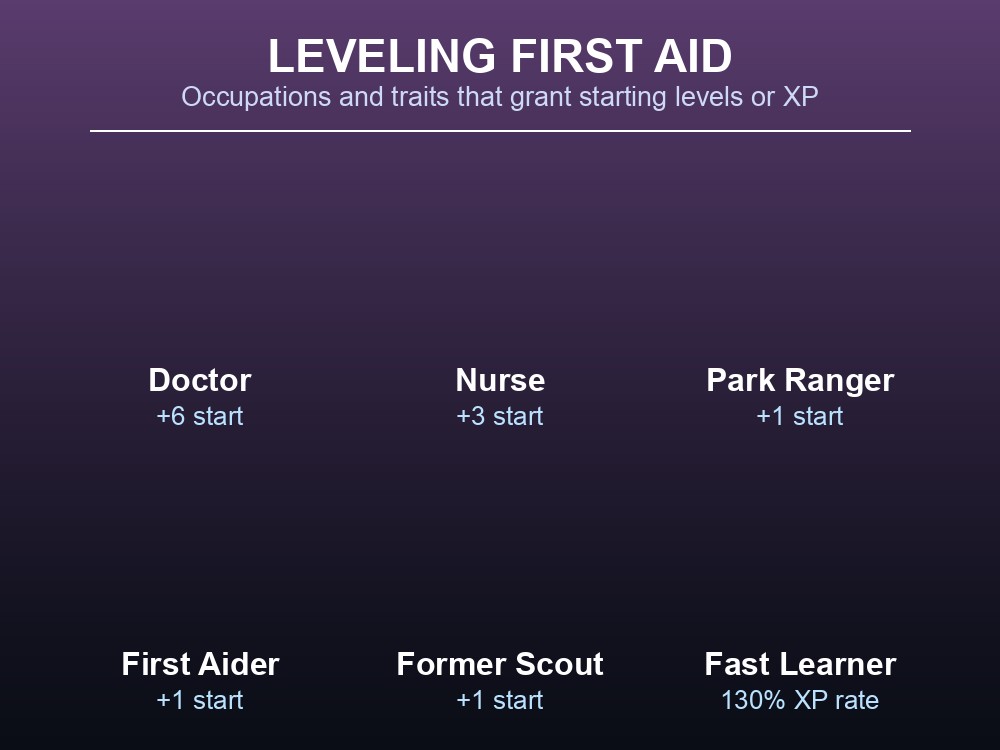
Three occupations set a character's starting First Aid level: Doctor (+6), Nurse (+3), and Park Ranger (+1). Two traits add a further starting level each: First Aider (+1) and Former Scout (+1). Separately, Fast Learner raises the XP rate to 130% and Slow Learner drops it to 70% — neither affects starting level, only how fast you gain from there. Beyond active treatment, five skill books raise the XP multiplier for specific level bands, each with an in-game title the wiki quotes directly: First Aid I, "A Scouts Injury Guide" (levels 1–2); First Aid II, "Bandaging and Suturing" (levels 3–4); First Aid III, "Emergency Paramedics Manual" (levels 5–6); First Aid IV, "Gray's Anatomy of the Human Body" (levels 7–8); and First Aid V, "Surgical Techniques of the Operating Room" (levels 9–10). VHS tapes also grant flat XP — Combat Wound Management gives +87.5 on either the retail or home cut, Emergency First Aid and Rosewood Medical First Aid (RMFA) give +75 each — but the wiki notes "entertainment gains are limited to the first 3 levels and any overflowing XP amount," so tapes stop being useful past early levels except for XP that would otherwise overflow.
Treating Wounds Step by Step
Right-click the body in the health status window (or right-click the health text itself) to open treatment. Every treatment step needs materials — even a basic one like ripped sheets or bourbon. The wiki's documented flow, by injury type:
- Scratch or laceration: apply a bandage as soon as possible. Wounds don't heal at all while unbandaged, and dirty bandages don't hurt healing — only the time spent with no bandage does — so the wiki specifically advises against swapping a bandage just because it's dirty.
- Deeper wounds (embedded object): remove any foreign object first — tweezers or forceps are recommended, and required for a bullet; using bare hands works but causes extra pain (the wiki doesn't give a numeric pain value for this). Then stitch with a needle and thread or a suture needle; bandaging afterward is recommended because it halves recovery time.
- Fractures: splint if the location allows it — head and torso fractures cannot be splinted. Bandage afterward. Comfrey applied as a poultice reduces fracture recovery time by a further 50%. The wiki doesn't state fracture recovery in exact hours, only that it "can take a very long time to heal."
- Fire: quench immediately with water or a fire extinguisher — the wiki calls the alternative outcome "imminent" death. Resulting burns are treated like lacerations and scratches but, per the wiki, "take much longer to heal than other injuries" (again, no exact hour figure is given).
- Bites: bandage to stop bleeding, same as a scratch. On default settings, a bite is 100% fatal via zombification unless the sandbox option is turned off; if made survivable, bite wounds still take much longer to heal than lacerations. The exact sandbox percentage options for surviving a bite aren't documented on this page.
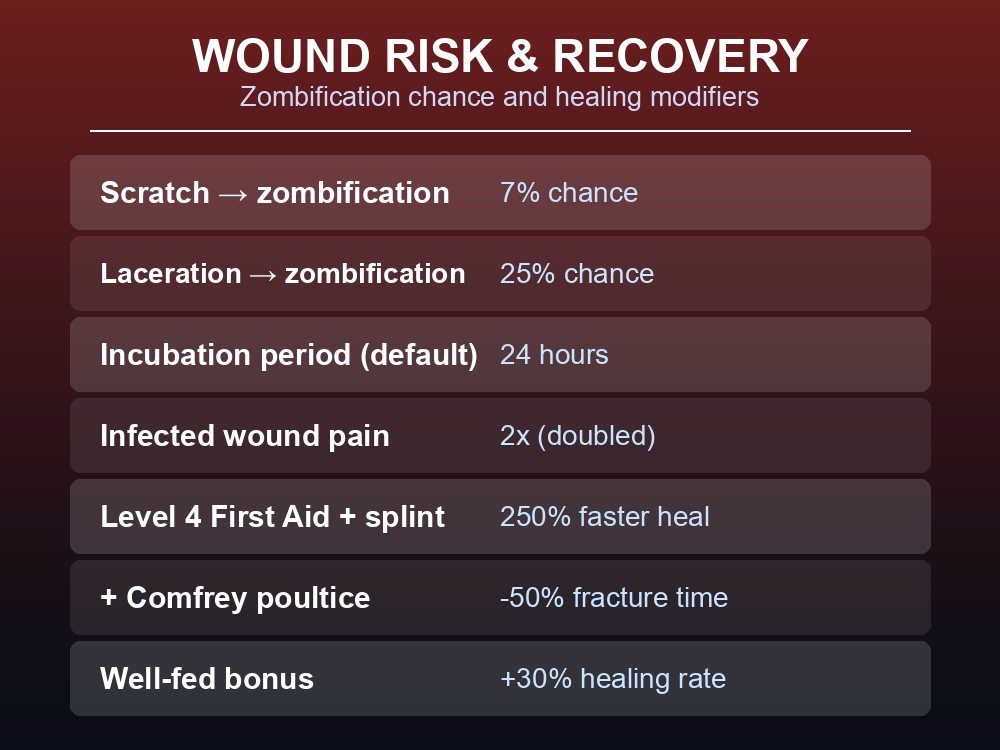
Once treated, monitor the wound: zombie-inflicted scratches carry a 7% chance of fatal zombification, lacerations 25%, and both should be watched for the 24-hour default incubation period. Open wounds can also get infected — infection doesn't slow healing, it doubles the pain gain of the untreated, infected wound. Being well-fed adds a separate +30% to injury healing rate on top of any First Aid or splint bonus. One accuracy note from the source itself: the page banner states it was last confirmed for build 42.18.0 while the current stable release is 42.20.4, so treat these figures as the best currently documented rather than guaranteed unchanged since the last patch.
Practical tips
- Bandage scratches and lacerations immediately — an unbandaged wound doesn't heal at all, dirty or not.
- Don't swap a bandage just because it looks dirty; that alone doesn't change healing.
- Use tweezers or forceps for embedded objects — a bullet requires it, and bare hands add extra pain.
- Stitch, then bandage — bandaging after suturing halves recovery time.
- Splint fractures where possible (not head or torso); add a comfrey poultice for another 50% off recovery time.
- Quench fire immediately — the wiki calls the alternative outcome imminent.
- Watch zombie-inflicted wounds for the full 24-hour default incubation period: 7% risk for a scratch, 25% for a laceration.
- Stay well-fed — it adds +30% to injury healing on top of any skill bonus.
Running your own Project Zomboid server
Medical risk changes completely once you're running with a group instead of solo — someone else can stitch and splint you when your own hands would add pain, and infection-fighting supplies like sterilized bandages and disinfectant stretch further when a group pools them. If your server enables the sandbox option to make bites survivable, that's a setting worth confirming with your whole group before anyone gets bitten, not after. A gamever Project Zomboid server keeps your world running with configurable sandbox settings, one-click backups before you test a change like that, and full admin/console access — get started and use promo code WELCOME.
Conclusion
First Aid in Project Zomboid doesn't heal scratches or lacerations any faster — what it does, level by level, is stretch bandage life to 250%, fracture healing to 550% (11x the untrained baseline), and fracture mobility to 0.75, while Doctor (+6), Nurse (+3), skill books and VHS tapes all get you there faster. The treatment steps themselves don't change with skill level: bandage immediately, remove foreign objects before stitching, splint and poultice fractures, quench fire on sight, and watch every zombie-inflicted wound through its full incubation window. Get the sequence right and the numbers above do the rest.