
How to Tame Pets in Abiotic Factor: Pests, Peccaries and Skinks
Abiotic Factor lets you turn hostile anteverse fauna into loyal companions — but only three families have a documented taming method: Pests, Peccaries, and Skinks. Each takes a different item combo, and a tamed pet then levels up on a feeding schedule, can sit in a protective Companion Slot, and can even be mutated. This guide covers the taming items, the feeding/XP math behind leveling 0 to 20, the combat rules for whether a pet can die permanently, and how mutation, milking and storage work.
How to Tame Pests, Peccaries and Skinks
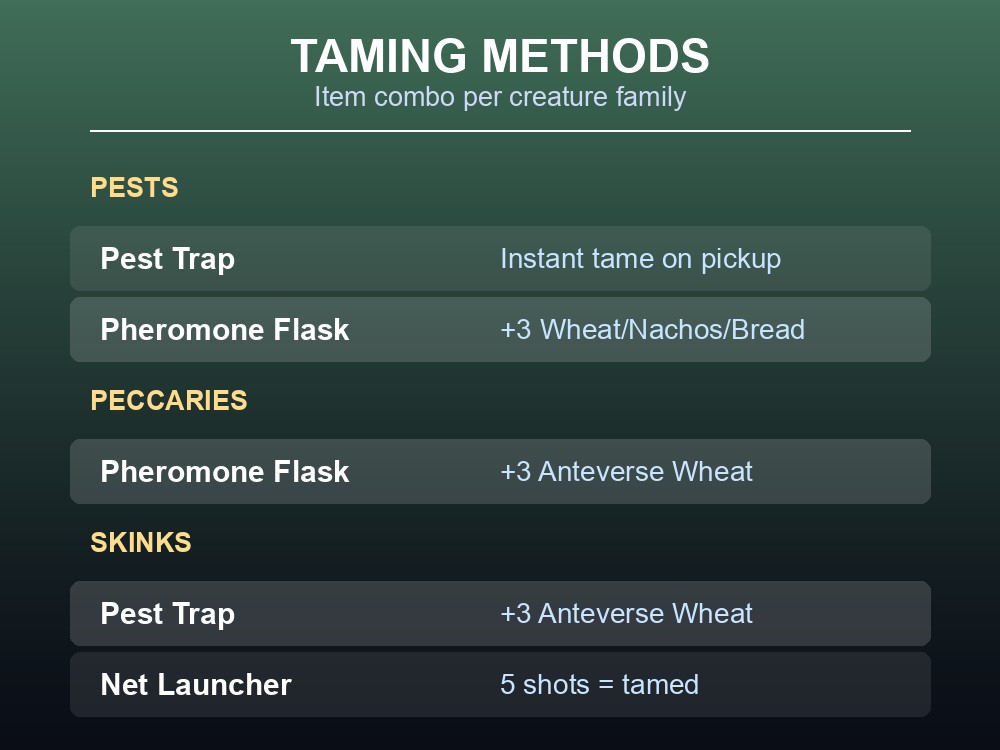
The wiki's Taming section documents methods for exactly three families:
- Pests (and any of its variants) — lure it into a Pest Trap, which "will cause the Pest to instantly become tamed upon picking it up." No trap handy? Throw a Pheromone Flask at it, then feed it three of Anteverse Wheat, Nachos, or Bread.
- Peccaries (and any of its variants) — throw a Pheromone Flask, then feed it three Anteverse Wheat. No Nacho/Bread alternative is listed for this family.
- Skinks — either lure it into a Pest Trap and feed it three Anteverse Wheat, or shoot it five times with a Net Launcher, "which will cause it to become tamed." The source's "or any of its variants" phrasing only covers Pests and Peccaries, not Skinks — whether Magma Skink and Verdant Skink tame identically is undocumented here.
The wiki's Types of Pets list runs wider than these three families: 9 Pest entries, 8 Peccary entries, 3 Skinks, 3 Lamogi, and 2 Summons — 9+8+3+3+2 = 25 named entries total. The Taming section covers only Pests, Peccaries and Skinks; how a Lamogi is tamed is undocumented here, and Summons aren't tamed at all — the source calls them pets that "follow the player due to certain Armor Sets, but cannot be interacted with outside of combat."
Feeding, XP and Leveling a Pet to 20
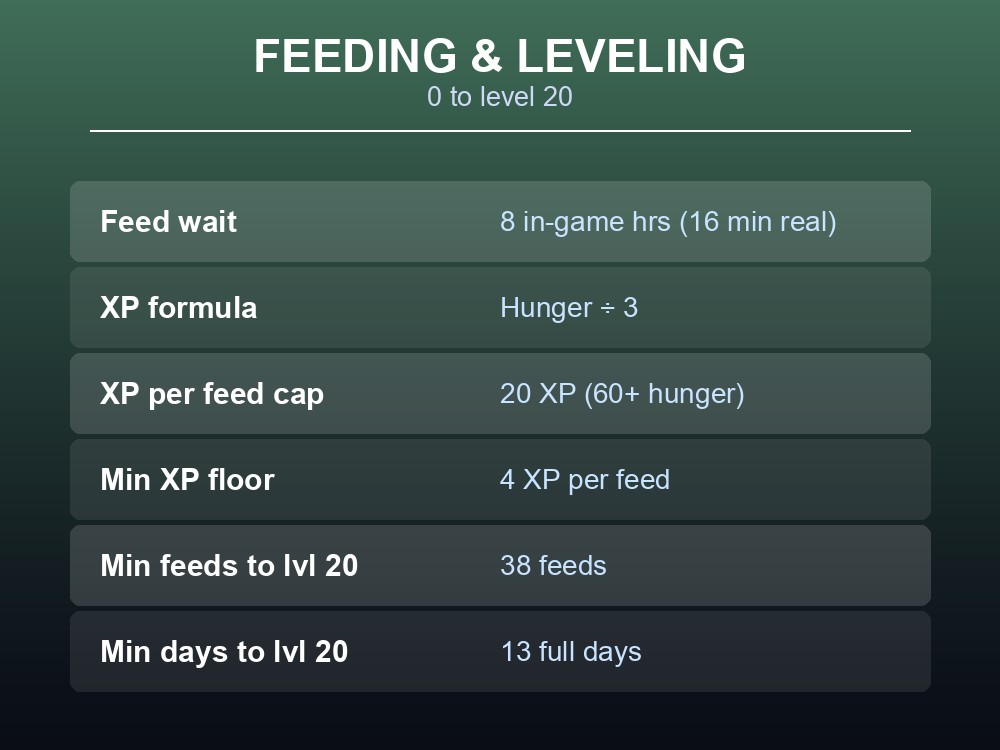
Once tamed, a pet needs 8 in-game hours (16 real-time minutes) before it's flagged "Hungry – Offer food item to feed." A freshly tamed Pest always starts hungry, so its first feed is immediate.
XP is a direct function of a food's hunger-fill stat: XP = Hunger ÷ 3. A 30-hunger item gives 10 XP; a 60-hunger item gives 20 XP (60 ÷ 3 = 20). Two limits apply: every feed grants a minimum of 4 XP, even for a zero-hunger item like Antewheat, and XP caps at 20 per feed — so any item at 60+ hunger delivers the same capped amount, which is why the source notes Pumpkin Bread and Cooked Fr-eyed Rice give identical pet XP despite different hunger values.
The level table runs 0 to 20, with the XP cost per level rising from 4 (level 1) to 100 (level 20); the source notes the curve "flattens from level 10 onward until level 19," then jumps sharply for the last step. Leveling a pet from 0 to 20 takes a minimum of 38 feeds, assuming every feed is a 60-plus-hunger item (the capped 20 XP each). At the stated pace of three feeds a day, every 8 hours, that's 38 ÷ 3 ≈ 12.7 days, which the source rounds up to a stated minimum of 13 full days of feeding — excluding the last feed on that 13th day.
Using Pets in Combat and the Companion Slot
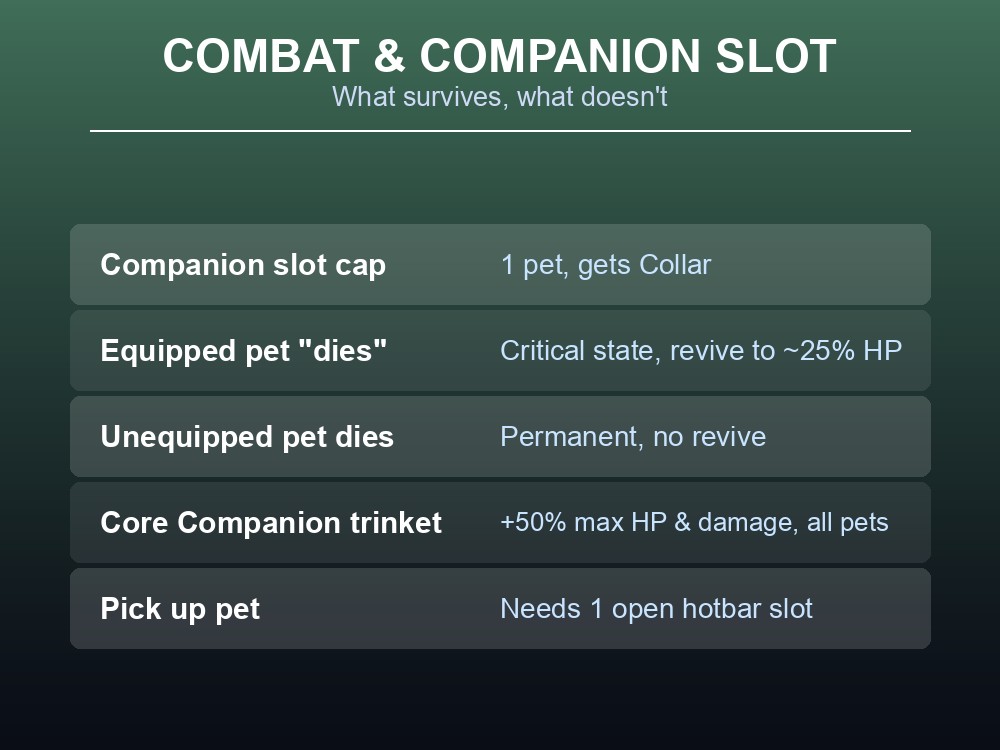
Equip a pet in the Companion Slot to bring it along as a follower. Doing so fits it with a Vital Stabilization Companion Collar, and "pets wearing this device will not die if injured, but wait to be picked up and nursed back to health." Only one companion can be equipped at a time.
That collar is the key combat difference: a Companion-slot pet that would otherwise die instead drops into a critically wounded state — run up and manually revive it, resetting its health to approximately 25%. A pet not equipped in the slot can die permanently, with no revive.
Pets attack automatically, including — per the source — "when the player is currently invisible, which may result in the player being forced into combat without intending to." The Core Companion trinket applies a 50% buff to the max health and damage of all pets. Picking a pet up requires at least one open hotbar slot; pets can only be stored in hotbar slots, and dropping one while holding it re-equips it to the Companion slot automatically — unless it's dropped from the Inventory screen.
Mutating, Storing and Powering Pets
Feeding a pet the right food or item can trigger a sparkling effect; keep feeding it and the pet mutates, gaining a new appearance and abilities. Every mutation needs three of that specific item, and only an un-mutated pet can mutate again. A crafting-bench alternative also exists: combining a pet with gadgets at a bench produces what the source calls a "bionically-enhanced new form." Mutated pets keep their accumulated XP and level.
A tamed Peccary Sow becomes milkable roughly 8 in-game hours (16 real-time minutes) after taming or mutating — hold a Test Tube and interact with it for one Vial of Milk.
For pets you aren't carrying, Pet Beds and Luxury Pet Beds keep them safe: a pet resting in a bed "will not move from the bed and cannot be harmed," though a roaming pet that wanders onto a bed on its own can still leave whenever it wants. Pests and Skinks have a second storage option — a Pest Trap also holds them. Both tamed Pests and Skinks can be manually placed in Pest Wheels to generate power, though the source is explicit that "they will not seek it out on their own" — you have to place them yourself.
Quick taming reference
- Pest: Pest Trap = instant tame, or Pheromone Flask + 3x Anteverse Wheat/Nachos/Bread
- Peccary: Pheromone Flask + 3x Anteverse Wheat
- Skink: Pest Trap + 3x Anteverse Wheat, or 5 Net Launcher shots
- Feed every 8 in-game hours (16 real minutes); 60+ hunger food caps XP at 20/feed
- Leveling 0→20 takes a minimum of 38 feeds over 13 full days at 3 feeds/day
- Companion Slot pets get revived instead of permanently dying
Running your own Abiotic Factor server
A pet's leveling clock runs on in-game hours, and the 13-day minimum to max a single pet only keeps ticking while a world is up — the same goes for Pest Wheel power setups and pet beds sitting in a base. A dedicated Abiotic Factor server keeps that world available around the clock instead of only while one player's game client is open, so a taming and leveling project doesn't stall between sessions.
Conclusion
Taming in Abiotic Factor breaks down into three documented methods: a Pest Trap or Pheromone Flask + 3 food items for Pests, a Pheromone Flask + 3 Anteverse Wheat for Peccaries, and a Pest Trap + 3 Anteverse Wheat or 5 Net Launcher shots for Skinks. Feeding follows an 8-in-game-hour clock and an XP = Hunger ÷ 3 formula (capped at 20, floored at 4), working out to a minimum of 38 feeds across 13 full days to reach level 20. A Companion Slot pet gets a revive-instead-of-death safety net; an unequipped one does not. Mutation, Peccary Sow milking, pet beds and Pest Wheel power round out what a tamed pet can do.
Want your tamed pets and their leveling clock running even when you're offline? Rent an Abiotic Factor server at gamever.io — instant setup, one-click backups and updates, and 24/7 uptime. Start with a free trial and use promo code WELCOME.