
How to Tame a Wyvern in ARK
The Wyvern is one of ARK's most dangerous flyers, and it is not a knockout tame at all — ark.wiki.gg's own infobox marks it tameable = No. The only documented path to a rideable Wyvern is raising one from a stolen egg. This guide covers exactly what the wiki page says about that process: why adults can't be tamed, how the egg-and-raising method works per the in-game dossier, the incubation and growth timers, the base stats and breath attacks you end up with, and what a wild Wyvern can do to you near its nest. Anywhere the page doesn't give a number, this guide says so instead of guessing.
Why You Can't Knock Out a Wyvern
The wiki's Domestication section lists the Wyvern as Tameable: No, Rideable: Yes, Breedable: Yes, with a note attached: "Adults cannot be tamed, but Wild Eggs can be hatched." A knocked-out adult isn't an option the way it is for a Rex or Argentavis — the only route the page documents is hatching and raising an egg.
The in-game Dossier, credited to survivor Helena Walker, spells out the method in its own words:
"However, Draconis vipera is too resilient to domesticate once it has become an adult. It must be raised from an egg if you wish to garner its loyalty. Good luck finding and stealing one of those though. Mother Wyverns are extremely hostile and will pursue egg thieves with a vengeance. If you somehow manage to acquire a wyvern egg, you'll then need to take down a female wyvern and extract her milk to keep the baby alive."
So the documented steps are: steal an egg while evading an aggressive mother, then separately defeat a female Wyvern to obtain milk that keeps the hatchling alive. The source doesn't name a specific milk item, doesn't say how much is needed or how long it sustains the baby, and doesn't detail the mechanics of approaching the nest beyond "extremely hostile" — those specifics are left undocumented rather than invented.
Getting the Egg and Raising the Baby
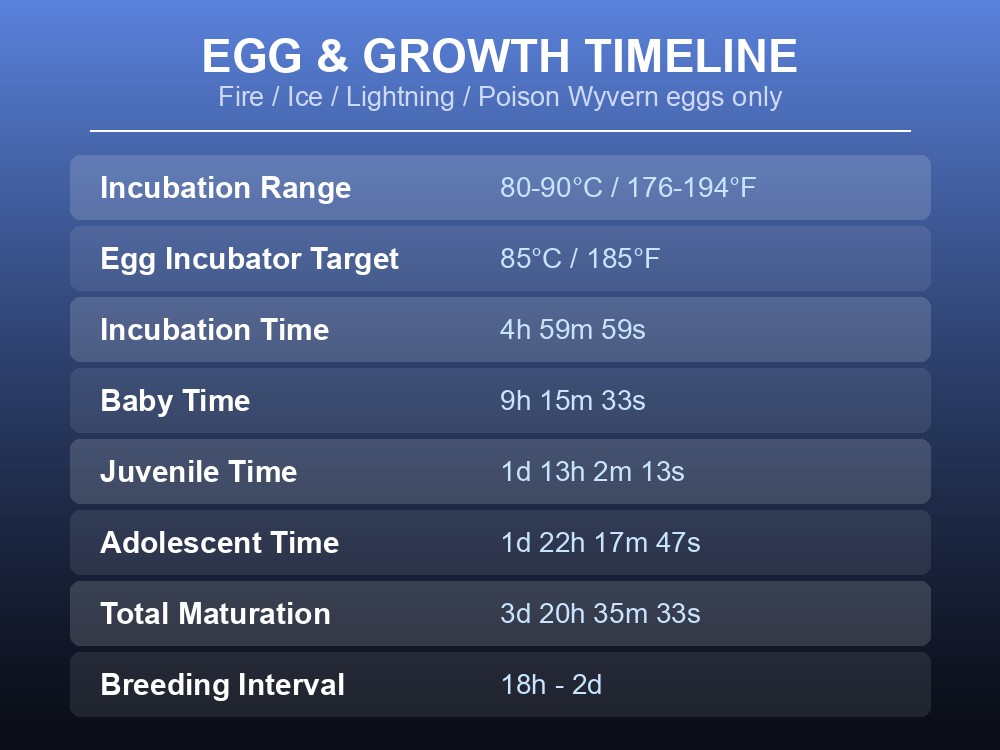
Only four egg types are listed under Reproduction: Fire Wyvern Egg, Ice Wyvern Egg, Lightning Wyvern Egg, and Poison Wyvern Egg. Corrupted and Forest variants are explicitly excluded — the page states the Corrupted Wyvern "is not tameable and doesn't lay eggs," and the Forest Wyvern "is not tameable, and does not lay eggs."
Once you have an egg, Reproduction data gives an Incubation Range of 80–90°C / 176–194°F, with an Egg Incubator target of 85°C / 185°F. Incubation itself takes 4h 59m 58.561s. After hatching, the wiki lists Baby Time 9h 15m 33.331s, Juvenile Time 1d 13h 2m 13.325s, Adolescent Time 1d 22h 17m 46.656s, for a listed Total Maturation Time of 3d 20h 35m 33.313s.
Checking that total in hours: Baby ≈ 9.26h, Juvenile ≈ 37.04h, Adolescent ≈ 46.30h; summed, 9.26 + 37.04 + 46.30 ≈ 92.59 hours, matching the listed Total Maturation Time (3×24 + 20 + 35/60 + 33/3600 ≈ 92.59 hours) — confirming the total is just those three stages added together. The page also lists a Breeding Interval of 18h–2d for already-tamed Wyverns, so a raised pair can produce fresh eggs on that cycle instead of you raiding a wild nest again.
What You End Up With: Base Stats and Abilities
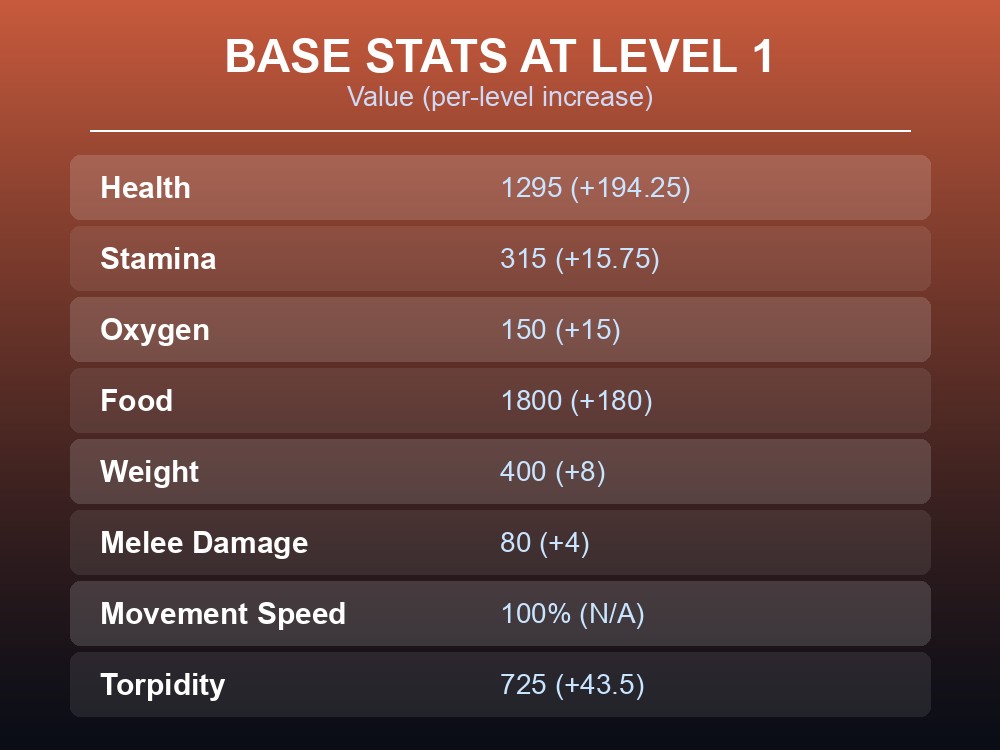
Base Stats at Level 1, with per-level increase: Health 1295 (+194.25), Stamina 315 (+15.75), Oxygen 150 (+15), Food 1800 (+180), Weight 400 (+8), Melee Damage 80 (+4), Movement Speed 100% (no increase listed), Torpidity 725 (+43.5).
Bite deals 80 damage, usable every 0.72s. Head damage multiplier is x1.5, and the page notes that "on ARK: Survival Ascended body multipliers also apply for player's melee attacks" — called out as version-specific rather than assumed universal. Each variant's breath attack, per the Abilities section: Fire deals 8% of the target's max health (capped 72–450) over 6 seconds, ignoring armor; Lightning fires 25 damage per server tick for a 3.3-second beam that bypasses most armor while degrading it; Poison deals 100 direct damage plus an 80-damage explosion, then a 5-second gas cloud dealing 10 damage every 0.4s, all ignoring armor unless the target wears a Gas Mask; Ice slows targets 50% for 10 seconds via six projectiles dealing 20 damage each, and is affected by armor. Each type is immune to its own breath and status effect, with one exception: a Poison Wyvern's breath still damages a fellow Poison Wyvern's rider unless they wear a Gas Mask or full Hazard Gear.
Handling Wild Wyverns and What They Drop
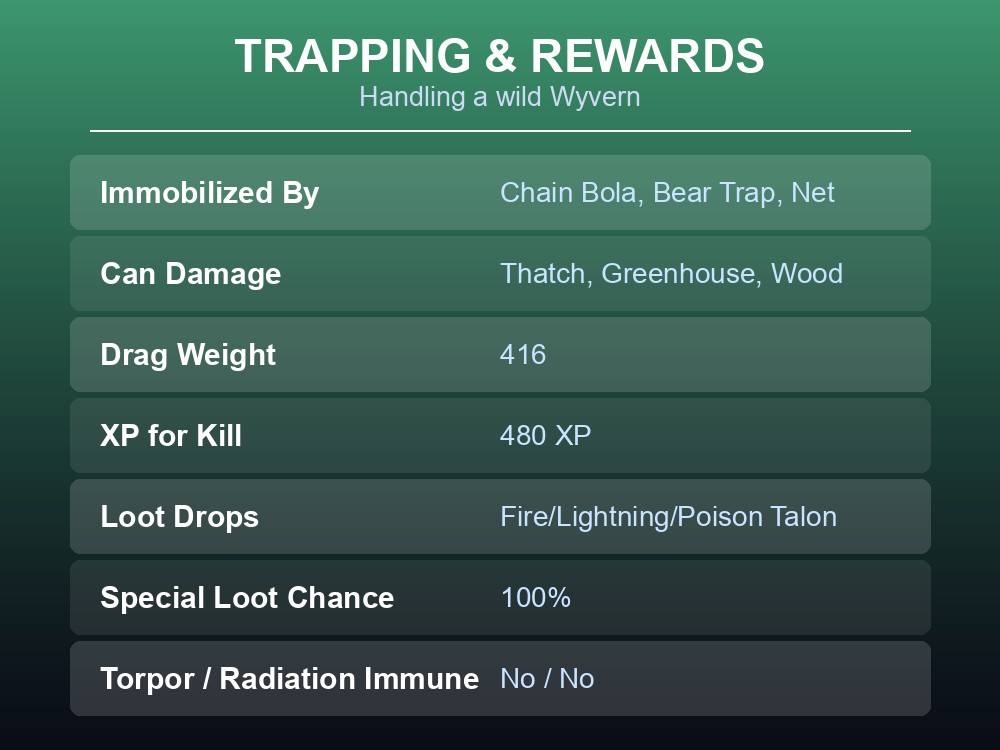
Fighting rather than sneaking past one, the page lists it as Immobilized By: Chain Bola, Large Bear Trap, and Net Projectile, and able to Can Damage: Thatch, Greenhouse, and Wood structures. It has a Drag Weight of 416, is not Torpor Immune and not Radiation Immune, and produces Medium feces. A kill is worth 480 XP, with loot of Fire Talon, Lightning Talon, and Poison Talon at a listed Special Loot Chance of 100% — the page doesn't clarify whether that means all three drop together or the 100% applies per-item, so that's left undocumented.
Once raised, Equipment lists "No Saddle Needed" — matching the Dossier's line that "the ridges on its back form a natural saddle, to the point where many riders prefer to ride Draconis vipera bareback." Rider Weaponry is listed as No, and the only cosmetic unlock noted is the Wyvern Bone Costume. The source doesn't describe a specific trap design for containing a wild Wyvern the way it does for ground dinos, so no build layout is given here.
Steal fast, don't linger: the Dossier warns mother Wyverns "pursue egg thieves with a vengeance," so plan an exit before you touch the nest. Keep the egg within the 80–90°C range (or an Incubator at 85°C) the moment you're clear. Line up a female Wyvern kill for milk before hatching — the source doesn't say how long a baby survives without it, so don't assume you have time to spare.
Running your own ARK server
Raiding a Wyvern nest, keeping an egg inside its incubation window, and babysitting a multi-day maturation timer is easier when your world doesn't reset or get griefed mid-raise. A private ARK server keeps that egg incubating, your tribe's food stockpile intact, and your tamed Wyverns exactly where you left them — no competing for limited spawns, and no losing a 3-day-plus raise to someone else's server restart.
Conclusion
Taming a Wyvern in ARK comes down to what the wiki documents: adults can't be knocked out, so you steal an egg from a hostile nest, extract milk from a female Wyvern to keep the hatchling alive, and carry it through roughly 5 hours of incubation and about 92.6 more hours of growth stages before it's a fully grown, saddle-free mount with its own elemental breath. The exact milk item, how long a baby survives without it, higher-level combat numbers, and any wild-Wyvern trap design aren't in the source and aren't guessed here.
Ready to raise your own Wyvern without racing a public server's restart clock? Spin up your own ARK server and get taming. Use promo code WELCOME for your first month free.