
How to Tame a Quetzal in ARK
The Quetzal — full name Quetzalcoatlus, usually shortened to "Quetz" — is ARK's biggest flying tame, and ark.wiki.gg's own description calls it out for one specific reason: it's "known for being able to become a small flying mobile shelter once equipped with its platform saddle." That size is exactly what makes it hard to tame: it never lands on its own, so you need a mount that can keep pace with it, or a partner who can. This guide walks through the wiki's knockout taming method, its documented KO strategies, the exact Level 1 food quantities and times from the source's own taming table, and the saddle levels and base stats you'll need once it's yours. Anywhere the wiki doesn't give a number, this article says so instead of guessing.
The Knockout (KO) Taming Method
The Quetzal's domestication data lists it as Tameable: Yes, Rideable: Yes, Breedable: Yes, Torpor Immune: No, with Taming Method: Knockout — you raise its Torpidity with tranquilizers until it goes unconscious, then load its inventory with food. Its temperament is Skittish, and the page's behavior notes explain why solo taming is hard: "The Quetzal is constantly flying and flees if attacked... if startled, they can move at surprisingly fast speeds — comparable to that of a pteranodon's sprint — in an attempt to escape."
Two documented cautions: "Be sure not to knock out the Quetzal above water or it could drown," and "Rare Flowers do not work on a Quetzal" — don't rely on that item as part of your food stock. What can immobilize a Quetzal for trapping: Chain Bola, Bear Trap, Large Bear Trap, Plant Species Y Trap, and Net Projectile. A kill yields 72 XP; its listed Drag Weight is 500. The wiki doesn't specify how Torpidity decays once a Quetzal is unconscious, or how long that window lasts — that mechanic isn't documented and isn't guessed here.
Best Food and KO Strategies for Taming a Quetzal
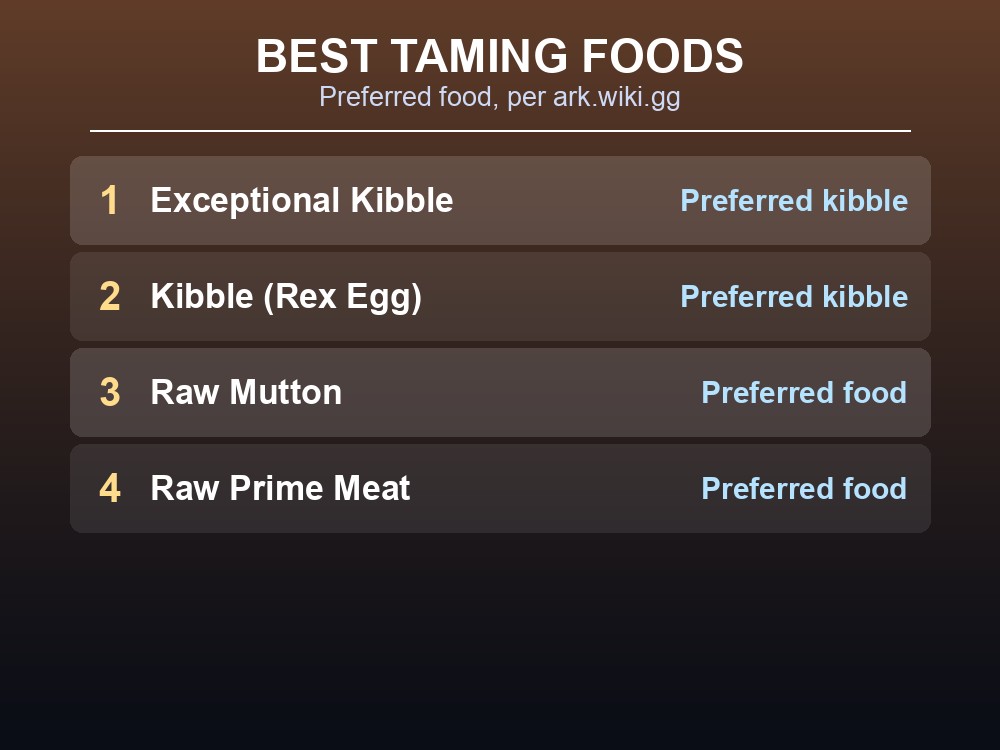
The domestication data names the Quetzal's preferred foods as Exceptional Kibble and, separately, an older-system Kibble (Rex Egg), with Raw Mutton and Raw Prime Meat listed as preferred non-kibble food. Exceptional Kibble is made from 1× Extra Large Egg, 5× Fiber, 1× Focal Chili, 10× Mejoberry, 1× Rare Flower, and 1× Water, per the wiki's ingredient list — that Rare Flower is a crafting input, not a direct food item, since Rare Flowers don't work as feed for this creature.
Because a wild Quetzal never lands, the page documents a family of named KO strategies rather than one single method: the 50/50 Glitch, Hit and Run, 1-Player and 2-Player Tapejara Strategy, Argentavis Solo Tame, Griffin Solo Tame, Wyvern Solo Tame, Parachuting, the Argentavis & Scorpion/Pachy/Titanoboa Strategy, and the Quetzal Cage Strategy — the last of which the page notes is "quite easy" once you already own one tamed Quetzal, since it can box in a second. The 50/50 Glitch is worth knowing specifically: it's a documented bug where "any startled Quetzal... travel[s] to coordinates 50, 50 on any map," which the wiki warns can drop a knocked-out Quetzal into a dangerous predator zone depending on the map.
Level 1 Taming Food Table: Quantity and Time
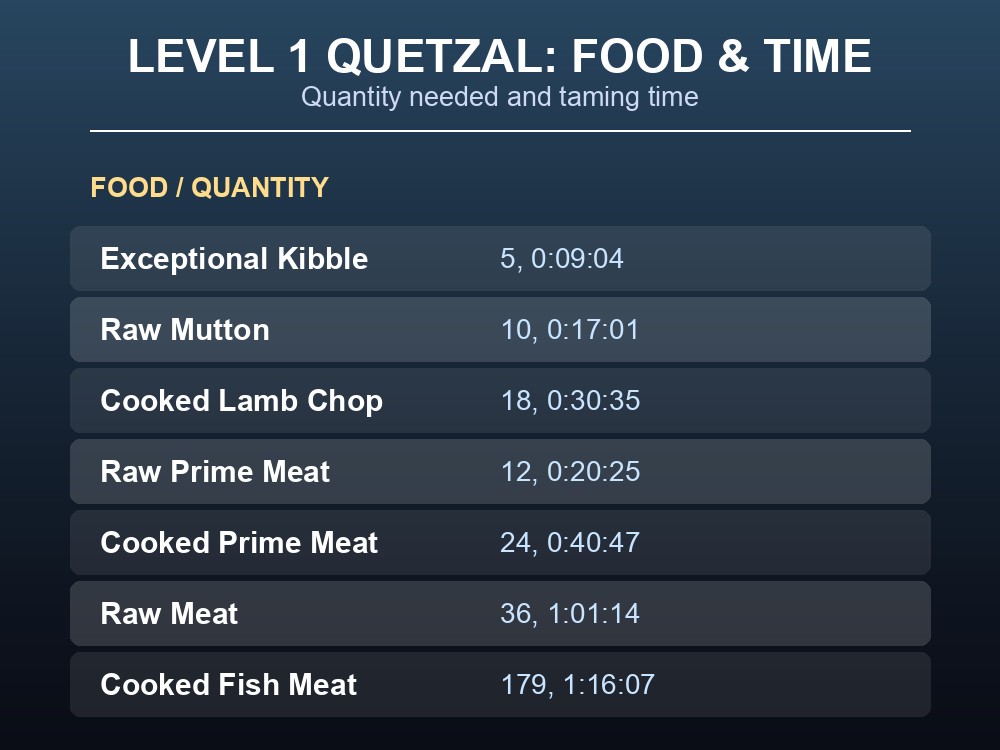
For a Level 1 Quetzal, the wiki's taming table lists how much of each food is needed and how long the tame takes at 100% effectiveness: Exceptional Kibble — 5, in 0:09:04; Raw Mutton — 10, in 0:17:01; Cooked Lamb Chop — 18, in 0:30:35; Raw Prime Meat — 12, in 0:20:25; Cooked Prime Meat — 24, in 0:40:47; Raw Prime Fish Meat — 30, in 0:25:31; Raw Meat — 36, in 1:01:14; Cooked Prime Fish Meat — 60, in 0:52:26; Cooked Meat — 72, in 1:01:14; Raw Fish Meat — 90, in 1:16:32; Cooked Fish Meat — 179, in 1:16:07.
Doing the arithmetic: Raw Mutton needs exactly double the kibble quantity (10 ÷ 5 = 2), and Cooked Fish Meat needs almost 36 times as much as kibble (179 ÷ 5 ≈ 35.8) for the same tame — why kibble tops the preferred-food list above. The same entry lists a torpidity-depletion rate of 3.4/s, with "time until all torpidity is depleted" given as 00:09:04. The source also lists six KO shot-count figures per level (1 through 150), but the extracted text didn't carry the weapon labels attached, so this guide doesn't attribute them to specific tranq weapons — treat that breakdown as undocumented rather than guessed.
Saddle Levels, Base Stats, and Breeding
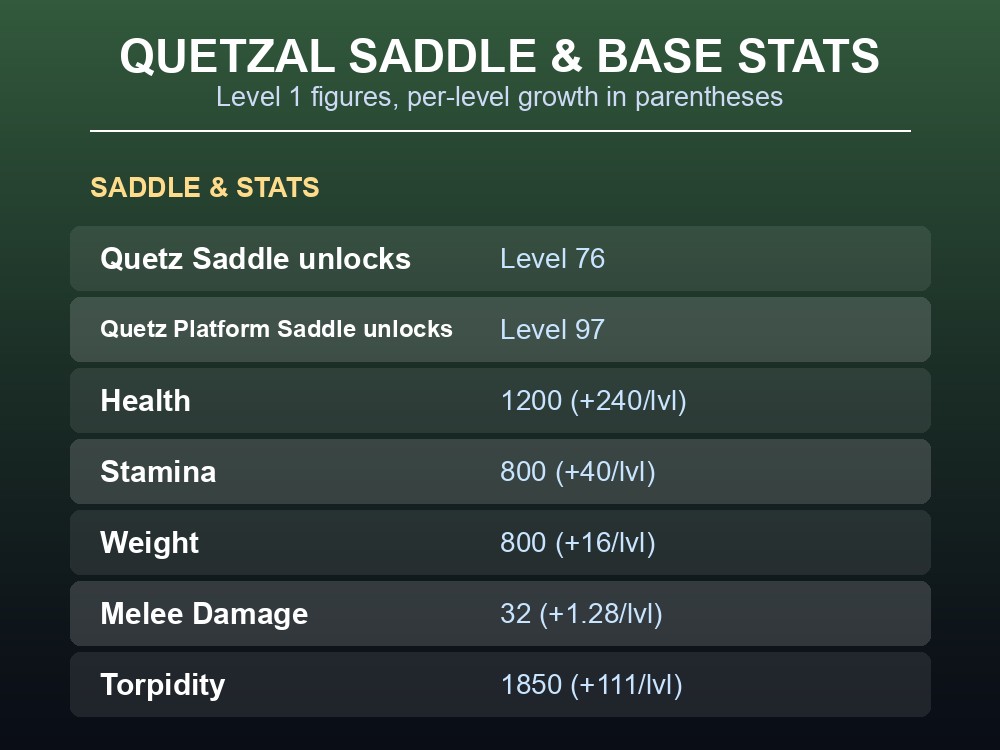
Per the domestication data, the Quetz Saddle unlocks at Level 76, and the Quetz Platform Saddle unlocks at Level 97 — the platform saddle is the one that turns a tamed Quetzal into a mobile base. Base stats at Level 1: Health 1200 (+240/level), Stamina 800 (+40/level), Oxygen 150 (+15/level), Food 1200 (+120/level), Weight 800 (+16/level), Melee Damage 32 (+1.28/level), and Torpidity 1850 (+111/level).
Breeding figures: Incubation Time 16h 39m 55.199s, Baby Time 13h 13m 39.048s, Juvenile Time 2d 4h 54m 36.19s, Adolescent Time 2d 18h 8m 15.238s, for a Total Maturation Time of 5d 12h 16m 30.476s, with a Breeding Interval of 18h–2d. Eggs need 5–6°C / 41–43°F (an Egg Incubator holds 6°C / 43°F). Named variants: Tek Quetzal (tameable, spawns at 5% rate, 20% higher level than standard), R-Quetzal (tameable, +5% melee damage / −3% health, level cap 500 on official servers), and the Malfunctioned Tek Quetzal and Skeletal Quetzal (both not tameable) — plus a note that "the Quetzal will receive a TLC in ARK: Survival Ascended sometime in 2026," so expect these figures to shift once that update lands.
Don't knock it out over water — a downed Quetzal can drown. Rare Flowers won't work as direct food, even though one is a kibble ingredient. Watch for the 50/50 Glitch dropping your target into a dangerous zone on maps like The Island. And if you already have one tamed Quetzal, the wiki calls the Quetzal Cage Strategy the easy route for your second.
Running your own ARK server
Chasing a fleeing Quetzal across the map with a Griffin or a pair of Tapejaras, then protecting it unconscious while you feed it Exceptional Kibble, doesn't survive a host disconnecting mid-tame. A private ARK server keeps your trap, your stockpiled kibble ingredients, and your knocked-out Quetzal exactly where you left them, with no risk of the 50/50 Glitch relocating your target right as a random server wipes your progress. It also makes multi-person methods like the 2-Player Tapejara Strategy easier to coordinate, since your tribe controls the schedule.
Conclusion
Taming a Quetzal in ARK comes down to what ark.wiki.gg documents: it's a knockout tame that never lands on its own, so pick one of the wiki's named strategies (Tapejara, Argentavis, Griffin, Wyvern, or Parachuting) to keep up with it; feed it Exceptional Kibble or Raw Mutton once it's down — 5 kibble versus 10 mutton for a Level 1 tame; watch for the 50/50 Glitch; and have a Quetz Saddle ready by Level 76, or the Platform Saddle by Level 97 for the flying-base build. What the source didn't spell out — Torpidity decay while unconscious, and the weapon-by-weapon breakdown behind its six KO shot-count figures — isn't guessed at here.
Ready to tame your own Quetzal without losing the tame to a random server restart? Spin up your own ARK server and get taming. Use promo code WELCOME for your first month free.