
How to Tame a Magmasaur in ARK
Magmasaurs are ARK's lava-dwelling mobile forge — a creature ark.wiki.gg says can "harvest large amounts of Metal and passively smelt it as well to transform Raw Meat into Cooked Meat in its inventory." But you can't walk up and knock one out: the wiki is explicit that adult Magmasaurs cannot be tamed at all — the only documented way to own one is to steal a wild egg or hatch one from a bred pair. This guide follows ark.wiki.gg's Magmasaur page point by point: how the "tameable" rule works, where eggs come from, the incubation and growth-stage timers, what a baby eats, and the stats and saddle level you're raising one toward. Anywhere the source doesn't give a number, this guide says so instead of guessing.
Why Magmasaurs Can't Be Tamed the Normal Way
ark.wiki.gg's own Domestication table spells it out: Tameable — No. Rideable — Yes. Breedable — Yes. The infobox's tameable comment is even more direct: "Adults cannot be tamed, but Wild Eggs can be hatched." There's no knockout method and no passive-feed method for an adult Magmasaur — full stop.
That leaves two documented paths. First, steal a wild egg from a nest and hatch it. Second, if you already own two tamed Magmasaurs, the wiki notes they "can only breed in lava" — specifically, you need to "have two tamed Magmasaur breed in a lava puddle at the Volcano Biome Simulation to produce an egg." That second route depends on already owning a tamed pair, so for a first Magmasaur, egg theft is the only documented starting point.
Magmasaurs sit in the Reptiles group, with an Omnivore diet and Territorial temperament, and the page lists them as present via the Genesis: Part 1, Genesis: Part 2, Lost Island, and Fjordur DLCs. The habitat field is simply listed as "Map" — the page gives no exact spawn coordinates or per-map rarity split, so this guide doesn't invent a location beyond "the volcano biome," where the page repeatedly places them.
Stealing (or Hatching) a Magmasaur Egg
Magmasaur eggs are only found in Magmasaur nests, which the page places "in and around any source of lava in the volcano biome," noting Magmasaurs "can also be found in very large numbers around their egg spawns inside the volcano." The wiki's recommended theft method is specific enough to quote directly: "use a Cactus Broth and ghillie armor to avoid getting detected, and then use Grappling Hooks, and a glider suit skin to fly around until you find a good egg. Prepare a teleportation and grab the egg at the last second to avoid getting hit."
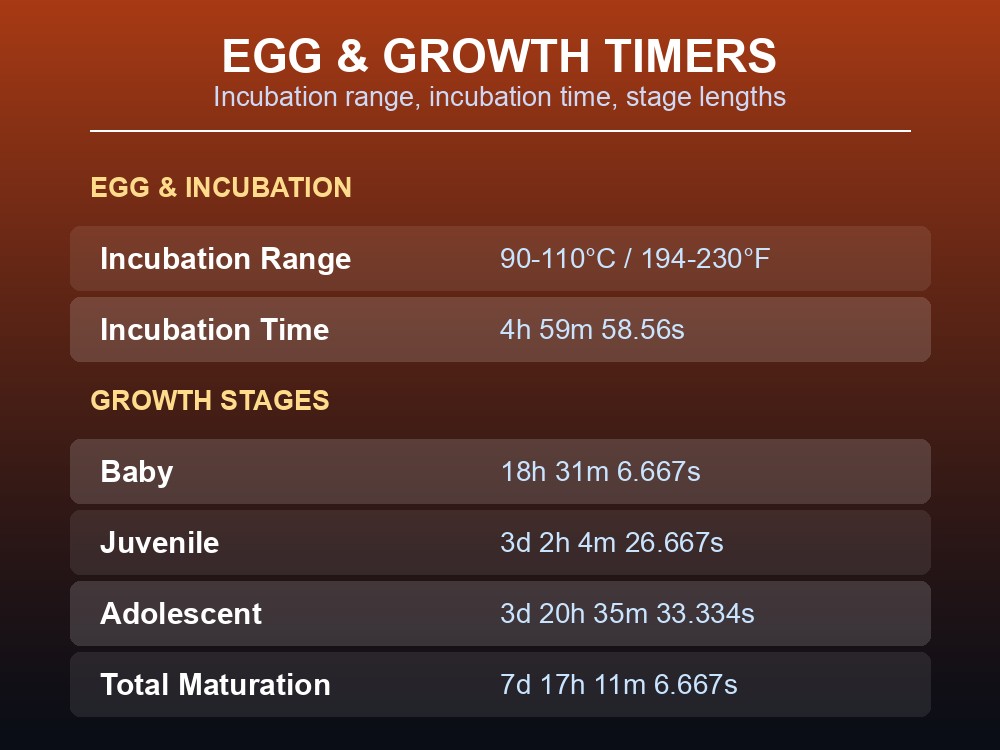
The infobox gives exact incubation numbers: the egg needs 90–110°C (194–230°F) — an Egg Incubator set to 100°C (212°F) sits right in that range — for 4 hours, 59 minutes, 58.56 seconds, just under five hours (the page's own prose rounds this to "a five hour incubation period"). One more ceiling worth knowing before you commit: the Magmasaur Egg has a maximum level of 150, per the page's Notes/Trivia section.
Raising the Baby Magmasaur
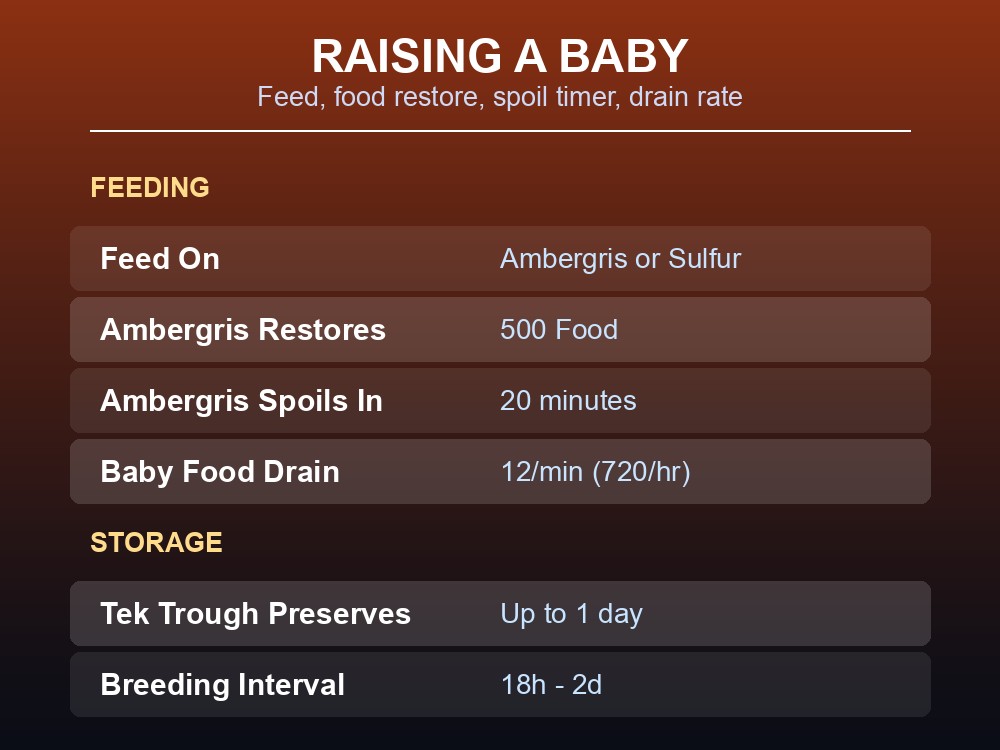
A baby Magmasaur eats a narrower diet than the adult: the page states babies "require Ambergris or Sulfur to feed off until adulthood." Ambergris restores 500 food per feeding but has a tight 20-minute spoil timer once out of cold storage. The wiki recommends a Tek Trough specifically because it "can preserve the Ambergris up to, at most, one day" — useful across the Juvenile and Adolescent stages when you're not watching the baby constantly.
Babies burn through food fast: the drain rate is 12 Food per minute, which checks against the page's own hourly figure — 12 × 60 = 720 Food per hour, exactly as stated. Consumption is documented as dropping at Juvenile and Adolescent, though the page gives no exact per-hour figures for those stages, so this guide doesn't estimate one.
Growth-stage timers, hatch to adult: Baby — 18h 31m 6.667s. Juvenile — 3d 2h 4m 26.667s. Adolescent — 3d 20h 35m 33.334s. Adding those three comes to 7d 17h 11m 6.667s, matching the page's own Total Maturation Time of 7d 17h 11m 6.667s almost exactly (the tiny gap is rounding). Once grown and tamed, the Breeding Interval for another egg is 18 hours to 2 days.
Magmasaur Stats, Abilities, and Saddle
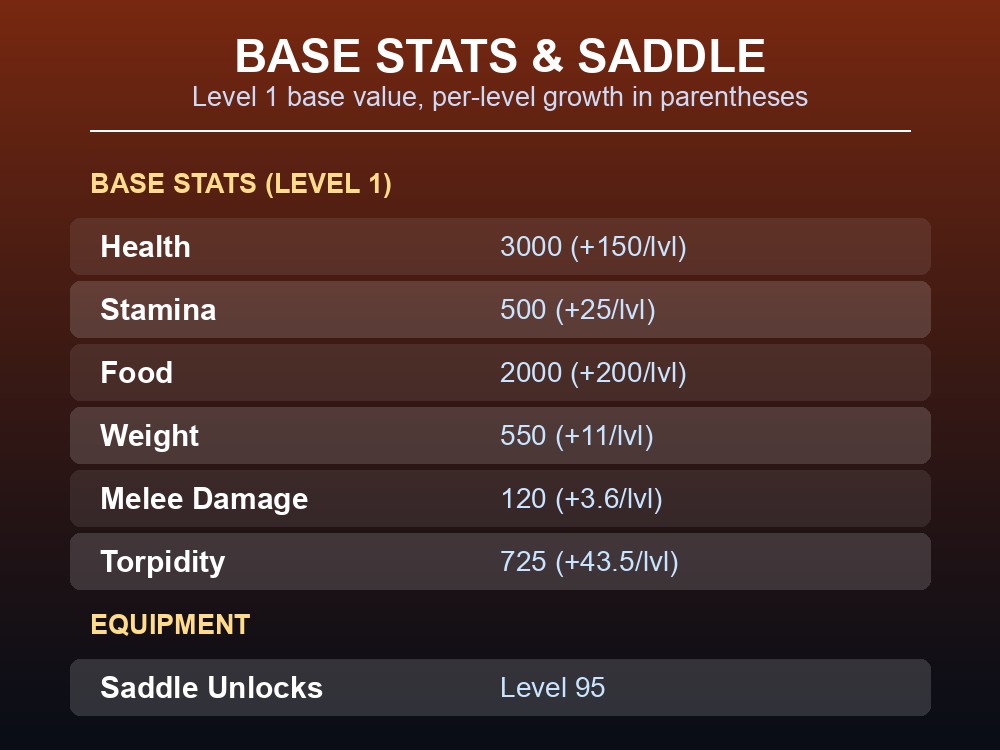
At Level 1, the wiki's Base Stats table lists: Health 3000 (+150/level), Stamina 500 (+25/level), Oxygen 200 (+20/level), Food 2000 (+200/level), Weight 550 (+11/level), Melee Damage 120 (+3.6/level), and Torpidity 725 (+43.5/level). The table also lists percentage "Taming Bonus" columns — but since a Magmasaur is never knocked out and hand-fed like a normal tame, the page doesn't explain how those bonuses apply to one raised from an egg, so this guide leaves that column out rather than guess.
The Magmasaur Saddle sits under Equipment and unlocks at Level 95. Its signature ability, "Live Furnace," is a Melting mode that turns its inventory into an upgraded Campfire-and-Forge combo, "only taking ~5 seconds to cook/refine the objects inside at the cost of ~100 Food per second." It only processes Metal, Gasoline, and any kind of Meat — Wood, Scrap Metal, and Chibi-Pets are excluded. It also cuts carried weight of Metal and Metal Ingot by 75% and Ambergris by 50%.
In combat terms, Bite/Claw deals 120 damage and can harvest Metal and Stone; a charged Searing Spit Launch deals 360 damage at 100% charge and consumes 1 Metal Ingot per shot. Both the Magmasaur and its rider are documented as immune to lava and fire damage, with the rider also protected from "physical damage like proyectiles [sic] and explosions while mounted."
Going after a wild egg: Cactus Broth plus ghillie armor to avoid detection, Grappling Hooks and a glider suit skin to move around the nest, and a set teleport ready so you can grab the egg and go. Keep Ambergris in a Tek Trough rather than a regular fridge — it buys the source's full one-day window instead of the 20-minute spoil timer. Wild Magmasaurs are documented as "weak when exposed to cold temperatures, more so when in water," and the page lists Chain Bola and Large Bear Trap as effective ways to immobilize one if a theft goes loud. Drops from a kill are Raw Meat, Raw Prime Meat, and Sulfur.
Running your own ARK server
Raising a Magmasaur is a multi-day commitment before adulthood — 7 days and 17-plus hours of Baby, Juvenile, and Adolescent growth on top of the incubation, all dependent on a Tek Trough staying powered and stocked with Ambergris. A dedicated ARK server keeps that timer running and your trough fed on your schedule, not whenever a shared host is up — and if the plan is breeding a second Magmasaur in lava at the Volcano Biome Simulation, that world needs to still be there days later with your first tame intact.
Spin up your own ARK server and keep that incubator running without losing progress to a random restart. Use promo code WELCOME for your first month free.
Conclusion
Raising a Magmasaur in ARK comes down to what ark.wiki.gg documents: adults can't be knocked out or passively fed, so you steal an egg (or breed an existing pair in lava) and incubate it at 90–110°C for just under five hours. From there it's roughly 7 days and 17 hours of Ambergris-or-Sulfur feeding through Baby, Juvenile, and Adolescent before you're riding one with a Level 95 saddle. Exact per-map nest locations, the meaning of the taming-bonus percentages for an egg-raised creature, and post-baby food drain rates aren't in the source and aren't guessed at here.