
How to Tame a Diplodocus in ARK

The Diplodocus is one of the least dangerous tames on the map for a simple reason: per ark.wiki.gg, its "attacks" are purely a knockback nudge that "does no direct damage." That harmlessness is also why the wiki calls it "the only dinosaur that can be tamed by both passive and knockout methods" — you can walk up and feed it directly, or knock it out the traditional way, and either works. This guide walks through both routes exactly as the wiki documents them: taming method, preferred food, Regular Kibble quantities and times by level, and the saddle/stats/breeding numbers you'll want once it's yours. Anywhere the source doesn't give a figure, that's stated plainly instead of guessed.
Knockout or Passive: Pick Your Method
The in-game dossier sums up the appeal directly: "It's not aggressive, it's trying to cuddle you. Feed it and it will be your friend," as the quote from Jen on the wiki's Diplodocus page puts it. Mechanically, the wiki's KO Strategy section explains why passive taming is so low-risk here: if the Diplodocus notices you, "it will try to push you away, which deals no direct damage (indirectly: fall damage or being pushed into hostile creatures)." The only real hazard is the knockback itself — getting shoved off a cliff or into something that can hurt you.
To avoid the nudging entirely, the wiki notes you can stand "near its front legs at the base of its neck or under its belly" and stay out of range, or use a Ghillie Suit to lower the chance it notices you at all, or a grappling hook to stop the knockback at a fixed distance. The source calls this "most likely the easiest of all passive tames."
Passive and knockout taming pull from different tables, and the trade-off shows in the numbers. At Level 1, the wiki's Knock-Out Tame Method table lists 8 Regular Kibble for a 0:05:07 total feeding time, while the separate Passive Tame table lists just 3 Regular Kibble across a 01:55 feeding interval, for a total time of 0:03:51 — passive taming needs less than half the kibble (3 vs. 8) and finishes faster, but it does require staying near an active, wandering dinosaur the whole time rather than a knocked-out one. The wiki's Knock-Out method table also lists raw "KO" multiplier figures (for example, ×300, ×123, ×34 at Level 1) alongside each food option, but doesn't label which weapon or tool each multiplier corresponds to — so this guide doesn't guess at that mapping.
Preferred Food and Kibble
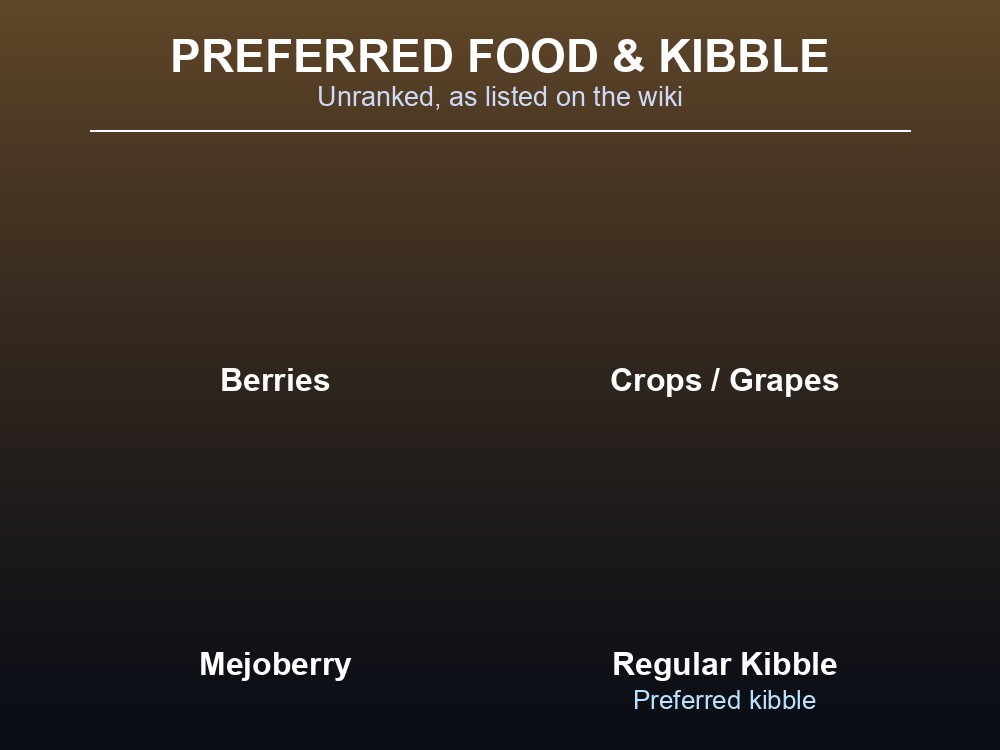
The wiki's Preferred Food list for Diplodocus is: Berries, Crops, Mejoberry, and Regular Kibble. That's presented as a plain list on the source page, not a ranked or fastest-to-slowest order, so this guide doesn't impose one either. Separately, the page also calls out Grapes specifically under its own "Preferred Food" line.
For kibble specifically, the wiki lists Regular Kibble as the preferred kibble, with Kibble (Lystrosaurus Egg) also accepted. Regular Kibble's own recipe, quoted directly from the page: "1 × Cooked Meat Jerky, 1 × Medium Egg, 5 × Fiber, 2 × Longrass, 2 × Savoroot, 1 × Water."
Regular Kibble Taming Times by Level (1–150)
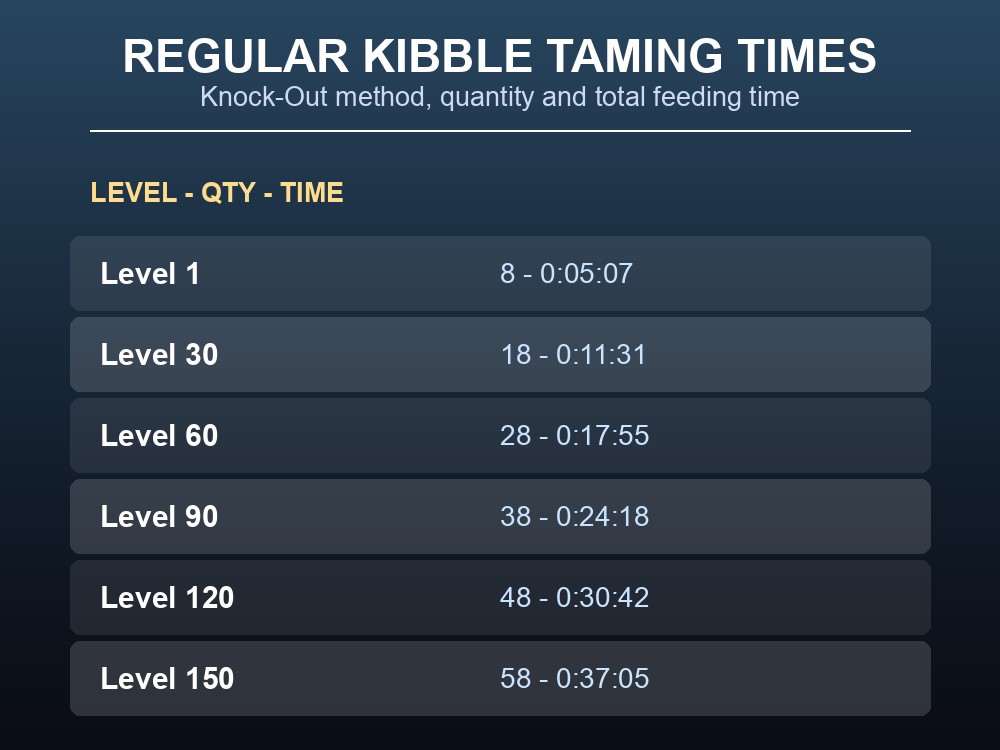
The Knock-Out Tame Method table gives Regular Kibble quantities and total feeding time at six levels only — 1, 30, 60, 90, 120, and 150:
- Level 1: 8 kibble, 0:05:07
- Level 30: 18 kibble, 0:11:31
- Level 60: 28 kibble, 0:17:55
- Level 90: 38 kibble, 0:24:18
- Level 120: 48 kibble, 0:30:42
- Level 150: 58 kibble, 0:37:05
The quantity climbs in a clean +10 step every time: 18 − 8 = 10, 28 − 18 = 10, 38 − 28 = 10, 48 − 38 = 10, 58 − 48 = 10. Time rises by roughly the same amount each step too — 0:11:31 − 0:05:07 = 0:06:24, and every later gap (0:17:55 − 0:11:31, 0:24:18 − 0:17:55, and so on) lands within a few seconds of that same 6-minute-24-second increment. No figures are given for levels in between, so none are stated here.
Saddle Level, Base Stats, and Breeding Timeline
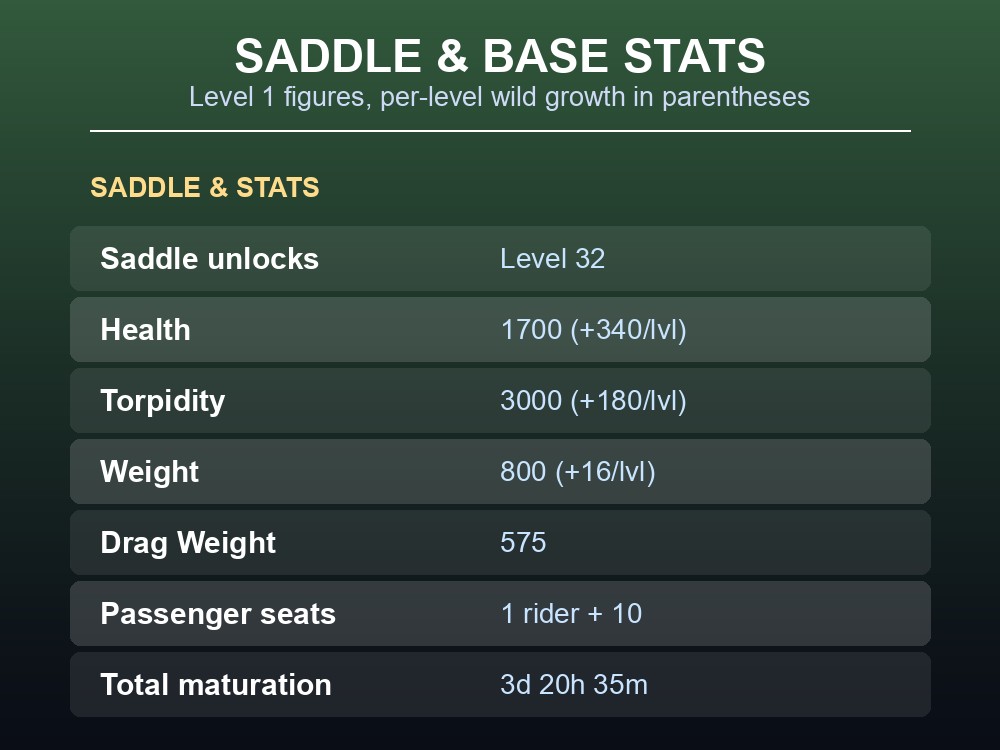
The Diplodocus Saddle unlocks at Level 32. Base Level 1 stats from the wiki's stat table, with the wild per-level increase in parentheses: Health 1700 (+340/lvl), Stamina 550 (+55/lvl), Oxygen 300 (+30/lvl), Food 10000 (+1000/lvl), Weight 800 (+16/lvl), and Torpidity 3000 (+180/lvl). Melee Damage's base value is 0, and the table lists +0 per wild level — the wiki explains this directly: that column is "greater than zero because it is also — or in this case only — used for the knock back impulse," meaning the Diplodocus deals no real damage at any level. The source's stat table also lists two additional taming-bonus percentages against Melee Damage (7% and 17.6%) without labeling which is additive versus multiplicative, so this guide states the base value only rather than guess at that breakdown. Drag Weight is listed at 575.
For seating, the wiki states the "Diplodocus Saddle has 1 rider and 10 passenger seats" — 1 rider plus 10 passengers is 11 seats total (1 + 10 = 11), matching the page's own description that the saddle "can be used to transport up to eleven passengers at a the same time."
Breeding and growth times, quoted with their full day component intact: Incubation Time 4h 59m 58s, Baby Time 9h 15m 33s, Juvenile Time 1d 13h 2m 13s, Adolescent Time 1d 22h 17m 47s, and Total Maturation Time 3d 20h 35m 33s. Breeding Interval is listed as 18h – 2d.
Stand under its belly or behind its front legs and it can't hit you while you tame it. Bring more food than the table says you need — the wiki's own note on the taming tables is blunt about it: "the values are for optimal cases, always bring extra supplies!" And plan your taming spot carefully: per the wiki's trivia, the Diplodocus "is not able to be transported by Raft or Platform Saddle," so tame it close to where you actually need it, or have a Cryopod ready.
Running your own ARK server
A Diplodocus tame is a patient job — five to thirty-seven minutes of feeding depending on level, plus a multi-day breeding timeline if you're raising one from an egg — and none of that survives well on a host's session timer or a crowded public server where a wild predator can wander into your open taming pen. A private ARK server keeps your Diplodocus, its saddle, and its kibble stockpile exactly where you left them, with no random restarts cutting a feeding cycle short. Set one up and get taming on your own schedule — use promo code WELCOME for your first month free.
Conclusion
Taming a Diplodocus in ARK comes down to what the wiki actually documents: it's the only dinosaur tameable by both knockout and passive methods, it deals no direct damage so the real risk is knockback fall damage, and Regular Kibble scales from 8 pieces at Level 1 up to 58 at Level 150 in clean +10 steps. Saddle up at Level 32, expect a multi-day breeding timeline if you're raising one from an egg, and bring more food than the minimum — the source says so itself.