
How to Tame a Deinonychus in ARK

The Deinonychus — ARK's feathered "Terrible Claw," nicknamed the Fluffy Raptor, introduced on the Valguero map — isn't tamed the way most carnivores are. Per ark.wiki.gg's own infobox, an adult Deinonychus is flatly untameable: "Adults cannot be tamed, but Wild Eggs can be hatched." The only path to owning one is stealing a fertilized egg from a wild nest and raising it yourself. This guide follows the wiki's taming page step by step: why adults are off the table, how to actually pull an egg off a guarded nest, what the incubation and growth timers look like, and the stats and equipment your hatchling grows into. Anywhere the source page doesn't give a number, this guide says so instead of guessing.
Why You Can't Tame an Adult Deinonychus
The wiki's Domestication table lists the Deinonychus as Tameable: No, Rideable: Yes, Breedable: Yes, with the explicit note: "Adults cannot be tamed, but Wild Eggs can be hatched." Its own in-game Dossier, credited to survivor Helena Walker, spells out why in the "Domesticated" entry: "Unless raised from eggs, they cannot be tamed; the hunter instinct of a wild Deinonychus is so strong that it reflexively pounces on a would-be master." The same dossier entry warns that raising one is not risk-free either: "The Deinonychus is also fiercely territorial near nests with eggs, even if the eggs aren't its own. This makes breeding successive generations a hazardous process." Per the infobox, the species spawns on the Valguero, Genesis: Part 2, and Fjordur maps.
Stealing a Deinonychus Egg
The wiki's Reproduction field lists two egg types that can spawn in a nest: Raptor Egg and Deinonychus Egg. For where to look, the page calls out one spot by name: "perhaps the most reliable place to find and farm eggs is the small canyon region in the White Cliffs called The Paradise, which is located in the flat plains area of the cliffs, near to The Lake region." The taming section notes a useful quirk: Deinonychus "are not initially aggressive to large-class predators such as Rexes or Spinos, and these tames may be walked directly up to the nests without conflict until an egg is stolen, making them excellent options for egg theft."
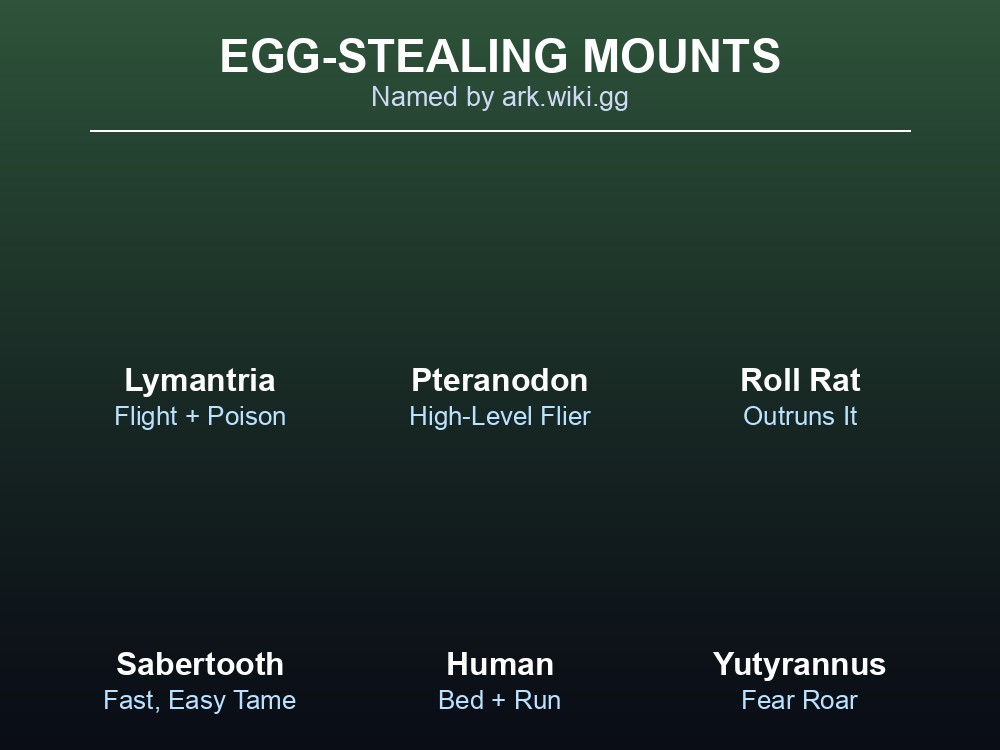
For the actual grab, the wiki names six specific options: a Lymantria ("very recommended, with its ability to fly and poison you can run away easily," easy to tame near The Paradise, saddle requires only level 35); a high-level Pteranodon, recommended for its flight so you can grab the egg and leave, or lure the pack off a cliff; a saddled Roll Rat, which "can easily outrun" a Deinonychus; a fast Sabertooth, easy to tame with a spawn area close to the Chalk Hills; a Human on foot, using a Sleeping Bag or Bed near the nest to steal the egg, run, and respawn on death to recover your gear; and a Yutyrannus, which counts as a large carnivore (so it won't aggro the pack) and whose fear roar can be used to scatter Deinonychus after you grab an egg.
Incubating and Raising the Hatchling
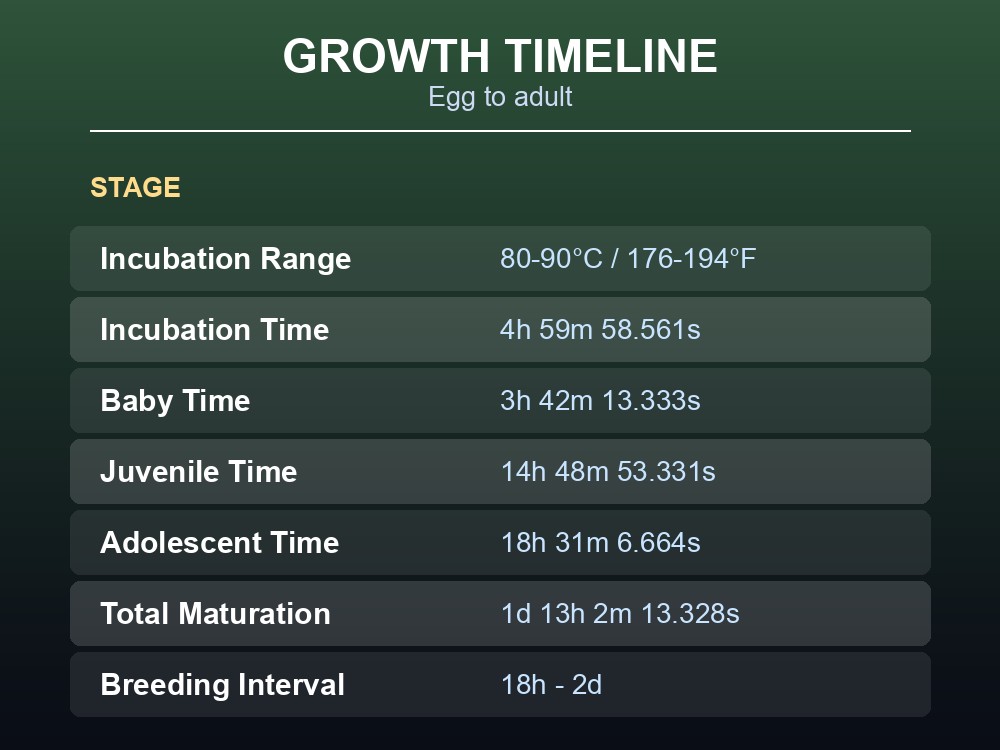
Once you have the egg, the wiki's incubation table sets the target range at 80–90 °C (176–194 °F), with an Egg Incubator holding a steady 85 °C (185 °F). The taming text adds that the range "can be reached through the use of various fires (14 Campfires for example), Air Conditioners, or a Dimetrodon." The stat table gives an Incubation Time of 4h 59m 58.561s.
From there the wiki's maturation table lays out the full growth timeline: Baby Time 3h 42m 13.333s, Juvenile Time 14h 48m 53.331s, Adolescent Time 18h 31m 6.664s, for a Total Maturation Time of 1d 13h 2m 13.328s — just over a day and a half from hatch to fully grown. Breeding Interval between successive clutches is listed as 18h – 2d. On feeding, the source is specific: hatchlings "do not require any special food source, and can be fed a standard carnivore diet straight out of the egg." The page also confirms tamed pairs can be bred for successive generations, with mutations possible for higher stats.
Base Stats and Equipment
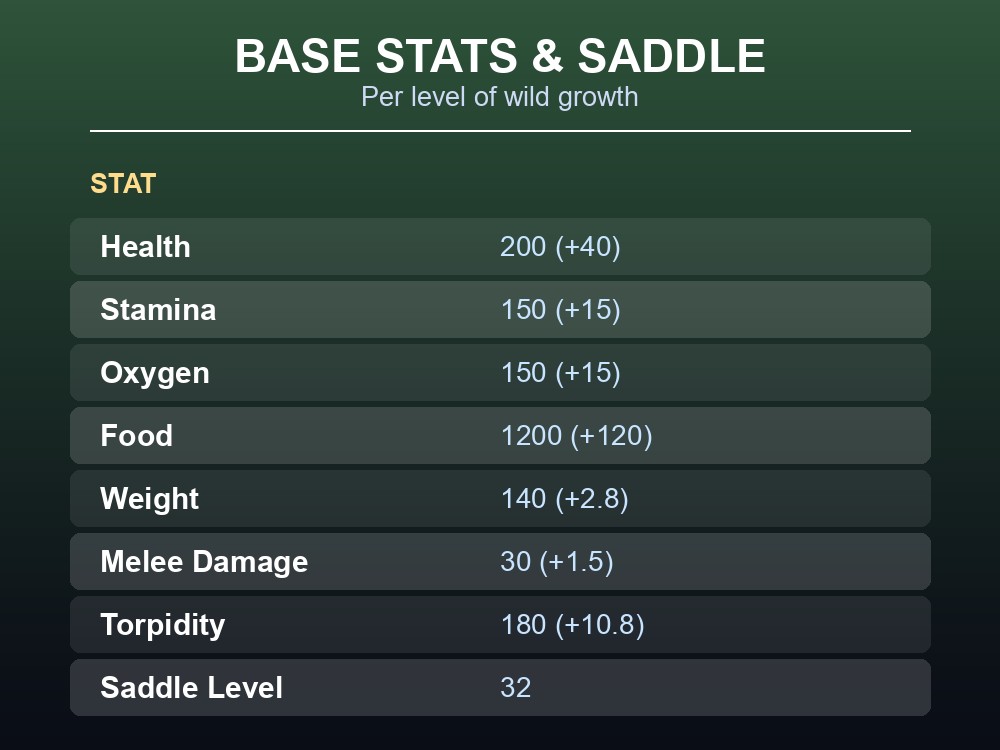
The wiki's Base Stats and Growth table lists, per level of wild growth: Health 200 (+40), Stamina 150 (+15), Oxygen 150 (+15), Food 1200 (+120), Weight 140 (+2.8), Melee Damage 30 (+1.5), and Torpidity 180 (+10.8). Doing the arithmetic for a wild Level 30 Deinonychus's Health specifically — base plus 29 level-ups of +40 each — gives 200 + (40 × 29) = 200 + 1160 = 1360 Health. That's the wild growth curve only; the source page doesn't break stats out per individual level beyond that formula, so this guide doesn't invent figures for any level it wasn't given.
Equipment-wise, the Deinonychus Saddle unlocks at Level 32, and Rider Weaponry is listed as Yes. A few more data points from the wiki's Data table: 12 XP for a kill, a 30% Special Loot Chance, a Drag Weight of 85, a Small feces size, and Torpor Immune / Radiation Immune both listed as No. A unique cosmetic, the Deinonychus Ghost Costume, is also documented.
If a Deinonychus pack notices the theft, the wiki warns it "can pounce riders, which can pose a great threat as it gives time for the rest of the pack to arrive" — grab the egg and move immediately, don't linger. The page also lists what can immobilize a Deinonychus if things go sideways (Bear Trap, Bola, Large Bear Trap, Plant Species Y Trap, Net Projectile) and what it's able to damage while raiding a base (Thatch, Greenhouse, Wood) — worth knowing before you build a nest-side outpost.
Running your own ARK server
Raising a Deinonychus from a stolen egg is a multi-hour commitment — incubating at the right temperature, then feeding through Baby, Juvenile, and Adolescent stages over a day and a half — and that's a lot easier on a dedicated world that keeps running whether or not you're logged in. A private ARK server keeps your incubator, your stockpiled meat, and your growing hatchling exactly where you left them, with no risk of a public server wiping progress mid-grow. It also makes coordinating an egg-stealing run with friends — bringing a Lymantria for the grab and a Yutyrannus for cover — something you can schedule on your own time instead of hoping enough people are online at once.
Conclusion
Taming a Deinonychus in ARK really means raising one: adults are untameable, so the wiki's own process is steal a Raptor Egg or Deinonychus Egg from a nest (The Paradise on the White Cliffs is the most reliable spot named), incubate it at 80–90 °C, and feed it a standard carnivore diet through roughly a day and a half of growth to reach adulthood, with a saddle ready by Level 32. Everything past what's listed here — per-level stat breakdowns beyond the base growth formula, and exact damage/defense numbers for a nest raid — isn't in the source and isn't guessed at in this guide.
Ready to raise your own Deinonychus without losing an egg-stealing run to a random server restart? Spin up your own ARK server and get taming. Use promo code WELCOME for your first month free.