
How to Tame a Basilosaurus in ARK
The Basilosaurus is one of the few ARK tames you never have to knock out. The wiki's infobox lists its temperament as Passive and its Taming Method as Passive, meaning you tame it by feeding it directly while it swims around you, not by dropping its torpor with tranq arrows or darts. That makes it mechanically closer to taming a herbivore than to a knockout apex predator — but the ocean around it is not safe. This guide sticks strictly to what ark.wiki.gg's Basilosaurus page documents: the passive-feed method, the preferred foods and how much of each you need, how that requirement scales by level, and the stats and saddle you get once it's tamed. Anywhere the page doesn't give a number, this guide says so instead of guessing.
Passive Taming: How It Works
The wiki states it plainly: "Basilosaurus are passively tamed and are docile, they won't fight back even when attacked." You open feeding and it eats directly — no torpidity bar, no unconscious window to manage. The infobox separately lists Torpor Immune: No, but the page never explains how (or whether) torpor factors into the passive-feed process itself, so this guide treats that field as a general combat stat, not part of the taming mechanic.
Feeding discipline matters more than combat prep. The wiki warns: "When not consistently fed, they will lose taming effectiveness very quickly. Towards the end of the process if there is a delay, you can be forced to start over, so Kibble and Prime Meat are preferred over raw meat." Exactly how fast "very quickly" is in seconds isn't quantified, so this guide doesn't put a number on it.
Location is documented, if not pinned to coordinates: Basilosaurus are "generally uncommon but found in great numbers around South Haven Island (Also known as Herbivore Island)." No exact coordinates are given.
The real danger is what feeding attracts. The wiki notes: "when it eats it creates a cloud of red around its mouth (presumably blood) which will attract other animals near it, including aggressive Megalodon and Manta." The strategy section recommends a fast mount like Ichthyosaurus to dart in, feed, and evade what swarms in response, and to "monitor your oxygen stat" throughout — SCUBA gear isn't required if your mount is fast enough, but it helps. With no speed-up items, the page suggests taming in the morning since the process can run long, and baiting predators away once feeding is nearly complete.
Best Food for Taming a Basilosaurus
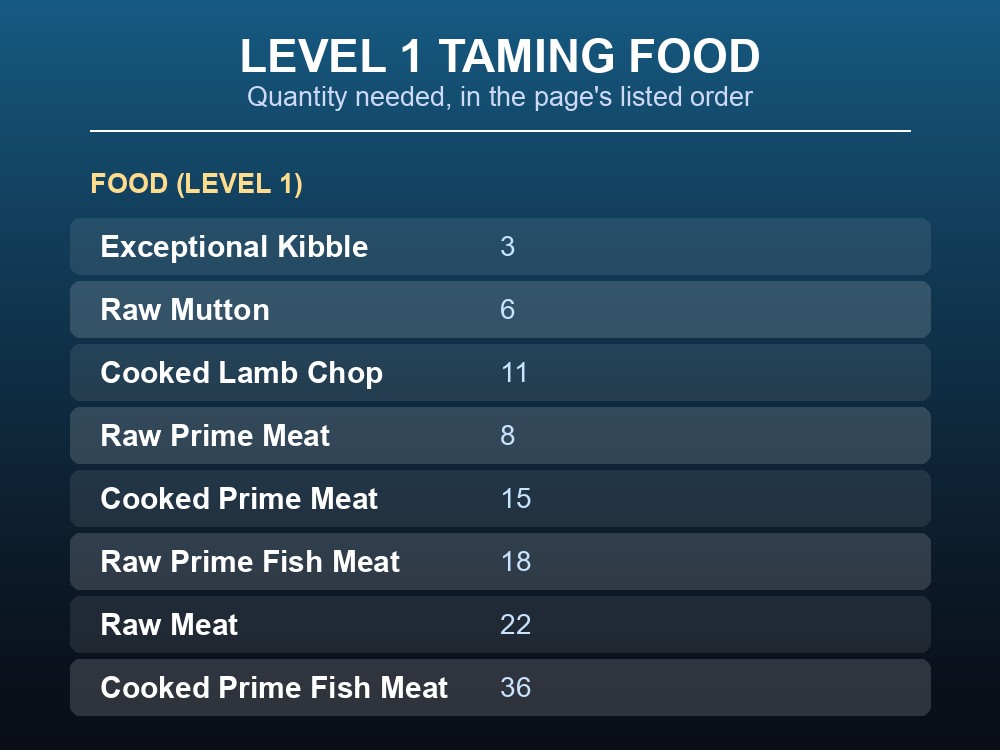
The infobox lists two preferred kibbles — Exceptional Kibble and Kibble (Therizino Egg) — plus two preferred non-kibble foods, Raw Mutton and Raw Prime Meat. The page doesn't explain why two kibble types are both marked preferred, so both are reported exactly as listed.
For a Level 1 Basilosaurus, the page's feeding table gives these quantities needed to fully tame it, in the order listed: Exceptional Kibble 3, Raw Mutton 6, Cooked Lamb Chop 11, Raw Prime Meat 8, Cooked Prime Meat 15, Raw Prime Fish Meat 18, Raw Meat 22, Cooked Prime Fish Meat 36, Cooked Meat 43, Raw Fish Meat 54, Cooked Fish Meat 108. Worth flagging with the arithmetic: the list order isn't a strict quantity ranking — Raw Prime Meat needs only 8, fewer than the Cooked Lamb Chop listed just before it at 11 — so read this as the page's own order, not a sorted "best to worst" ladder.
Exceptional Kibble itself is crafted from, per the page: "1 × Extra Large Egg, 5 × Fiber, 1 × Focal Chili, 10 × Mejoberry, 1 × Rare Flower, 1 × Water."
How Taming Food Needs Scale by Level
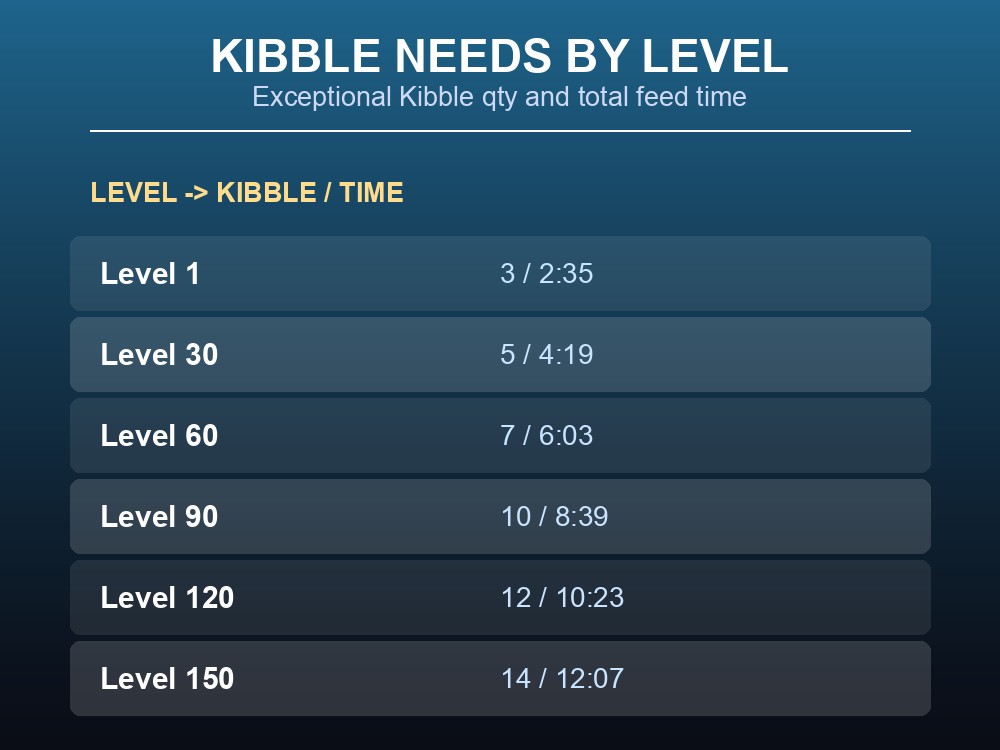
The wiki breaks the feeding table out separately for Levels 1, 30, 60, 90, 120, and 150. Tracking the Exceptional Kibble line across those tiers: Level 1 needs 3 kibble (total time 0:02:35), Level 30 needs 5 (0:04:19), Level 60 needs 7 (0:06:03), Level 90 needs 10 (0:08:39), Level 120 needs 12 (0:10:23), and Level 150 needs 14 (0:12:07).
Doing the arithmetic: a Level 150 Basilosaurus needs 14 ÷ 3 ≈ 4.67 times as much Exceptional Kibble as a Level 1 does. The total feeding-time figures track a nearly identical ratio — 155s versus 727s gives 727 ÷ 155 ≈ 4.69×. This guide only tracked the Exceptional Kibble progression in detail; the page documents the same level breakdown for the other foods too, but those per-level figures aren't reproduced here.
Base Stats and What You Get
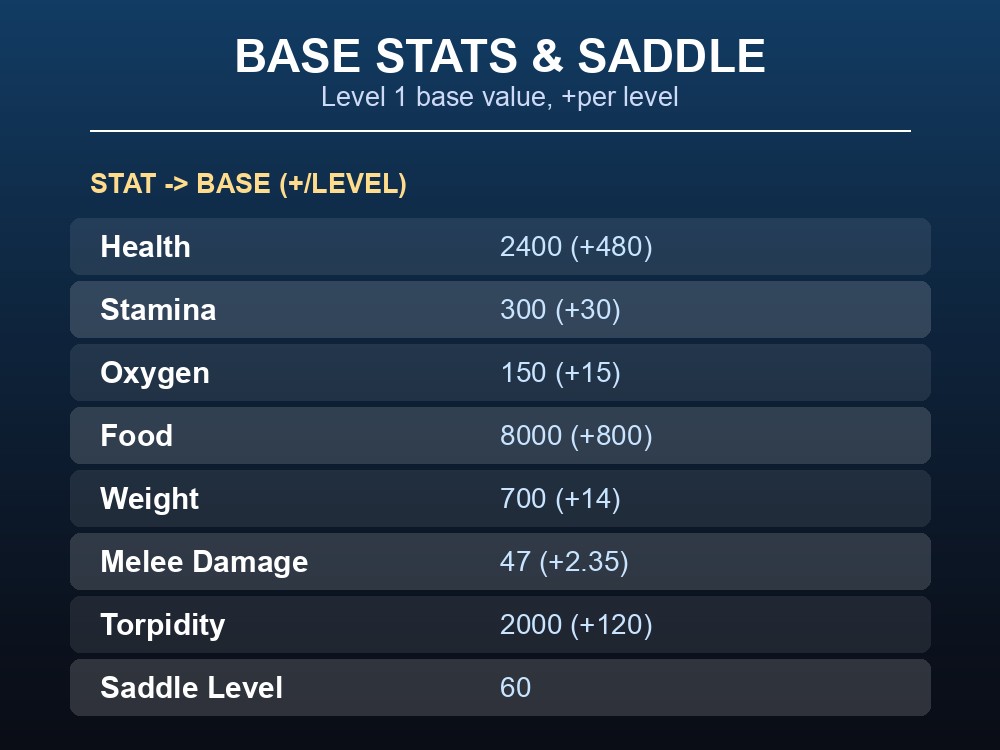
Base stats and per-level growth, per the wiki's stat table: Health 2400 (+480/level), Stamina 300 (+30/level), Oxygen 150 (+15/level), Food 8000 (+800/level), Weight 700 (+14/level), Melee Damage 47 (+2.35/level), and Torpidity 2000 (+120/level). Movement Speed is listed at 100% with no per-level increase ("N/A"). The page's own movement/speed table has several cells marked with unresolved "?" placeholders, so exact walking/swimming speeds are left undocumented rather than guessed.
The Basilosaurus Saddle unlocks at Level 60. Drag Weight is 12000, it's Rideable (Swimming) and Breedable, and killing a wild one yields 60 XP — the page doesn't separately document taming XP. Its guaranteed special drop is Basilosaurus Blubber, with a stated Special Loot Chance of 100%.
Passive abilities documented on the page: it's immune to electric attacks from Cnidaria and Electrophorus and can't be grabbed by Tusoteuthis; a rider gets an Insulation effect providing 562 Hypothermic and Hyperthermic insulation; it passively produces Oil in its inventory (capping around 20 Oil, per the Roles section); and it regenerates health faster near the surface while slowly losing health in deeper water. Its damage multiplier table lists Head: x1.5, and the page notes that on ARK: Survival Ascended specifically, "body multipliers also apply for player's melee attacks."
Feed it constantly once you've started — a lapse near the end can force a restart. Ride something fast like an Ichthyosaurus to dodge what the blood cloud attracts, keep an eye on your oxygen, stay near the surface where it regenerates fastest, and tame in the morning if you have no speed-boosting kibble on hand. Once tamed, lead it toward a beach or shallow water rather than lingering in the deep.
Running your own ARK server
Passive taming still means minutes of continuous feeding while Megalodons and Manta swarms circle — a random public server restart or another tribe pulling aggro mid-feed can undo the whole attempt. A private ARK server keeps South Haven Island exactly as you left it, your Exceptional Kibble stockpile safe nearby, and your half-tamed Basilosaurus right where you're feeding it, with no outside griefing risk mid-tame.
Ready to tame your own ocean tank without racing someone else's server session? Spin up your own ARK server and get taming. Use promo code WELCOME for your first month free.
Conclusion
Taming a Basilosaurus in ARK comes down to what the wiki documents: it's a passive, direct-feed tame (no knockout needed), Exceptional Kibble and Kibble (Therizino Egg) are its preferred kibbles alongside Raw Mutton and Raw Prime Meat, a Level 1 needs just 3 Exceptional Kibble versus roughly 4.7× that at Level 150, and the saddle unlocks at Level 60. What isn't in the source — exact taming-effectiveness decay speed, tame XP, precise swim speeds, and per-level quantities for foods other than Exceptional Kibble — is left undocumented here rather than guessed.