
How to Survive Blood Moon Horde Night in 7 Days to Die
The wiki doesn't undersell it: "The Blood Moon Horde is a major recurring event in 7 Days to Die," and "a large number of zombies will aggressively seek out the player, making it one of the most challenging and crucial aspects of survival in the game." What makes the night dangerous isn't just the numbers — it's that the horde's zombies "know exactly where all players are regardless of how quiet the players are, how many walls they hide behind, or how deep underground they go," and they'll "break down obstacles, climb, or dig as they are able" to reach you. Surviving it comes down to three things: the warning timeline, how a wave actually ends, and which setting is capping how many zombies you fight at once. (The wiki's page infobox carries no additional structured values beyond the article text — undocumented.)
Read the Warning Signs Before 22:00 Hits
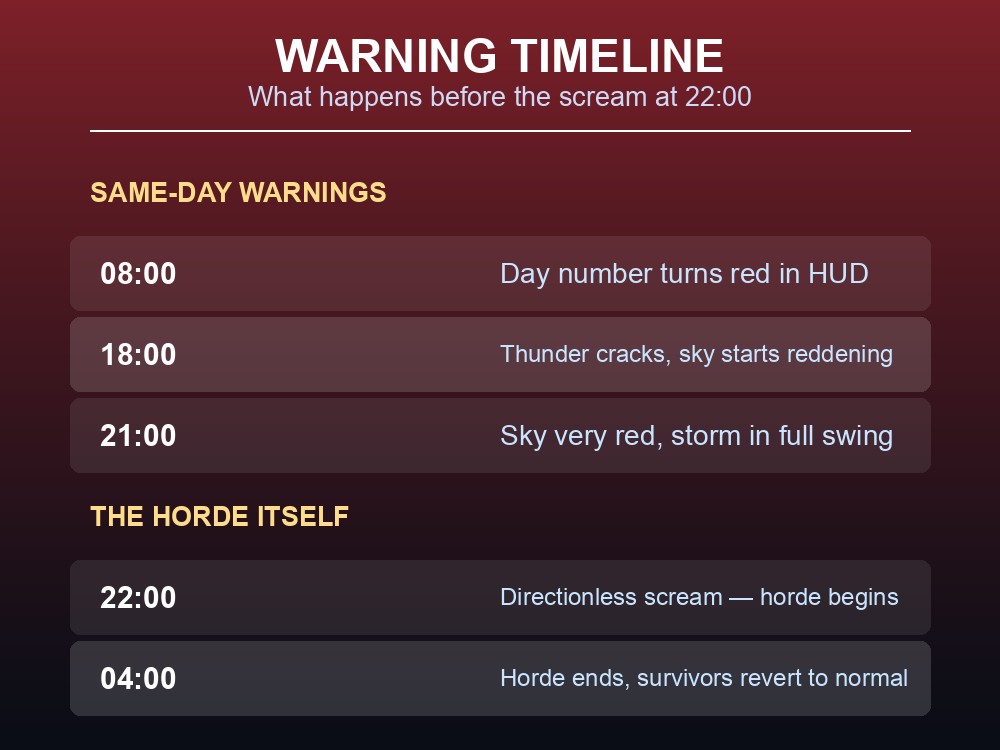
Blood Moon strikes on a fixed schedule by default: "Frequency: Every 7th day (e.g., Day 7, Day 14, Day 21, etc.)" and "The horde starts at 22:00 and ends at 04:00 the next day" — a six-hour siege window. The wiki lays out the same-day warning sequence: "At 08:00 on the day of a Blood Moon, the day number in the HUD will turn red. This is your first indication that the horde will be coming that night." Then "At 18:00 you will hear a crack of thunder, and the sky will slowly start to turn red." Finally, "By 21:00 the sky will be very red, and the storm will be in full swing. You are definitely running out of time!" That's 08:00 to 22:00 — 14 in-game hours — to finish fortifying once the day number flips red. This schedule isn't fixed in stone, either: "Blood Moon Horde settings can be changed in the Game Settings, including the frequency, predictability, and challenge of the event," so a save or server you're on may not run the stock every-7-days pattern.
How the Attack Actually Unfolds
At 22:00, "there will be a directionless scream announcing the beginning of the horde," and the initial wave "spawn[s] some distance away the player and immediately begin running towards them." That wave's size "is determined by the Game Stage and the number of players in close proximity," and as you kill zombies, "replacement zombies will spawn a distance away and join the attack, until all zombies in this initial wave are killed" — or until the wave's own maximum duration runs out. Subsequent waves follow, and "each subsequent wave is more numerous and more difficult," with the total wave count "determined by the Game Stage."
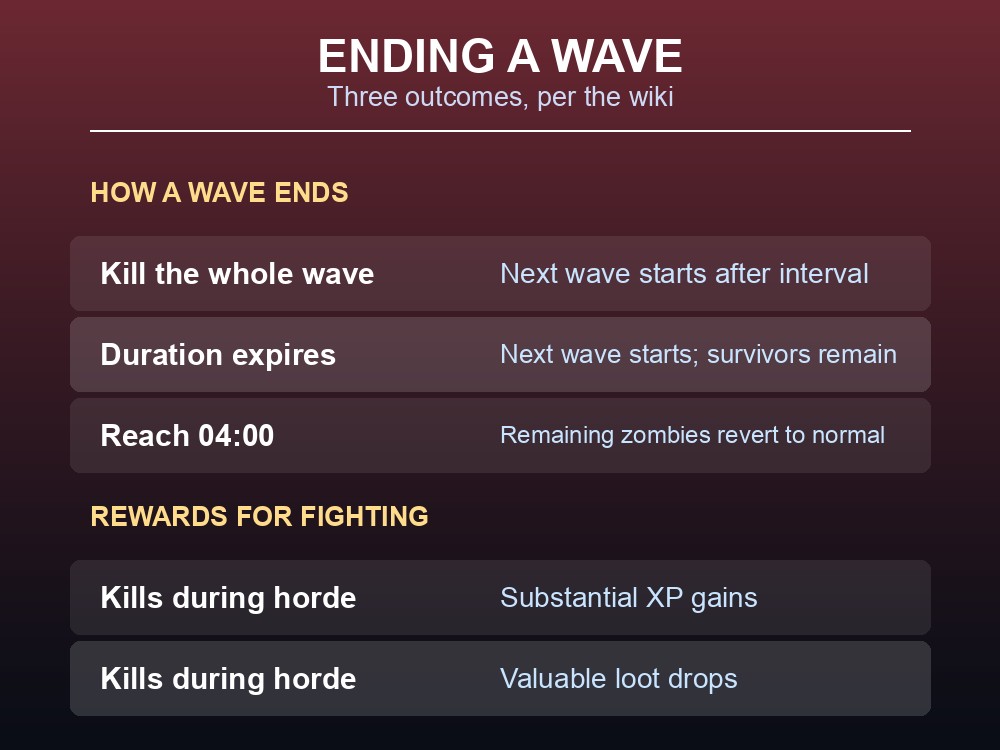
Here's the part that shapes how you play the night: each wave ends one of three ways. "Kill all of the zombies in the wave" and the next wave starts right after its interval. "Fight/evade the wave until its duration expires" — same, next wave after the interval, but survivors from that wave are still out there. "Fight/evade the wave until 04:00" and "all remaining zombies will switch to normal behavior." The wiki is explicit that clearing waves outright lets you finish early: "If you repeatedly achieve result #1, it is quite possible to 'beat' the Blood Moon well before 04:00... If you at least achieve result #1 on the final wave, you will 'beat' Blood Moon and spawns will cease." At 04:00 regardless, "the sky will turn from red to clear, and any remaining Blood Moon Horde zombies will return to normal behavior." There's upside to finishing waves too — "Killing zombies during the horde can result in substantial XP gains" and "Zombies killed during the horde can drop valuable loot."
The Math Behind How Many Zombies You'll Fight
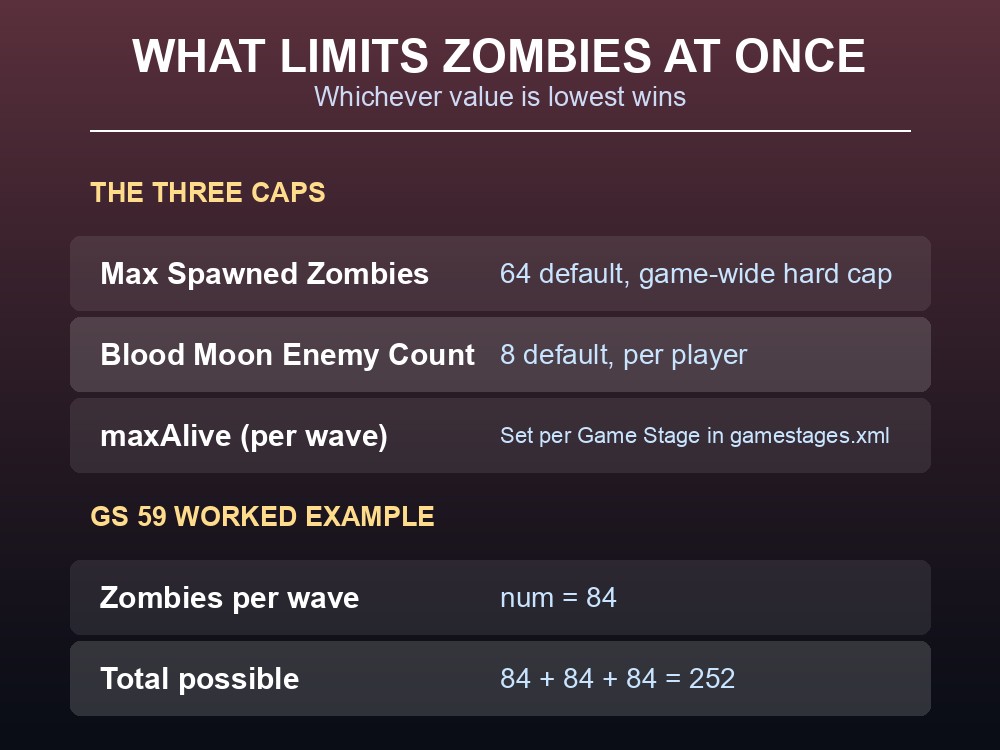
The wiki's worked example uses Game Stage 59, where the gamestages.xml entry runs three waves, each with num="84". As arithmetic: 84 + 84 + 84 = 252 possible zombies across the whole night, exactly as the source states. That's a ceiling, not what spawns at once, though: "The total number of zombies which will spawn at once... is the lesser of" three values — Max Spawned Zombies (game-wide cap, default 64), Blood Moon Enemy Count × number of players (default 8 per player), and maxAlive for the horde wave × number of players (varies by Game Stage — 20 in the GS59 example above).
The wiki's own examples show why identifying the limiting value matters. Single-player, Max Spawned Zombies 64, Blood Moon Enemy Count 8, wave maxAlive 22: "the limiting factor is Blood Moon Enemy Count, so only 8 zombies will spawn from the horde at once." Raise Blood Moon Enemy Count to 32 with maxAlive still 22, and "now the limiting factor is the 'maxAlive' parameter for the horde wave, which is 22." On a 3-player dedicated server, Blood Moon Enemy Count 32 and maxAlive 22: 22 × 3 = 66, which exceeds Max Spawned Zombies (64), so "the limiting factor is Max Spawned Zombies" and only 64 spawn. Natural spawns count against that same cap too — 10 pre-existing natural zombies would mean "the horde would only be able to spawn in 54 zombies (64 max minus the 10 already in the world) to start with."
Practical tips
- You have until 22:00 once the day number turns red at 08:00 — use the 18:00 thunder and 21:00 red sky as your final fortification checkpoints.
- Finishing a wave outright, not just surviving to its duration limit, is the only documented way to end the horde before 04:00.
- If your horde feels too small for your Game Stage, check whether Blood Moon Enemy Count or Max Spawned Zombies — not
maxAlive— is the actual bottleneck.- Doubling Blood Moon Enemy Count roughly doubles simultaneous attackers on multiplayer per the wiki — a real performance cost, not just a difficulty knob.
- Killed zombies still drop loot and XP during the horde, so a wave you can safely clear is worth finishing rather than evading.
Running your own 7 Days to Die server
Every one of these numbers lives in server-side config: BloodMoonFrequency and BloodMoonRange in serverconfig.xml control the day cadence and its drift, BloodMoonEnemyCount sets the per-player simultaneous-zombie count, and MaxSpawnedZombies sets the game-wide hard cap the wiki's own multiplayer example shows getting hit. A gamever 7 Days to Die server keeps those files a click away, runs 24/7 so your group's Game Stage keeps advancing between sessions, and takes automatic backups before anyone touches horde-difficulty settings — useful given how directly BloodMoonEnemyCount and MaxSpawnedZombies trade off against server performance. Renting one takes minutes, and new servers get a free trial with promo code WELCOME.
Conclusion
Blood Moon Horde runs on a fixed skeleton — every 7th day, 22:00 to 04:00, with warnings starting at 08:00 — but the fight itself is shaped by numbers most players never check: Game Stage sets wave count and size, and whichever of Max Spawned Zombies, Blood Moon Enemy Count, or a wave's maxAlive is lowest decides how many zombies you actually face at once. Clearing a wave outright, not just outlasting it, is the only documented way to end the night early. Know the timeline, know which cap is limiting your fight, and Blood Moon night stops being a mystery and starts being a number you can plan around.